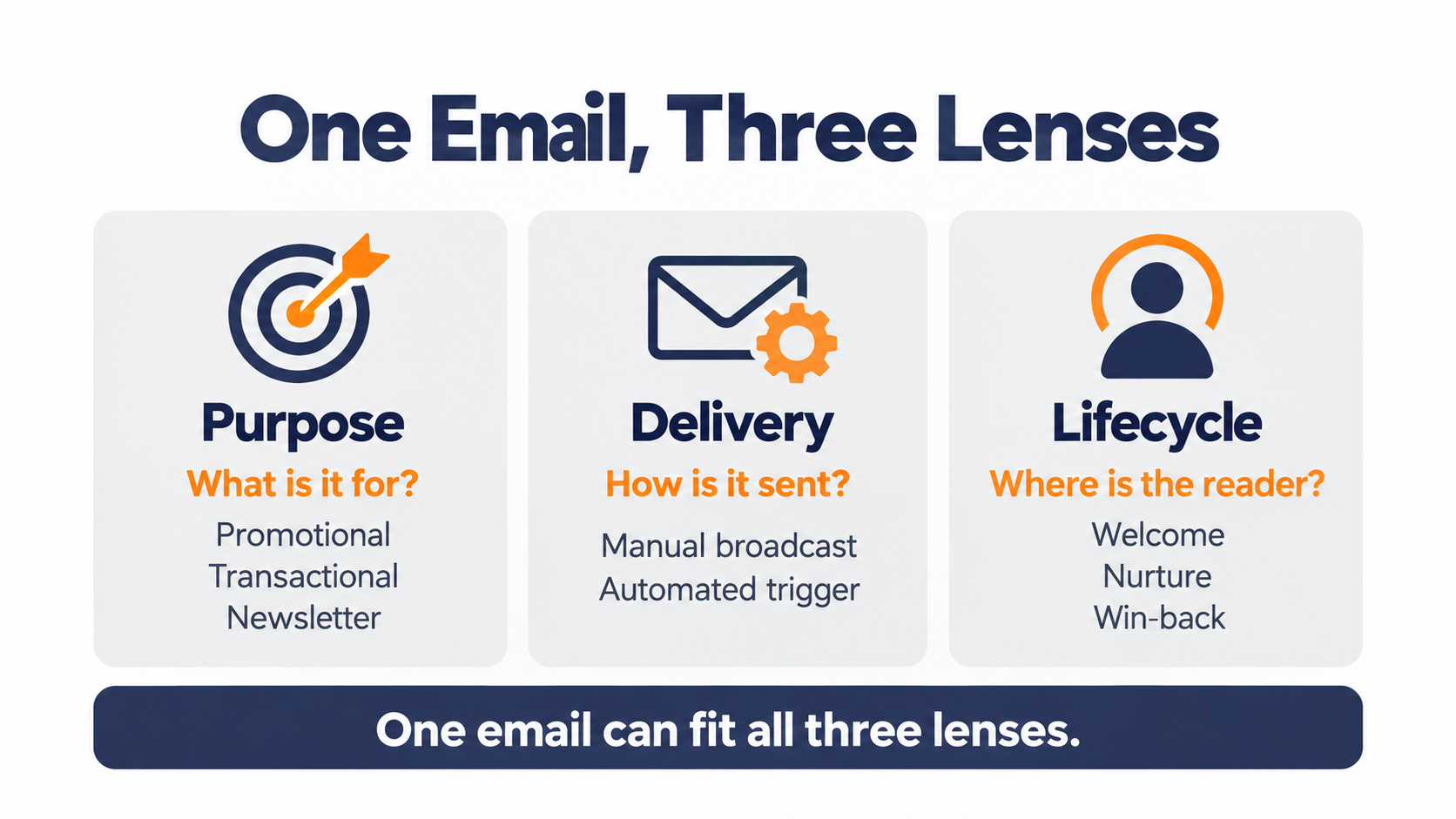
Email marketing types are the categories of marketing email you send, sorted in three ways at once. By purpose, whether it is promotional, transactional, or a newsletter. By how it is sent, a manual broadcast or an automated trigger. And by where the reader sits in their lifecycle, from a first welcome to a win-back.
Most guides to the different types of email marketing hand you a flat list of labels and leave you to figure out how they fit together. That is where it breaks down, because one email is often several types at once. A welcome email is a lifecycle email and is usually automated. Depending on what it says, it can also be promotional or transactional.
This guide covers every major email type, what each is for, when to send it, and how to combine them into a program that works. If you run email for a business and you are deciding what to actually send, start here.
Key Takeaways
- Email marketing types break into three frameworks. By purpose, delivery method, and lifecycle stage, one email sits in multiple categories. Automation is a delivery method, not a type, so a promotional email can run manually or triggered.
- Automated emails drive 30% of revenue from just 2% of sends. In Omnisend's 2025 ecommerce data, automated flows earn roughly 16 times more revenue per send than scheduled campaigns, making welcome and abandoned-cart automations the highest-leverage sends.
- Welcome and abandoned-cart emails together generate 76% of automation-driven orders. Welcome emails convert at around 2% and return roughly $6.30 per email, while cart reminders are among the strongest automated types.
- Email ROI varies by type and industry. Litmus data shows customer-engagement, promotional, and newsletter emails sit among the highest-return types, with most companies seeing returns in bands from $10 to $36 per dollar spent, and roughly one-third reaching $36 to $50.
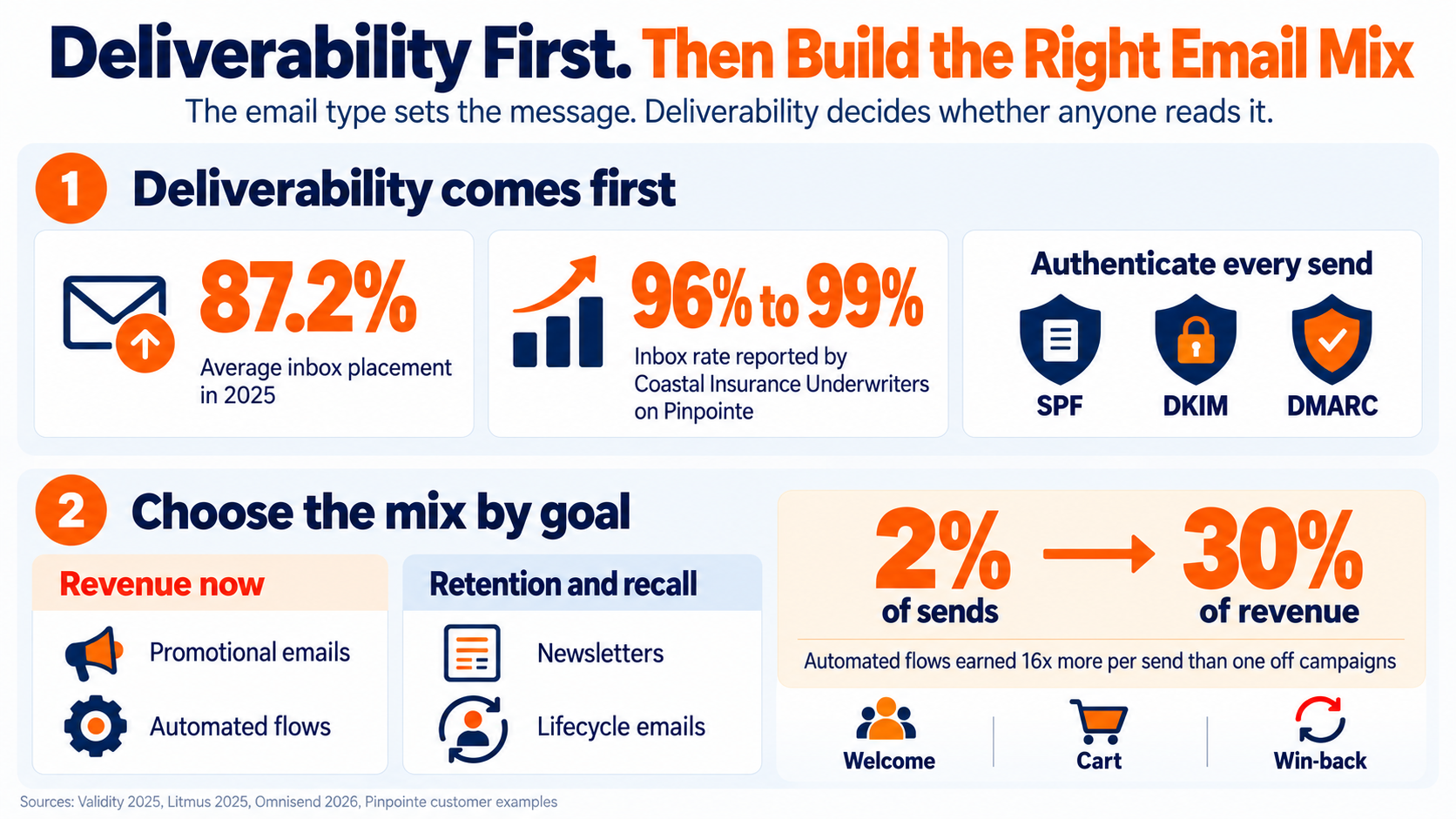
- Deliverability protects all email types equally. Global average inbox placement for marketing email reached 87.2% in 2025, meaning even well-run senders lose a slice of every send without consistent infrastructure, list hygiene, and authentication.
In this guide
- How to Think About the Different Types of Email Marketing
- Promotional Emails
- Transactional Emails
- Email Newsletters
- Automated and Triggered Emails
- Re-Engagement and Win-Back Emails
- Segmentation and Personalization Across Email Types
- How Deliverability Affects Every Email Type
- How to Choose the Right Mix of Email Types
- Running Every Email Type From One Platform
How to Think About the Different Types of Email Marketing
There is no single correct list of email types, and chasing one is a waste of time. The same email lands in several buckets depending on which question you ask. Sort your emails by three questions instead, and the overlap stops being confusing.
What is this email for? How is it sent? Where is the reader in their relationship with you?
Types by purpose
Purpose is the classic split, and it is what most people mean by "types of email." A promotional email exists to drive a sale or an action. A transactional email confirms or documents something the reader did, like an order or a password reset, and serves a functional purpose rather than a promotional one.
A newsletter shows up on a schedule to inform and keep a relationship warm. Those three purposes cover most of what reaches an inbox.
Types by delivery, manual versus automated
Delivery is a separate question from purpose, and mixing the two is where static lists go wrong. A manual or broadcast email is one you build and send once, to a segment, at a time you pick.
An automated email fires on its own from a trigger, a signup, a purchase, a click, or a stretch of silence. Automation is a method, not a category of message. And a promotional email can be a one-off blast or an automated trigger, and it is still promotional either way.
Types by lifecycle stage
The third lens is where the reader sits in their journey with you. Welcome emails greet a brand-new subscriber. Nurturing emails move someone toward a decision. Re-engagement or win-back emails try to revive a subscriber who went quiet. Milestone emails mark a birthday or an anniversary.
Promotional, transactional, newsletter, welcome, nurturing, re-engagement, abandoned cart, and milestone emails cover most of what shows up in an inbox, and every one of those is really a purpose, a delivery method, and a lifecycle moment stacked together.
Promotional Emails
Promotional emails are a workhorse of many email programs. They announce a sale, a launch, a discount, a webinar, or gated content, and they carry a clear call to action. If you send only one type of email, it is almost certainly this one.
The catch is that a promotional email is a broadcast to a broad audience, so it lives or dies on relevance. Send the same offer to everyone, and response stays flat. Focus it, and the numbers move.
OES Global, a wholesale reseller running several e-commerce brands, used Pinpointe click Heat Maps to strip its promotional emails down to the two links people actually clicked, and saw close to 100% click-through improvements with website traffic spiking 15 to 20 times higher in the minutes right after a send. That lift is the immediate post-send surge, not a permanent traffic change, and it came from cutting clutter rather than adding it.
Transactional Emails
A transactional email is triggered by something the reader did, an order, an account change, a password reset, and its job is functional rather than promotional. People expect these, need them, and open them.
That expectation is why transactional emails post some of the highest open rates in email. Transactional open rates are around 80% to 85% versus roughly 21% for promotional email. While those figures are a bit dated and come from two different datasets rather than a controlled comparison, they can still be looked at as a good indicator of how these emails work directionally. The point holds regardless of the exact numbers, and a receipt gets opened when a sale email gets skipped.
That brief attention moment is an opening you should utilize. A confirmation or shipping notice can carry a light, relevant next step without turning into a sales pitch, which is why sharp programs treat transactional mail as prime real estate rather than something to ignore.
Email Newsletters
A newsletter is a recurring send, on a schedule, built to inform and to keep your brand in front of a subscriber between purchases. It is the connective tissue of a program, the reason someone remembers you when they are finally ready to buy.
Newsletters are another email type to keep in your marketing calendar, as they consistently outperform other email types. And if you've hit writer's block on what to include in your upcoming newsletter, check out this post on 30+ newsletter ideas that keep engagement high.
At the same time, consistency and deliverability matter more here than any single clever send, because a newsletter is a long game. As an example of this, Networld Media Group runs up to 7 million emails a month across 10 separate publications on Pinpointe, and after switching platforms, it watched newsletter link clicks climb from roughly 12 to 15 per email up to 20 to 25 per email. Small per-send gains compound when you send every week to a growing list.
Automated and Triggered Emails
Automated emails are the highest-leverage category in the whole list, and the one most programs underuse. Instead of you picking the moment, the email fires on a trigger, a signup, a purchase, an abandoned cart, a birthday, or a lapse in activity. That timing is the entire advantage.
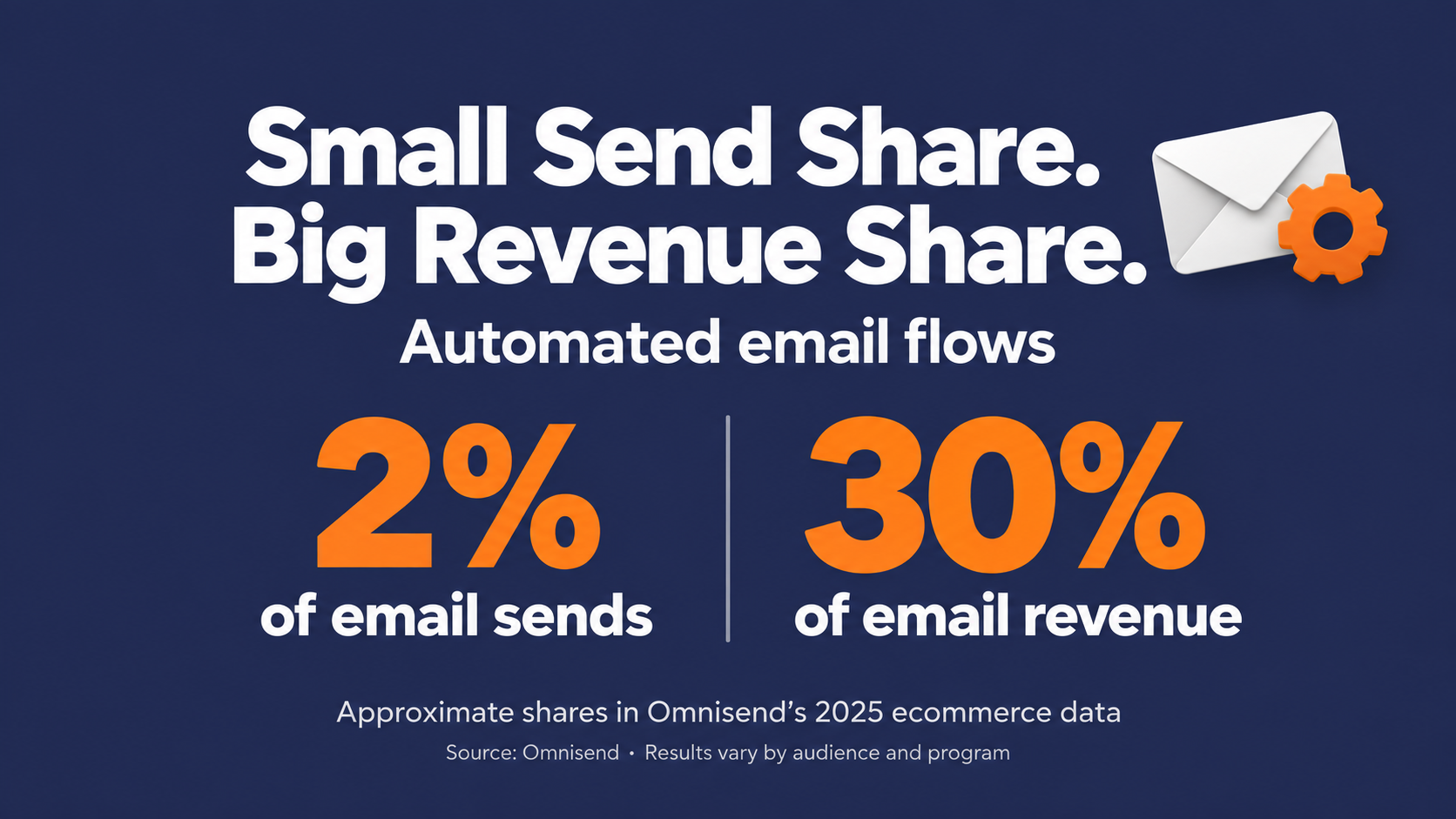
The data is lopsided. Automated flows now generate about 30% of all email revenue from just 2% of sends, and they earn roughly 16 times more revenue per send than scheduled campaigns.
This happens because when a trigger reaches someone at the moment they care, they are more likely to take action. And this can lead to a sliver of your volume driving nearly a third of your return. However, getting this right takes more than picking a trigger, it takes a marketing automation strategy that maps each flow to a stage in the funnel.
Welcome and onboarding emails
A welcome email fires the second someone joins your list, when their interest is at its peak. Welcome emails convert at around 2% and return roughly $6.30 per email, making them one of the strongest automations you can run. Set it once, and it greets every new subscriber for years. But if you sell to other businesses, a B2B welcome email sequence needs a slightly different pace than a consumer one, since the buying group is bigger and slower to move.
Abandoned cart emails
An abandoned cart email reminds a shopper who added something and left. Alongside welcome emails, cart reminders do the heavy lifting in automation, together making up about 76% of all automation-driven orders.
The idea travels well beyond retail. 21st Mortgage built an automated abandoned-cart drip aimed at people who start a loan application and do not finish, running inside a program that sends 2.5 million emails a year across its sister companies on Pinpointe. Same mechanic, different finish line. For ideas on what to actually say, a few abandoned cart email examples show how the tone shifts from a gentle nudge to a firmer last call.
Drip and nurture sequences
A drip is a set sequence of emails that goes out on a timeline after a trigger, and a nurture sequence is a drip aimed at moving someone toward a decision.
A sequence keeps working while you sleep. If you have not built one before, a step-by-step drip email campaign guide is a faster start than building the timeline from scratch.
Behavioral trigger emails
Behavioral triggers fire on a specific action like a click, a page view, or a form submission. A single behavior can kick off one email or a whole series. And because they land on intent rather than a calendar, automated emails routinely earn more revenue per send than scheduled campaigns. This is the same engine behind welcome emails, abandoned cart, and win-back emails. Getting specific about which action fires which message is what separates a working behavioral email marketing program from a generic drip.
Lifecycle and milestone emails
Milestone emails mark a moment, a birthday, an anniversary, a membership renewal. These email triggers are simple and can feel extremely personalized, which is why they often perform so well. One trigger per customer per year, and it just works.
Re-Engagement and Win-Back Emails
Re-engagement emails, also called win-back emails, target subscribers who have gone quiet. They are a behavioral trigger aimed at a lapse in activity, a nudge to remind someone why they signed up before you lose them for good.
One caution to this strategy is that mailing a large, long-dormant list can hurt your deliverability and sender reputation. This means you need to be careful when sending re-engagement emails, and list hygiene matters most. More on that next.
Segmentation and Personalization Across Email Types
Segmentation and personalization are not a type of email. They are the multiplier that makes every type above work harder. The same promotional or lifecycle email, sent to the right slice of your list with the right details filled in, simply performs better.
The lift is real even at the surface. Emails with personalized subject lines are about 26% more likely to be opened. That is an older, directional figure, but the pattern has held for years. A handful of proven email personalization techniques go well beyond dropping in a first name.
It compounds over time. An example of this is when the Gerson Companies grew its opt-in list roughly eightfold across a decade-long program on Pinpointe that leaned on behavioral and event-based segmentation across about 25 targeted lists. Segmentation was not the only reason, but relevance is what kept that audience engaged long enough to grow.
How Deliverability Affects Every Email Type
None of these types matter if the email lands in spam. Deliverability is the floor under the entire program, and it is easy to forget until it breaks. Global average inbox placement for marketing email was reported at about 87.2% in 2025 by Validity, which means even well-run senders lose a slice of every send.
Reputation is what protects that placement, and it is built on consistent sending, clean lists, and solid infrastructure. Coastal Insurance Underwriters has held a 96% to 99% inbox rate for more than five years on Pinpointe using certified dedicated IPs, even while sending policy language that trips generic spam filters.
Another example was Surplus Record, which saw email open rates rise 25% to 33% simply by moving its auction sends to a private IP address.
None of that holds without the basics in place, starting with email authentication so mailbox providers trust that you are who you say you are. The type of email you send sets the message. Deliverability decides whether anyone reads it.
How to Choose the Right Mix of Email Types
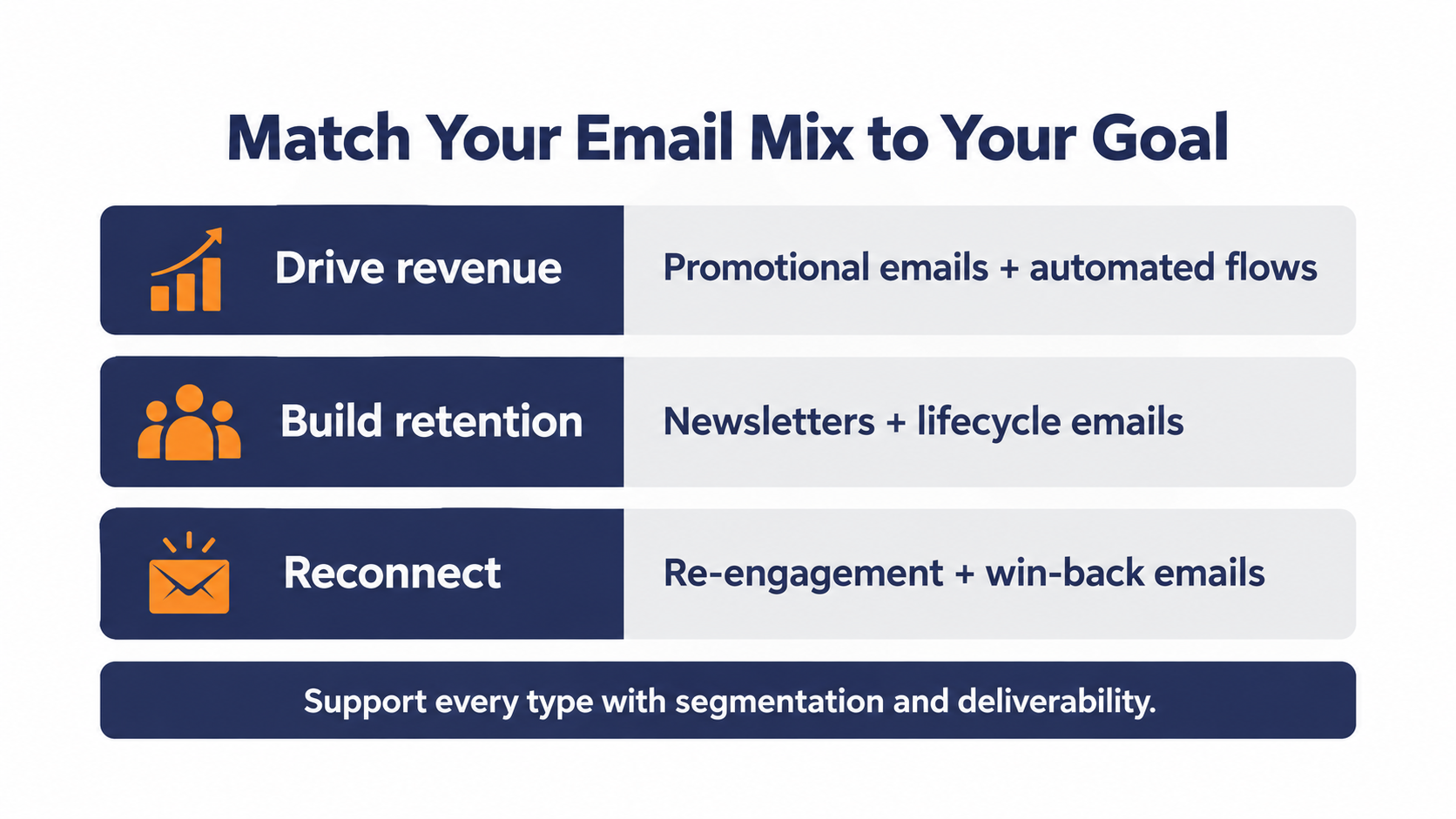
You traditionally don't pick just one type of email and that's all you send. You build a mix, and the right mix follows your goals rather than a checklist. Start from what you are trying to do, then map types to it.
If you want revenue now, promotional emails and automated flows carry it. If you want retention and recall, newsletters and lifecycle emails do the work.
Build your automation foundation before scaling broadcasts
Weight the mix toward automation earlier than feels natural because automated flows return a wildly disproportionate share of revenue for their volume.
This means a handful of well-built triggers often beats another month of one-off campaigns. Send the broadcasts your calendar needs, but let welcome, cart, and win-back flows run underneath everything.
Running Every Email Type From One Platform
Here is the catch with everything above. The hard part is rarely picking a type. It is running the full mix of promotional, transactional, automated, and lifecycle emails, at the same time, to the right people, without the whole thing turning into a pile of disconnected tools.
You'll need to combine journeys, automated flows, triggered and lifecycle email sends, dynamic segments, and content tags for the personalization that makes each type land.
Plus, utilize predictive send timing that delivers to each contact when they are most likely to open. And without a platform with a deliverability engine, pre-send spam scoring, dedicated IPs, and automated list hygiene that protects every send, your email campaigns won't be as successful as they could be. This is why choosing the right marketing automation system is so important.
Scaling complex campaigns across multiple audiences
It matters even more when you are not running one list but many. Agencies, publishers, and multi-brand operators have to run all of these email types across separate audiences at once, keeping each one isolated while managing them centrally.
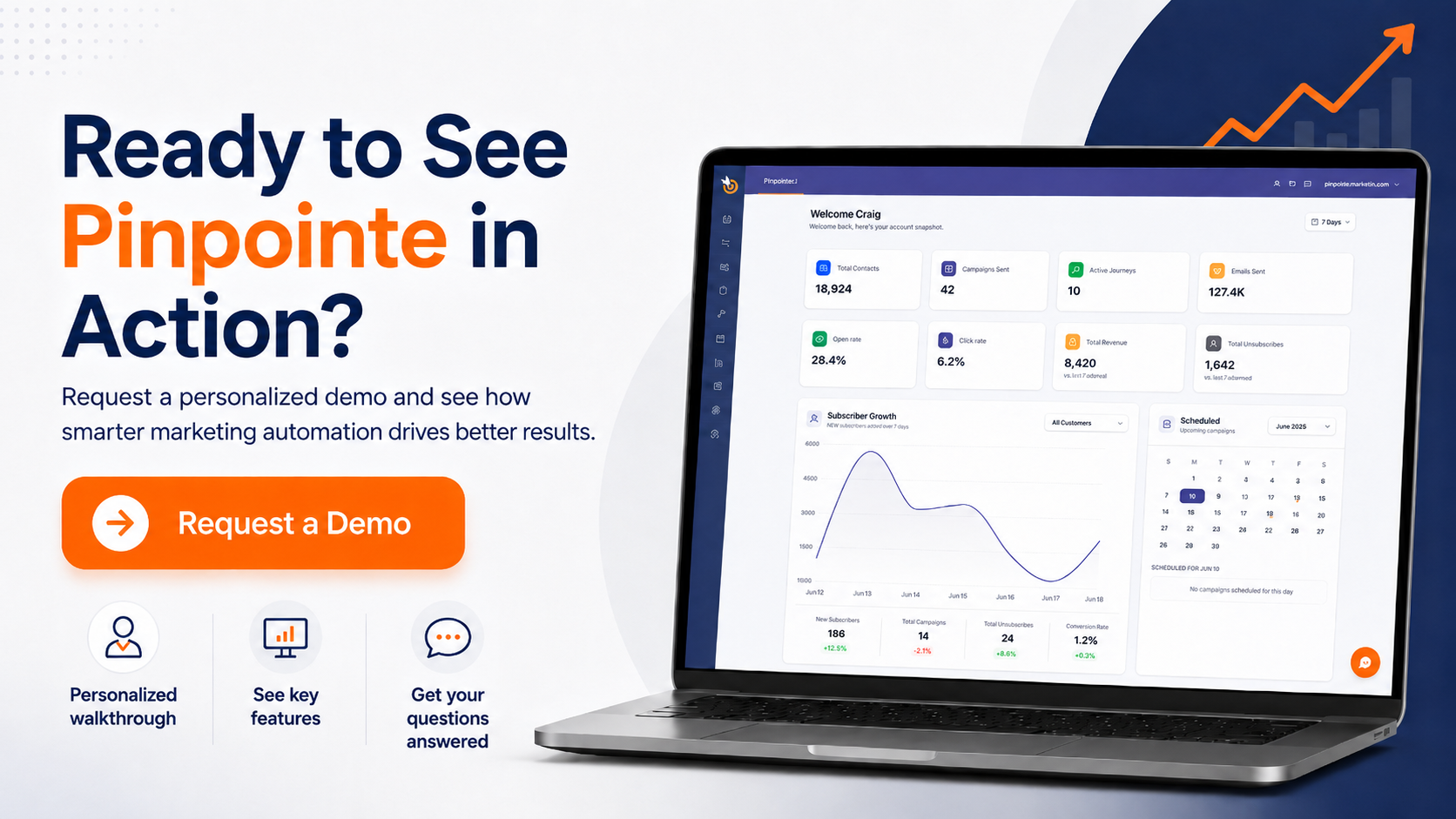
Managing separate lists, sender identities, and distinct reporting shouldn't require a fragmented tech stack. Schedule a personalized demo to see how easily you can scale multi-brand engagement from a single console.
Frequently Asked Questions
A few common questions about the different types of email marketing and how they fit together.
How many types of email marketing are there?
There is no fixed number, because the categories overlap. The more useful view is that most emails are a purpose (promotional, transactional, or newsletter), a delivery method (manual or automated), and a lifecycle stage (welcome, nurture, re-engagement) combined into one message.
What is the difference between promotional and transactional emails?
A promotional email exists to drive a sale or an action and goes to a broad audience. A transactional email is triggered by something the reader did, like a purchase or a password reset, and serves a functional purpose. Transactional emails are opened far more often because people expect and need them. A 2020 Brafton roundup reported transactional open rates as high as 80 to 85%, against roughly 21% for promotional email, a dated but directionally consistent gap.
What are the types of emails in email marketing?
It depends on how you slice it. By purpose, the core categories are promotional, transactional, and newsletter emails. By delivery, any of those can be sent manually or through automation. The common automated lifecycle emails are welcome, abandoned cart, nurture, behavioral trigger, and win-back emails, and welcome emails in particular are among the highest-returning automated sends you can run.
Are email newsletters still effective?
Yes. Newsletters remain one of the highest-return email types when they are consistent and relevant, sitting alongside promotional and customer-engagement emails at the top for ROI, though which one leads varies by industry. Networld Media Group grew its newsletter click performance substantially after focusing on deliverability and rendering across its publications.