Your subscribers can tell the difference between "Hi [First Name]" and a brand that actually knows them. Most companies never get past the first one.
You've probably done this yourself: swapped in a merge tag, called it personalization, and moved on. It feels like progress.
It isn't, not really. A name field is table stakes now, not a strategy.
Turn contextual subscriber data into a competitive edge
Real email personalization means tailoring what a subscriber actually sees based on their behavior, where they sit in your funnel, and what they've already bought from you. A first name is a nice touch on top of that. It's not the thing itself.
Done right, personalized email marketing is one of the highest-leverage things a growth team can build, precisely because so few competitors bother to build it properly.
Why a first name isn't personalization anymore
You send an email that opens with someone's name and call it a day. Meanwhile, everyone else in their inbox is doing exactly the same thing.
That's the problem. Name merges stopped being a differentiator years ago, once every email platform made them a default setting.
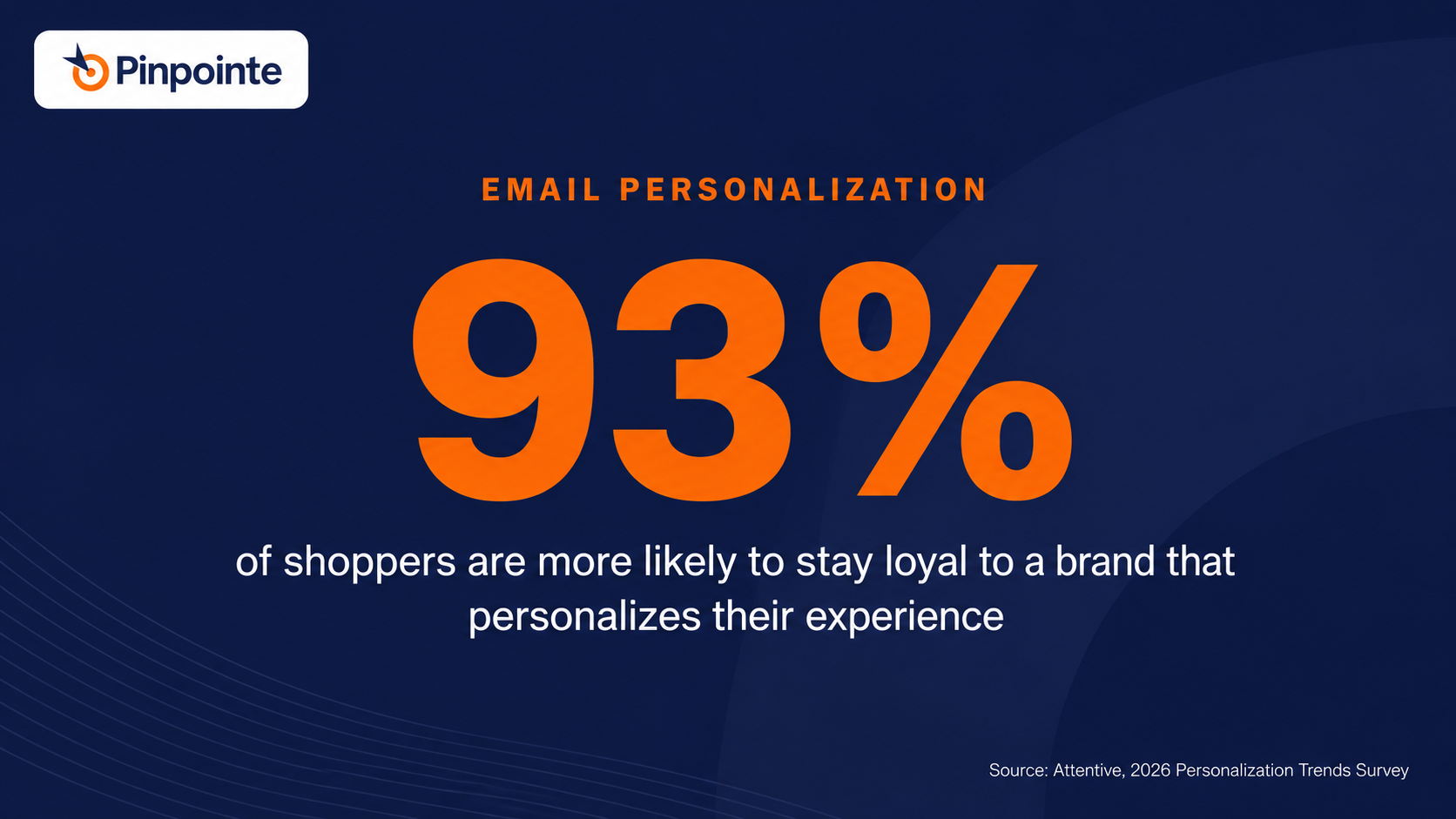
Subscribers have noticed. Personalized experiences influence 93% of shoppers to stay loyal to a brand, and that number keeps climbing as inboxes get more crowded. Loyalty like that doesn't come from a name field.
What subscribers actually want instead
They want relevance. Shoppers are more likely to purchase when they receive product recommendations that match their actual needs and preferences.
That's a completely different skill than inserting a name. It requires knowing what someone looked at, what they bought, and what they're likely to want next.
Bad personalization is a quiet campaign killer
Get it wrong, and the cost is real. 64% of shoppers say brand messages feel too generic, and 80% say they're more likely to ignore a brand entirely after it sends them something irrelevant.
That's not a soft metric. That's subscribers opting out of paying attention to you, one ignored send at a time.
The gap between knowing this and doing something about it
Most marketers will nod along with all of this. Fewer actually rebuild their program around it.
Part of the problem is that real personalization sounds like a big lift. It doesn't have to start that way. It starts with a handful of decisions about what data you collect and how you use it, and it compounds from there.
What email personalization actually means
Personalization is customizing the content of an email based on real signals: browsing behavior, funnel stage, purchase history, engagement level, stated preferences.
It's not a merge tag. It's a decision engine sitting underneath your send, quietly deciding what each subscriber sees before you ever hit send.
Why so few companies actually do this
Only a small slice of companies personalize their emails this thoroughly, and that gap is exactly why it works so well for the ones who close it.
If most of your competitors are still sending the same email to everyone on their list, doing this properly is one of the cheapest ways to stand out in a crowded inbox.
Here's the part people skip past: personalization isn't something you do to an email after it's written. It's something you build before you ever write a subject line, by collecting and organizing subscriber data first.
A quick gut check before you go further
Ask yourself how many versions of your last campaign actually existed. If the honest answer is one, you're not personalizing yet. You're just addressing.
Collecting the data you need before you segment anything
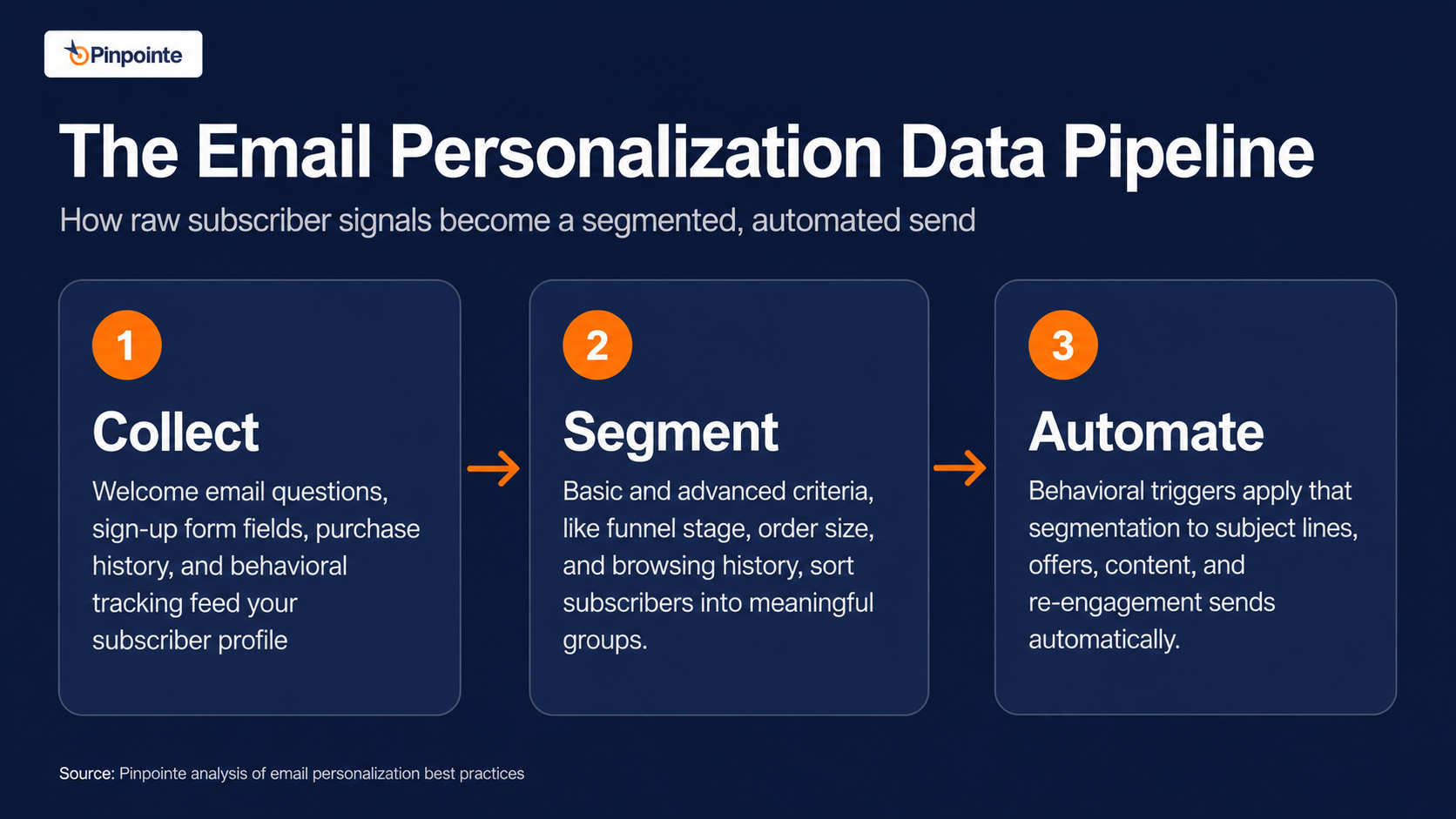
You can't build real email segmentation on a list you haven't actually learned anything about. Data collection comes first, always, and it's the step most teams try to skip.
Use your welcome email to ask, not just announce
Your welcome email is prime real estate. New subscribers are paying attention, so ask them a question or two about what they want from you: product category, size, how often they want to hear from you.
People are more forthcoming right after they sign up than they'll ever be again. A short preference question in that first send gets answered at a much higher rate than the same question buried in email twelve.
Use that window while it's open, because it closes fast.
Treat your sign-up form as a data source, not a formality
A sign-up form that only asks for an email address is leaving information on the table. Add a field for interests, product category, or purchase intent, and you're segmenting before the first send even goes out.
This doesn't mean turning your sign-up form into a survey. Two or three well-chosen fields beat ten generic ones every time, because people abandon long forms before they finish them.
Let purchase history do some of the work
If someone bought a specific product, you already know something valuable about them. Recommend the next logical thing instead of guessing, and build a repeatable email marketing strategy around that signal instead of reinventing it every campaign.
A customer who bought running shoes doesn't need a blanket "shop now" email. They need to hear about the gear that pairs with what they already own.
Bring in behavioral tracking and third-party tools
A customer data platform or CRM integration does the heavy lifting of tying browsing behavior, email engagement, and purchase data into one subscriber profile. Trying to do that manually in a spreadsheet doesn't scale past a few hundred contacts.
Behavioral tracking picks up what people don't tell you directly: pages they browsed, products they viewed twice, categories they keep coming back to. That data is often more honest than anything a form ever captures.
Segmenting the data you've collected
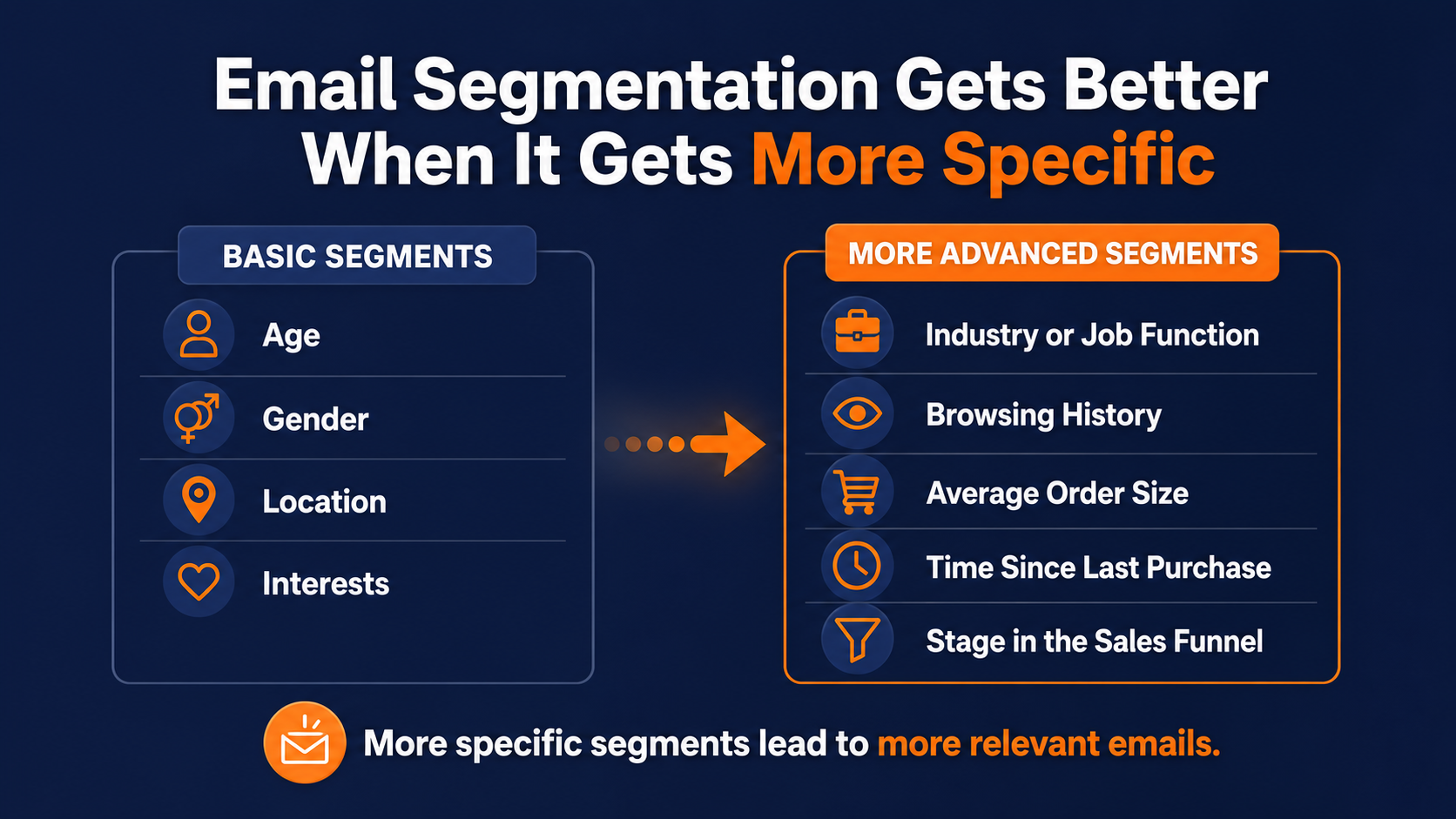
A basic email segmentation approach can be as simple as age, gender, or stated interests. It can also get a lot more specific, and the more specific version usually performs better.
Basic segments that still do real work
Age, gender, location, and stated interests are the easiest place to start, and they're not nothing. Even a basic split between new and returning customers changes what an email should say.
More advanced segments worth building
Consider building segments around:
- Industry or job function, for B2B lists
- Browsing history and pages viewed
- Average order size
- Time since last purchase or open
- Stage in the sales funnel
None of this requires guessing. It requires organizing what your subscribers have already told you, directly or through their behavior.
Why more segments beat one big list
A list with a dozen thoughtful email segmentation groups will consistently outperform one giant list getting the same generic blast. Every segment lets you say something more specific, and specific is what gets opened.
Where segmented data actually pays off
Once your list is segmented, you're not sending one email to everyone. You're sending the right version of an email to each group, and the differences show up in every part of the send.
|
Personalization tactic |
Generic approach |
Segmented approach |
|
Subject lines |
Same line for the full list |
Written to match each segment's interest or funnel stage |
|
Offers |
One discount code for everyone |
Offer tied to browsing or purchase history |
|
Content |
Identical body copy |
Product blocks that change by segment |
|
Re-engagement |
Ignored until unsubscribe |
A dedicated win-back series triggered by inactivity |
Subject lines built for the segment, not the whole list
A subject line that references something a segment actually cares about gets opened more than a generic one written for everyone at once. It doesn't need to be clever. It needs to be specific to that group.
Content that changes based on who's reading it
The body of the email doesn't need to be identical for every recipient. Swap product blocks, testimonials, or use cases based on segment, so a first-time buyer sees something different than a repeat customer scrolling the same email.
VIP customers respond to different signals than new subscribers. A loyalty perk or early access line lands with someone who's already spent hundreds with you. It falls flat on someone who signed up last week.
Offers and discounts tied to behavior
A discount that responds to what someone's already shown interest in converts better than a blanket coupon code blasted to the whole list. Someone who abandoned a cart doesn't need 10% off everything. They need a nudge on the specific item they left behind.
Reminder and re-engagement emails triggered automatically
Cart abandonment, low-stock alerts, and win-back series for quiet subscribers all depend on solid email segmentation to trigger the right message at the right moment. Behavioral email triggers are what make this run without you manually building each send.
The revenue difference shows up fast once this is in place. Automated, behavior-triggered flows generate roughly 41% of total email revenue from just 5.3% of sends, with revenue per recipient nearly 18 times higher than standard campaigns.
That's not a small edge. That's the difference between email being an afterthought and email marketing being your highest-performing channel.
PRO TIP: Start your first segment with your highest-intent group: subscribers who opened your last three emails and visited your site in the past 30 days. That group alone usually outperforms your full list on every metric that matters.
Bringing product recommendations into the mix
Recommendations work best when they're grounded in something concrete about the subscriber, not a generic "you might also like" block dropped into every send.
AI-driven product recommendations lift average email click rates to roughly 3.75%, with top-performing sends reaching close to 8.8%. The lift comes from relevance, not novelty.
That gap between average and top performer is worth sitting with. It's the same list, the same platform, the same basic idea, and the difference is how specific the recommendation actually is.
Cross-sell and upsell emails built on real purchase data
A cross-sell email that references what someone actually bought reads as helpful. The same email sent to your entire list reads as a sales pitch. The content is nearly identical, but the targeting changes how it lands.
Product-based testimonials that match the browsing session
Pairing a testimonial with the exact product a subscriber browsed does more work than a generic five-star badge sitting at the bottom of every email. It answers the question that subscriber actually had.
VIP treatment for your highest-value segment
Your best customers already know they're valuable to you. Treat them that way in your emails. Early access to new products, a loyalty tier callout, or a skip-the-line perk on a launch does more for retention than another 10% off code that goes to everyone.
This is also where segmentation pays for itself the fastest. A small VIP segment, treated well, tends to keep spending. The same group buried in your general list just becomes another name on the send count.
How to tell if your personalization is actually working
It's easy to assume personalization is working because it feels more sophisticated than a blast. Feel isn't a metric.
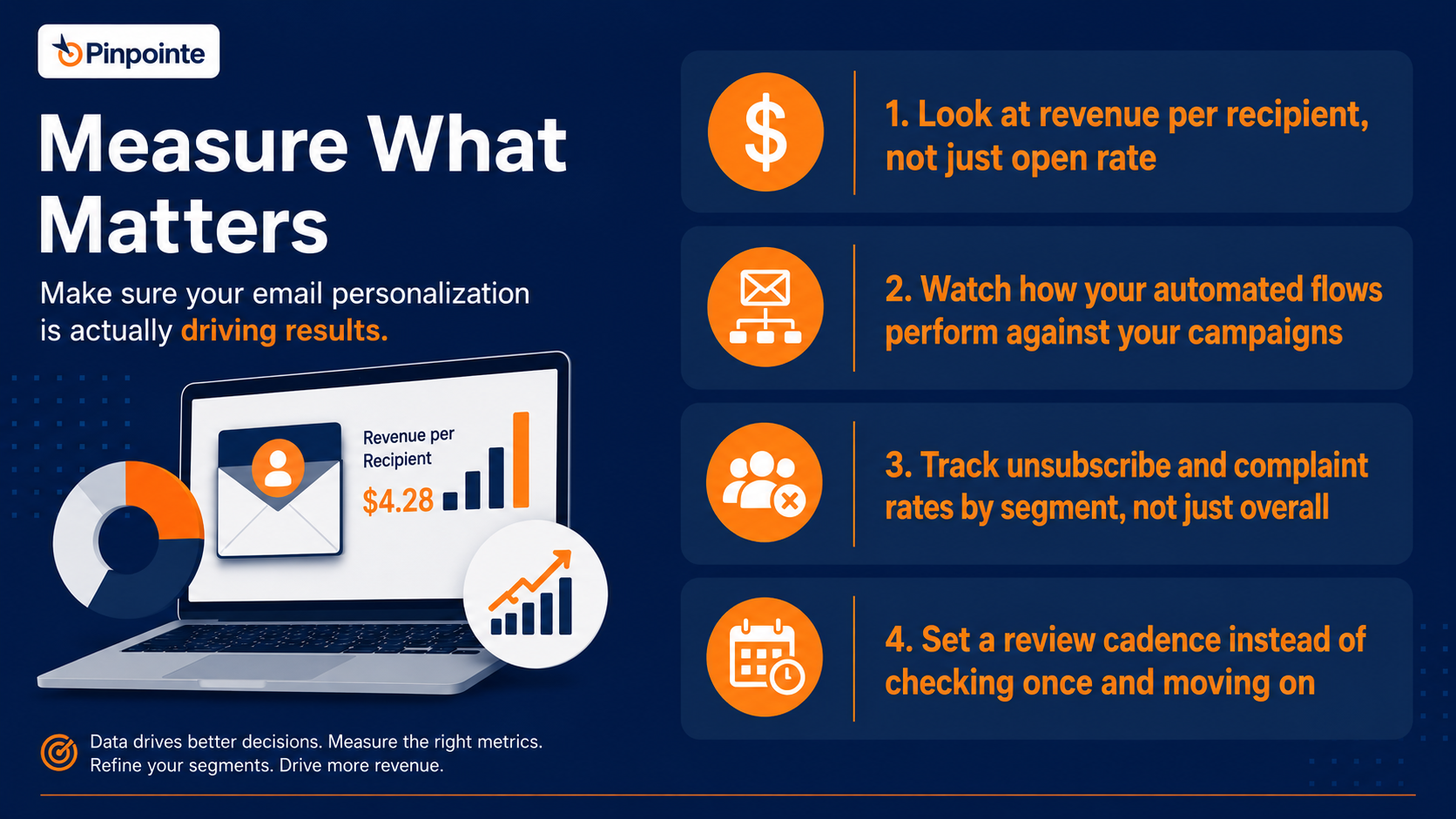
Look at revenue per recipient, not just open rate
Open rate tells you a subject line landed. It doesn't tell you whether the email made money. Revenue per recipient, measured segment by segment, is the number that tells you whether your targeting is actually paying off.
Compare your top segment's revenue per recipient against your full list average. If there's no meaningful gap, your segments aren't different enough yet to matter.
Watch how your automated flows perform against your campaigns
Behavior-triggered flows should consistently outperform one-off campaigns on click rate and conversion, because they're reaching someone at the exact moment they showed interest. If your campaigns and flows perform about the same, your triggers probably aren't specific enough.
Track unsubscribe and complaint rates by segment, not just overall
An overall unsubscribe rate can hide a segment that's quietly churning. If one group is opting out at a much higher rate than the rest of your list, that's usually a sign the content they're getting doesn't match what they actually want from you.
Set a review cadence instead of checking once and moving on
Segments drift. A subscriber who was a new customer six months ago isn't new anymore, and their segment membership should reflect that. Build a quarterly check into your process, not just a one-time setup.
Why this compounds instead of staying flat
None of these tactics work in isolation for long. A great subject line on an ungenerous segment still underperforms. A sharp recommendation engine feeding a stale list still stalls out.
The compounding happens when data collection, segmentation, and automation are all feeding the same subscriber profile at once. Each send gets a little sharper because the last one taught the system something new.
That's the difference between running individual email personalization tactics and running an actual email marketing performance system. One is a collection of tricks. The other keeps improving on its own.
Connecting segmentation, automation, and recommendations
Most teams get stuck because they treat these as separate projects on separate timelines: a segmentation project this quarter, an automation project next quarter, a recommendation engine sometime after that. By the time all three ship, the data each one was built on is already stale.
The fix isn't doing all three faster. It's building them on top of one shared subscriber profile from the start, so each piece is already talking to the others the moment it goes live.
How Pinpointe brings personalization together across channels
Most platforms make you choose between good segmentation and good automation. You end up managing one manually while the other runs on autopilot, and neither talks to the other.
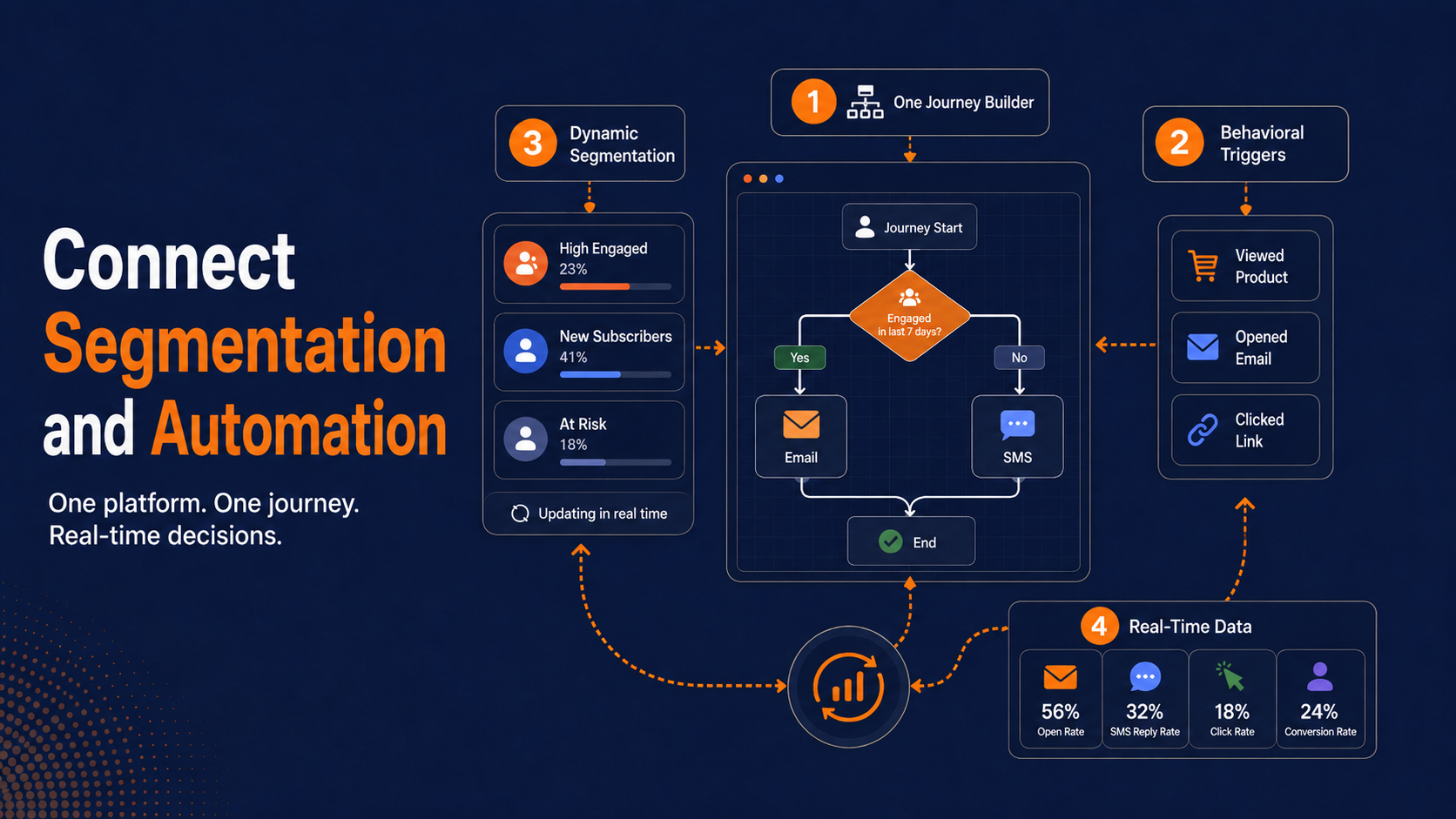
One journey builder instead of separate tools for email and SMS
Pinpointe's omni-channel journey builder lets you build a single customer journey that spans email and SMS, instead of stitching together two separate systems that don't share data. A subscriber's SMS click informs their next email, and vice versa.
Behavioral triggers that fire without manual setup each time
Once a behavior is defined, whether that's browsing a category, clicking a specific link, or going quiet for 30 days, Pinpointe fires the right message automatically. You set the logic once, and it runs on every subscriber who matches it going forward.
Dynamic segmentation that updates itself
Static lists go stale the moment someone's behavior changes. Pinpointe's dynamic segmentation updates a subscriber's segment membership in real time, based on what they're actually doing right now, not what they did when they first signed up.
Real-time engagement data feeding every future send
Every open, click, and purchase feeds back into the subscriber profile. That means your next send is built on current behavior, not a snapshot from three months ago.
We built this because we watched too many marketing teams personalize one email brilliantly, then send the next one blind. Segmentation and automation only compound when they're connected to the same data, on the same platform, in real time.
Ready to stop guessing what your subscribers want?
You don't need to personalize every email perfectly on day one. You need a system that gets a little sharper with every send.
Schedule a demo and see how Pinpointe connects your email and SMS data into one segmentation and automation engine, so your next campaign is built on what your subscribers are actually doing, not a guess.