Your open rates are down, and you're not sure why. Chances are, you're still sending the same email to everyone on your list and hoping it lands.
That's the hit-and-miss approach. It's expensive, it's slow, and your customers can tell. Worse, it's a habit that's easy to fall into once your list gets big enough that "just send it to everyone" feels like the only option that scales.
Customer data tells you the best way to optimize your email marketing
Customer data flips that around. Instead of guessing what your audience wants, you already know. You know what they clicked. You know what they abandoned. You know when they actually open their inbox.
The question isn't whether you should be using that data. It's whether you're using it well enough to move your open rates, click-through rates, and bounce rates in the right direction.
Here's how to actually do it.
Focus Your Email Segmentation Strategy on Your Customer Data First
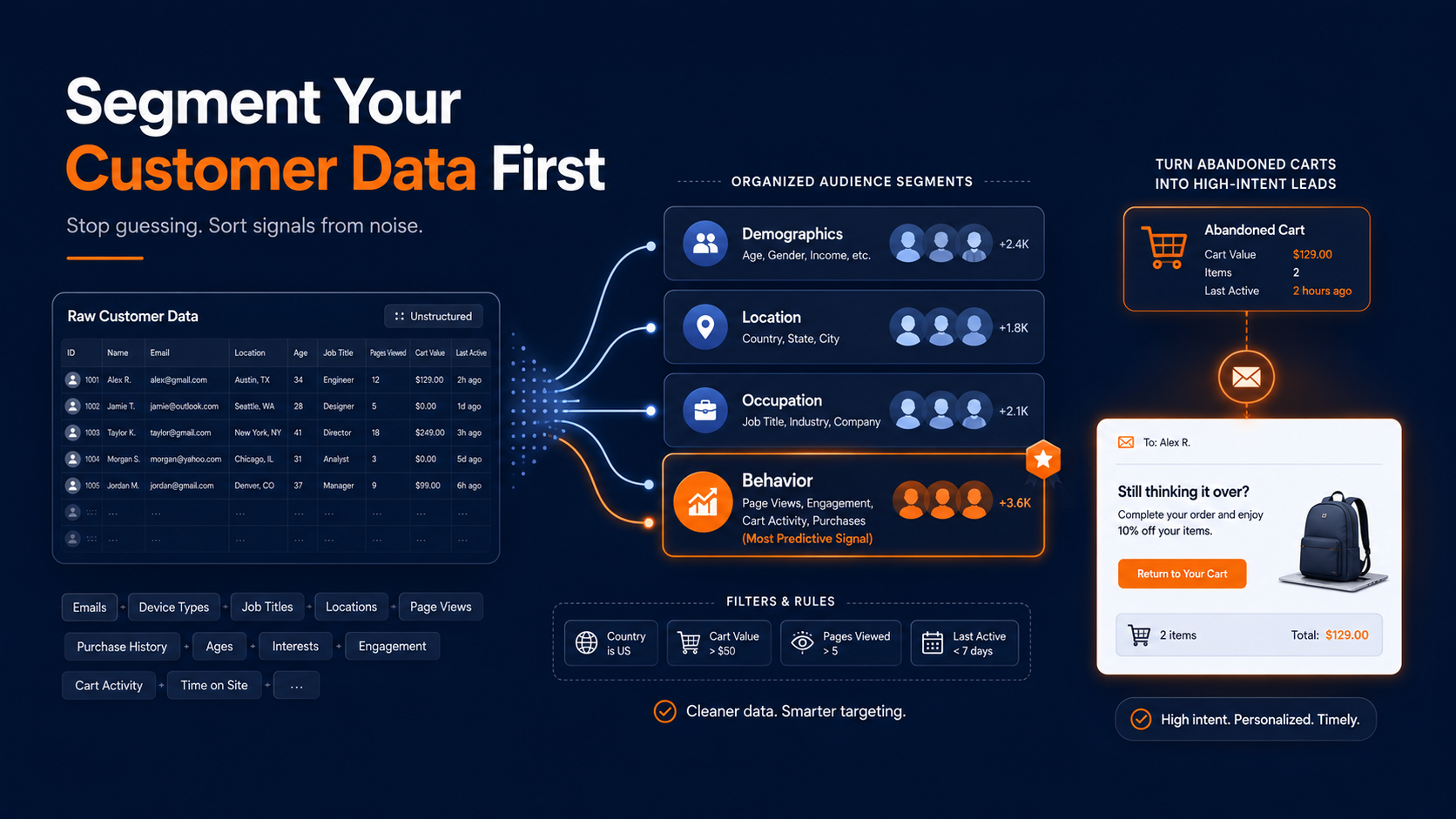
Raw customer data doesn't do much on its own. A spreadsheet full of names and click timestamps is just noise until you organize it.
Segmentation is what turns that noise into a plan. It's the difference between "we have data" and "we use data."
Sorting Signals From Noise
Every list you own is a mix of hot leads, lukewarm prospects, and people who signed up for a discount code and forgot about you. Lumping them together kills your metrics.
Segment first. Sort second. Send third.
Think about what happens when you don't. Your best prospect, the one who's opened your last six emails and clicked twice, gets the exact same message as someone who hasn't opened anything in four months. Neither one is well served by that.
Building Segments That Actually Predict Purchase
The best segmentation frameworks combine a few layers:
- Demographics, for baseline fit
- Location, for timing and relevance
- Occupation, for tone and use case
- Behavior, for actual purchase intent
Behavior is the layer most teams underuse. Demographics tell you who someone is. Behavior tells you what they're about to do.
Behavioral data tells you where someone actually is in their journey, not where you assume they are. That distinction matters more than any demographic field ever will, because a 45-year-old and a 25-year-old who both just viewed the same product page three times in a day are showing you the exact same signal.
| Segmentation Strategy | What It Tells You | Best Practice & Execution | High-Impact Example |
| Behavioral Intent | What the customer is about to do, regardless of who they are. | Prioritize action over identity. Group users by recent, high-frequency actions rather than static traits. | Target anyone who viewed the same product page 3x in 24 hours with a tailored product spotlight. |
| Cart Abandonment | High purchase intent interrupted at the finish line. | Send a nudge, not a newsletter. Avoid generic promo blasts; treat them like an active sales conversation. | A triggered email sent within 1–2 hours featuring the exact items left behind and a simple customer service check-in. |
| Engagement Status | The health of your relationship and immediate conversion likelihood. | Segment first, sort second, send third. Separate your hyper-actives from those dormant for 4+ months to protect deliverability. | Send exclusive early-access perks to your top 10% openers; move 120-day inactives to a sunset/win-back sequence. |
| Demographics & Occupation | Who the customer is, setting the tone and use case. | Use this layer to establish the baseline fit and vocabulary, not to predict when they will buy. | Tailor the technical depth of B2B copy based on job title (e.g., high-level ROI for executives vs. feature specs for engineers). |
| Geographic Location | Where they are, dictating timing, seasonality, and relevance. | Optimize send times based on the recipient's local time zone, local seasons, or regional compliance laws. | Schedule a morning coffee promo to drop at exactly 7:00 AM in the recipient's local time zone across the globe. |
| Lifecycle Stage | Where they stand in their overall customer relationship. | Map content to their relationship milestone (New Subscriber vs. First-time Buyer vs. Repeat VIP). | Send a "Welcome Sequence" series to new sign-ups, while skipping them on aggressive promotional pushes. |
Turning Abandoned Carts Into Your Best Leads
Cart abandonment is one of the clearest purchase-intent signals you'll ever get. Someone got close enough to buy and stopped.
That's not a cold lead. That's a warm one you haven't closed yet.
Treat abandoned-cart segments differently than your general list. Send them a nudge, not a newsletter. A generic promo blast to someone who just abandoned a cart full of items feels tone-deaf, like you weren't paying attention to what they just did on your site.
Segmented and personalized campaigns generate up to 58% of email revenue for most companies that have an optimized email segmentation strategy. Make sure email segmentation is a priority in your email marketing automation platform setup.
Make Every Email Feel Like You Know the Person
Generic emails get ignored. That's not an opinion, that's just what happens in a crowded inbox.
Your subscribers already expect you to know something about them. Brands have been personalizing for years now, and the bar has moved. "Hi [First Name]" doesn't clear it anymore.
Personalizing Beyond the First Name
A first name in the subject line is table stakes, not a strategy. Real personalization pulls from purchase history, browsing behavior, and where someone sits in their journey with you.
Personalized subject lines see roughly 50% higher open rates than generic ones. That's a big enough gap to notice in your own numbers within a single send cycle, which makes it one of the easier wins to test this quarter.
Here's what that looks like in practice. Instead of "New Arrivals This Week," you send "Sarah, the boots you looked at just came back in your size." Same product, wildly different email.
Using Data to Solve Real Pain Points
Your customer data tells you what someone's actual problem is. Use it to offer a specific fix, not a generic pitch.
Email is uniquely suited to this. No other channel lets you speak to one person, in their inbox, on their terms, the way email does. Social feeds are shared space. Email is theirs.
With Precision Email Targeting, Each Email Can Feel Like a 1:1 Conversation
Kick your open rates and click-through rates up by making every send feel like it was built for the person reading it, because with the right data, it actually was.
There's a trust dividend here too. When your emails consistently feel relevant, people stop treating your brand name in their inbox as a reason to skip. That's worth more over a year than any single campaign.
Stop Overwhelming (or Underwhelming) Your List
Here's something most marketers get wrong: your first email to a new prospect gets the best open rate you'll ever see from them. Every email after that has to fight for attention.
The fix isn't sending more. It's finding the right number for each segment.
Watching Open Rates Segment by Segment
There's no universal ideal email frequency. There's only the ideal frequency for a specific segment, and you find it by watching the data.
Run a cadence. Watch what happens. Adjust.
If a segment gets three emails every 10 days and their open rate drops off a cliff, that's your answer. Back off. If a different segment barely notices the extra volume, you've probably got room to send more.
This is one of those places where the instinct to "just pick a number and stick with it" actually costs you. Different segments behave differently because they are different people with different relationships to your brand.
Finding the Frequency Sweet Spot
Most experienced marketers land somewhere around once every two weeks as a starting cadence. That's a starting point, not a rule.
Some segments will reward you for mailing twice a week. Others will punish you for mailing twice a month. You won't know which is which until you test it against real send data.
Getting this right takes a campaign or two. That's fine. The tuning is the point, not a sign something's broken.
One practical way to start: pick your three largest segments, run a slightly different cadence on each for a full month, and compare open and unsubscribe rates side by side. You'll usually see a clear winner faster than you'd expect.
Send at the Time Your Data Says, Not the Time You Assume
There's a persistent myth that evenings or nights are the only good time to send brand email. It's not true, and it hasn't been true for a while.
Killing the "Best Time to Send" Myth
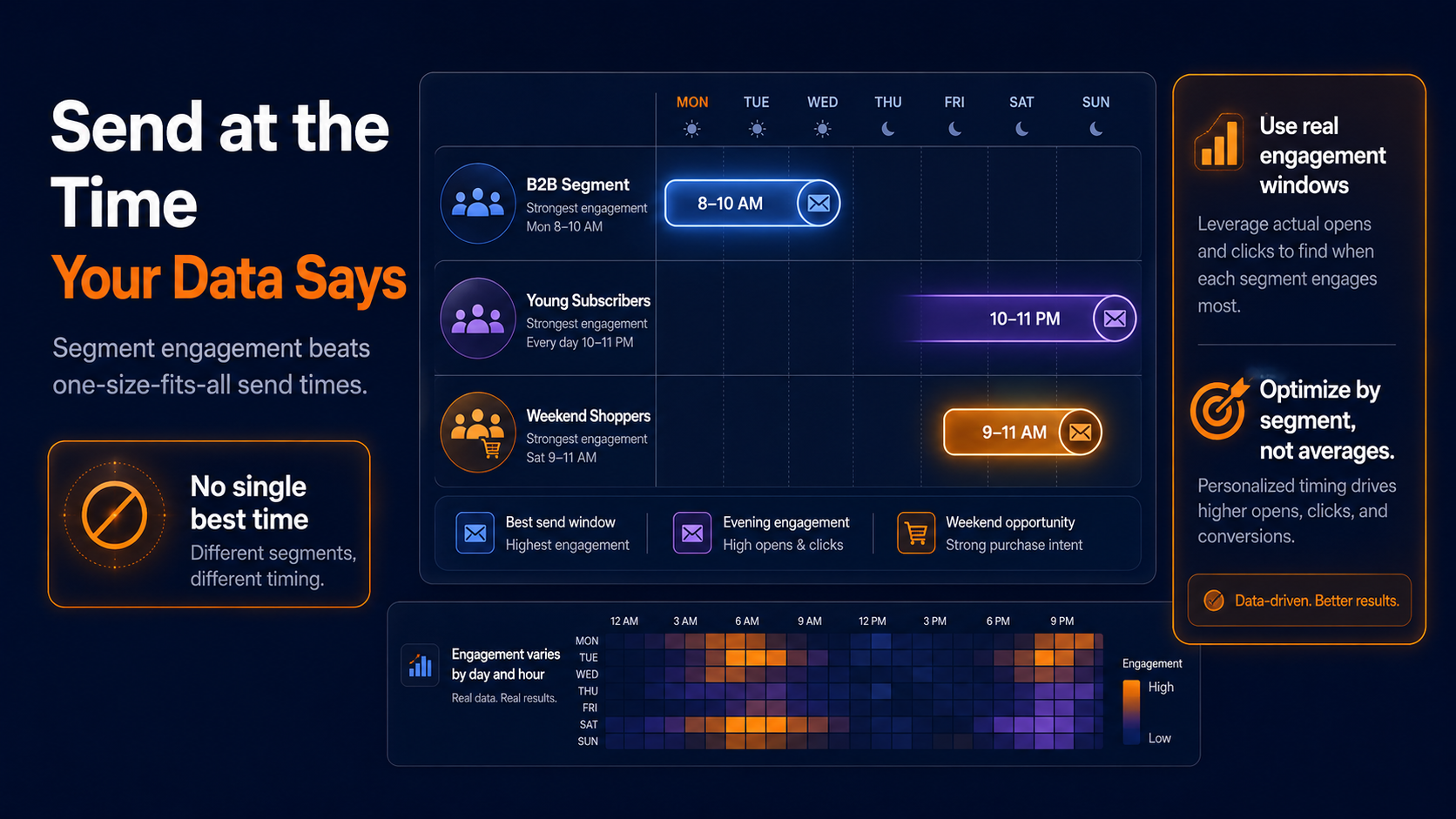
Every segment engages differently. Some open on their commute. Some open at their desk at 10 am. Some open right before bed.
Assuming a single "best time" across your whole list means you're optimizing for an average person who doesn't exist. Averages hide the segments that would actually convert best at a completely different hour.
Weekend sends get a bad reputation for no great reason. Plenty of segments engage just as well on a Saturday morning as they do on a Tuesday afternoon, especially B2C audiences with more free attention on weekends.
Letting Real Engagement Windows Guide You
Recent send data shows weekend performance isn't the drop-off marketers used to assume it was. That alone should make you question any timing rule you inherited from a blog post in 2019.
Look at when your specific segments actually open. Your younger subscriber base might engage most at 11 pm on a Tuesday. Your B2B segment might open first thing Monday morning. Both are right for their segment.
The only way to know for sure is to look at your own send-time data, segment by segment, instead of applying one rule to everyone on your list.
Know Which Numbers Actually Prove Your Data Strategy Is Working
It's easy to get excited about a segmentation project and forget to check whether it's actually moving the numbers that matter. Open rate alone won't tell you that story.
Watching Beyond Open Rate
Open rate is the easiest metric to obsess over and one of the least reliable on its own. Privacy features on major mail clients have made raw opens noisy, so treat it as a directional signal, not a scoreboard.
Click-through rate and conversion rate are harder to fake. If your segmented, personalized sends aren't outperforming your old batch sends on clicks and conversions, the segmentation isn't the problem. Something in the offer or the creative is.
Bounce rate deserves its own line item too. A rising bounce rate usually means your list hygiene has slipped, not that your targeting got worse. Clean your list before you touch your segments.
Setting a Baseline Before You Change Anything
You can't tell if segmentation worked if you don't know what your batch-and-blast numbers looked like beforehand. Pull three months of baseline data before you flip the switch on a new segmentation strategy.
Compare like against like. A holiday campaign against a random Tuesday send isn't a fair test, and it'll make your new strategy look better or worse than it actually is.
Giving Every Test Enough Time to Mean Something
One send isn't a trend. Give any frequency, timing, or personalization change at least three to four sends before you decide it's working or it isn't.
Marketers who kill a test after one underwhelming send are usually reacting to noise, not signal. Small segments especially need more data points before a pattern is real, and pulling the plug too early is one of the most common ways teams talk themselves out of a strategy that would have worked.
Rolling This Out Without Overhauling Everything at Once
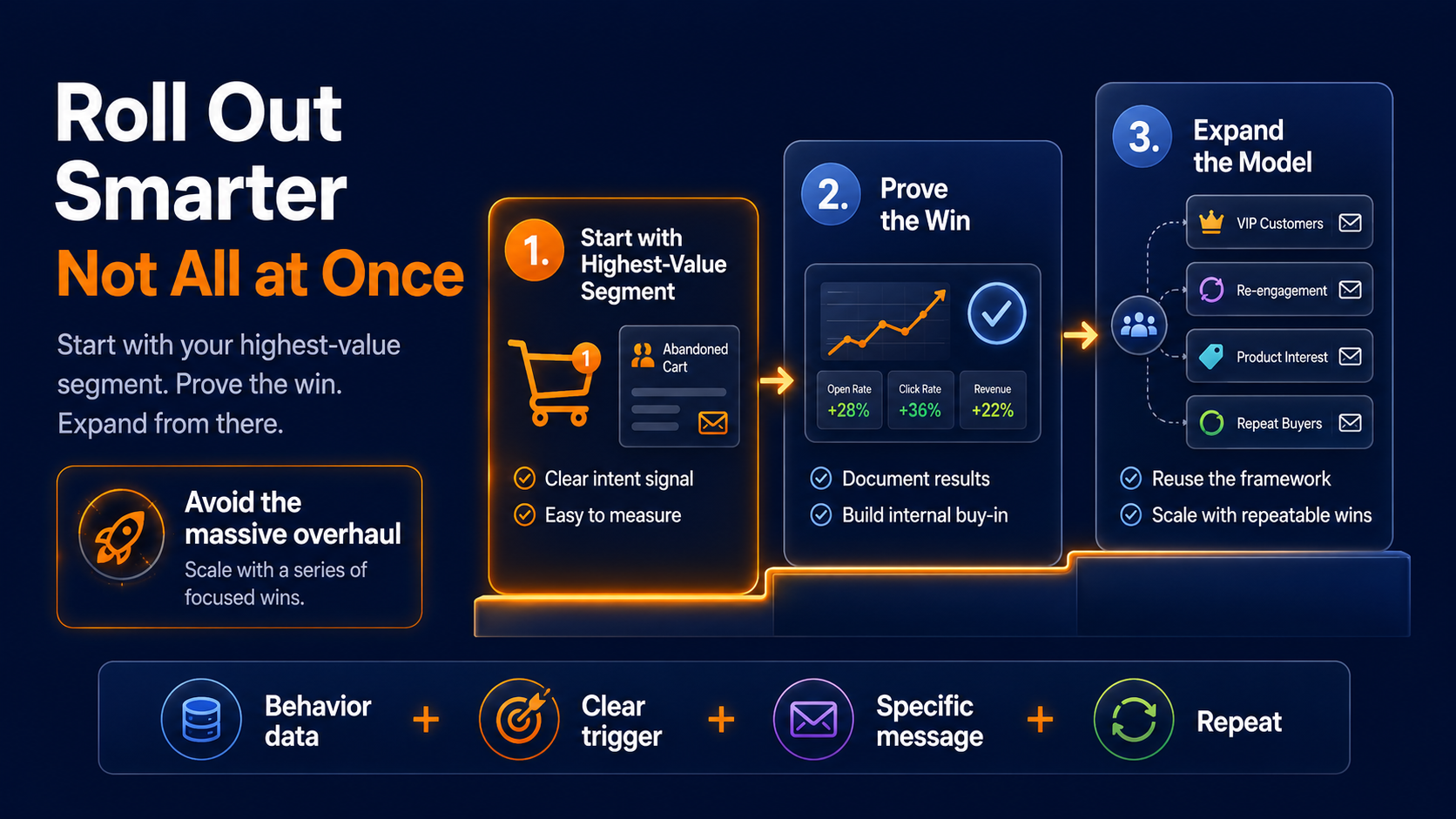
You don't need to segment your entire list, personalize every template, and rebuild your send calendar in the same week. That's how good initiatives stall out.
Starting With Your Highest-Value Segment
Pick the segment with the clearest signal and the most revenue at stake. Abandoned cart is usually the easiest first move, because the intent signal is unmistakable and the win is easy to measure.
Prove it works there first. A clean, well-documented win on one segment makes it much easier to get buy-in for rolling the same approach out across the rest of your list.
Expanding Once You've Got a Working Model
Once your first segment is performing, use the same framework, behavior data plus a clear trigger plus a specific message, on your next highest-value segment. Repeat that pattern instead of reinventing your approach every time.
This is how segmentation programs actually scale inside real teams. Not with one massive rollout, but with a series of proven, specific wins stacked on top of each other.
Put All of This on Autopilot With Pinpointe
None of this works if you're doing it by hand in a spreadsheet. Segmentation, personalization, frequency tuning, and send-time optimization are four full-time jobs if you're managing them manually across a growing list.
This is exactly the gap Pinpointe's platform closes.
Building Segments Automatically as Behavior Changes
Pinpointe's dynamic segmentation updates in real time as customer behavior changes, so a subscriber who clicks a link to schedule a demo today gets treated like a demo request lead today, not three days from now when someone finally exports a CSV.
Your segments stay current without a manual rebuild every time behavior shifts. That means the schedule a demo nudge, the win-back sequence, and the loyalty offer are all working off the same live picture of your customer, not a snapshot from last week.
Triggering Sends Based on Real-Time Signals
Behavioral triggers inside Pinpointe fire off the actual signal, not a scheduled batch. A link gets clicked, a trigger fires. A high-intent page gets visited twice, a trigger fires.
Automated, triggered sends produce roughly 6x higher transaction rates than standard batch campaigns, which is the kind of gap that's hard to close manually no matter how disciplined your team is.
Pair that with email and SMS living in one platform, and you get one coherent customer journey instead of two disconnected channels guessing at the same person. Your deliverability infrastructure also matters more than most teams give it credit for. None of this segmentation and personalization work pays off if the email never reaches the inbox in the first place.
Tying Journeys Together Instead of Managing Channels Separately
Most teams run email and SMS as two separate workstreams with two separate calendars, which means the same customer can get a discount email and a full-price SMS on the same afternoon. That's not a data problem, it's a coordination problem, and it's exactly what an omni-channel journey builder is meant to fix.
When one behavioral trigger can kick off a coordinated sequence across both channels, your demo request gets a single, sensible thread instead of two competing messages from the same brand. That kind of consistency is hard to fake with two disconnected tools, and it's a lot easier to build once with the right platform under it.
Real-time engagement data closes the loop. You're not waiting for a weekly report to tell you a segment's behavior shifted. You're seeing it as it happens, and your sends can react the same day instead of the same quarter.
Building a Data-Driven Email Program That Actually Converts
Email isn't going anywhere. Close to 4 billion people worldwide still check an inbox, and email remains one of the few channels where you get real one-on-one time with a prospect.
But that one-on-one time is worth less every year if you're not backing it with real data. Consumers who feel brands don't personalize are increasingly willing to walk, saying they've dropped a brand over generic messaging,
Be intentional with your email segmentation strategy and stay consistent
Segment with intent. Personalize with real data, not just a name field. Tune your frequency and timing to what each segment actually shows you, not what an old blog post assumed.
None of these four moves are complicated on their own. What's hard is doing all four at once, consistently, across a list that's constantly changing. That's the actual job.
Do that consistently, and your list stops being a list of addresses. It becomes a group of people who trust that when you show up in their inbox, it's worth opening.
Ready to Put Your Customer Data to Work?
You don't need to rebuild your entire email segmentation strategy overnight. You need an email marketing automation platform that turns the customer data you already have into segments, personalization, and triggers that run themselves, without adding three new manual processes to your team's plate.
Schedule a demo with Pinpointe, and we'll walk through what a data-driven, automated email program looks like for your specific list, your specific segments, and your specific goals.