Most marketing teams are confident they know what their spending earns them. Very few actually do. 85% of marketers said they were confident in their ability to measure holistic ROI, while only 32% actually measured it across their channels. That's a fifty-point spread between what teams believe about their own numbers and what the numbers can actually tell them.
You've probably felt the edge of that problem yourself. The dashboard looks complete. The charts are full. And yet when finance asks which specific campaign produced last quarter's pipeline, the honest answer is a shrug dressed up as a slide.
Building a unified marketing engine
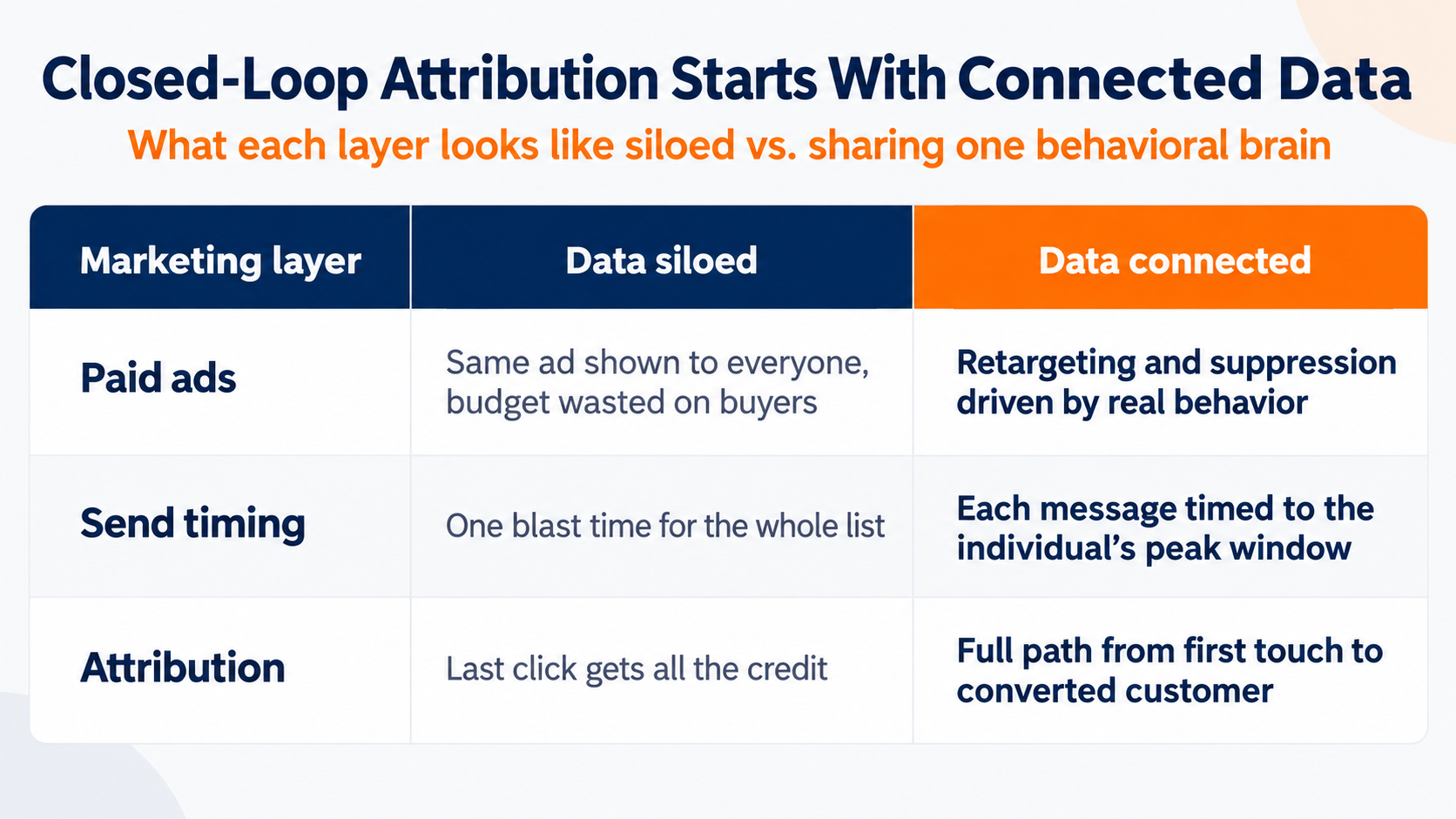
Before you spend another dollar on ads, another hour on AI tooling, or another afternoon rebuilding a report, understand that none of those layers work in isolation. Your paid acquisition, your send timing, and your attribution are three parts of one engine, and the engine only runs when they share the same data. When they don't, you get exactly what most teams have, which is a lot of motion and very little you can trace back to revenue.
This post is about closing that distance. Not by buying more tools, but by connecting the ones you already run to the behavioral data sitting inside your marketing automation platform.
Paid Ads Fail When They Can't See Your Own Data
Paid acquisition earns its keep for one reason. It skips the slow grind of organic reach and puts your message in front of people today. You pay to jump the line.
But the money you pour into Meta, Google, or LinkedIn doesn't get smart on its own. The intelligence that separates a profitable ad account from an expensive one doesn't live inside the ad manager. It lives inside your marketing automation platform, in the record of who opened, who clicked, and who went quiet.
Sell the small yes to cold traffic
The most common paid-ads mistake is asking strangers to marry you on the first date. Teams push their flagship product straight at cold audiences and then wonder why the cost per lead is brutal.
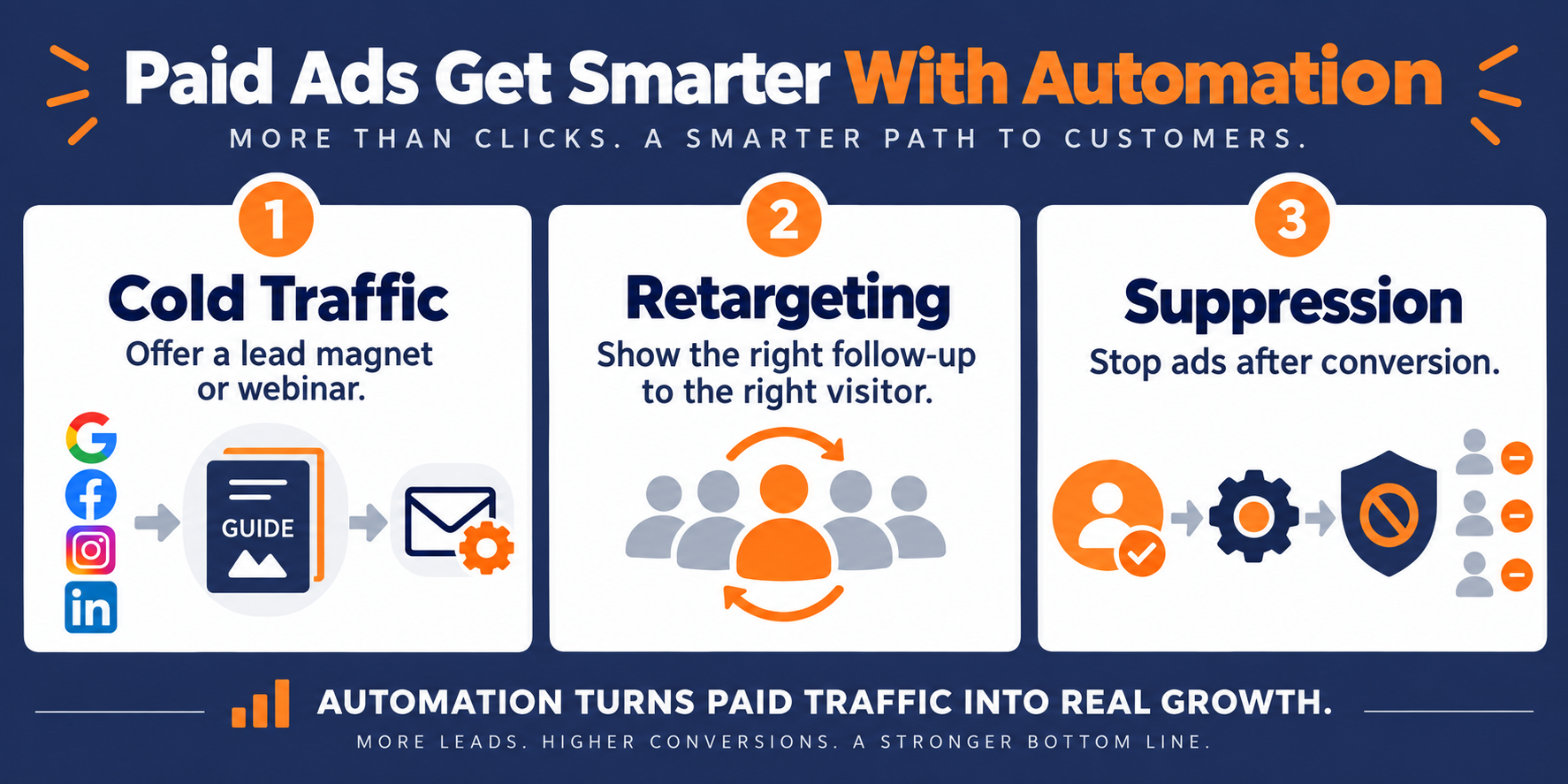
Cold audiences convert poorly because they have no reason to trust you yet. So don't sell them the big thing. Sell them the small yes. Promote a truly useful lead magnet or a spot at your next webinar, feed those opt-ins straight into an automated nurture sequence, and let the relationship do the selling that a single ad never could.
This is also where your front-end cost per lead drops. A proven lead magnet almost always converts cold traffic more cheaply than a demo request does, because you're asking for a much smaller commitment. You lower the cost of getting someone in the door, and then your nurture sequence carries the weight of turning that low-commitment opt-in into a real prospect over time.
Retargeting is where the real return hides
Most website visitors never convert on that first visit, which means the vast majority of the traffic you already paid to bring in leaves without a trace. Retargeting exists to go back to them, and the return on it is hard to argue with. Warm retargeting audiences convert at roughly two to five times the rate of cold traffic, at a lower cost per acquisition.
That kind of lift doesn't come from magic. It comes from relevance. You already know something about these people, so you can stop showing everyone the same ad and start showing each group the thing that actually matches where they stalled.
Someone who visited your pricing page and left needs a different nudge than someone who registered for a webinar and never showed. One wants reassurance, the other wants a reason to come back. The catch is that your ad platform can only sort them that way if it knows what they did, and that knowledge starts in your automation data.
Stop paying to reach people who already bought
Retargeting has an ugly failure mode nobody likes to talk about. You keep serving ads to people who already converted, burning budget to sell something a customer already owns.
The way to avoid this issue is to build a suppression list that updates itself. The moment someone buys or books a call, an automated trigger should pull them out of the retargeting audience and drop them into a suppression segment your ad platform respects. No spreadsheet exports, no manual cleanup, no awkward “buy now” ad landing in a new customer's feed the day after they paid you.
|
Pro Tip: Wire your “purchased” and “booked a demo” triggers to a suppression sync so ad budget stops chasing people who are already on your customer list. |
Guessing At Send Times Is Costing You Opens
Your list is full of people with different rhythms. The early riser clearing her inbox at 6am, the manager who only surfaces after lunch, the west-coast contact three hours behind your send button. One universal send time is wrong for almost all of them at the same moment.
The market has already moved on this
Timing has become one of the first places marketers hand the keys to a machine. Two-thirds of marketers now use AI to optimize their send times, letting engagement history decide the moment instead of a calendar invite and a gut feeling.
The logic is simple once you see it. A system watches when each contact has actually opened in the past, then holds each message and releases it at that person's individual peak window. Same email, same list, better arrival time for every single recipient. What used to be a guess becomes a decision the data makes for you.
Small lifts, enormous list, real money
The per-person gain from optimized timing stays modest. It's a few percentage points on open rate, nowhere near a doubling. That modesty is exactly why it's easy to dismiss.
But run those few points across a list of fifty or a hundred thousand people, campaign after campaign, and the compounding gets serious. More opens feed more clicks and more clicks feed more conversions. You already wrote the email. You're just choosing to deliver it when it has the best odds of being seen.
The reason timing matters this much is that it sits upstream of everything else in the funnel. An email nobody opens can't be clicked, and a link nobody clicks can't convert. Improve the moment of arrival, and you widen the top of every downstream number at once.
Timing only works if it reads real behavior
There's a right and wrong way to do this. Some tools try to guess an optimal time from thin signals, like a single recent open or a broad regional average, and those guesses tend to drift.
Individualized timing that holds up over time leans on a longer history of first-party engagement, the accumulated record of when a specific person has actually opened your messages across many sends. The deeper that history, the sharper the prediction, which is one more reason your engagement database is the asset that makes everything else smarter.

One Great Video Can Feed A Month Of Sequences
Content is the heaviest tax on any marketing team. Somebody has to make the thing, and the thing is never finished.
This is the other place AI earns its seat. Not by writing slop you'd be embarrassed to send, but by stretching one strong asset across a lot of surfaces. Record a single sharp video where your best person answers the question customers actually ask, and you've got the raw material for weeks of touchpoints.
Turn one asset into many
That one recording can become a set of blog posts pulled from its strongest points, a run of short social pieces built around individual insights, and a multi-part nurture flow that walks a new subscriber through the same argument over several days.
You're not manufacturing brand-new ideas every week under a deadline. You're taking one idea you already believe in and meeting people wherever they happen to be paying attention. The insight stays consistent because it all traces back to the same source, which is exactly what makes a brand sound like it knows what it's talking about rather than chasing a content calendar.
Consistency is the point, not volume
The goal here was never to publish more for the sake of more. Flooding every channel with thin variations of the same post trains your audience to tune you out.
The goal is coherence. When your blog, your social media marketing strategy, and your email sequence all reinforce one clear point of view, each touch makes the next one land harder. That only holds if the pieces actually connect, which is far easier when they were carved from the same block to begin with.
|
Pro Tip: Before you record, write down the single question the asset answers, and repurpose only the pieces that answer it, so the whole set stays pointed at one idea. |
If You Can't Trace The Dollar, You're Guessing
Now for the layer that makes the other two provable. Everything above is a bet until you can follow the money.
And most teams can't. Forrester estimates that roughly 37% of digital advertising budgets produce no measurable business impact, lost to poor targeting, broken tracking, and attribution that can't connect a click to a customer. More than a third of the money disappears into a fog you can't see through.
Tag every link as it owes you an answer
The unglamorous solution starts with UTM parameters, the little tags appended to a link that tell your analytics where a click came from and what it was doing there.
Done consistently, every link in every email, every SMS, and every content block carries a source, a strategy, a campaign, and the specific asset that earned the click.
It's tedious to set up, and it is the whole difference between “email did well this quarter” and “the third message in the onboarding flow drove these fourteen deals.” One of those sentences survives a budget review. The other gets you a polite nod and a smaller budget.
|
Parameter |
What it captures |
Example value |
|---|---|---|
|
utm_source |
The platform the click came from |
email_automation |
|
utm_medium |
The strategy layer behind it |
nurture_series |
|
utm_campaign |
The commercial goal it served |
q2_product_launch |
|
utm_content |
The exact link or asset that won the click |
case_study_button |
Fill those four fields the same way every time, and your analytics stop guessing. A click that lands with all four tags tells you not just that email worked, but which email, in which sequence, aimed at which goal, and which specific button inside it did the job.
Knowing these details can help you effectively track revenue generated from email marketing and more.
Follow one buyer end-to-end
When your automation platform's engagement records line up with your analytics, a single customer's path stops being a mystery and becomes a story you can read start to finish.
You can see that a lead first found you through a video, opted in through a specific form, clicked the third email in a sequence at 8:15 in the morning, browsed three case studies, and finally converted. That's no vanity report. That's a map of which sequences actually create customers, so you can move money toward what works and starve what doesn't.
When attribution breaks, look at your plumbing
Here's the part most “measure your ROI” advice skips. When attribution breaks, the culprit usually has nothing to do with a missing tool. The culprit is disconnected data.
Your ad platform knows one slice, your email tool knows another, your analytics knows a third, and nobody's holding the whole picture.
If those systems don't talk to each other, no dashboard can stitch their pieces back together for you. The report ends up crediting whatever touch happened to be trackable, usually the last click, for work that a dozen earlier touches actually did.
Your Audiences Are Only As Smart As The Data Behind Them
Ads, timing, and attribution all depend on the same thing, which is knowing who someone is and what they've done. That knowledge is your segmentation, and it's either shared across your stack or trapped in one corner of it.
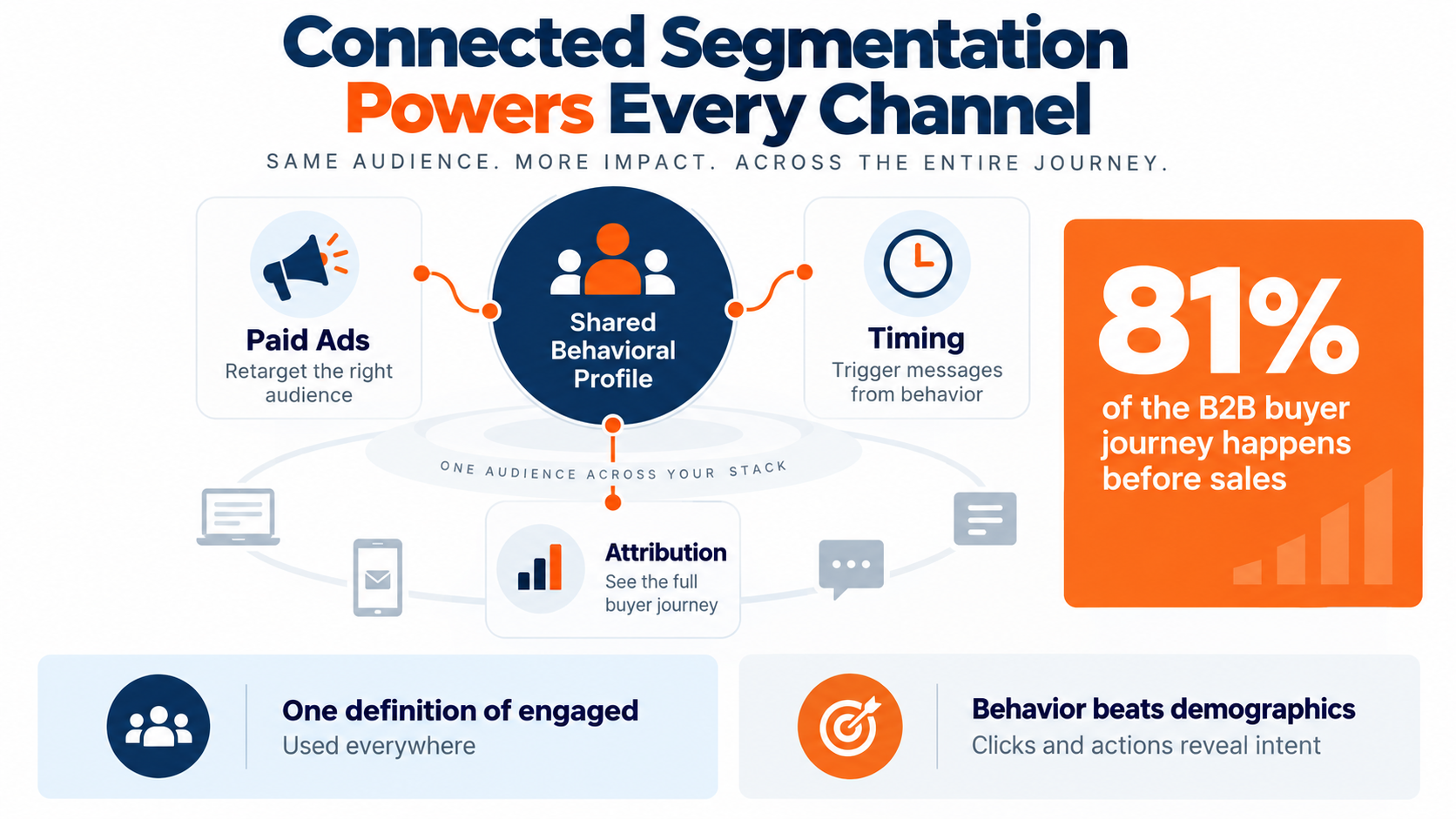
This matters more than it used to, because the buying journey keeps getting more complex without the right data. Research on B2B buying finds that around 81% of the journey happens before a lead ever enters your sales pipeline, most of it in channels your reporting barely sees. All that early influence only becomes visible if your audience data is shared, so the same person shows up as one recognizable profile everywhere instead of a stranger to each tool in turn.
When your segmentation is trapped, every tool reinvents the wheel. Your ad platform builds one definition of an engaged lead, your email tool builds another, and the two never reconcile. You end up managing three versions of the same audience and trusting none of them.
One definition of engaged, used everywhere
The way to avoid this trap is to let one behavioral profile drive everything downstream. A contact who has opened three pricing emails and clicked two case studies is a hot lead in your email tool, a retargeting priority in your ad account, and a flagged record in your reporting, all from the same underlying signal rather than three separate guesses.
That's what dynamic segmentation actually buys you. Not prettier lists, but a single, current definition of each audience that every channel can act on at once. When the definition updates, every channel updates with it.
Behavior beats demographics for this job
Static traits like job title or company size tell you who someone is on paper. They don't tell you whether that person is ready to buy this week.
Behavioral signals do. What someone actually clicked, opened, and revisited is a far better predictor of intent than any field they typed into a form once. Build your audiences on behavior, keep them synced across channels, and your ads, your timing, and your reporting all start working from the same live read of who's paying attention right now.
Connect What You Already Have
Here's what this comes down to. Paid ads, AI-assisted timing, and closed-loop attribution are not a menu of separate upgrades. They're one system, and each part gets sharper the moment your behavioral data flows through all three instead of pooling in silos.
You saw it play out across every layer. Ads waste budget when they can't read your own engagement data. Send timing reduces open rates when a calendar overrides real behavior.
Segmentation splinters when every tool keeps its own version of the truth. And your ad spend evaporates when your systems can't connect a click to a customer. The common thread was never a missing feature. It was disconnected data.
Putting your behavioral data to work
So the shift worth making comes down to getting the behavioral data you already generate to flow into the places where decisions happen.
The right marketing automation platform is the one that turns that signal into shared audiences your ads can read, individualized send timing your subscribers respond to, and end-to-end tracking your reporting can trust, all from one behavioral record instead of five disconnected fragments.
Behavioral triggers, dynamic segmentation, predictive send timing, and a real analytics integration are the capabilities that make that possible, whichever tool you run them in.
The missing connective layer
None of this means replacing what works. What changes is whether they're fed by one shared read of your audience or left guessing on their own.
The piece they're missing is the connective layer that lets those pieces talk, and that's a configuration problem far more often than it's a budget one.
Teams rarely fall behind because they lack channels. They fall behind because their channels can't see each other. So start where you can trace the impact fastest.
Pick one flow, wire its triggers, timing, and tracking to the same behavioral source, and watch what suddenly becomes measurable.
Stop the hidden drain on your marketing ROI
If you want a clear read on where your data is already disconnected and what it's quietly costing you, book a marketing automation audit to map it out.