You sit down to plan next month's sends, and the well is dry. Same newsletter, same promo, same three-day sale you already ran in the spring. Your subscribers can feel the autopilot, and it shows up in your open rates.
Here's the good news. Email still returns better than 40 to 1 on average, more than any other channel you have. The money is there. What runs out isn't budget or reach. It's your email newsletter ideas that actually convert.
So this is a working list of email campaign examples you can lift and adapt, from one-and-done sends to multi-step drip sequences that run on their own. Steal the structure, swap in your own offer, and give your calendar something better than "newsletter #47."
What turns a send into an email campaign
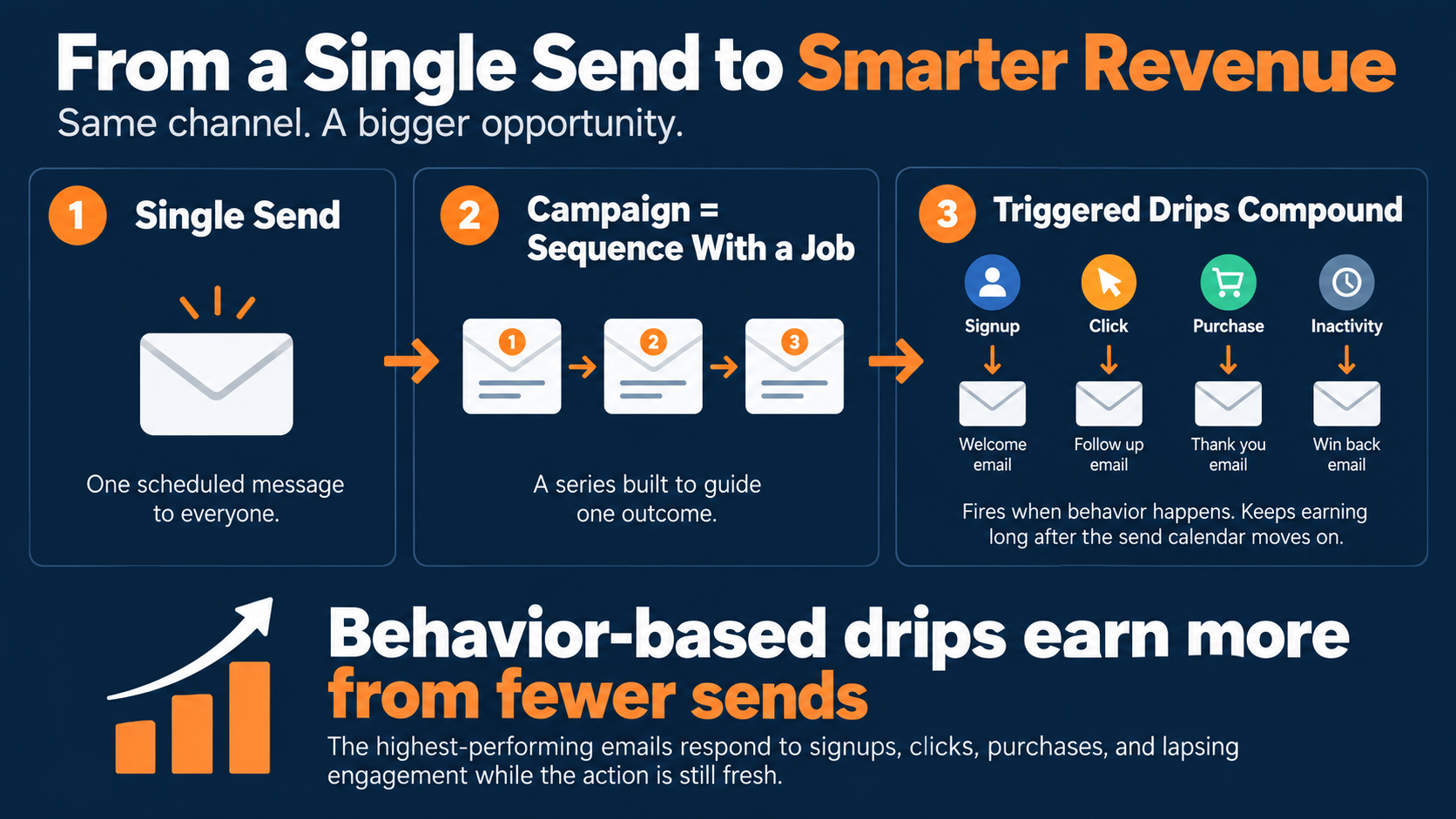
A single email is a send. A campaign is a sequence with a job.
That distinction matters more than it sounds. The best-performing email is rarely the one you blast to everyone on a Wednesday. It's the one that fires because someone did something, signed up, clicked, bought, or went quiet, and it lands while that action is still fresh.
That's why triggered sequences punch so far above their volume. A small share of your sends, the ones tied to real behavior, does most of the earning, and they keep working long after you've moved on to your next marketing campaign.
Keep that in mind as you read. Some of these are single sends you schedule. The ones that compound are the drips.
Drip Campaign Examples That Run Without You
A drip campaign is a set of emails sent on a schedule or a trigger, one after another, from a single starting event. You build it once, and it works every time someone qualifies.
If you only add one thing to your program this quarter, make it these. Here are four email drip campaign examples that every company should be using.
The welcome series
The moment someone subscribes is the most attention they'll ever give you. They just raised their hand, so your first email lands in a window where opens and clicks run far higher than your usual newsletter. A single "thanks for signing up" wastes that.
Build three to five emails instead. Email one welcomes and sets expectations. Email two tells your story or shares your best proof. Email three makes a specific, low-friction offer, and you can stretch to five with an education email and a nudge for anyone who hasn't clicked yet.
This matters because your welcome message sets the tone for every customer relationship that follows. As an example, Networld Media Group, a publisher running 10 trade sites, uses triggered welcome flows in Pinpointe as part of a program that lifted link clicks by 167%.
The lead nurture sequence
Not everyone who joins your list is ready to buy. A nurture drip walks a cold contact toward "sales-ready" without a rep having to babysit it.
The structure is simple. Space four to seven emails over a few weeks, each one answering the next objection a buyer would have, and watch who clicks what. Engagement tells you who's warming up.
The tactic that makes it pay off is the handoff. Nurture the cold contacts automatically, then push only the ones who actually engage into your sales CRM. That filters the tire-kickers from the buyers before a rep spends a minute, and it can help align sales and marketing to increase conversion rates.
The win-back drip
Every list goes quiet at the edges. A win-back drip is a short sequence aimed only at subscribers who haven't opened or clicked in a set window, say 90 or 120 days.
Three emails usually do it. One acknowledges the silence and asks if they still want to hear from you. One brings a real reason to come back, a discount, a new feature, a "here's what you missed." The last is a clean goodbye that lets them confirm or drop off.
Here's the catch that most people miss. A win-back that fails is still a win. Clearing disengaged contacts off your active list protects your sender reputation, which protects deliverability for everyone who does want your email.
The post-purchase drip
The sale isn't the end of the sequence. It's the start of the next one.
A post-purchase drip confirms the order, sets expectations for shipping or onboarding, then follows up days later with tips, a replenishment reminder, or a cross-sell. For a consumable product, a "time to reorder" email timed to your average repurchase cycle is close to free money.
|
Pro Tip: Time the reorder nudge to land a few days before the customer would actually run out, not the day they do. You want to be the reminder, not the afterthought. |
| Campaign Type | Trigger / Timing | Sequence Length | Primary Goal |
| Welcome Series | Immediate upon email sign-up | 3–5 emails | Capitalize on peak attention, share brand story, drive first offer |
| Lead Nurture | Cold contact sign-up or lead capture | 4–7 emails over weeks | Address buying objections, qualify warm leads for sales CRM |
| Win-Back Drip | Inactivity for 90–120 days | 3 emails | Re-engage quiet subscribers or prune list to protect deliverability |
| Post-Purchase Drip | Immediately after order completion | 2–4 emails post-sale | Guide onboarding, encourage reviews, nudge timely reorders |
| Abandoned Cart | Incomplete checkout or abandoned form | 2–3 emails (hours to days) | Remove conversion friction, recover lost high-intent revenue |
| Mini-Course | Specific opt-in for educational series | 3–5 daily/weekly sends | Build authority and trust by delivering value before making an ask |
| Gift Guide | Seasonal holidays or occasion milestones | 1–2 scheduled sends | Resolve buyer hesitation with curated, budget-segmented picks |
| Apology Send | Sent immediately following a broadcast error | 1 email | Acknowledge mistakes quickly, humanize brand, offer light incentive |
Reminder and Abandoned Cart Campaigns
Every business sends the promo. Fewer send the follow-up, and that's where the revenue leaks out.
Your first promotional email gets attention, but it doesn't always get the sale. This can happen for a number of reasons, like your customer got distracted, compared prices, or simply forgot. A reminder a few hours or a day later does the unglamorous work of closing that gap.
Turn high-intent abandonments into completed conversions
The abandoned cart email is the sharpest version of this. Roughly 70% of online carts get abandoned before checkout, according to Baymard Institute's running analysis. That's not lost intent. Those are people who wanted the thing enough to add it, then stalled.
A cart drip of two or three emails recovers a meaningful chunk of that. First, a simple "you left something behind." Second, address the friction, a shipping cost, a size worry, an unanswered question. Third, a light incentive if your margins allow it.
As an example, 21st Mortgage runs automated abandoned-cart drips in Pinpointe for homebuyers who start a loan application but don't finish, and closes more loans because of it.
Email Courses and Gift Guides People Actually Want
Not every campaign sells directly. Some earn attention first and sell later, and two formats do that better than most.
Mini courses and lessons by email
A mini course is a drip in disguise. You promise a subscriber something useful over a set number of emails, then deliver one lesson at a time.
A kitchenware brand can run a five-day "dinner this week" recipe course. A software company can teach one feature a day. The rules are the same either way. Tie the lessons to something you sell, keep a consistent look so each email feels like part of a set, and tell people up front how many emails to expect.
The reason this works is trust. By the time the course ends, you've shown up in the inbox five useful times without asking for anything. The ask and call to action lands a lot softer after that.
Gift guides for every occasion
Gift guides solve a real problem. People are stumped about what to buy, and you sell things they could buy.
Build one of two ways. Show a handful of products right in the email, each with its own button, so people can browse without leaving. Or point to full guides on your site, split by category, "gifts under $50," "for the golfer," "wedding season."
And don't cap it at the holidays. There are a dozen gift-giving moments a year, from graduations to Father's Day. A guide segmented by occasion or budget beats a generic "shop now" every time, and a follow-up with a small discount on featured items gives fence-sitters a reason to move.
The Apology Email for When You Get It Wrong
You'll send a broken email eventually. A "Dear (First Name)" that never populated, a link to nowhere, the wrong segment entirely. Everyone in this job has done it.
The recovery isn't complicated. Own it fast, keep it short, and don't grovel. One line acknowledging the mistake and, if it fits, a small discount to smooth it over. Handled well, the apology often outperforms the email that broke, because it reads as human.
Better still, avoid the send in the first place. Preview every campaign across devices before it goes, and run the copy through a spam check so a clumsy word choice doesn't drop you in the junk folder. A thirty-second preview beats a public apology.
Running These Email Marketing Campaigns Across Every Brand You Own
Any one of these campaigns is a good afternoon's work. Now run all of them at once. Then run them for six brands, or forty clients, or twenty store locations, each with its own list, its own branding, and its own numbers to report on.
That’s where standard email tools break down. Execution becomes an operational bottleneck the moment you replicate these sequences across multiple brands.
Scale multi-brand email operations
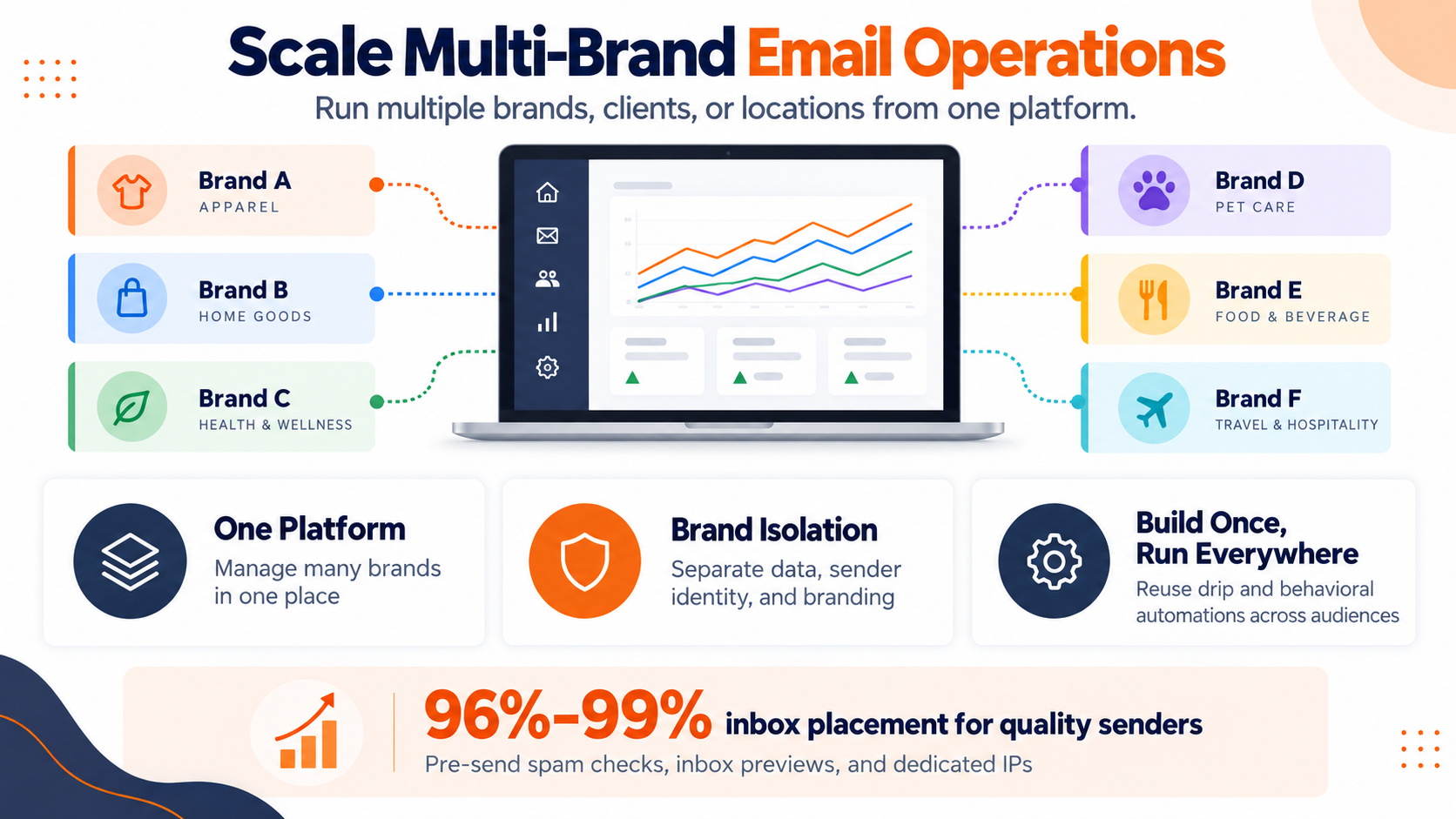
This is where we built Pinpointe differently. Pinpointe is a multi-brand marketing cloud, one platform that runs many independent brands, clients, or locations at once. Each one gets isolated data, its own sender identity, and its own branding, while you manage the whole operation from a single place.
The drip, trigger, and behavioral automation behind every example above run inside that structure. You build the welcome series, the cart drip, and the win-back once, then run them independently for every audience without rebuilding a thing or risking a cross-brand mix-up.
Deliverability sits under all of it. Our pre-send spam checker, inbox previewer, and dedicated IPs are why quality senders on the platform hold 96% to 99% inbox placement, which is the difference between a campaign that converts and one that never gets seen.
Build once, scale everywhere
"We send millions of emails a month across 10 distinct publications, so keeping our data strictly separated is non-negotiable. Being able to build our welcome series and cart drips once, then deploy them independently across every audience without starting from scratch, has saved us hundreds of hours." — Networld Media Group
Where to Start With Your Next Email Marketing Campaign
You don't need all nine of these live by Friday. Pick one. The welcome series is the highest-leverage place to start, because it hits subscribers at peak attention and runs forever once it's built. Add the abandoned cart drip next if you sell online, then a win-back to keep your list clean.
The pattern across every one of these email marketing campaign examples is the same. Stop thinking in one-off blasts and start thinking in sequences that trigger on what your subscribers actually do. That shift is what separates a calendar you dread filling from a program that earns while you sleep.
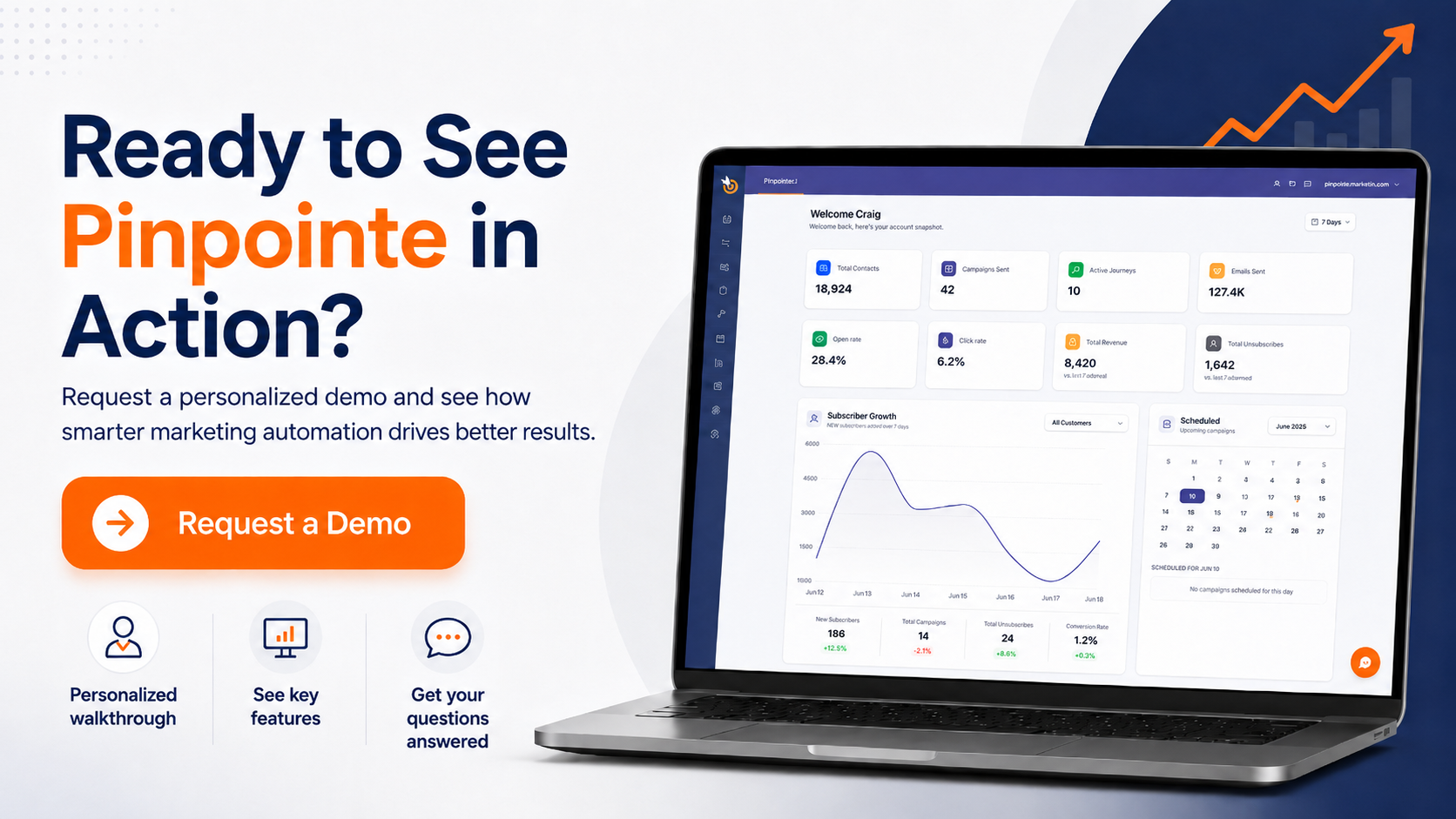
And if you're running email for more than one brand, client, or location, that's exactly what Pinpointe was built to handle. See how Pinpointe runs independent campaigns for every audience from one platform, and we'll help you build your first drip this week.