
Here's a stat that should stop you mid-scroll: 82% of C-level executives think their sales and marketing teams are aligned, while only 35% of the people actually doing the work agree with them. That gap isn't a communication problem. It's a leadership team that hasn't looked at the pipeline data in a while.
You've probably lived some version of this. Marketing hits its lead number and throws a small internal party. Sales looks at the list and asks who approved these. Nobody's wrong, exactly. They're just optimizing for two different scoreboards, and the customer is the one who feels the disconnect.
Drive sales and marketing alignment with marketing automation software
This isn't a new problem, and it isn't unique to any one industry or company size. What's changed is the cost of ignoring it. Buyers have more options, shorter attention spans, and less patience for a brand that feels disjointed between the email they got last week and the call they got yesterday.
Sales and marketing alignment used to be a nice-to-have that showed up in a slide deck once a quarter. Now it's the difference between a buyer who trusts your process and one who quietly goes back to researching your competitor.
Let's talk about why this keeps happening, what it's actually costing you, and where your email and automation strategy either makes it worse or starts fixing it.
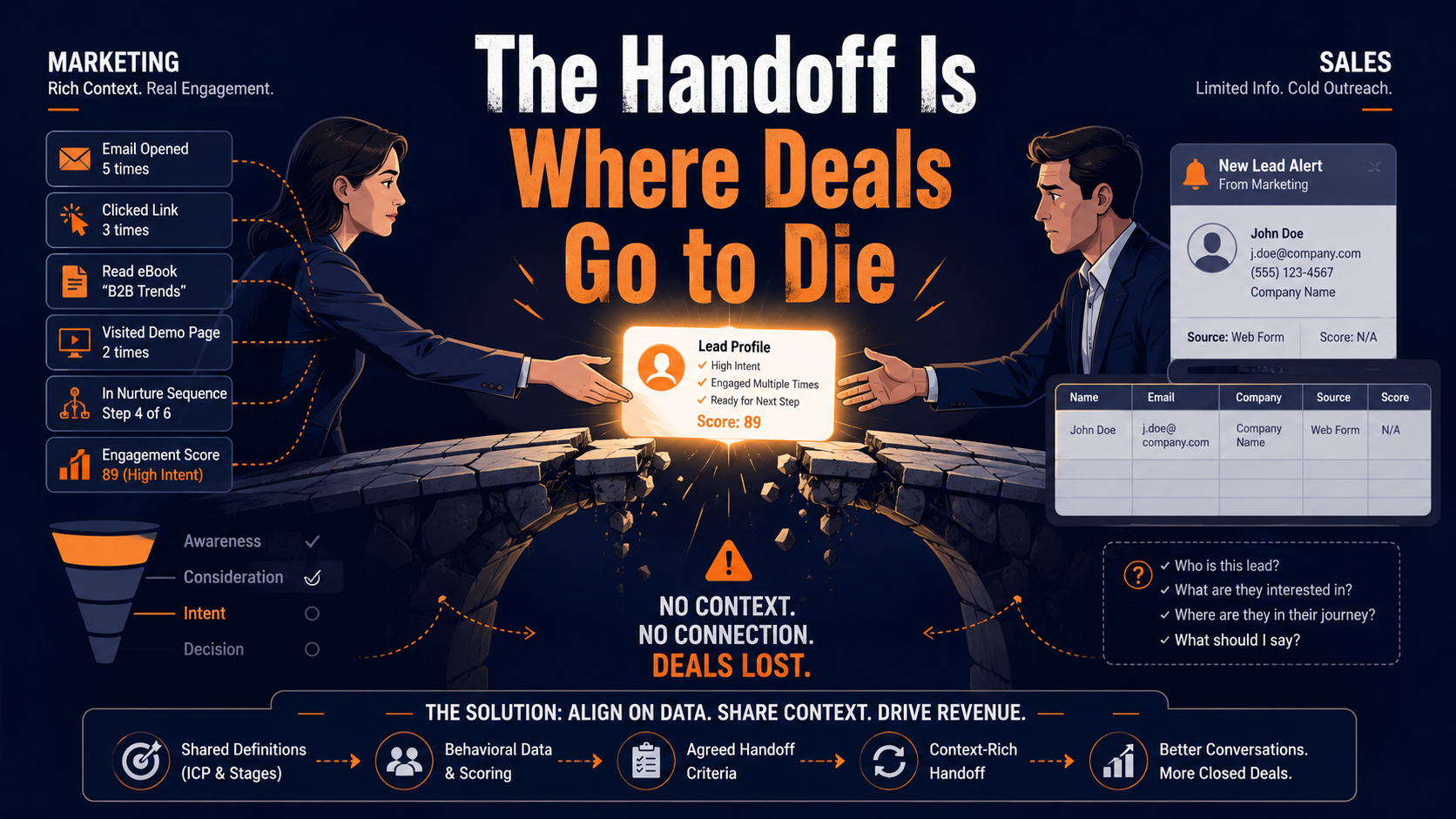
The Handoff Is Where Deals Go to Die
Every sales and marketing relationship has a moment where a lead crosses from one team to the other. That handoff is the single most fragile point in your entire funnel, and most companies treat it like an afterthought.
Marketing builds a list, hands it to sales, and considers the job done. Sales opens the list, finds a pile of people who downloaded a whitepaper once in 2023, and starts making calls nobody asked for. Buyers now complete 67% of their own research before they ever want to talk to a rep, and they're getting reached out to like it's still 2015.
What does your marketing-to-sales handoff actually look like?
Think about what that handoff actually looks like on a random Tuesday. A rep gets a spreadsheet, or worse, a CRM notification with a name, a company, and maybe a job title. No context on what that person read, clicked, or ignored. No sense of whether they're three emails into a nurture sequence or brand new to your brand entirely.
The rep is left guessing, so they default to a generic outreach script, and the buyer can tell immediately that nobody actually paid attention to what they've already done.
Develop a plan for what sales-ready really means
The fix isn't a better spreadsheet. It's agreeing, in writing, on what "sales-ready" actually means before marketing sends a single lead over. What behavior triggers a handoff.
What context comes with it. Whether the rep can see what content that person actually engaged with, or if they're starting the conversation blind.
Get specific here. "Engaged prospect" isn't a definition. "Opened three emails in the pricing sequence and visited the demo page twice in the last two weeks" is a definition, and it's the kind of thing both teams can actually build a process around.
Your Buyers Already Did Their Homework
Stop thinking about your email program as a top-of-funnel tool that hands off to sales at some magic moment. Your buyers are doing the vast majority of their research before anyone from your team ever talks to them directly, consuming a stack of content along the way.
That means your email sequences aren't warming someone up for a sales conversation. They're often the sales conversation, just without a human on the other end yet. If your emails read like generic newsletter filler while your buyer is quietly building a business case internally, you've already lost ground you can't easily get back.
Utilize lead-nurturing best practices
This changes what "good" email content looks like. It's not about volume. It's about matching the exact question your buyer is asking at that stage, whether that's "does this actually work for a company our size" or "what does implementation really take."
Generic drip campaigns don't answer specific questions. Specific content does.
Customize your email sequences based on specific activities
Picture two different sequences. One sends the same five emails to everyone who fills out a contact form, regardless of what page they were on or what they clicked.
The other adjusts based on whether that person came from a pricing page, a comparison page, or a general blog post. The second sequence is doing the actual work of a sales conversation before sales ever picks up the phone.
It's answering objections, addressing specific use cases, and building the internal case your buyer needs to bring to their own stakeholders.
Match your nurture sequence to the right stage of the buyer's journey
This is also where a lot of teams get the sequencing backwards. They front-load product features and save the proof points, the case studies, the "here's exactly how this worked for a company like yours" content, for later in the funnel.
Buyers who've already done most of their own research aren't looking for a features list anymore. They already know what your product does. What they need is evidence that it works for someone in their position, and they need it earlier than most sequences deliver it.
Nurtured Leads Spend More, Not Just Convert More
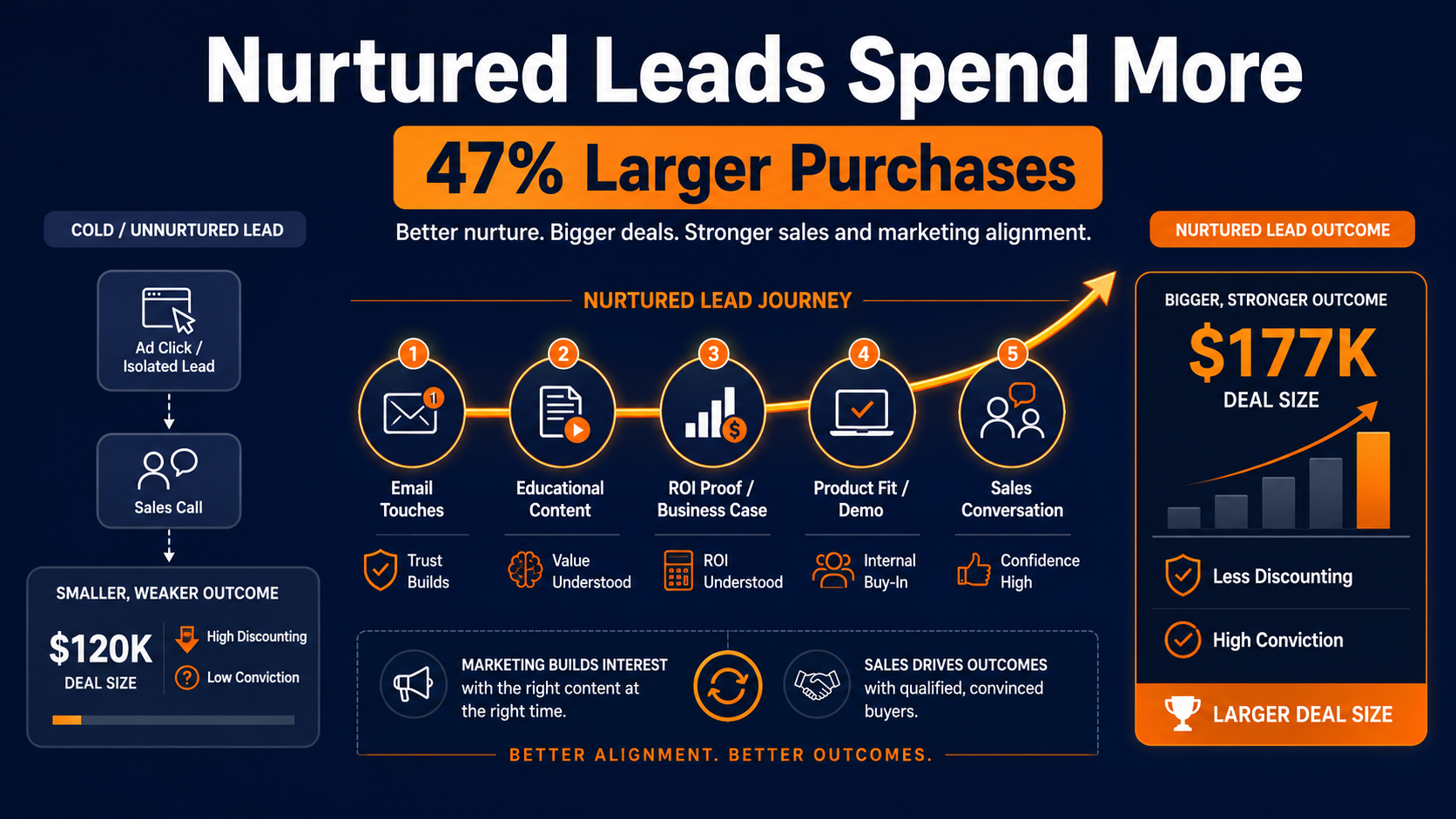
Everyone talks about nurturing in terms of conversion rate, and sure, that matters. But the number that should actually get your attention is bigger. Nurtured leads make purchases roughly 47% larger than leads who skip that process entirely.
Read that again. This isn't just about getting more people over the line. It's about the size of the deal once they're there. A buyer who's been walked through the right content at the right pace trusts the value proposition more by the time they're negotiating, and that shows up in the final number.
Measure the KPIs that accurately show sales and marketing alignment
If your team is still measuring email success purely on open rate and click-through, you're tracking the wrong outcome. The real question is whether the people who go through your nurture sequence end up buying more, staying longer, and needing less discounting to close. That's a sales and marketing conversation, not a marketing-only metric.
Here's why the math works this way. A buyer who jumps straight from a single ad click to a sales call hasn't had time to internalize the value of what you're selling. They're negotiating from a place of uncertainty, which usually means they're negotiating hard on price, because price is the only thing they feel confident evaluating.
Why following lead-nurturing best practices produces better leads
A buyer who's been through a thoughtful nurture sequence has already seen the ROI case, already understands where your product fits relative to alternatives, and already has internal buy-in built before the sales conversation even starts. They're not negotiating from uncertainty. They're negotiating from conviction, and that changes the entire tone of the deal.
This is exactly why sales teams that dismiss nurturing as "just marketing stuff" are leaving money on the table without realizing it. The deals that come through a well-built nurture sequence aren't just easier to close. They're bigger, and reps closing them have an easier time defending price because the buyer already did the math themselves before the call.
Shorter Sales Cycles Aren't a Sales Team Problem to Solve Alone
Sales teams that work closely with marketing report sales cycles running roughly 30% shorter than teams operating in silos. That's not because reps got better at closing overnight. It's because the buyer arrived already educated, already segmented correctly, and already talking to the right person about the right thing.
Every extra week a deal sits in the pipeline is a week your competitor has to get in front of that buyer instead. Automation is one of the few levers that actually compresses that timeline at scale, because it does the repetitive qualification and education work a rep can't realistically do one-on-one for every lead in the funnel.
Use AI-assisted workflows to reduce cost per lead
This is also where AI-assisted workflows are starting to show up in the data. Teams running AI-assisted content and outreach workflows are seeing meaningfully lower cost per lead and more meetings booked per rep.
The tools aren't replacing the strategy. They're just removing the manual grind that used to make good segmentation too expensive to bother with.
Think about what actually eats up time in a typical sales cycle. It's rarely the negotiation itself. It's the back-and-forth of figuring out whether this is even the right fit, chasing down the right stakeholder, re-explaining the value prop to a new person who just joined the buying committee.
A lot of that friction is educational, and education is exactly what a well-built automated sequence handles before a rep ever gets involved.
Marketing automation software should assist reps, not necessarily completely replace them
That doesn't mean automation replaces the rep's job. It means the rep stops spending the first three calls on things a well-timed email sequence should have already covered.
By the time a qualified lead reaches a sales conversation, they should already understand pricing tiers, already have seen a relevant case study, and already know roughly what implementation looks like.
The call becomes about answering their specific, high-value questions instead of repeating the same onboarding pitch every rep gives every prospect.
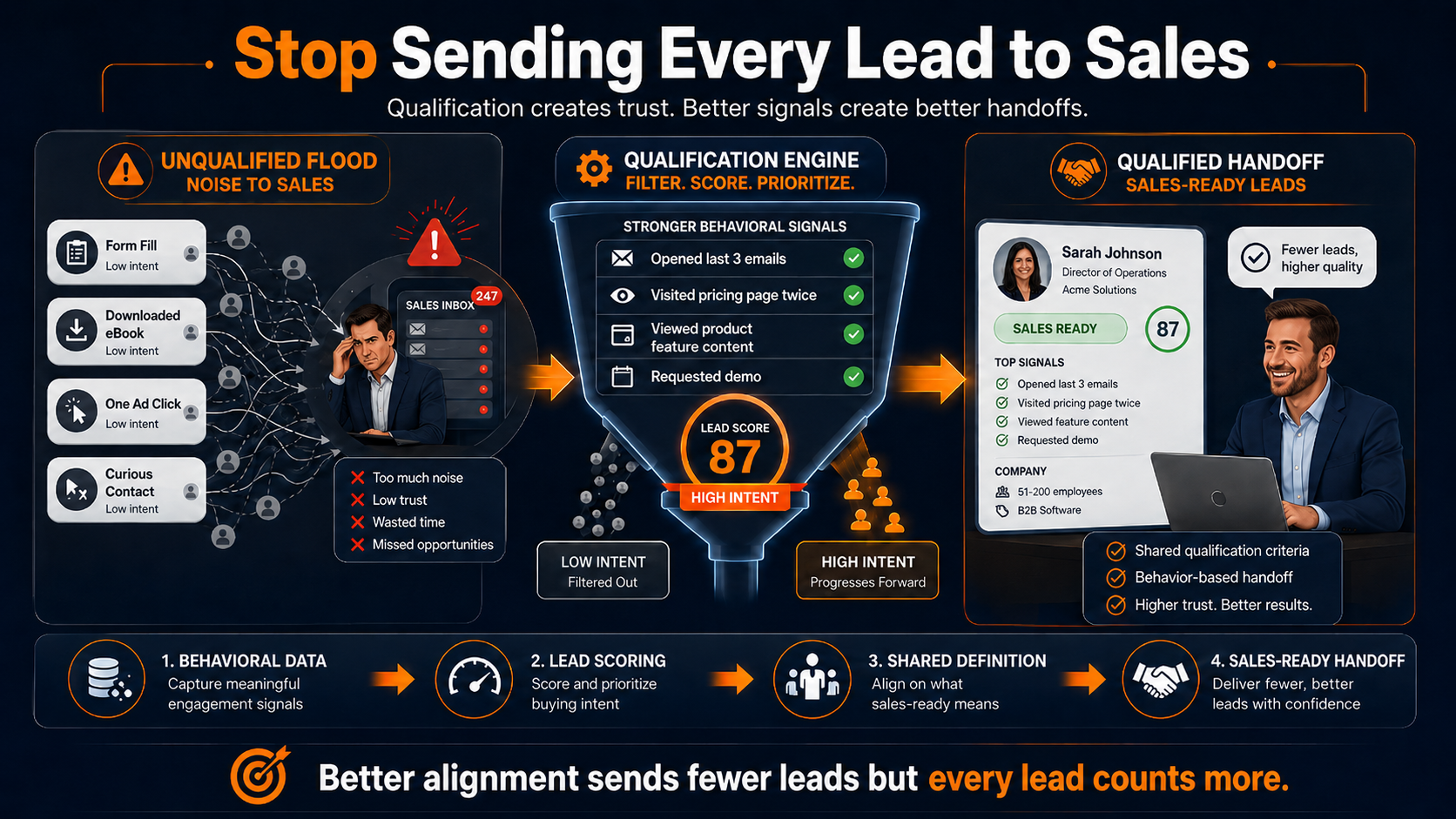
Stop Sending Every Lead to Sales
Here's an uncomfortable one. A large share of leads that marketing sends directly to sales were never qualified in the first place, which is exactly why so many reps have stopped trusting the leads they're handed.
When that trust breaks down, sales starts ignoring marketing's list entirely and goes back to prospecting cold, which defeats the entire purpose of your funnel.
Build qualification criteria sales and marketing align on
The instinct to send everything to sales usually comes from a good place. Marketing doesn't want to be accused of sitting on leads. But dumping unqualified contacts on a sales team doesn't move revenue forward, it just moves the problem downstream and makes it someone else's job to filter.
The better move is building qualification criteria both teams actually agree on, and using behavioral data, not just form fills, to decide when someone's ready. Did they open the last three emails. Did they visit the pricing page twice. Did they engage with a specific product feature more than others. That's a different quality of signal than "they downloaded an ebook once."
Fit lead scoring to where marketing activities match buying intent
Think about the difference in practice. A form fill tells you someone was curious enough to trade an email address for a PDF. It tells you almost nothing about whether they're actually evaluating a purchase.
Repeated visits to your pricing page, multiple opens of a specific product-feature email, or a demo request after weeks of quiet browsing, those are behaviors that actually correlate with buying intent. A qualification model built on the first kind of signal will keep flooding sales with noise. One built on the second kind will send fewer leads, but every one of them will be worth a rep's time.
Create true sales and marketing alignment with a structured process
This is also where the two teams need a genuinely shared definition, not two separate ones that happen to use the same word.
If marketing's definition of "qualified" is based on lead score thresholds nobody in sales has ever seen, and sales' definition is based on gut feel from a call that hasn't happened yet, you don't have alignment.
You have two teams guessing in different directions and calling it a process.
Where Pinpointe Helps Solve Sales And Marketing Alignment
None of this works if your email and SMS efforts live in a different system than the data your sales team is looking at. That's usually the actual root cause when alignment breaks down.
It's not that people don't want to cooperate. It's that marketing is working off one dataset and sales is working off another, and nobody's looking at the same picture of the buyer.
Our marketing automation software uses behavioral triggers to implement lead nurturing best practices
Pinpointe's behavioral triggers are built around exactly the kind of signal that should define a real sales-ready lead: what someone actually clicked, opened, or engaged with, not just what form they filled out once.
Combine that with dynamic segmentation, and you stop sending every contact down the same generic path. A buyer who's engaged three times with pricing-related content gets a fundamentally different sequence than someone who opened one welcome email and went quiet.
Use omni-channel marketing to create high-quality leads
The omni-channel journey builder means that sequence doesn't have to live only in email.
If someone's more responsive to SMS, the journey adjusts without your team building two separate campaigns from scratch.
Improve speed-to-lead follow-up time
And because the engagement data updates in real time, sales isn't working off a lead list that's already a week stale by the time they pick up the phone. They're seeing what that buyer did yesterday, not what they did last month.
This matters more than it sounds like on paper. A rep who opens their CRM and sees that a prospect clicked through a pricing email this morning has a completely different conversation than one who's working off a lead that came in three weeks ago with no update since.
The first rep can reference something specific and current. The second rep is starting cold, even though marketing technically already "engaged" that lead once.
Improve your B2B email marketing strategy with enhanced email deliverability
Deliverability infrastructure plays into this too, in a way that's easy to overlook. None of this segmentation and triggering matters if the emails aren't actually landing in an inbox.
A perfectly built nurture sequence that lands in spam does nothing for alignment except waste both teams' time. Getting the infrastructure right so your messages actually arrive is the unglamorous foundation everything else in this article depends on.
Pinpointe can fix the trust gap between marketing and sales to improve alignment
That's the actual fix for the trust gap between your teams. Not a meeting about "better communication." A shared, current view of what the buyer is actually doing, so marketing's definition of "ready" and sales' definition of "worth calling" finally match.
The Alignment Gap Is a Choice, Not a Given
The data is consistent across every source that studies this: companies with genuinely aligned sales and marketing teams grow faster, close more, and keep customers longer than the ones still treating these as two separate departments with two separate scoreboards.
The 82% of executives who think their teams are already aligned are, statistically, mostly wrong. The 65% of practitioners who say alignment doesn't exist are the ones actually living the disconnect every day.
Value statements are not enough to fix sales and marketing alignment issues
You don't fix this with a values statement or a quarterly all-hands. You fix it by giving both teams the same data, the same definition of a qualified lead, and an email and automation strategy that treats the buyer's actual behavior as the signal, not a guess. That's a system problem, and systems can be rebuilt.
Creating sales and marketing alignment doesn't happen overnight
Start small if you need to. Pick one thing both teams can agree on this month, whether that's a shared definition of a sales-ready lead, a single dashboard both sides actually check, or a standing weekly conversation about what's actually happening in the pipeline versus what the CRM says is happening.
Alignment doesn't require a company-wide overhaul on day one. It requires both teams agreeing to look at the same picture of the buyer and building from there.
The key is to get alignment on what both marketing and sales see as a true buyer
The question worth asking your own team this week isn't whether sales and marketing get along. It's whether they're working off the same picture of the buyer. If the honest answer is no, that's the actual place to start.
Ready to Close the Gap?
If you're not sure whether your sales and marketing teams are actually working from the same data, that's worth finding out before you build another campaign on top of the disconnect.
Schedule a marketing automation audit with our team, and we'll show you exactly where the handoff is breaking down and what it would take to fix it.