
Ninety seconds. That's roughly how long a cold prospect spends deciding whether your email is worth a reply, a delete, or a spam report. Most senders lose that window before they ever get to their pitch.
The old fear around cold email marketing was that you're interrupting a stranger. That part hasn't changed.
What has changed is how unforgiving inboxes have gotten about generic, mass email blast outreach. You don't need to abandon cold email marketing. You need a cold email strategy that treats it like a system instead of a numbers game.
Here's the five-part shift that actually moves reply rates.
Cold doesn't have to mean careless
A cold email is just an email to someone who hasn't heard from you yet. Nothing about that makes it automatically bad email marketing. Treat that first message with the same care you'd give a warm lead, and you change the entire equation.
Most senders are optimizing the wrong metric
Open rate feels like the obvious scoreboard. It isn't anymore.
Apple's Mail Privacy Protection quietly pre-loads tracking pixels on a huge share of inboxes, which means a chunk of your "opens" never involved a human eye. Reply rate is the number that actually tells you whether your message landed with a real person.
Segment Your List Before You Write a Single Word
Skipping segmentation is the single most common reason a cold email marketing campaign underperforms before it's even sent.
Group your contacts by something that actually changes what you'd say to them. Industry, company size, job function, how they ended up on your radar in the first place.
A prospect you found through a webinar signup behaves differently than one you found through a trigger event like a funding round or a new hire.
This isn't busywork. Segmented email campaigns drive 30% more opens and 50% more clickthroughs than unsegmented ones. That gap exists because a segmented message can speak to a specific situation instead of a generic one, and specificity is exactly what a skeptical inbox is scanning for.
Smaller, tighter lists often win
You might assume a bigger list means more shots on goal. In practice, the opposite tends to hold. A campaign built around a few dozen tightly-matched contacts usually outperforms one built around a thousand loosely-matched ones, because every line in the email can be more specific when the audience is narrow.
Think about the math for a second. A thousand generic sends and a hundred sharply-targeted ones can land you a similar number of replies. But the smaller campaign gets there with a fraction of the infrastructure, a fraction of the spam risk, and a much higher share of replies that are actually worth having a conversation about.
Build segments around triggers, not just categories
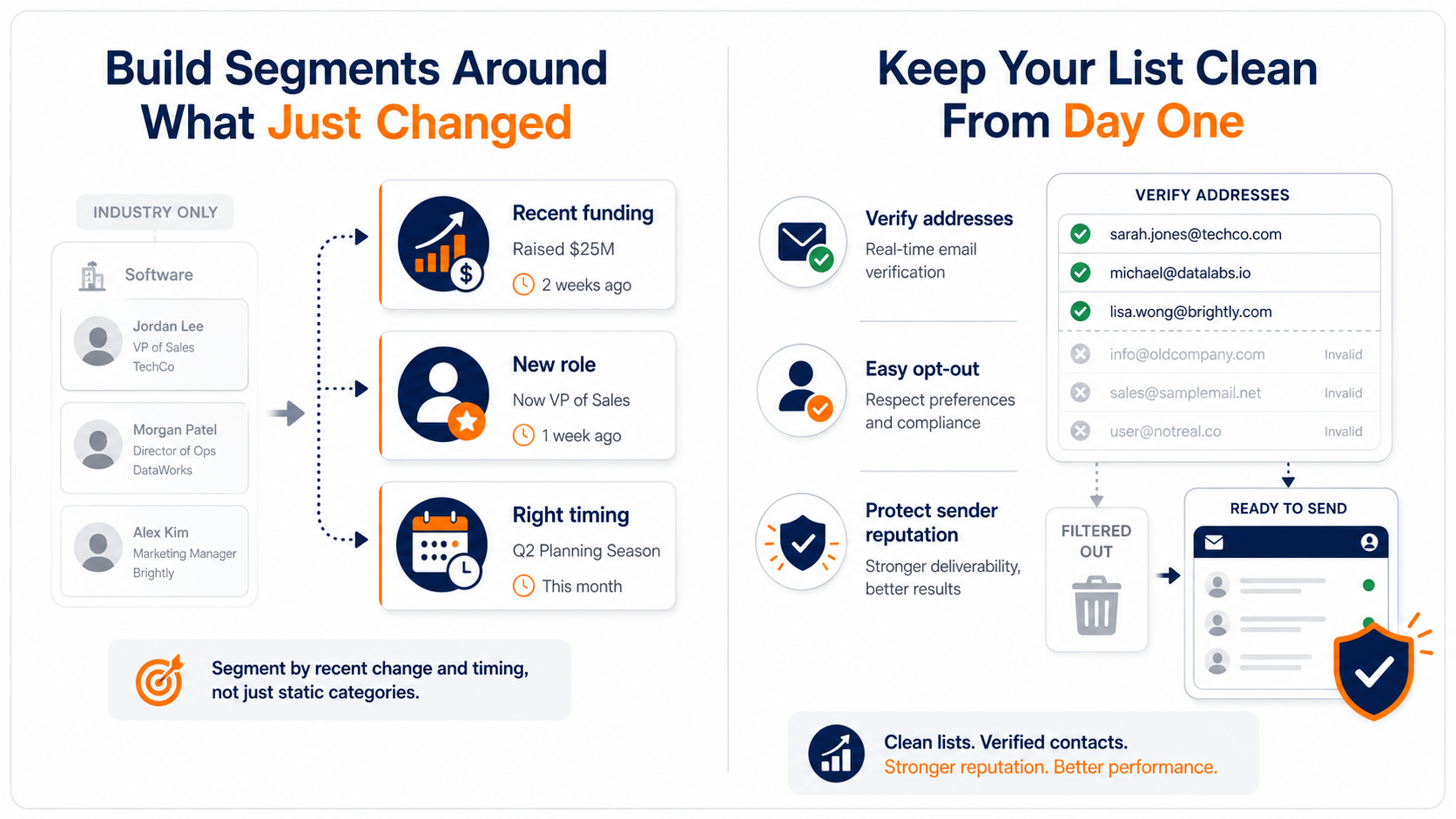
Static categories like "SaaS companies" or "healthcare" are a starting point, not a finish line. The sharper move is building segments around something that just changed.
A company that raised funding last month has different priorities than one that's been stable for years. Someone who was just promoted into a new role is actively figuring out their tools and vendors. Build your list around timing, not just industry.
Keep your list clean from day one
Note where every contact came from and keep an easy opt-out visible in every send. This isn't just good manners, it protects your ability to keep sending at all.
Sloppy list hygiene is one of the fastest ways to tank your sender reputation before your message even has a chance to land, and a reputation problem drags down every campaign that follows, not just the one that caused it.
Verify addresses before you send, not after a bounce report tells you something was wrong. A list with a lot of dead or catch-all addresses looks like a spam operation to inbox providers, regardless of how good your copy is.
PRO TIP: Before you write a single subject line, sort your list into groups of no more than a few hundred. You'll write sharper copy for a tight segment than you ever will for "everyone."
Nail the Value Proposition For Each Segment
Once your list is segmented, the next question in any cold email strategy is simple. Why should this specific person care?
A generic value proposition, something like "we help businesses grow," gets ignored because it could apply to anyone. A specific one names the exact pain point a segment is dealing with right now, in language that sounds like it came from inside their world rather than a marketing deck.
Ask what changes for them, not what your product does
Instead of starting with your feature list, start with what's currently frustrating about their day. What are they doing manually that shouldn't be manual?
What deadline are they missing? What number is quietly getting worse every quarter, and who's the one who has to explain it in the next leadership meeting?
Answering those questions before you write a word of copy changes what you write. You stop pitching a product and start describing a situation the reader already recognizes.
Write the proposition in their language, not yours
If you're speaking to operations leads, talk about time and headcount. If you're speaking to marketing leads, talk about pipeline and conversion. If you're speaking to finance, talk about cost per acquisition and forecasting accuracy.
The words you choose signal whether you've actually done your homework or you're running a template with the logo swapped out.
One proposition per segment, not one proposition for everyone
Resist the urge to write a single, all-purpose pitch and reuse it across every list. A message tuned for a 20-person startup and a message tuned for a 2,000-person enterprise should barely resemble each other, because the pain points, budgets, and decision processes aren't the same.
Write Subject Lines People Actually Open
Great cold email subject lines have one job. Earn the next three seconds of attention.
Generic curiosity bait has worn out its welcome. Phrases that once felt clever now read as automated, and prospects have gotten good at spotting them on sight. A subject line that could have been generated for anyone reads exactly like it was.
Specificity beats cleverness every time
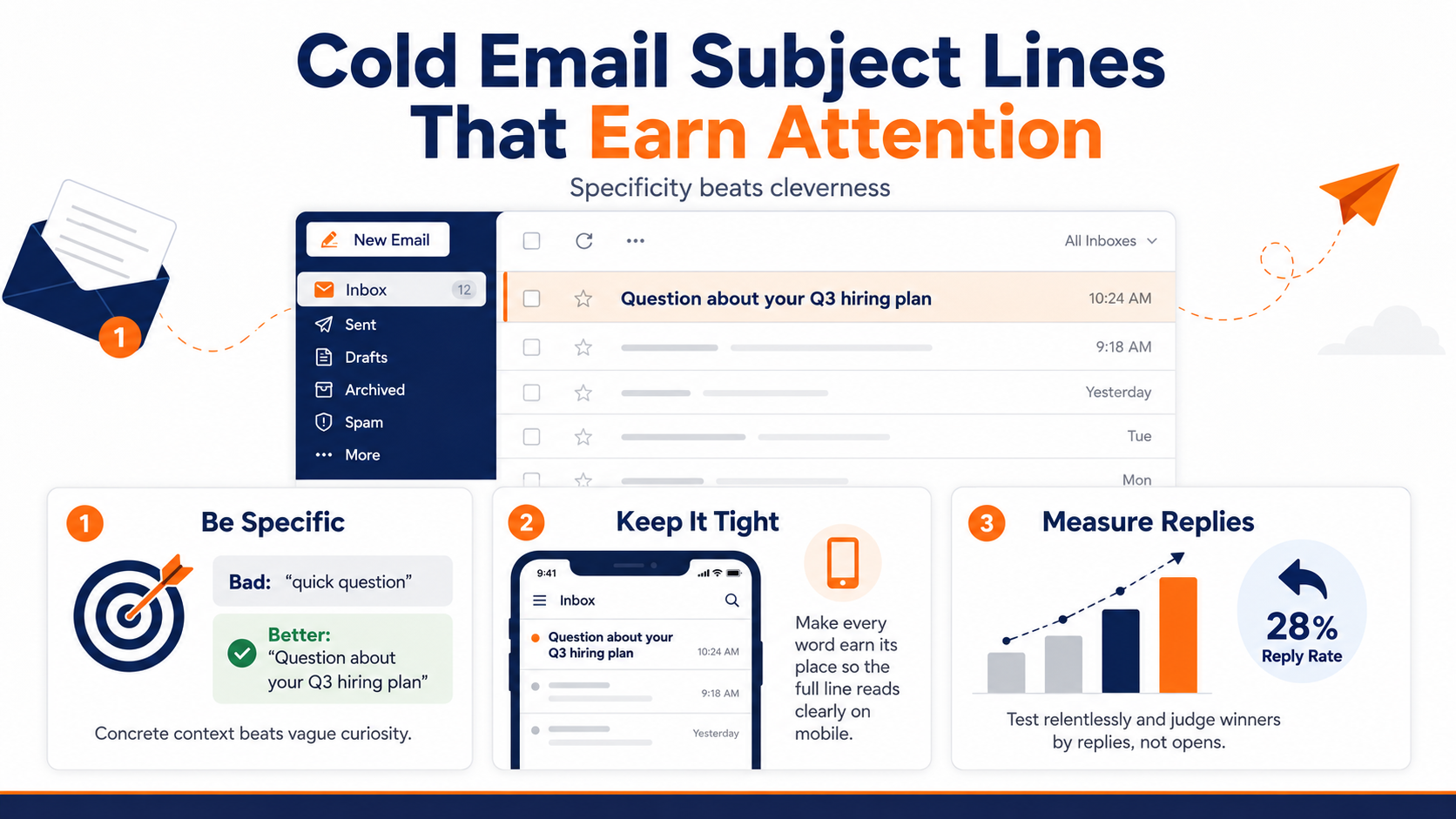
A subject line that references something concrete, a role, a recent event, a specific outcome, will consistently beat a vague teaser. "Question about your Q3 hiring plan" does more work than "quick question," because it proves you actually know who you're writing to before the reader even opens the message.
Length matters less than precision, but it still matters. A subject line that runs long enough to get cut off on mobile loses whatever punch it had. Keep it tight enough to read in full on a phone screen, and make every word earn its place.
Test relentlessly and track replies, not opens
Split test your subject lines the way you'd test anything else you care about. But judge the winner by who replied, not just who opened. A subject line that inflates opens without moving replies isn't actually working, it's just tricking the inbox into loading a tracking pixel.
PRO TIP: Rewrite your subject line last, after the body is finished. It's easier to summarize a sharp email than to write a sharp email around a summary you made up first.
Keep the Email Itself Short and Specific
Here's where most cold email drafts go wrong. They try to do too much in one message.
Save your full pitch for later in the relationship. A cold email needs one clear idea, delivered fast enough that the reader doesn't have to work for it. If your draft needs more than a few short paragraphs to make its point, the point probably isn't clear enough yet.
Structure it around three moves
Open with why you're reaching out to this specific person. State the one thing you're offering. Close with a single, easy-to-answer call to action, ideally a yes or no question rather than a request to fill out a form or book a full call on the spot.
Every sentence you add past that structure is a sentence competing for the reader's patience. Cut anything that doesn't directly support one of those three moves.
Cold email personalization is what actually moves the needle
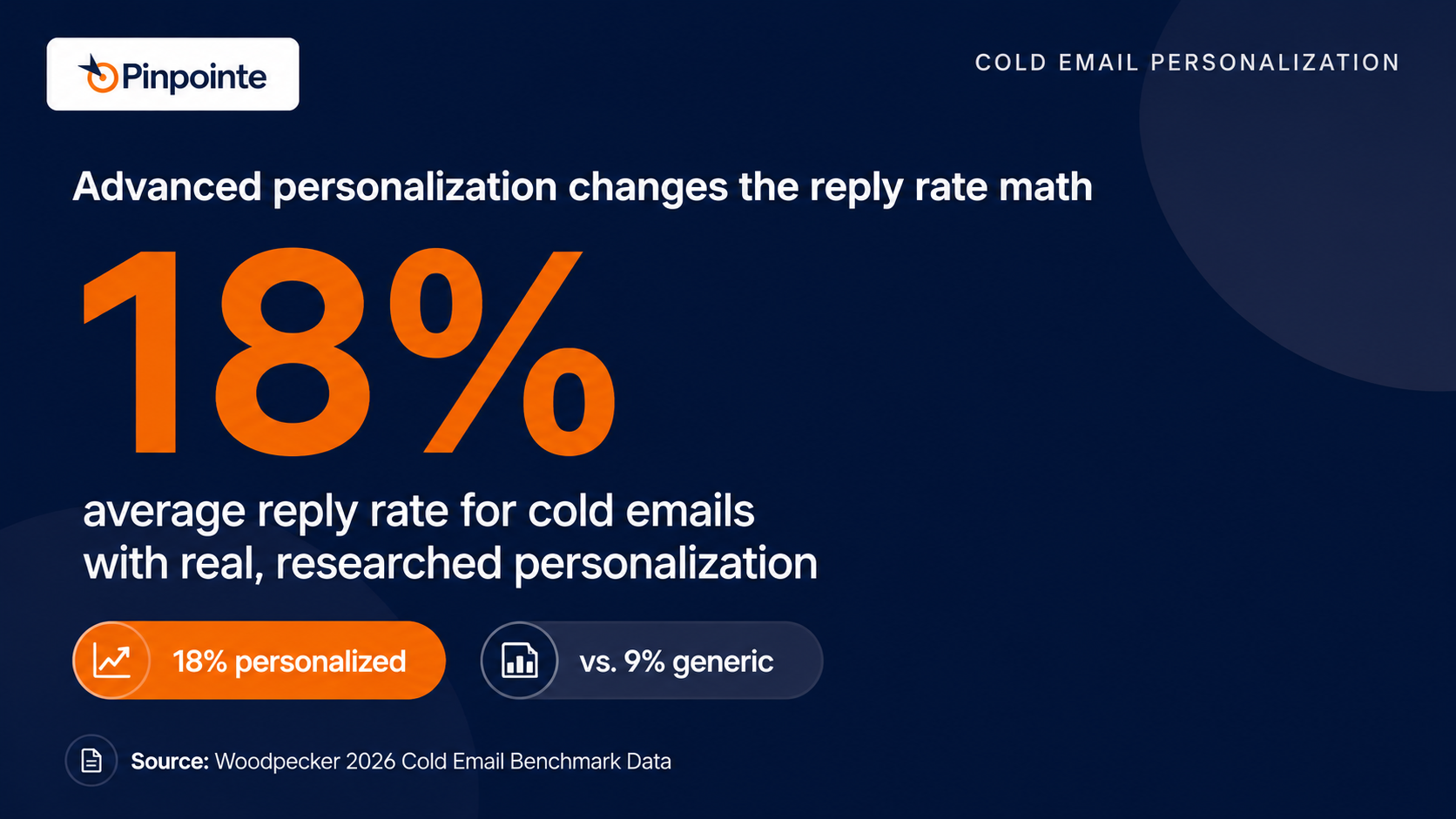
This is the part most senders underinvest in, and it shows up directly in the numbers. Cold emails built around real, specific personalization, a recent hire, a product launch, a genuine shared detail, land reply rates around 18%, compared to roughly 9% for generic or barely-personalized sends. That gap is large enough to separate a campaign that works from one that quietly dies in inboxes.
Personalization here doesn't mean inserting a first name into a template. It means referencing something true about that specific person or company that a template couldn't have guessed.
A line that only makes sense for this one reader is worth more than three lines that could apply to anyone on your list.
Add warmth without adding length
A little personality goes further than you'd think. One honest, human line does more to build trust than three paragraphs of polished corporate copy ever will. People reply to people, not to brochures, and a message that sounds like it came from a person tends to get treated like one.
Don't Skip the Follow-Up Sequence
Most cold email campaigns stop after one message, and a cold email follow-up sequence is exactly what separates the campaigns that quietly die from the ones that compound. That's leaving the majority of your potential replies on the table.
Adding a single, well-timed follow-up increases total replies by 65.8%. Most of that lift comes from persistence, not from a better first draft, which means the campaigns quietly losing the most replies aren't the ones with weak copy. They're the ones that stop too early.
Space your follow-ups out and give each one a reason to exist
A follow-up that just says "checking in" adds nothing and reads as pressure. Every follow-up should bring something new to the table, a relevant detail, a different angle, a reason this is worth a second look. Space them three to seven days apart rather than sending them back to back, so each one lands like a fresh thought instead of a nag.
A sequence of four to seven total touches tends to be the sweet spot. Fewer than that and you're walking away before the data says you should. More than that and each additional message starts adding risk without adding much reply volume.
Know where your replies actually come from
Your first email matters, but it isn't the whole story. Follow-ups regularly account for close to half of total replies across a well-built sequence, which is exactly why cutting a campaign off after one send costs you more than it seems like it should on paper.
Here's how the numbers stack up when you compare personalized cold email to a generic blast.
|
Approach |
Typical reply rate |
What drives it |
|
Generic, no personalization |
Roughly 7% to 9% |
Same message, different name |
|
Advanced personalization |
Roughly 17% to 18% |
Specific, researched detail per contact |
|
Single email, no follow-up |
Meaningfully lower baseline |
One shot, no persistence |
|
Sequence with a follow-up added |
65.8% more total replies |
Persistence plus new value each touch |
Track Reply Rate, Not Just Opens and Clicks
Once your cold email marketing campaign is live, the temptation is to watch the dashboard that updates fastest. That's usually opens, and it's usually the least useful number you have.
Reply rate tells you whether your targeting and your message actually worked together. Positive replies, the ones that turn into an actual conversation, tell you even more. A campaign with a high reply rate but mostly negative or unsubscribe-style responses isn't a win, it's a sign your targeting missed.
Watch for the gap between clicks and conversations
A prospect who clicked through to your site but never replied is telling you something. They were curious enough to look, not yet convinced enough to talk.
That's a warmer lead than a cold one, even without a reply, and it's worth a different kind of follow-up than someone who never engaged at all.
Give reply rate context before you react to it
A 4% reply rate on a cold, unfamiliar list and a 4% reply rate on a warm, well-researched segment are not the same result, even though the dashboard shows the identical number. Context is what turns a raw percentage into a decision about your cold email strategy, not just a number to react to.
Before you decide a campaign underperformed, check what you were actually asking of that list. A broad, top-of-funnel segment will naturally reply less often than a narrow, high-intent one, and that's not a failure of your cold email marketing strategy, it's just math.
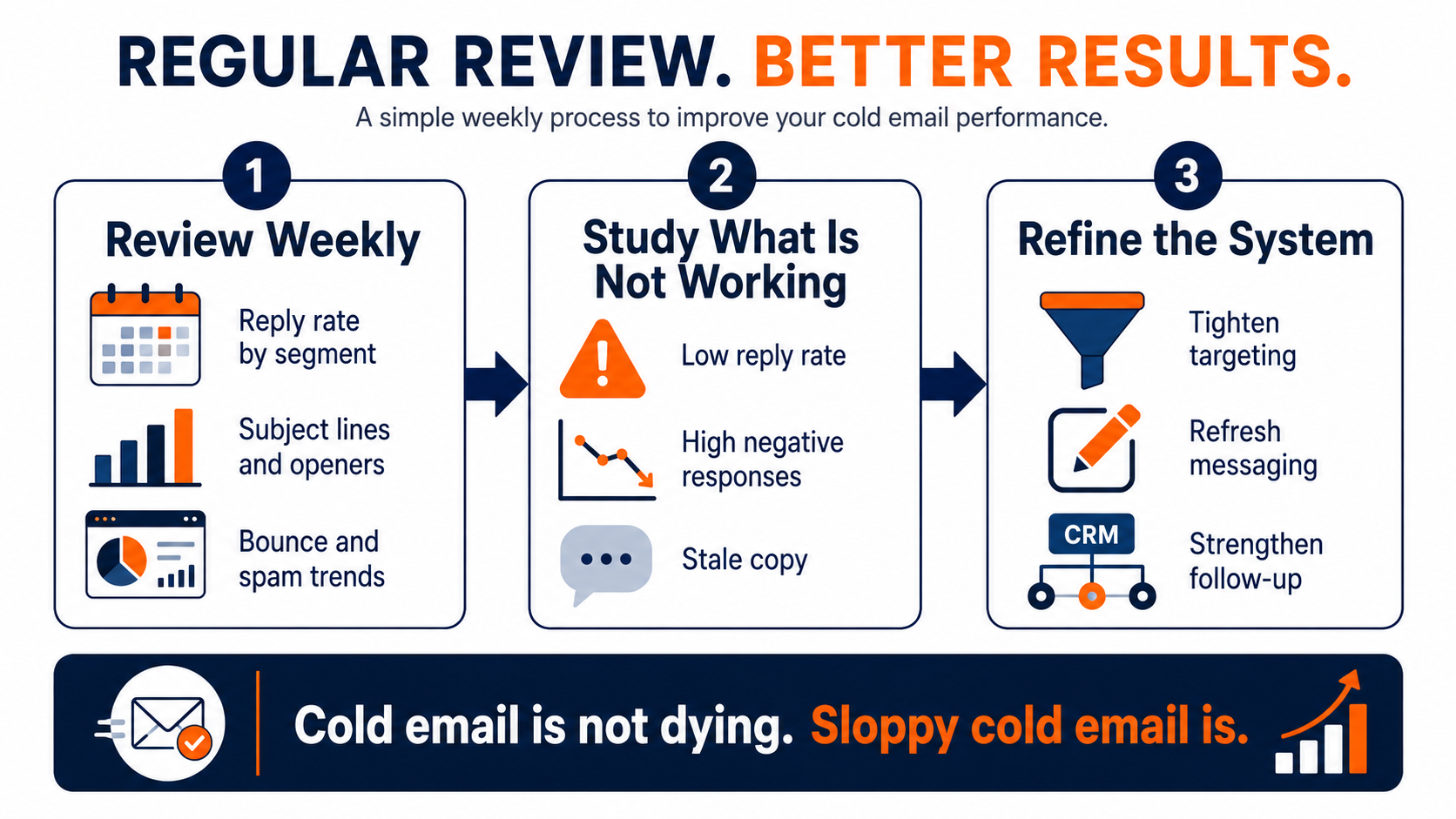
Review your worst-performing segment before your best
It's tempting to study what's working and repeat it. It's more useful to study what isn't. A segment with a low reply rate and a high negative-response rate is telling you your targeting or your message doesn't fit that group, and that's a faster fix than trying to squeeze more performance out of your best segment.
Build a habit around the review, not just the send
Set a recurring time each week to actually sit with the numbers instead of glancing at them between meetings. Pull the reply rate by segment, note which subject lines and openers are still earning replies, and retire the ones that have gone stale.
Cold email copy has a shelf life. What worked on a list three months ago can quietly stop working as the same phrasing shows up in more inboxes and starts to feel familiar instead of specific.
This is also where you catch problems in your email copywriting early. A rising bounce rate or a spike in spam complaints is much easier to fix before it tanks your sender reputation than after your whole domain is struggling to reach the inbox at all.
Cold email marketing isn't dying. Sloppy, unsegmented, one-and-done cold email is.
Every piece here connects to the next. A segmented list makes your value proposition sharper, a sharp value proposition makes your subject line easier to write, and a specific subject line earns the open that lets your personalization actually land. A real follow-up sequence catches the replies your first email alone was never going to capture.
None of that holds together without a system behind your cold email strategy once a reply actually comes in.
Move Beyond Manual Spreadsheets To Scale Your Outreach
Manually tracking segments in a spreadsheet and copy-pasting follow-ups into your inbox works until it doesn't.
The moment your list grows past what one person can track by memory, the whole system starts to crack, and replies start slipping through unanswered.
If your cold email follow-ups are still living in a mental checklist instead of an automated sequence, schedule a marketing automation audit and see exactly where the gaps are costing you replies!