Most email programs fail by sending the exact same message to loyal VIPs and long-dormant subscribers alike. Behavioral email fixes this by triggering sends based on real customer actions rather than arbitrary calendar dates.
Otherwise, you end up sending cat food discounts to someone who doesn't even own a cat. When an email is written for everyone, it ends up relevant to no one.
Drive massive conversion lifts with action-based messaging
Emails built around what a customer actually does can convert at anywhere from 2.8x to over 300x the rate of a generic broadcast, depending on the industry and how tightly the trigger fits the moment. That's a spread wide enough to feel unreal, but the direction of it never changes. Behavior beats email blast, every time, in every category studied.
Turn customer clicks into relevant automated responses
The reason is almost boring once you see it. The batch and blast strategy comes down to guessing rather than basing the send on real customer data. An email blast is written for an average subscriber who doesn't exist, so it lands as slightly wrong for almost everyone.
A behavioral email doesn't guess, because the customer already told you what they want by doing something. You're not persuading a stranger. You're answering a question they just asked with their clicks.
So the question isn't whether behavioral email works. It's why so few programs run on it.
What Behavioral Email Marketing Actually Means
Behavioral email marketing is a simple idea but often sounds more difficult to implement than it really is because of its technical name.
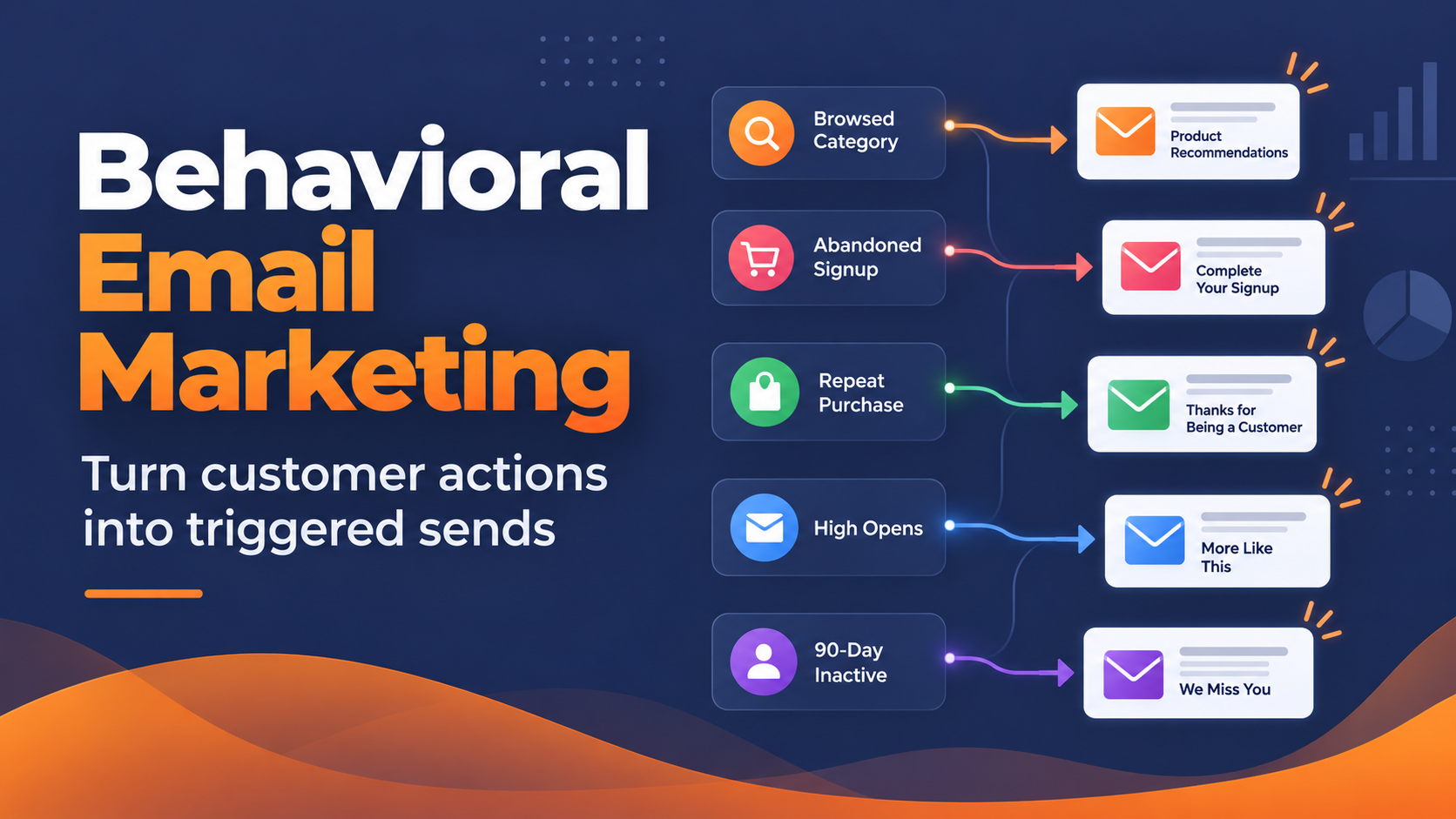
Basically, you just watch what a subscriber does, and you send the message that fits what they just did. If someone browses a category three times without buying, then they get a different email than someone who just made their first purchase. The trigger is the behavior. The behavior is the signal.
Most teams already have the data to do this. What they're missing is the wiring that turns a click into a send without a human deciding to make it happen.
The signals you need to watch for
You don't need to track everything, but you do need to track the handful of actions that predict what someone wants next.
Below are a few of the key behaviors you should be tracking in your marketing automation platform.
- What page or product category someone spent real time on, versus what they quickly bounced from.
- Where a subscriber dropped out of a flow they started, whether that's a signup, a form, or a checkout.
- Whether someone is regularly opening your emails or not, like those who open every email you send or haven't opened one in ninety days.
- What they've actually bought, and how long it's been since they last did.
Each of these creates a distinct fork in behaviors and corresponding follow-up actions to get them back to being engaged. A person who abandons a signup form needs a nudge back to the exact step they left.
A person who opens everything but never clicks needs a different offer, not the same one louder. The behavior tells you which path they are on and how to continue them on their buyer's journey.
Start with purchase and churn signals as a foundation
The mistake most teams make is trying to track all of it at once. You end up with a dashboard full of signals and no flows firing off any of them. Make your life simple and just start with two.
Pick the one behavior that most reliably predicts a purchase in your business, and the one that most reliably predicts a subscriber going cold.
Build a triggered email for each, watch them run for a month, then add the third. A small program that consistently fires beats an ambitious one that never ships.
Why intent beats a preference center
Another challenge most marketing teams run into is that you can ask people what they want, and they'll tell you something, but unfortunately, it's usually wrong. Not because they're lying, but because what people say they're interested in and what they actually click on are two different things.
The great part about behavioral targeting is that it sidesteps the whole problem. You don't ask. You watch. Someone who clicks every link about one topic has told you more with that behavior than any checkbox ever will. This is the advantage of running on behavior-driven email targeting instead of stated preferences, because you're acting on proof instead of a guess.
Pro Tip: Segment on the last click, not the last survey. Behavior from the past thirty days predicts the next purchase better than anything a subscriber told you at signup.
Welcome Sequences Set The Foundation Of Your Relationship
The first email you send does more work than any other. It's the moment a new subscriber decides whether you're worth the inbox space, and most brands waste it on a generic “thanks for joining.”
A behavior-triggered welcome fires the instant someone signs up, no scheduling, no waiting for the next newsletter. And it consistently outperforms almost everything else you'll send, because the person is paying attention. They just raised their hand. You have their full attention for roughly one email before it fades.
This is where the real power of behavioral email shows up. A behavioral email is a system you build once and let run, not a campaign you schedule and forget, and the return on that setup is wildly out of proportion to the effort. Most teams underinvest here precisely because it doesn't look like a campaign on the calendar.
What a first email should look like
Say who you are, warmly, in a voice that sounds like a person wrote it. Give one clear next step or call to action, not seven. Include the trust signals a new subscriber quickly checks for, like a real sender name, a working unsubscribe link, and a way to reach you.
Then stop. A welcome email that tries to do everything ends up accomplishing nothing. The goal is a single, obvious action that pulls the new subscriber one step deeper into your sales funnel.
Turning one welcome email into a nurture sequence
The best programs don't send one welcome. They send a short series, and each email continues where the last one landed. Someone who clicks the link in email one gets a different email two than someone who ignored it. That branching is the difference between a drip and an actual behavioral flow.
This is where automation stops being a convenience and starts being the whole point. You can map every path by hand once. You cannot send them by hand at scale, which is exactly why automated welcome and triggered email sequences exist, so the second and third message depend on the subscriber's behavior instead of someone remembering to hit send.
Notification And Transactional Emails Get The Most Opens
Order confirmations, shipping updates, password resets, account alerts. Nobody thinks of these as marketing, which is exactly why they're the most valuable email real estate you own. People open them at rates a promotional campaign will never touch, because they're waiting for the information inside.
That attention is an asset most brands leave sitting on the table.
Keep your core message clean
The functional part of a transactional email has one job, and clarity wins over everything else. Stick to short sentences and use one large, obvious call to action button. Clear contact details if something goes wrong.
A password reset should read as calm and helpful, because a stressed person is reading it and your tone either builds trust or burns it. Don't bury the thing the person opened the email to find. Lead with it.
Earn the second sale with relevance
Once the core message is handled, you've got a highly engaged reader for a few seconds more. That's room for one relevant, personalized suggestion tied to what they just did, not a generic banner blasted to everyone on the list. A confirmation for a specific product is a natural moment to surface a closely related one.
The key word is relevant. The moment a transactional email feels like a sales pitch stapled to a receipt, you lose the trust that made it valuable. Restraint is what keeps these emails opening at the rates they do.
Drive massive lifts with a single behavioral button tweak
When you do add that one suggestion, how you ask matters as much as what you offer. Personalized calls to action, the ones shaped by what a specific subscriber has done, convert about 202% better than a generic default button.
Tripling the response on a button is the kind of lift most teams chase with entire redesigns, and here it comes from a single behavioral tweak on an email people are already opening. The engaged audience is doing you a favor by showing up. A personalized ask is how you return it.
Pro Tip: Add exactly one behavioral recommendation to a confirmation email, tied to the specific item bought. One relevant suggestion outperforms a wall of bestsellers.
Retention Emails Cost Less Than Winning Someone New
The math on retention has been settled for years, and it still gets ignored. Keeping a customer engaged is dramatically cheaper than acquiring a new one, yet most email budgets pour into the top of the funnel while existing subscribers go cold.
Behavioral email is how you catch them before they're gone. The signal is almost always there before the customer actually leaves. You just have to be watching for it.
Drive massive conversion lifts by responding to real signals
The payoff for catching these moments is massive across every category. Data consistently shows that behavior-triggered campaigns deliver dramatically higher conversion rates than standard broadcast emails.
That difference doesn't come from better subject lines. It comes from reaching a customer at the exact moment their behavior said they were ready, which is the whole game in retention, timing the message to the signal instead of the calendar.
The three times retention emails matter most
There are three distinct situations where a behavioral retention email does real work, and each needs its own message.
-
The first is the registered-but-inactive subscriber, someone who signed up and then never took the next step. A reminder keyed to where they stalled moves more of them forward than a generic check-in ever will.
-
The second is the recent buyer you can grow. Someone who just purchased is primed for a well-matched suggestion, sent at the right interval, based on what they bought and when.
-
The third is the fading regular, a once-active subscriber whose opens and clicks are trailing off. Catch that pattern early and a re-engagement email can pull them back before they're fully gone.
Fire win-back triggers the exact moment a subscriber slips
The difference between these three is timing, and timing is exactly what a behavioral system is built to nail. A calendar-based “we miss you” blast hits everyone on the same day regardless of where they actually are.
A behavioral trigger fires the moment a specific subscriber crosses the line from active to slipping, which for one person might be three weeks and for another three months.
That precision is the whole reason behavioral retention outperforms a scheduled win-back campaign. You're not guessing when someone went cold. You're reacting to the exact moment they did.
Personalize the win-back or don't bother
A generic “we miss you” email is worse than no email. To bring someone back you need the specifics, what they used to buy, how often, what they last looked at. Those details are what let you send something that feels aimed at them instead of scraped from a template.
This is where dynamic segmentation built on real engagement data does the heavy lifting, sorting a fading regular from a happy repeat buyer automatically, so the right message reaches the right person without you building the list by hand every time.
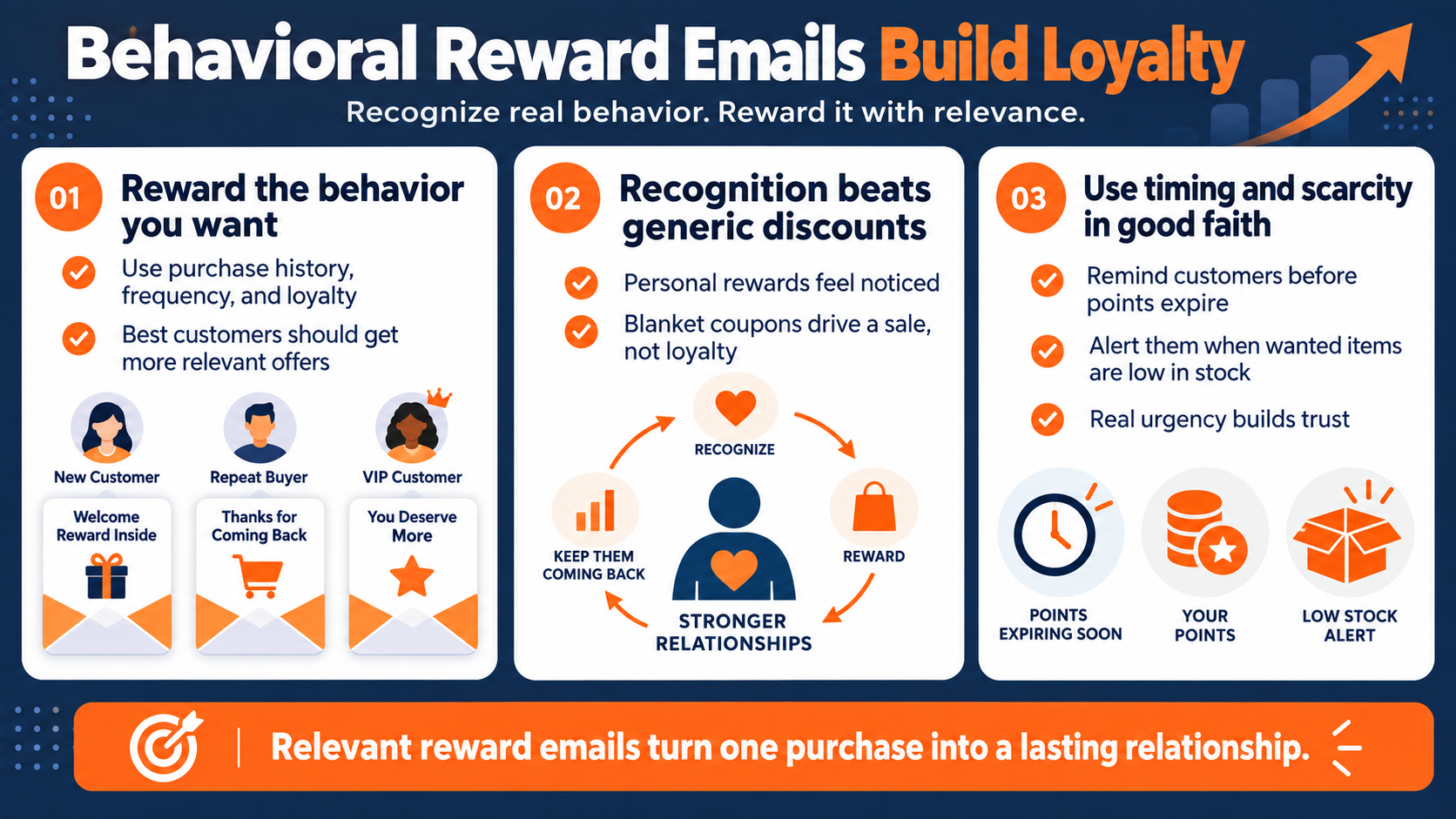
Reward Emails Turn Buyers Into Regulars
Loyalty gets built, one well-timed email at a time, and reward emails are among the most underused tools for building it. Done right, they make your best customers feel seen. Done generically, they're just another discount nobody asked for.
The behavioral angle is what separates the two.
Celebrate what you want to duplicate
Use what you know about a customer to shape the offer. How long they've been with you, what they buy, how often. A reward that reflects an actual relationship lands completely differently than a blanket coupon code sent to the entire list.
A customer who has bought monthly for two years should not get the same “welcome back” offer as someone who bought once. The behavior earned something specific. The email should reflect that.
There's a trust dividend here that's easy to overlook. When a reward clearly maps to what someone has actually done, it reads as recognition, and recognition is stickier than a discount.
A customer who feels their loyalty was noticed is far more likely to give you the next purchase, and the one after that. A blanket coupon buys a single transaction. A behavioral reward buys a relationship.
Use timing and scarcity in good faith
If you run a points or rewards program, a reminder timed to just before expiration creates a real reason to act now. That's not manipulation, it's a genuine deadline the customer would want to know about.
The same goes for limited offers tied to what someone actually cares about. A heads-up about a low-stock item a customer has shown clear interest in is a service, not a sales trick, as long as the interest is real and the scarcity is honest. The moment either one is fake, the trust starts to erode.
Behavioral Email Marketing Comparison
Not every behavioral email does the same job. Here's how the main types line up by trigger, timing, and what they're for.
|
Email Type |
Behavioral Trigger |
Primary Goal |
|---|---|---|
|
Welcome |
New signup |
Set the relationship, earn a first action |
|
Notification |
Account or order event |
Deliver info, build trust |
|
Transactional |
Purchase or shipping update |
Confirm, then gently cross-sell |
|
Retention |
Inactivity or lapse in engagement |
Re-engage before the customer is lost |
|
Reward |
Loyalty milestone or purchase history |
Deepen loyalty, drive repeat sales |
The pattern across all five is the same. The trigger is a real behavior, the timing follows from that behavior, and the goal is specific to where the person actually is. Miss the trigger and you're back to sending cat food ads to people without cats.
Where Most Programs Break, And What Fixes It
Everything above is achievable. The reason most teams don't run programs like this isn't strategy, it's the lack of follow-through. The welcome flow gets built, works beautifully, and then the retention triggers never get wired up because someone got pulled onto the next launch.
You've probably seen the pattern yourself. A team maps out a gorgeous lifecycle on a whiteboard, ships the first flow, celebrates, and then quarterly planning swallows the rest. Six months later the welcome series is still running, still working, and the abandoned-signup catch and the win-back and the reward timing are all sitting in a doc marked “phase two” that phase two never arrived for.
Stop leaving revenue behind by expanding automated triggers
The cost of stopping at flow one is bigger than it looks. Automated, behavior-triggered emails account for roughly 41% of all email orders while making up only about 2% of the volume a brand sends. A sliver of your total sends drives close to half your email revenue, and it's the sliver you leave half-built when the roadmap moves on. Every trigger that never ships is a piece of that 41% you're choosing to skip.
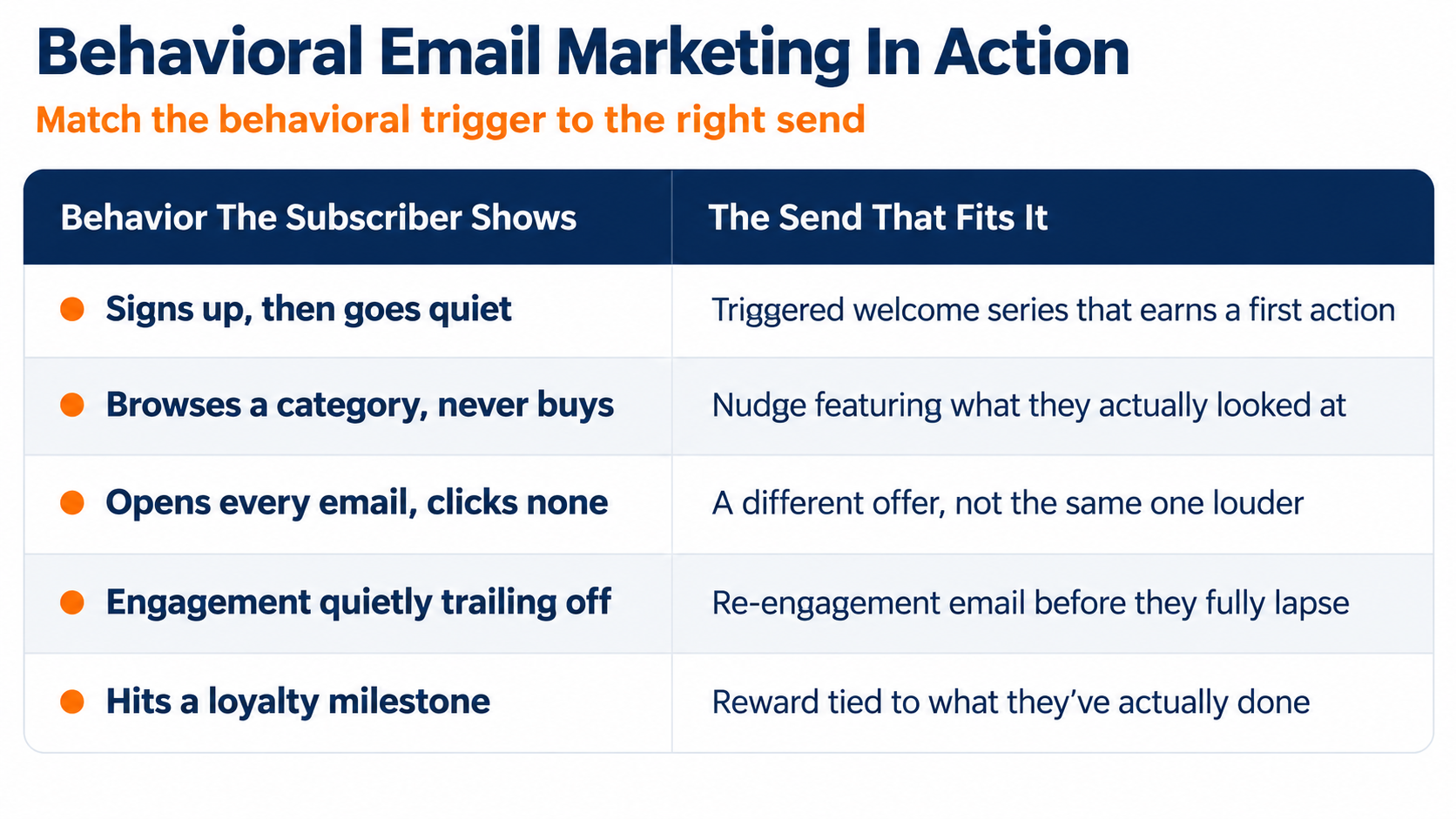
What's missing is rarely a better idea. It's usually the system that fires every one of these sends off real behavior without a person having to remember to build it each time. Once the logic is set, the sends stop depending on anyone's memory or bandwidth. They depend on the subscriber, which is exactly where the decision belonged all along.
Wire The Behavior To The Send And Stop Rebuilding It
So here's what it all comes down to. Behavioral email marketing means sending off what a subscriber actually did, and it beats generic broadcasts by a margin no other tactic touches.
The welcome sequence sets the relationship, transactional and notification emails carry attention you already own, retention emails catch fading customers cheaply, and reward emails turn buyers into regulars.
Scale cross-channel triggers without relying on manual effort
Every one of them fires off a real behavior instead of a calendar. The teams pulling this off aren't bigger or better funded. They just stopped letting good sequences sit half-built.
The real move, then, has nothing to do with writing a better email. It's putting the whole set of triggers on rails, so every behavioral moment fires on its own instead of waiting for a person with a free afternoon. This is where a platform built for behavioral triggers and automated journeys does the part people can't, holding the logic for every sequence at once and firing each send the instant a subscriber's behavior calls for it, across email and SMS.
The welcome series, the win-back, the reward reminder, they all keep running whether or not anyone remembers they exist. Set the rules once and the follow-through stops being a person's job.
Fix your retention gaps with a behavioral audit
If your welcome flow works but your retention triggers never got wired up, that's the place to start. See what your own program looks like running on behavior by booking a marketing automation audit with our team.