
Say "email blast" in a room full of email marketers and watch the wincing start. It's one of the few terms in this industry that everyone uses, and almost nobody defends.
We hear it constantly: a weekly update that goes out to buyers and sellers alike, no split, no targeting, just one version blasted to the whole list.
In this post, we'll be diving into why the "email blast" philosophy can be damaging to your digital marketing campaigns and brand.
Why the "one-size-fits-all" default fails everyone
Whoever's sending the "email blast" usually isn't thrilled about it either.
The list gets treated like a single audience-shaped blob instead of a few thousand different people, and the word "blast" is exactly why.
That's not a personal failing on the sender's part. It's what the term and the old batch-and-send habit both encourage, and it's worth taking apart properly.
Why "Blast" Is the Wrong Verb for What You're Doing
Here's the useful test. Would you blast a birthday card? Would you blast a handwritten thank-you note?
No. We'd never use that word for something built for one person. We only reach for "blast" when we're picturing a crowd.
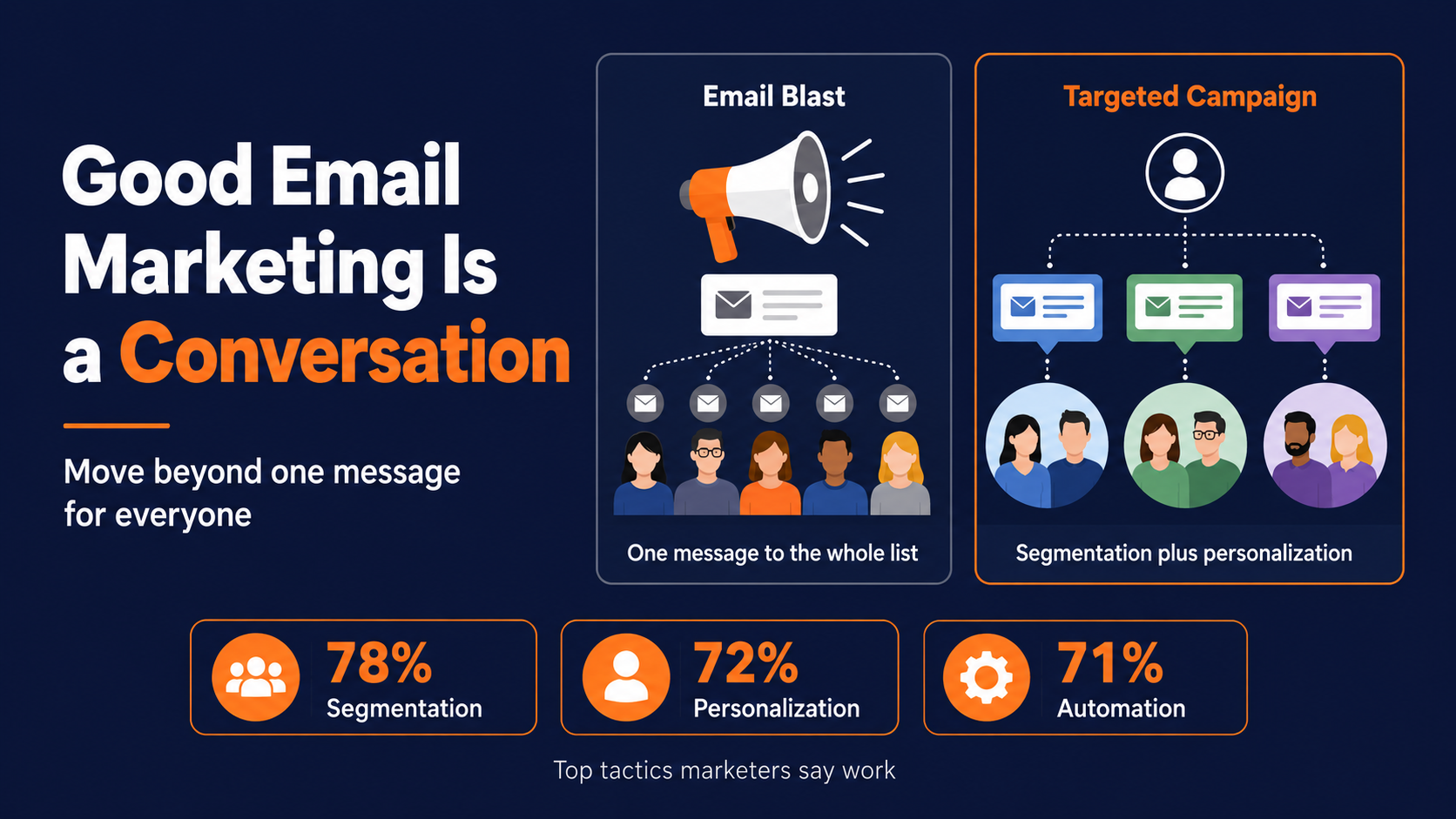
That's the whole problem in one sentence: the word describes a megaphone, and good email marketing is a conversation.
Trading one-way noise for targeted email marketing
A megaphone doesn't know who's listening. It doesn't adjust its pitch for the person standing closest, or skip the people who already bought what it's selling. It just gets louder and hopes volume does the work that targeting was supposed to do.
A conversation is the opposite of that. It notices who it's talking to. It changes what it says based on what the other person already knows, and it stops when they've heard enough.
Every time a team calls their campaign a blast, they're telling on themselves, often without meaning to, about which of those two things they built.
What email segmentation actually looks like
For anyone newer to this, segmentation just means splitting a list into smaller groups based on something real: what someone bought, how long they've been a subscriber, whether they clicked the last three sends or none of them.
It doesn't take a data science team. Most email and SMS platforms will build a segment from a single filter, like "opened in the last 30 days" or "purchased category X."
The point isn't complexity. It's that the message changes based on who's receiving it, instead of staying identical for everyone on the list.
High-impact email personalization without the tech stack headache
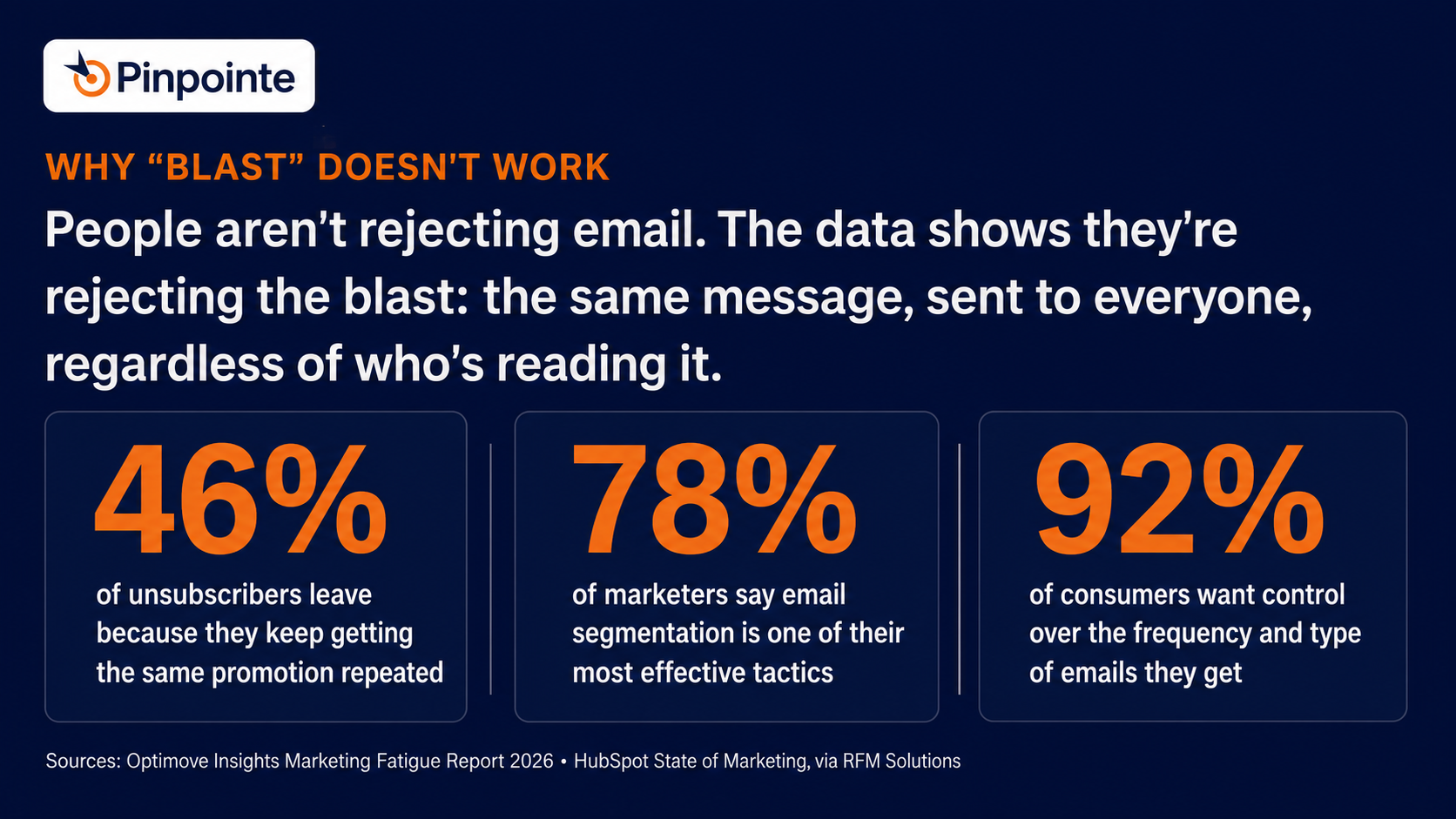
It's also one of the more reliably effective moves available. HubSpot's research puts segmentation, personalization, and automation at the top of the list of tactics marketers say actually work, at 78%, 72%, and 71% respectively. None of that requires enterprise-level tooling to start.
Targeted email marketing, at its simplest, is just segmentation plus a message written for that specific slice of people rather than the list as a whole. That's the entire difference between a blast and a campaign that performs.
What marketers actually mean when they say it
In practice, "eblast" usually just means "email campaign." Nobody means anything malicious by it. It's shorthand, the same way people say "Kleenex" instead of tissue.
But shorthand carries assumptions, and this one's assumption is ugly: one message, one send, one version, going to everyone regardless of what they want or where they are in the relationship.
Take a weekly email blast for a real estate company as an example. With a "blast", buyers and sellers get the identical email. Someone who closed on a house last month gets the same content as someone who just started browsing listings.
The Insecurity Hiding Inside the Word
We don't want to turn this into email marketing group therapy, but the fear is universal across this industry. Say "email marketing" at a party, and there's a decent chance someone grins and says, "Oh, so you're a spammer." It's usually a joke.
It still lands somewhere. That joke is why "blast" stings. It confirms the worst version of what people already suspect is happening on the other end of the list.
That fear says more about the sender's habits than about the channel itself. People aren't recoiling from the inbox, they're recoiling from what a bad sender does with it.
The guilt that keeps solopreneurs quiet
Founders and solopreneurs feel this worse than anyone. Plenty of them go quiet on email entirely, not because they lack things to say, but because they've convinced themselves that showing up in someone's inbox is an imposition. It's easy to feel like the send hasn't been earned, even when every person on that list opted in themselves.
That instinct has it backwards. A well-built email isn't a favor being asked of someone. It's the thing the person on the list actually signed up to receive.
The two definitions of spam
Part of the discomfort comes from mixing up two very different definitions. There's the compliance definition, the CAN-SPAM checklist most senders clear without thinking about it: a real unsubscribe link, an accurate subject line, a physical address in the footer.
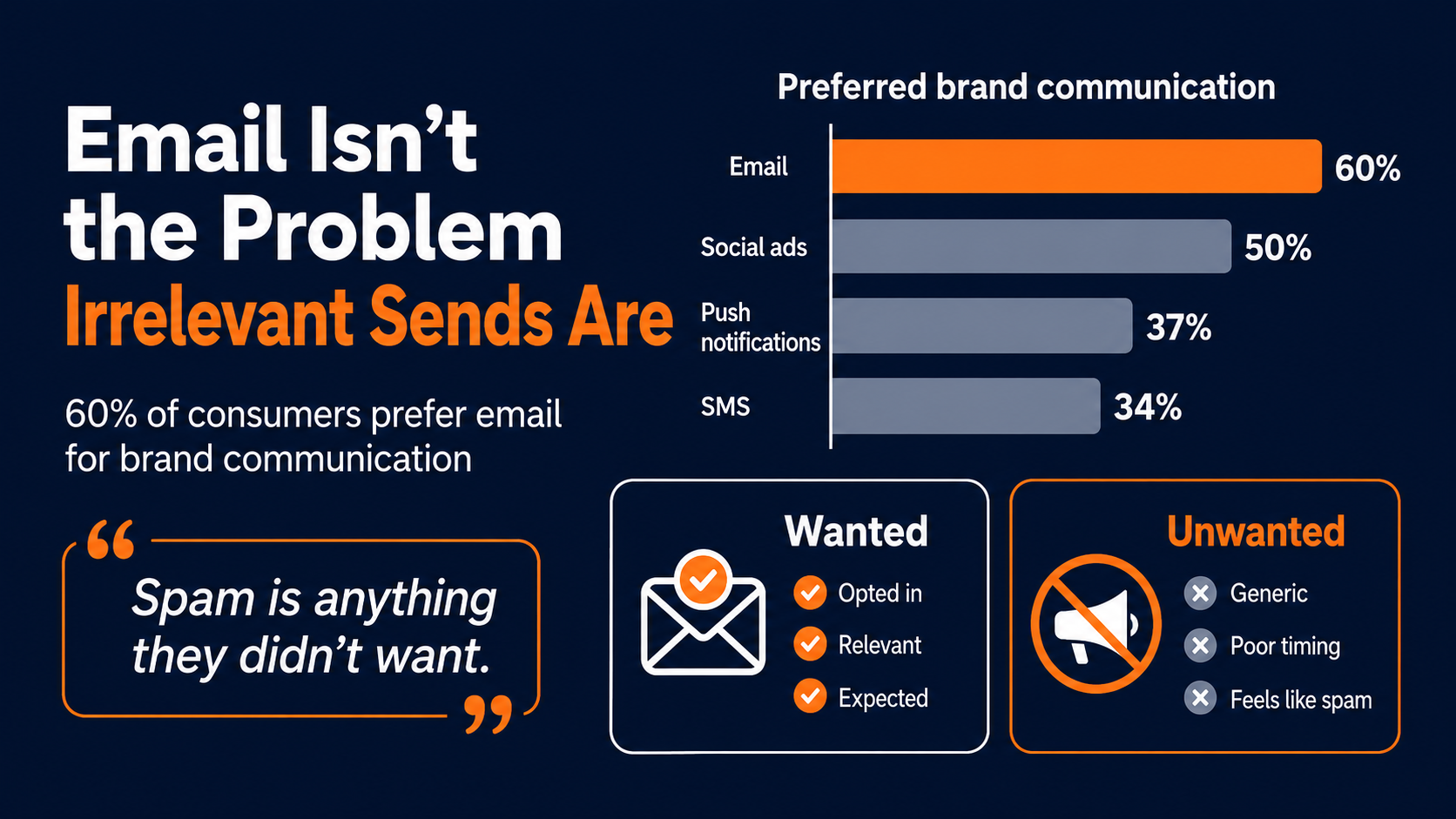
Then there's the definition that actually matters to the person reading the email, which has nothing to do with a checklist at all. To them, spam is simply anything they didn't want.
A sender can pass every legal requirement and still send something that reads as spam to the one person it landed on. That's the gap a blast lives in. It's compliant, and it's just not wanted, at least not by everyone it reached.
What the Data Says About Batch-and-Blast Thinking
The research keeps landing on the same story, and it's worth sitting with for a second before moving on. Batch-and-blast thinking treats a shrinking list as a reach problem. The numbers say it's almost always a relevance problem instead.
"Isn't more email just more reach?"
Reach isn't the bottleneck. Relevance is. The instinct to blame volume for a shrinking list gets the diagnosis backwards.
Here's the sentence worth underlining, the one this whole piece is really about: nobody has ever unsubscribed from an email that felt like it was written for them.
Email segmentation and personalization aren't nice-to-haves layered on top of a "real" strategy. It's worth sitting with why segmentation works as well as it does. It's not because subscribers are impressed by the technical effort.
It's because a segmented send answers a question the recipient was already asking: is this for me? A blast can never answer that question, because it wasn't built to.
One list, two very different ROI numbers
And the ROI backs it up at scale. Litmus's most recent State of Email data found 35% of companies earn $10 to $36 back for every $1 they put into email, 30% earn $36 to $50, and 5% earn more than $50. That's an enormous spread.
The difference between the bottom of that range and the top usually isn't the platform. It's whether the sender treated the list like one audience or like a few thousand individuals.
Here's the two approaches side by side, stripped down to what actually changes:
|
|
The Blast |
The Conversation |
|
Audience |
Entire list, one version |
Segments built from real behavior |
|
Timing |
Fixed schedule, sender's calendar |
Triggered by what the subscriber does |
|
Content |
Same message for everyone |
Written for that specific segment |
|
Channel |
Email only, regardless of fit |
Email or SMS, whichever gets noticed |
|
Typical result |
Rising unread rate, slow list decay |
Higher opens, lower unsubscribe, repeat engagement |
The Real Cost Isn't the Unsubscribe
Losing a subscriber stings, but it's not actually the expensive part of blasting a list. The expensive part is what happens to the people who stay.
Every irrelevant send trains the best subscribers to stop paying attention. They don't unsubscribe. They just quietly stop opening.
By the time engagement starts sliding, that's not one bad email causing it. That's months of megaphone behavior finally catching up.
Stop blaming frequency for bad content
That's the quiet tax nobody puts in a case study, and it matches exactly what makes people leave in the first place. Of the people who unsubscribe, 46% leave because they kept getting the same promotion over and over, 18% leave because the offers had nothing to do with them, and 17% leave because the messaging felt generic and impersonal.
None of those three reasons is about getting too much email. They're all about getting the wrong email.
"But our list expects an eblast"
Some teams assume their audience is different, that subscribers signed up for a firehose and would be confused by anything more tailored. Almost nobody actually wants that, even where that's the habit a list has been trained into.
Here's the honest way to test it: pick two segments in the list right now, buyers and sellers, new and returning, engaged and dormant, whatever split is obvious, and send each one something that only makes sense for them. Watch what happens to opens on that send compared to the usual blast.
The list didn't change. What it was given did.
Five Ways "Blast" Undersells What's Being Built
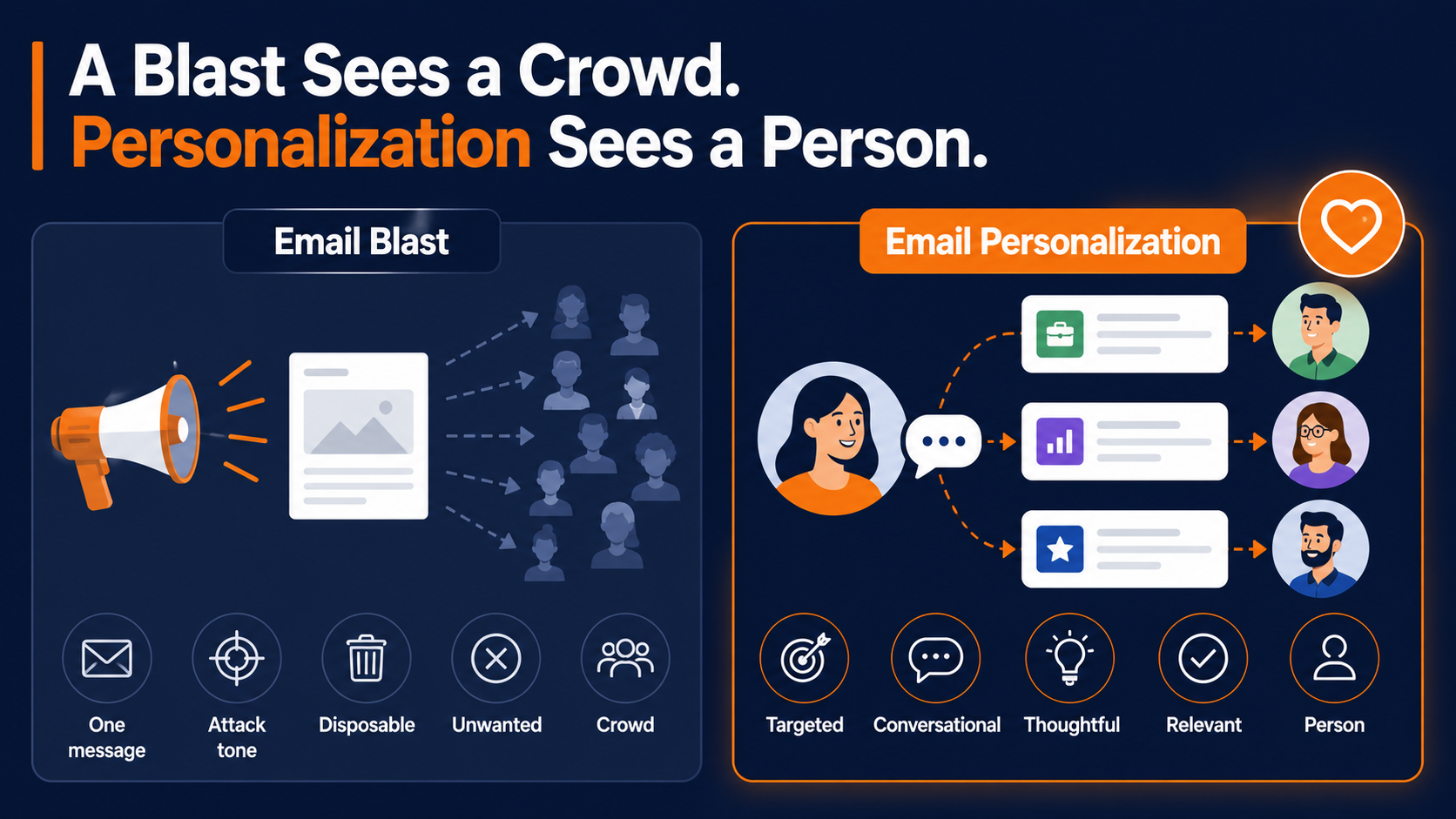
Let's take the word apart properly, because each piece of it does quiet damage to how a team thinks about its own work. Every one of these is really the same complaint wearing a different outfit: the email blast assumes a crowd, and email personalization assumes a person.
Only one of those can be built at a time.
It erases targeting. "Blast" describes one message going to everyone. There's no split for the buyer versus the seller, no dynamic content, no acknowledgment that a first-time subscriber and a five-year customer need different things.
It sounds like an attack. A blast targets, it doesn't befriend. If people don't want the emails, the better move is to let them go gracefully, not keep firing at a shrinking list out of habit.
It implies disposable content. Nobody polishes something they're about to blast. Calling emails "blasts" is a permission slip to phone them in, and subscribers can tell.
It borrows spam's reputation. Even under CAN-SPAM's technical definition, most senders think they're in the clear. Consumers use a simpler test: it's spam if they didn't want it.
It flattens subscribers into targets. A conversation has two people in it, a blast has a sender and a crowd. Which one sounds like the relationship worth building?
Better Words, and Why They're Not Just Semantics
Swapping the word doesn't fix the strategy by itself, but it's a useful gut check. Try newsletter, update, campaign, or just email. Even "broadcast" carries some of the same one-way baggage, so that one belongs on the shelf too.
The exercise isn't really about vocabulary. It's about noticing what word comes to mind first, because that word usually tells the truth about what got built before anyone's had a chance to talk themselves out of it.
Building the habit of giving before asking
One structural fix worth borrowing is what we call the 4-to-1 Rule: four emails that give something useful, followed by one that asks for the sale. Not four discount codes disguised as value, four things a subscriber would want even if they never bought anything at all.
Then, on the fifth send, make the pitch.
Run the math on what that actually costs. Sending weekly, that's roughly one give-first email extra a month, swapped in for what would've been another straight sales push.
Will that dent short-term numbers a little? Maybe.
Will the list trust the brand enough to stick around and buy more over the next year? Almost always.
How to tell if a list is still getting an email blast
Most teams don't decide to send an email blast on purpose. It happens by default, because segmentation takes an extra hour and the deadline doesn't. A few honest questions settle which side of the line a campaign is actually on.
Pull up the last campaign and ask whether every recipient got the identical subject line, body, and offer regardless of what they'd done before. If the answer is yes, that's a blast, no matter how nice the design looked.
Calendar sends vs. behavioral signals
Ask whether the send went out on a fixed calendar or in response to something the subscriber did, like a click, a purchase, or three weeks of silence. A fixed schedule is a hallmark of batch-and-blast thinking. A triggered send is email segmentation actually doing its job.
Then ask the harder question: if ten random people on that list heard the email read aloud, would nine of them feel like it wasn't really written with them in mind?
If the answer is yes, the fix isn't the subject line.
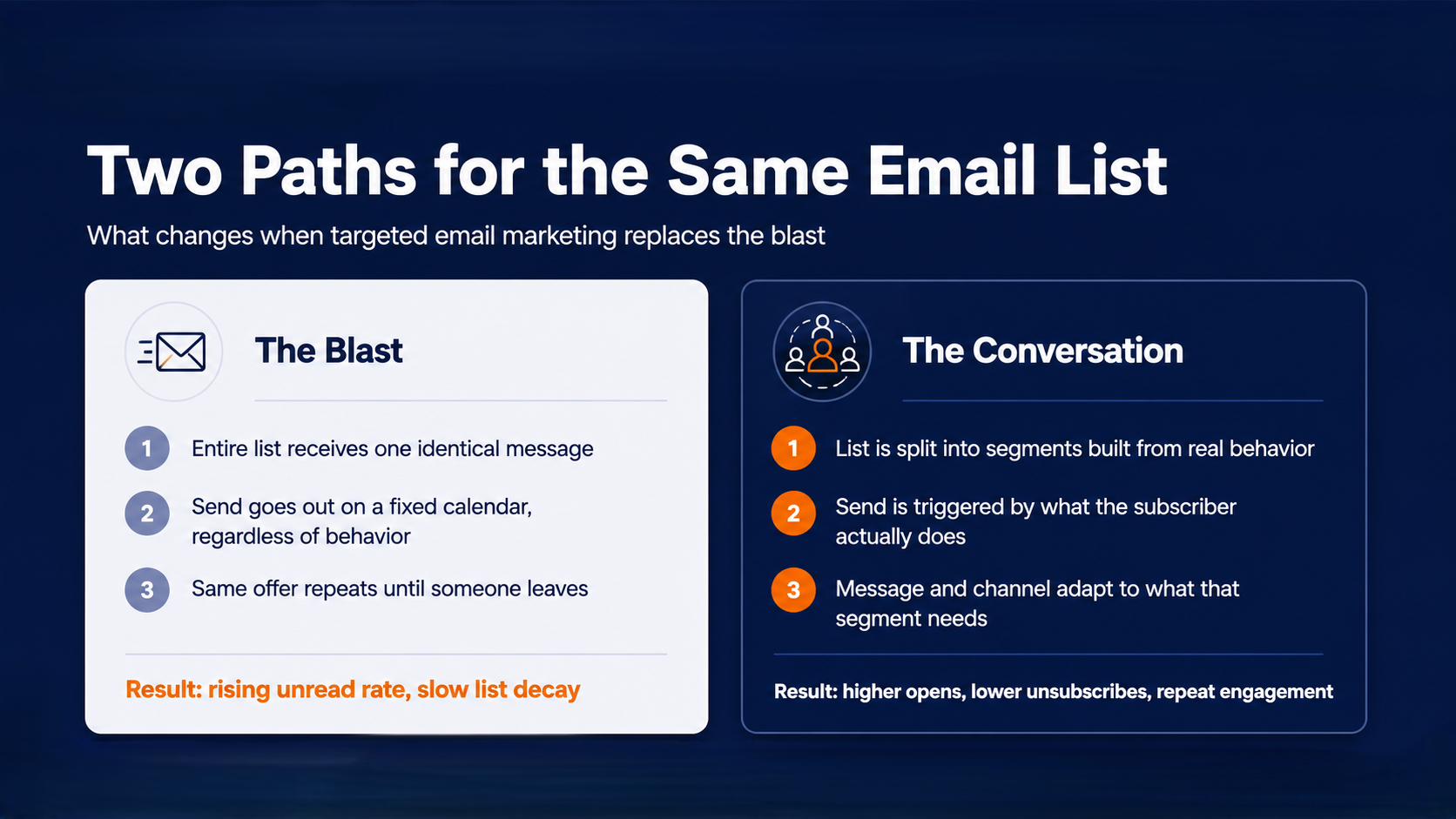
How Pinpointe Turns "Blast" Into "Built for This Person"
This is exactly the gap Pinpointe exists to close. Most consumers say they want control over the frequency and type of messages they receive, and segmentation is how a brand actually delivers that instead of guessing.
As an omnichannel marketing platform built around email and SMS, the tools that make targeted email marketing practical, dynamic segmentation, behavioral triggers, and real-time engagement data, aren't bonus features bolted onto a send button.
They're the difference between the megaphone and the conversation this whole piece has been building toward.
Replacing weekly blasts with behavioral triggers
Segmentation inside Pinpointe means a weekly real estate update stops being one email to everyone. Buyers get listings. Sellers get market data on their own neighborhood.
Someone who closed last month drops into a different journey than someone still browsing. Behavioral triggers take it further: instead of waiting for a fixed day on the calendar, the platform can respond the moment someone clicks a listing or goes quiet for three weeks, sending the right nudge on its own schedule instead of the sender's.
Cross-channel logic built for real human behavior
And because Pinpointe runs email and SMS from the same platform, that same logic extends across channels instead of stopping at the inbox. A subscriber who hasn't opened three emails in a row can shift to a quick text instead of a fourth ignored send.
That's not more volume. That's the same conversation, moved to wherever the person is actually listening.
None of that requires an engineering team or a rebuilt list. It requires treating the list as a room full of individuals instead of a target to hit.
Every Email Is a Choice Between the Megaphone and the Table
Every send is a choice between standing in a parking lot with a bullhorn or sitting across a table from one actual person. The word a team uses for what it's building is a symptom, not the disease, but it's a symptom worth listening to.
So here's the question worth asking before the next send: if the person on the other end could see the label privately given to this email, blast or conversation, would they still want to open it?
Ready to Replace the Blast With Something That Actually Converts?
If a list has been getting the same email blast regardless of who's reading it, schedule a marketing automation audit with Pinpointe and we'll show you exactly where email segmentation and behavioral triggers would change the numbers, not just the vocabulary.