Email marketing lead generation uses email to attract, capture, and nurture interest in what a business sells. This guide focuses on permission-based programs and on how opted-in contacts become qualified leads that sales wants to call.
Your marketing program can capture contacts successfully and still lose momentum before the sales handoff. The form converts, the list grows, and new contacts sit on the monthly newsletter until they forget why they signed up.
This guide covers the whole lead generation system, from where email leads come from to how you decide one is ready for a sales call. It also covers the consent rules that decide what you're allowed to send in the first place.
Key Takeaways
- Email marketing lead generation carries real compliance stakes: each CAN-SPAM violation can draw a civil penalty of up to $53,088 per email, assessed per message, not per campaign.
- High-ROI email programs tie performance to pipeline: teams hitting 36:1 ROI or better are 14% more likely to tie email to MQLs and 28% more likely to use multi-channel attribution, per Litmus's State of Email 2026.
- Bulk senders face strict mailbox rules: Google treats anyone sending close to 5,000 messages a day to personal Gmail accounts as a permanent bulk sender, requiring a spam rate kept under 0.1% that never reaches 0.3%.
- Automated nurture scales real pipeline: 21st Mortgage Corporation's automated drip campaigns on Pinpointe sent 2.5 million emails a year across more than 450,000 contacts and have significantly increased closed loans.
In this guide
- Where Email Marketing Leads Come From
- How Email Marketing Leads Move From Subscriber to Sales Ready
- How Lead Generation Through Email Marketing Works Step by Step
- Measuring Email Marketing and Lead Generation Together
- The Consent Rules Behind Email Marketing Lead Generation
- Email Lead Generation Mistakes That Stall the Pipeline
- Frequently Asked Questions About Email Marketing Leads
Where Email Marketing Leads Come From
Email can't create a lead out of thin air. Every contact in a permission-based program arrived some other way first, through a form on your site, a gated guide, a webinar registration, or a purchase.
That shapes what email is for. Its job starts after the opt-in, turning a contact who showed a flicker of interest into one who's ready to talk to sales.
Email works on people who already raised a hand
Everyone your email marketing program can work with gave you their address and permission to use it. That permission is the asset. It's the reason your nurture sequence has an audience at all, though as the next section shows, not every opted-in contact is a lead yet.
The capture side, meaning lead magnets, forms, and list growth tactics, is its own discipline. This article focuses on what happens once someone is on the list.
Cold outreach is a different discipline
Cold email goes to prospects who never opted in and have no relationship with you yet, while email marketing goes to subscribers who did. Consent is the dividing line between the two, and it changes everything downstream, from the tools you use to the rules you follow.
Both can feed a pipeline. This article covers the permission-based side, where nurture and qualification carry the load.
How Email Marketing Leads Move From Subscriber to Sales Ready
Not every contact on your list is a lead, and treating them all the same is how sales ends up chasing people who only wanted a checklist. If the terms themselves are still fuzzy for your team, our breakdown of lead nurturing meaning is a good starting point.
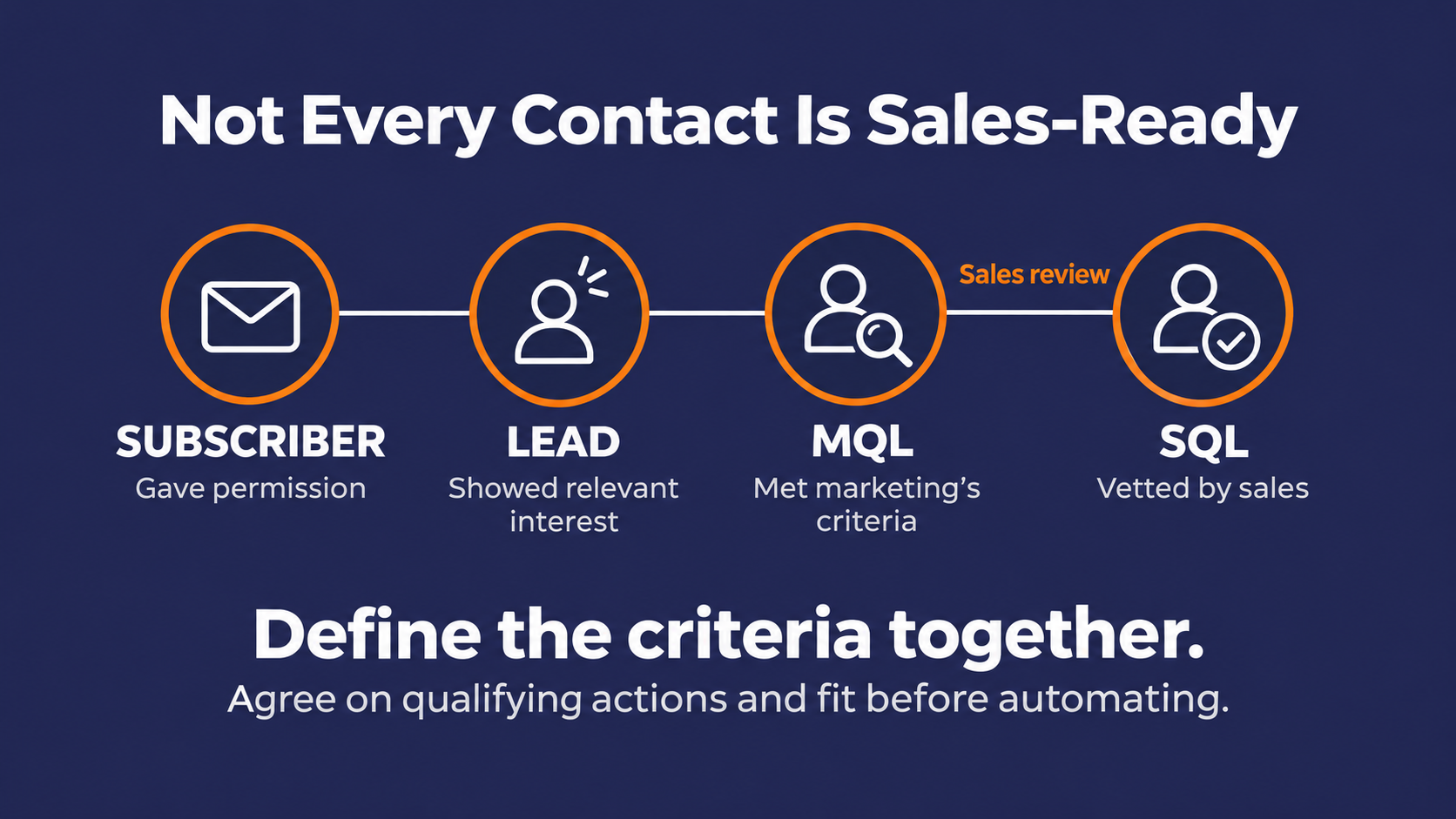
One useful framework is a lifecycle model that moves contacts from subscriber to lead to marketing qualified lead to sales qualified lead, with a specific action marking each step. This guide uses that model, and your team may draw the lines differently.
Subscribers gave permission, Leads showed interest
A subscriber has agreed to receive your email. A lead has done something that suggests they might need what you sell, like downloading a resource tied to a real problem or coming back to your product pages again and again.
The two need different emails. Subscribers need a reason to stay, and leads need help deciding.
When a lead becomes marketing qualified
A marketing qualified lead is one whose engagement suggests it's more likely to become a customer, before sales has vetted it. An MQL becomes a sales-qualified lead (SQL) only when sales reviews it and agrees it's ready for direct outreach.
That second check is the safety valve. Marketing decides who looks ready, and sales decides who is.
Your stage definitions are a team agreement
No universal standard says what counts as an MQL. Each organization sets its own criteria, so two companies using the same labels can mean completely different things.
The definition has to come out of a conversation between marketing and sales. Write it down, so both sides can point at it when a handoff goes wrong.
Pro Tip: Write your MQL definition as one sentence that names the qualifying actions and the fit criteria, then have your sales lead approve that exact sentence before you build anything around it.
How Lead Generation Through Email Marketing Works Step-by-Step
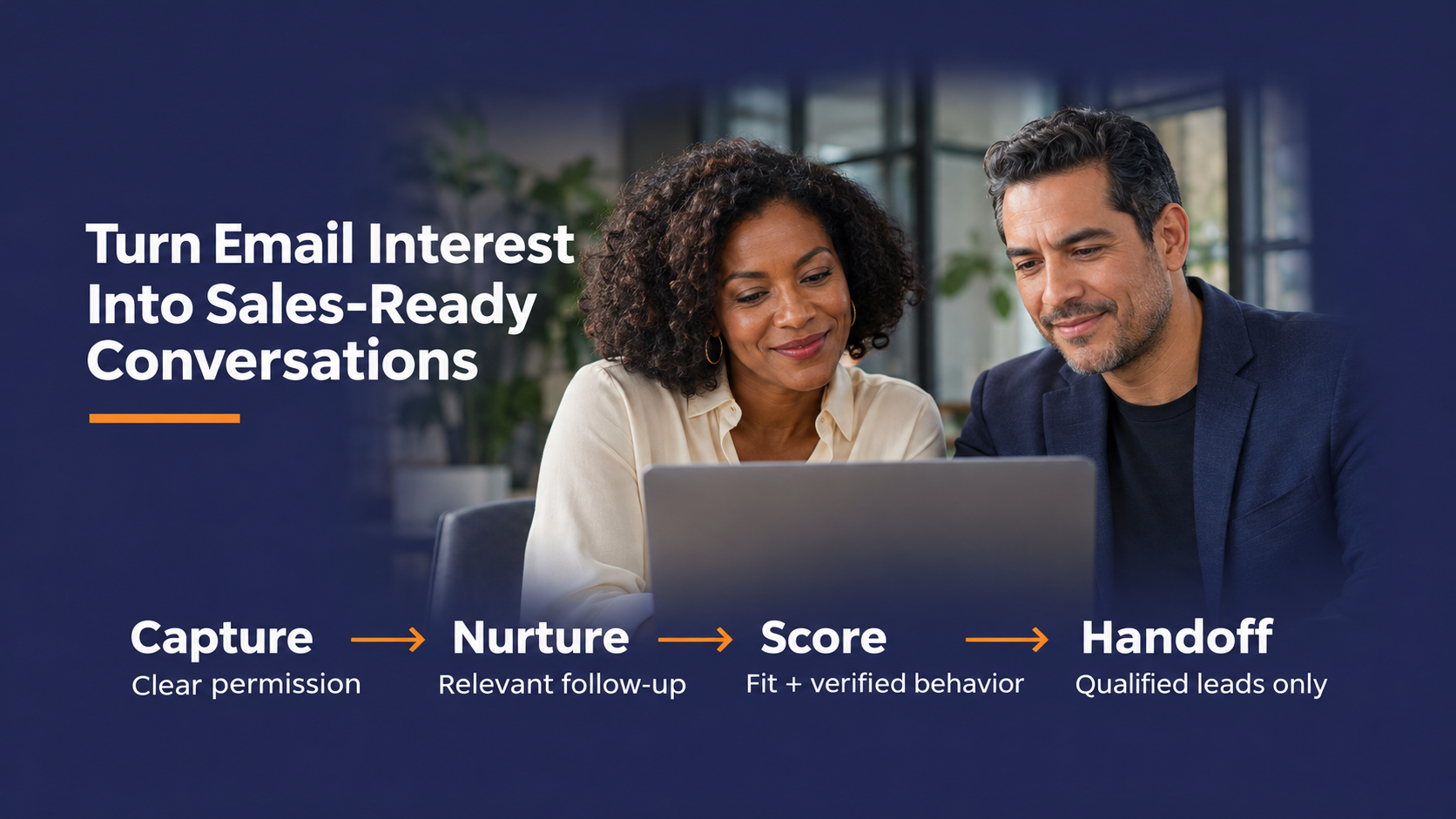
The system has four moving parts, and each one hands off to the next. When one is missing, leads pile up at that point instead of moving forward. If you want ready-to-send examples at each stage, see our post on 3 Lead Generation Emails That Actually Fill Your Pipeline.
Capture with clear permission
Every lead starts with an opt-in that tells the person what they're signing up for. A form that promises a guide and then enrolls someone in weekly promotions without saying so creates a consent problem and a resentful subscriber at the same time. Good email opt-in form best practices make the trade explicit before anyone fills in the first field.
Ask only for what the next step needs. You can collect more detail later, once the person has a reason to trust you with it.
Nurture while the interest is fresh
The first emails after an opt-in land while the person still remembers why they signed up. A welcome message that delivers what you promised, followed by a short sequence tied to the problem they raised, keeps that context alive instead of letting it fade into the newsletter. That's the core of a solid lead nurturing strategy. You want to stay relevant to the reason someone signed up, not just present.
Nurture also works on people who started something and stopped. An example of this is when 21st Mortgage Corporation ran automated drip campaigns on Pinpointe aimed at homebuyers who begin a loan application but don't finish it. They sent 2.5 million emails a year across more than 450,000 contacts, and the company reported those campaigns significantly increased closed loans.
That sequence fires on what the person did, which tells you far more than a date on a content calendar. Someone who abandoned an application has already shown you where they got stuck.
Score on the most reliable signals
Build your scoring model around both fit, such as role, company, and industry, and behavior, such as clicks, downloads, and return visits. The result tells you who is warming up. One area that organizations often struggle with is matching intent and scoring to signals that are no longer reliable, such as email opens alone.
For contacts using Apple's Mail Privacy Protection, Apple preloads tracking pixels through its own servers, often before anyone opens the message, so opens from those users tell you very little. Clicks are more useful than opens, but security scanners and link checkers can generate clicks too, fetching links before a person ever sees the email.
Filter suspected bot activity, then combine clicks with form submissions and visits to pricing or product pages before you qualify anyone. A single click on its own is a weak signal. For the full mechanics of assigning points, see our guide to email lead scoring.
Hand off only the leads sales should call
The handoff is a common place for email lead generation programs to leak. Pass everyone to sales, and they stop trusting marketing's leads. Pass no one, and the program can't show it does anything.
A way to boost the efficiency of the handoff between sales and marketing and save money is by only sending highly qualified leads to your sales team and CRM and focusing lead nurturing in your email marketing system like Pinpointe.
An enterprise SaaS company uses Pinpointe as the top-of-funnel nurturing engine for its trade show leads, sending webinars and newsletters and tracking clicks so the data flows into its HubSpot CRM. Only highly engaged leads pass to sales, which keeps the company from paying for expensive CRM seats on contacts who never engaged.
That setup does the qualifying inside the email program, where it costs less, and saves sales time for people who already showed intent.
Pro Tip: Add a "returned to marketing" status for leads sales rejects, and route those contacts back into a nurture sequence instead of letting them fall through the cracks.
Measuring Email Marketing and Lead Generation Together
Email reporting usually stops at the campaign, and lead reporting lives in the CRM. The numbers that matter are often found between the two.
In Litmus's State of Email 2026 research, teams earning 36:1 or better on email were 14% more likely than lower-ROI teams to tie email to MQLs, and 28% more likely to use multi-channel attribution. That doesn't prove attribution causes a better return, but it does show the stronger programs tend to connect email activity to pipeline.
Count conversions against the right denominator
A conversion rate is only as honest as what you divide by. Use a cohort-based method instead. Take every lead captured in a given period, count how many of those same leads became MQLs within your chosen window, and divide by the total leads in that cohort.
Pick one window, such as 90 days from capture, and use it for every stage. Otherwise, MQLs from leads captured last quarter end up credited to this quarter's capture, and the rate looks better than it was.
Separate sourced from influenced pipeline
For this reporting model, count pipeline as email-sourced when the lead's first qualifying conversion happened through an email or an email-driven form. Count it as email-influenced when the contact clicked or converted from your email within a set window, such as 90 days, before the opportunity opened, even if they first arrived from search or an event.
Both are worth tracking, and they answer different questions. The two numbers overlap, so report them side by side and never add them together.
Pro Tip: Add a lead source field that gets set once at capture and never overwritten, then report email's influence separately from it.
The Consent Rules Behind Email Marketing Lead Generation
The rules that apply to your email depend largely on where your recipients are. What follows is a general overview, not legal advice, so check with counsel before you mail a new region at scale.
United States and CAN-SPAM
CAN-SPAM covers all commercial email, not only bulk sends, and it makes no exception for business-to-business messages. Every commercial message also needs a clear, working way to opt out, and that right holds even for people in a subscription or membership program.
The stakes are counted per message. Each separate email that violates the law can draw a civil penalty of up to $53,088, so one bad campaign multiplies fast.
The UK opt-in standard
For unsolicited marketing emails to UK individual subscribers, you generally need valid consent unless a soft opt-in applies. That consent has to be freely given, specific, informed, and unambiguous, and pre-ticked boxes or silence don't count.
The products and services soft opt-in is narrow. It applies only when you collected the details directly from the person while selling or negotiating to sell to them, you're marketing your own similar products or services, and you offered an opt-out both at collection and in every message since. Negotiations can include a prospect who requested a quote or more details, so the person doesn't have to have bought anything.
The UK rules treat corporate subscribers, such as limited companies, differently from individual subscribers. Sole traders and ordinary partnerships count as individual subscribers, so a business-looking address doesn't settle the question. If you also mail EU recipients, check the EU's rules separately.
Canada and CASL
For lead generation, the opt-in on your form has to do real work. A vague checkbox buried in your terms is a weak foundation for a nurture sequence aimed at Canadian contacts.
Gmail sets its own sender rules
Mailbox providers add a layer of policy on top of the law. Google treats anyone sending close to 5,000 messages a day to personal Gmail accounts as a bulk sender, and that status is permanent.
Google's requirements for bulk senders include SPF, DKIM, and a DMARC record, one-click unsubscribe on marketing mail, and a user-reported spam rate kept under 0.1% that never reaches 0.3%. Other large mailbox providers publish requirements of their own, so check each one that makes up a big share of your list.
Email Lead Generation Mistakes That Stall the Pipeline
These are the failure points worth checking first. Each one shows up as leads that stop moving, even while the list keeps growing.
Capturing contacts with nothing behind the form
A new opt-in with no follow-up sequence gets the next scheduled newsletter and nothing tied to why they signed up. By the time anyone notices, the interest that prompted the form fill is weeks old.
Scoring leads on opens
If opens carry real weight in your scoring model, contacts using Mail Privacy Protection can score as engaged without reading a word. Pixel preloading inflates open data for that segment, so the leads you hand to sales may be warm only on paper.
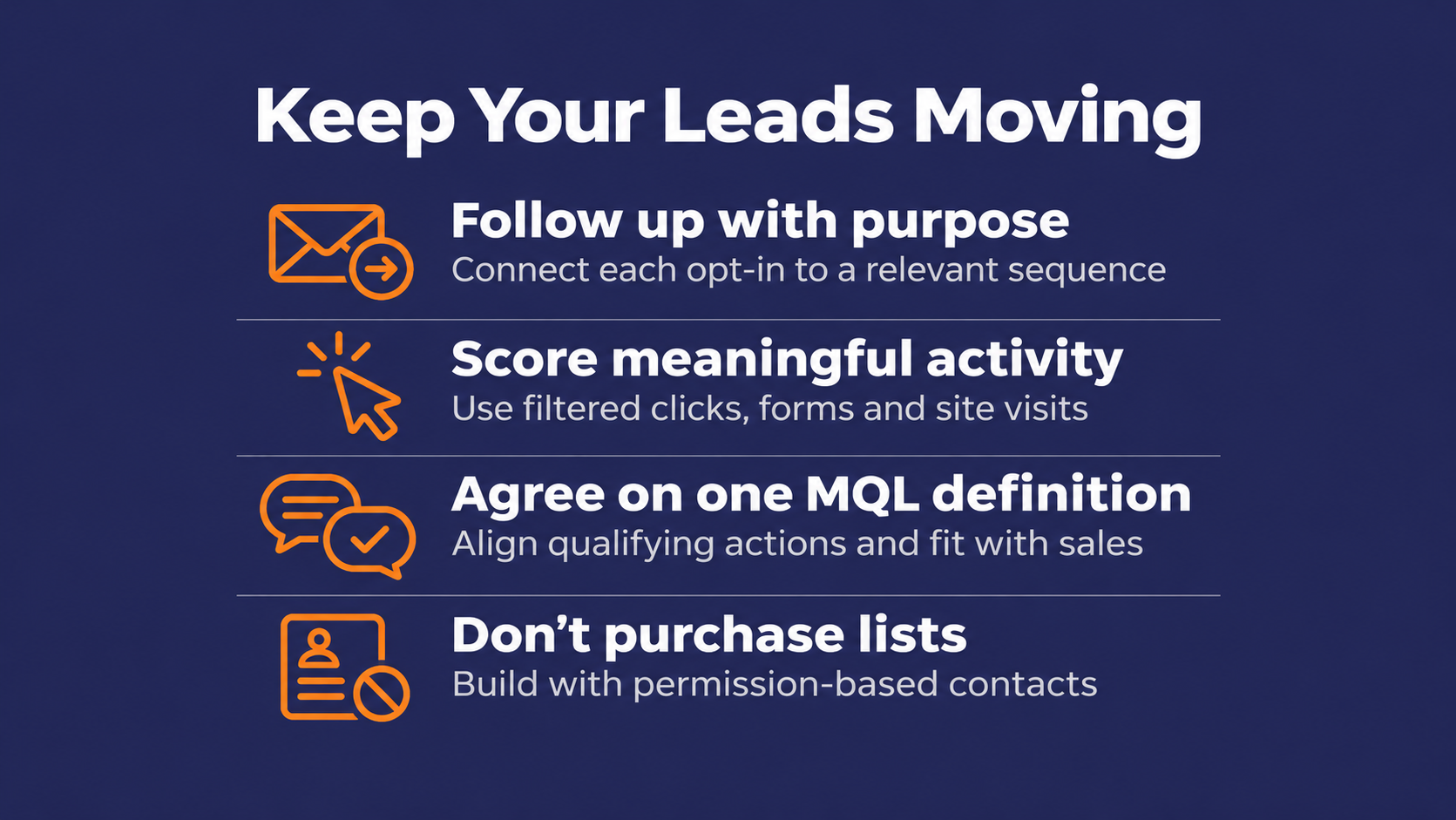
Rebuild the model around filtered clicks, form activity, and site visits, and treat opens as a tiebreaker at most.
Letting marketing and sales define MQL separately
When each team works from its own definition, every handoff turns into an argument about lead quality. Each organization sets its own MQL criteria, so nobody outside your company can settle that argument for you.
Mailing a purchased list
Don't buy an email list, and don't mail one if someone hands you one.
Buying a list doesn't by itself give you permission to email the people on it. Check whether you have valid consent or another applicable basis under the rules that govern those recipients, and note that for UK individual subscribers, a bought-in list can never use the soft opt-in.
Even where US law allows the send, spam complaints from those recipients count toward Google's user-reported spam rate, and a rate that reaches 0.3% puts delivery to your real subscribers at risk.
A purchased list also has nowhere to run on Pinpointe. The platform is built for permission-based, opt-in contacts, not uploaded prospect databases, so a bought list isn't something you send through it in the first place.
Turning Email Marketing Lead Generation Into a Pipeline Sales Trusts
Email marketing lead generation works when every stage has a job. Permission brings contacts in, nurture keeps their interest alive, scoring on filtered clicks and real actions separates the curious from the ready, and a shared MQL definition decides who sales gets. Consent rules and mailbox requirements sit under all of it.
Plenty of programs have the forms and the content in place. When they stall, it tends to be in the stretch between the opt-in and the handoff, where follow-up depends on someone remembering to send it.
Passing only sales-ready leads to your CRM
The stretch between opt-in and handoff is where Pinpointe's Journeys do their work. A form submission or a link click can enroll a contact in an email and SMS sequence, conditions can branch the path based on what they do next, and dynamic segments keep updating as their engagement changes.
Once you've set the rules for what ready means, a configured integration through the API, webhooks, or Zapier can push those leads into your CRM, so sales only sees the contacts who earned a call.
If you run lead generation for several brands or clients, each brand account runs its own journeys from its own segments, and your central team still sees every one of them from a single admin login. Every customer also gets hands-on onboarding from our team, including help authenticating your sending domains.
Find where your leads stall with a marketing automation audit
If you're not sure where your own leads stop moving, start with our free marketing automation audit. It's a 1-on-1 session that finds the manual work eating your team's time and the points where prospects drop out of your funnel. You leave with an automation roadmap for the stretch between capture and handoff.
Frequently Asked Questions About Email Marketing Leads
Here are short answers to common questions about lead generation through email marketing.
Is email marketing good for lead generation?
Yes, for contacts who have already opted in. Email gives you a direct, repeatable way to nurture interest until a lead is ready for sales, and Litmus's 2026 research found high-ROI email teams are more likely to tie email to MQLs. The channel earns its keep when you measure it against pipeline.
Is cold email the same as email marketing lead generation?
No. Cold email goes to people who never opted in, while email marketing goes to subscribers who did, and that difference in consent changes the tools, the tactics, and the rules involved.
Can you buy an email list for lead generation?
You can buy one, but don't, and don't mail one even if it lands in your lap. Purchased lists shouldn't be used in email marketing. Buying a list doesn't give you permission to email it, and for unsolicited marketing to UK individual subscribers, bought-in lists can't rely on the soft opt-in, so you'd need valid consent that specifically names your organization and covers email marketing.
In Canada, CASL requires express or implied consent before you send, and even under US law, complaints from people who never opted in count against the spam rate Google tracks. Pinpointe is built for permission-based, opt-in contacts, so a purchased list isn't a fit for the platform regardless.
Are email opens a reliable signal of lead interest?
Not on their own. Apple's Mail Privacy Protection preloads tracking pixels for users who enable it, which inflates opens. Clicks are more useful, but security scanners can generate them too, so filter suspected bot activity and combine clicks with form fills and page visits.