Your email list is shrinking right now. Not next quarter, not "eventually if you ignore it." Right now, while you're reading this sentence, somebody on your list just changed jobs, torched their old inbox, or quietly decided your emails aren't worth the swipe to delete anymore.
Nobody likes hearing that. It feels almost personal, like your list is ghosting you. But it's just how email works, and it's not a reflection of your last campaign.
9 Ways to Grow Your Email List Faster Than It's Decaying
Most lists lose somewhere between 22% and 30% of their contacts every single year, and that number doesn't care how clever your subject lines were or how good your open rates looked last month. If you're not actively replacing what you're losing, your list isn't stable.
It's just dying slower than you think, and the scary part is how invisible that decline is on a day-to-day basis. Nobody gets an alert saying "you lost 40 subscribers today." It just happens quietly in the background while your dashboard still looks fine.
Stop leaving your email list building strategy to chance
Here's the thing though, this is genuinely one of the more fixable problems in marketing. It's not a strategy problem. It's mostly a laziness problem. Most brands get their list-building machine running once, feel good about it, and then never touch it again.
Meanwhile, the leak never stops, month after month, campaign after campaign. So let's talk about how to actually outrun it, with nine ways to keep new subscribers coming in faster than old ones are falling off.
1. Your Blog Shouldn't Be a Dead End
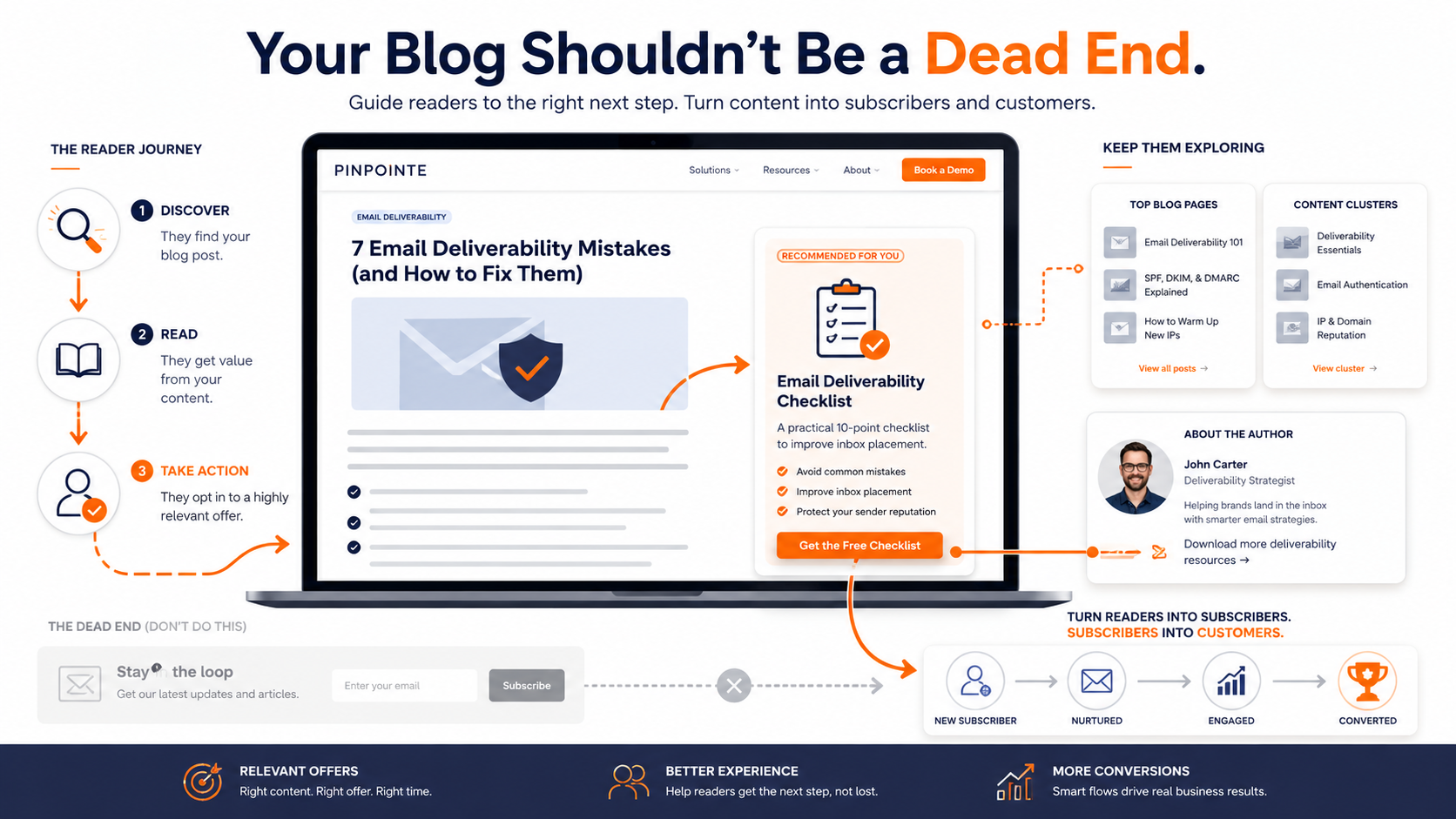
Think about the last genuinely great blog post you wrote. Someone found it through search, read the whole thing, actually got value out of it, and then what? If the answer is "they left," you just did all the hard work of earning their attention and then handed it right back with nothing to show for it.
This happens constantly because most brands treat their signup form like a piece of furniture. It's in the footer, it says "subscribe to our newsletter," and it hasn't been touched since 2021. Nobody signs up for "our newsletter."
That phrase means nothing to a stranger who just found you through Google. What they'll actually sign up for is a specific reason tied to what they were just reading, delivered at the moment they're most interested.
Audit your top pages for email list building opportunities
So audit your top pages. Not just your homepage, your actual highest-traffic content, because for a lot of brands that's the blog, not the homepage, and it's usually not even close. Give each cluster of content its own reason to opt in.
A post about deliverability should offer something related to deliverability, not a generic "join our list" box that could be bolted onto any page on the internet with zero changes.
And don't sleep on guest content either. If you're writing for someone else's blog or newsletter, your author bio is basically free advertising space you already paid for with your time and expertise.
Use it to point back to your own list, not just your homepage, and make the ask specific rather than a vague "check out our blog."
2. Make People Actually Want to Forward Your Emails
A "forward to a friend" button sitting at the bottom of a mediocre email does absolutely nothing. It's decoration. People don't forward things because there's a button sitting there waiting to be clicked.
They forward things because the content made them think of someone else who'd genuinely want it, which is a much higher bar than most marketing content clears.
So this tip only works in one direction. Fix the content first, and the sharing takes care of itself. Once you've got something genuinely useful, make it easy to pass along.
Include relevant CTAs in your emails to help grow your email list
Put a plain-text subscribe link at the very bottom of every send, not just a styled button, because forwarded emails frequently lose their formatting along the way and buttons vanish with it. A plain link survives that trip intact, even through three or four forwards.
Think of this less like a growth hack and more like a reward system. It pays you back for writing something worth sharing, and it does nothing at all for content nobody wanted in the first place.
That's honestly a useful gut check to run on your own content calendar. If you wouldn't personally forward your own email to a friend, why would anyone else bother?
3. Kill the Boring PDF, Build Something People Actually Use
Gated ebooks have been having a rough decade, and it's not really about the format itself. It's about what happens after someone downloads one. Most of the time, the answer is nothing.
It sits in a downloads folder, unopened, next to eleven other PDFs from other brands making the exact same offer with the exact same stock photo on the cover.
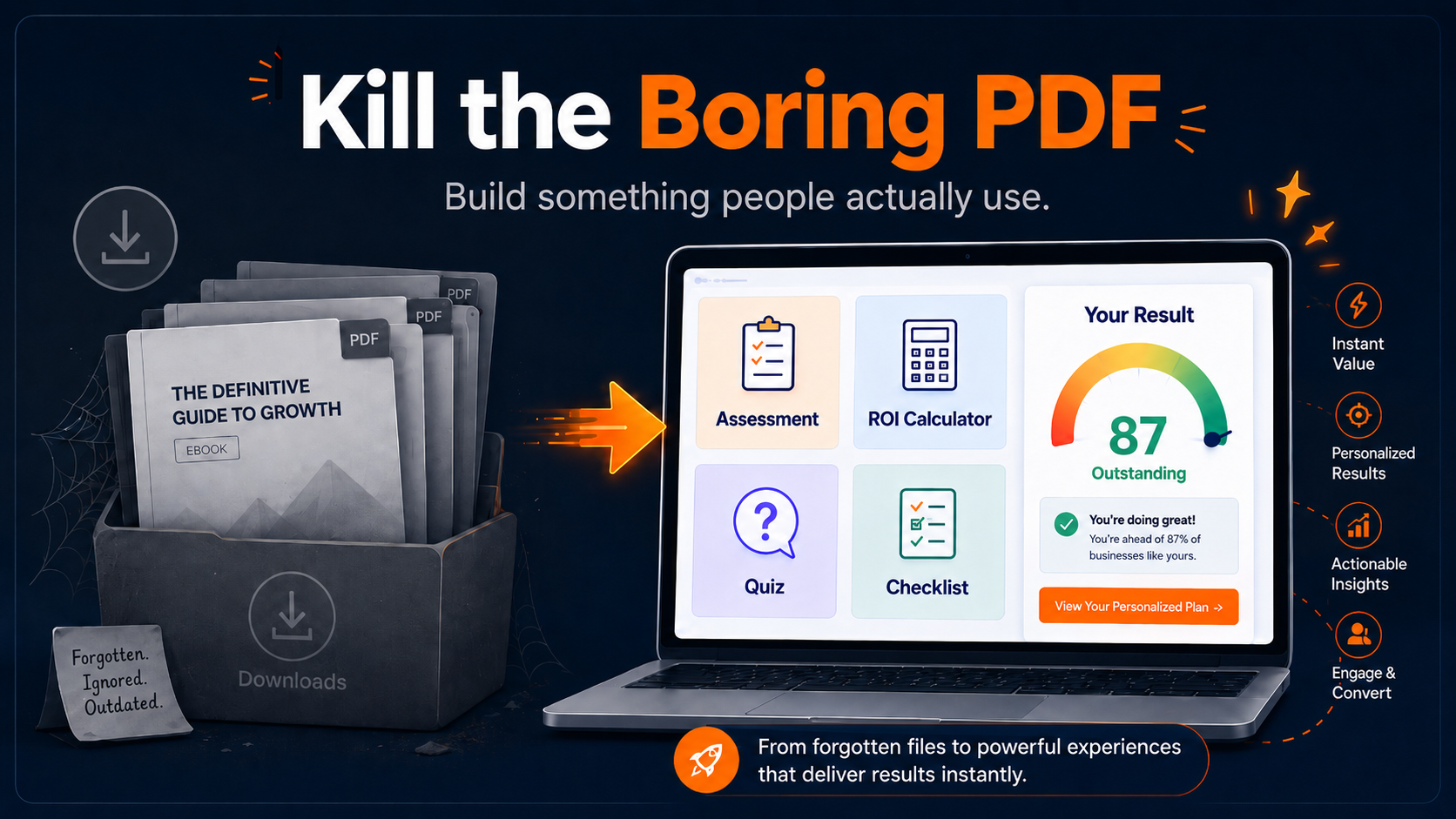
What's actually working right now is stuff that delivers value the moment someone interacts with it. A quick assessment that tells them where they stand relative to their industry.
A calculator that spits out a real, specific number based on their own inputs. A short quiz that ends with something tailored to them instead of a generic result everyone gets.
Craft a valuable lead magnet to promote email marketing list growth
These formats work because the person gets something back immediately, not three weeks later when they finally remember they downloaded a thing and can't find it in their inbox anymore.
If you're still building long gated content because it feels more substantial or more impressive, resist that instinct. A tight, specific checklist that solves one real problem will consistently outperform a sprawling 40-page guide that tries to cover everything and ends up being useful for nothing in particular.
Nobody wants to read a whitepaper just to get an email address into your system. They want the fastest possible path to something they can actually use today.
4. Your Incentive Is the Problem, Not Your Form
Most opt-in rates are mediocre for a pretty boring reason. The offer just isn't good enough to compete for attention. The average opt-in rate across the board can range from 1% on the low end to 7% or more for top performers.
That gap has almost nothing to do with button color, form placement, or which shade of your brand purple you used on the call to action.
Develop an irresistible offer to drive email list growth
It's the offer. Every single time. Before your team spends another sprint tweaking form design or running A/B tests on button copy, sit down and ask honestly whether "sign up for our newsletter" gives anyone a real reason to hand over their inbox to a brand they just met.
Most of the time it doesn't, and no amount of design polish fixes a fundamentally weak offer. Fix the offer first. Everything downstream, like your form design, your placement, your follow-up sequence, gets dramatically easier once the actual value proposition is solved.
5. Don't Just Build the List Once and Walk Away
This is the mistake almost every team makes, and it's sneaky because it doesn't feel like a mistake while it's happening. You push hard on list growth for the first few months after launch.
It works. The list grows steadily. Everyone's happy, the numbers look good in the monthly report, and list building quietly slides down the priority list.
Then, without anyone deciding to, the promotion stops, because the list "looks healthy" and there are other fires to put out that feel more urgent that week. Six months later, growth has flatlined, and everyone's confused about why.
Don't blame market saturation for your email list building strategies not working
The usual explanation people reach for is market saturation, like you've simply run out of people who could possibly want to sign up. That's almost never what actually happened.
What happened is you stopped doing the thing that was working, and nobody replaced it with anything else in the meantime.
The fix here isn't complicated. It's just a discipline problem. Keep the promotional muscle active even when, especially when, the list feels fine.
A healthy-looking list with no active acquisition behind it is just a list that hasn't started noticeably shrinking yet. Put list growth on the same recurring calendar as your actual sends, not as a one-time launch activity you check off and forget.
6. Grab the People Standing Right in Front of You
If your brand has any physical presence at all, such as a retail counter, a trade show booth, a pop-up event, or a conference table, you are almost certainly sitting on subscribers you're not capturing.
A stack of business cards collected at a conference that never makes it into your ESP isn't a lead list. It's just a stack of paper taking up space in someone's bag until it gets thrown away.
Use QR codes to grow your email list at events
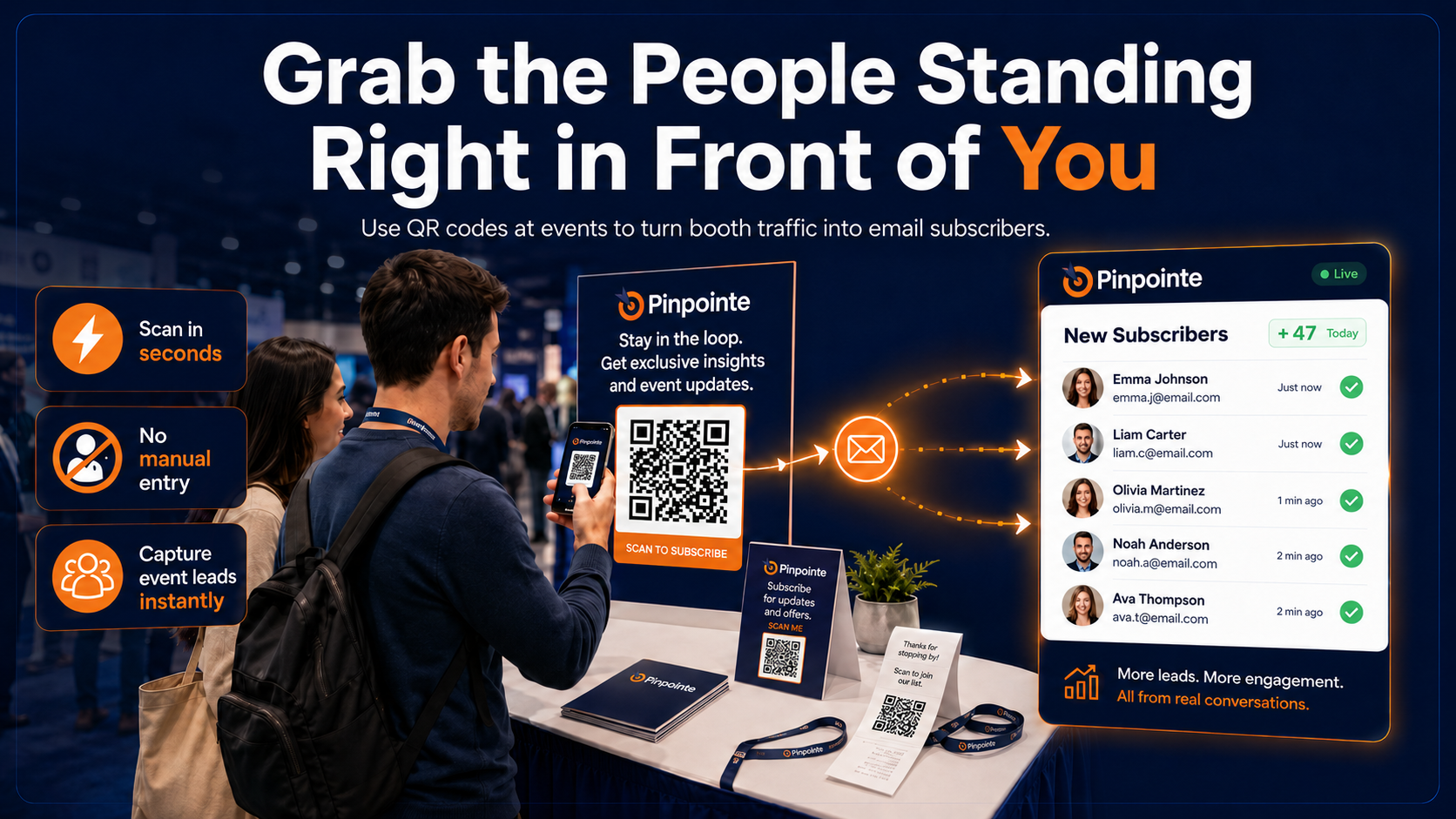
QR codes have made this embarrassingly easy to fix. Someone scans, taps send, and they're in your system before they've even walked away from your booth.
No typing out an email address on a tiny phone keyboard with bad convention center lighting, no clunky landing page that takes forever to load on overloaded wifi.
If your team isn't putting a code on every table tent, receipt, badge, or piece of signage at your next event, that's one of the fastest wins available to you, and it costs almost nothing to set up compared to almost any other acquisition channel on this list.
7. Stop Running Email and SMS as Two Separate Projects
This is the one most teams are genuinely behind on, and it's costing them more than they realize. When email and SMS opt-in live in different tools, run by different people, with different popups and different rules, you end up with two half-built lists instead of one strong one, and neither channel gets the attention it deserves.
Combined offers convert noticeably better than single-channel ones, and checkout is the moment most brands underuse the most. Post-purchase checkout opt-in alone captures nearly 40% of the people who reach checkout, and it costs you basically nothing since the customer is already standing right there.
If your checkout flow only asks for an email and skips the phone number entirely, you're leaving your single highest-intent moment half-used, every single day, on every single order.
| Channel | Conversion Rate | Notes |
|---|---|---|
| Post-purchase checkout opt-in | 38.4% | Highest LTV, $0 incremental cost |
| Two-step email-to-SMS popup | 6.4% | Best for premium brands |
| Email + SMS combined popup | 9.7% | 3x single-channel SMS popup |
| In-store/packaging QR code | 12.7% | Strong for omnichannel retail |
| Abandoned cart email-to-SMS upgrade | 22.1% | Warm audience, high intent |
| Paid social lead ads | 0.4% to 1.1% | Cheapest CAC, weakest LTV |
Source: SMS Marketing Statistics 2026 report, Digital Applied
8. Not All Subscribers Are Worth the Same
A sweepstakes will absolutely flood your list with new names fast. It'll also flood your list with people who never wanted your product in the first place.
They wanted the prize, and most of them will quietly churn out within a few months once the excitement wears off and the emails start feeling like an obligation instead of a reward.
On a growth chart, that channel looks incredible. Three months later, it's dragging your engagement numbers down, and nobody's connected the dots back to that one campaign.
Monitor the long-term results of your email list building strategies
Track where your subscribers actually come from, and don't stop watching after the signup happens. Follow how each channel behaves over time, not just at the moment of capture.
The source that looks best on day one isn't always the one still paying off in month three. And if you're not tracking acquisition channel as a real, ongoing data point, you have no way of catching this before it starts quietly hurting your deliverability across your entire list, not just the contacts from that one campaign.
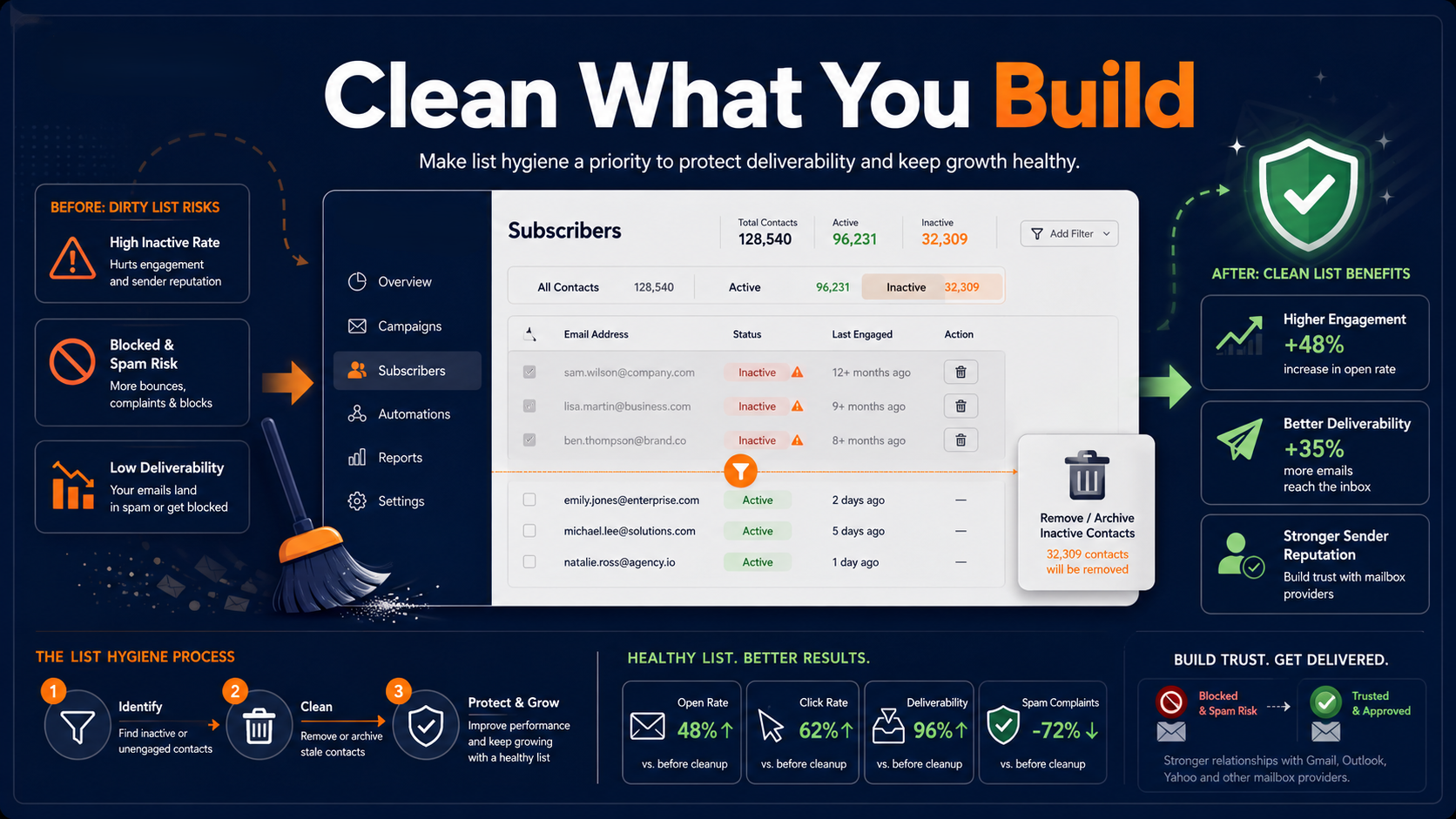
9. Clean What You Build
Growth without email list hygiene is fake growth, plain and simple. A list padded with a thousand contacts who haven't opened anything in a year isn't an asset sitting on your dashboard.
It's a liability quietly working against you every time you hit send, dragging down your engagement rates and making mailbox providers trust you a little less with every single campaign you push out.
Make list hygiene a priority to maintain growth of your email marketing list
Both Gmail and Microsoft have tightened their standards recently, and the consequences for ignoring this aren't just soft anymore. A messy, uncleaned list doesn't just underperform.
It can get entire sends blocked outright, regardless of how good the actual content inside that email was. Clean as you grow, continuously, as an ongoing habit built into your process, not as some once-a-year spring cleaning project you keep pushing to next quarter because it never feels urgent until it suddenly is.
Where Pinpointe Fits Into Your Email List Building Strategies
Here's the honest problem with most of the tips above: they each live in a completely different tool, run by a different person, reporting into a different dashboard that nobody cross-references. Your popups are handled by one platform. SMS lives in another.
The trade show leads are sitting in a spreadsheet somebody forgot to import three weeks ago. None of it talks to each other, and none of it agrees on who your most engaged subscriber actually is at any given moment.
Combine multiple marketing automation strategies into one system
Pinpointe puts email and SMS in the same system, so a checkout opt-in, a QR scan at your booth, or a two-step popup on your site all land in one place instead of three.
Behavioral triggers pick up automatically from there: a welcome sequence, a cart recovery flow, whatever actually fits that specific contact and how they came in, without someone manually building that logic for every possible entry point.
Manage your email list growth with real-time analytics
Because every subscriber carries their acquisition source natively, you can finally see in real time which channels are bringing in people who stick around versus people who bail within 90 days, and fix the leak before it drags your whole list down instead of finding out during your quarterly review.
It's the difference between running nine separate tactics that each need their own maintenance and reporting, and running them as one connected system that actually gets smarter the more contacts flow through it over time.
Your List Is Smaller Right Now Than It Was This Morning
That's not a scare tactic, it's just the math. Every single day you're not actively building is a day you're losing ground to churn that doesn't care about your launch calendar, your Q3 priorities, or how busy your team is this particular week.
Pick three tips from this list that you're not currently doing, and put them into motion this week, not next quarter, not after the next planning cycle. The list isn't going to pause and wait for a better time to start shrinking less.
Growing Your Email List Is a Habit, Not a One-Time Project
Lists don't hold steady on their own. They decay, always, and the only real defense is treating acquisition as something you never stop doing, not a project you finish once and check off before moving on to the next priority.
If you want to grow your email list in a way that actually lasts, it comes down to running multiple channels at the same time, giving people a real reason to opt in, and staying disciplined about cleaning out what's stopped working before it quietly damages the rest of your list.
Ready to see where your email list is actually leaking?
Most teams know their list is decaying somewhere. Almost none of them can point to exactly which channel, which segment, or which flow is responsible. That's not a knock on anyone, it's just really hard to see without the right visibility into how each acquisition source actually performs over time.
Schedule a marketing automation audit with our team, and we'll go through your current acquisition channels, your opt-in flows, and your engagement data together, then show you exactly where subscribers are falling through the cracks and what a real fix looks like for your specific list.