
You spend real money and real effort getting someone onto your list, and a third of them are gone before your welcome sequence even finishes.
Roughly 34% of new subscribers drop off within the first 30 days, and only about 56% are still around a year later. That is the number nobody puts on the quarterly dashboard.
Take control of the hidden drivers behind list churn
Understanding why people unsubscribe from emails is the first step to slowing that bleed, and most of the reasons are more predictable than they feel in the moment.
Most teams treat unsubscribes as a housekeeping metric. Someone clicks the link, the count ticks up by one, you move on. But the click is the last event in a story that started weeks earlier, and by the time you see it, the decision has already been made.
The good news is that a lot of what drives people away is inside your control. Not all of it, but enough that a small improvement in retention changes your whole growth math.
The Math That Makes Unsubscribes Worth Your Attention
New marketers hit a wall that confuses them. They add subscribers every single week, and the list still barely grows.
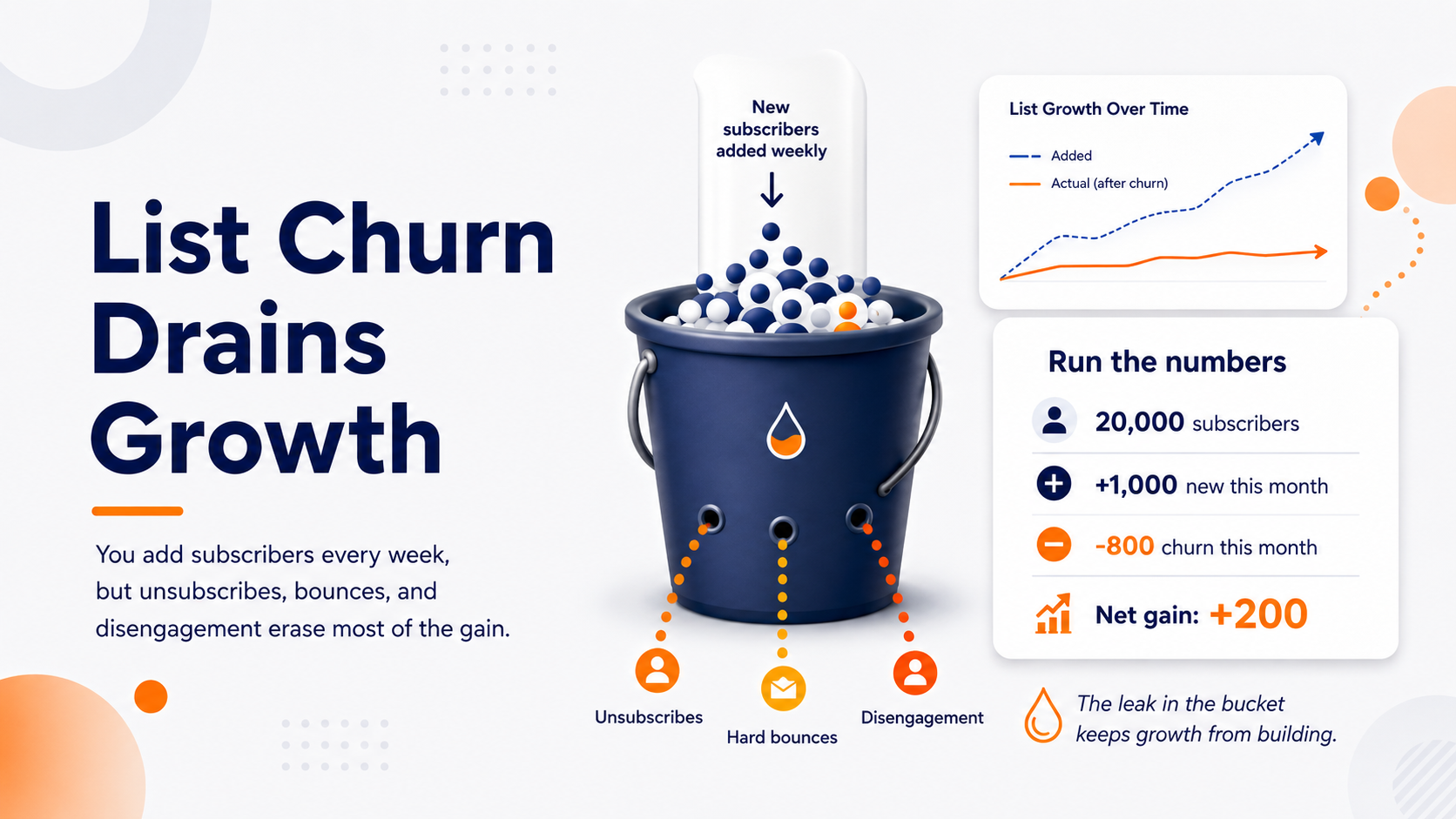
The culprit is list churn, the steady erosion of your audience through unsubscribes, hard bounces, and disengagement. It rarely shows up as a single dramatic number. It shows up as growth that never quite arrives.
Run the numbers on your own list
Picture a list of 20,000 subscribers. You are proud of a solid 5% monthly growth rate, so you add 1,000 new contacts this month. In that same month, though, 4% of your existing subscribers quietly fall away through bounces, opt-outs, and dead accounts. That is 800 people gone.
Your net gain is 200 subscribers, not 1,000. You did the work of adding a thousand and kept a fifth of it. Stretch that across a year, and the acquisition treadmill starts to feel exhausting for a reason. It is.
Why churn hides in plain sight
Churn is unglamorous, so it rarely gets discussed. Acquisition gets the budget and the credit. The leak in the bucket gets ignored until someone notices the bucket never fills.
Here is the part that flips the priority order. Reducing unsubscribes even slightly is often cheaper and faster than out-acquiring your losses, because every subscriber you keep is one you already paid to get. A point of retention saved is worth more than a point of acquisition added, and it usually costs less to get.
What list churn actually costs you
List churn is not only a headcount problem, but it is also a compounding one. The subscribers you lose are disproportionately the ones who had been around long enough to trust you, which means they were also the ones most likely to buy. Losing a six-month subscriber is not the same as losing a six-day one, even though your report counts them identically.
There is a reputation cost layered on top. As disengaged contacts pile up, your sends look worse to the mailbox providers, and worse sender reputation means even your happy subscribers see you less. Left alone, list churn taxes the deliverability of every campaign you send, not just the ones going to people on their way out.
Pro Tip: Before you fund another lead-gen push, calculate your monthly churn rate. If it is eating most of your new signups, fixing retention will move the needle further than adding more names.
The Two Kinds Of People Who Leave Your List
There are two ways a subscriber exits, and only one of them shows up in your reports.
The first is the active unsubscribe. They find the link, they click it, they are gone. It stings, but at least it is honest and measurable. The second is quieter and far more common. These are the people who simply stop opening, stop clicking, and drift out of reach without ever telling you.
Meet the emotionally unsubscribed
Marketers sometimes call that second group the emotionally unsubscribed. They have not filled out any form or clicked any button. They have just decided, somewhere in the back of their mind, that your emails no longer earn their attention.
That decision is invisible to your dashboard. Your list size looks fine. Your reputation is quietly rotting underneath it.
How disengagement snowballs
Once someone stops engaging, the mailbox providers notice before you do. Your emails start landing in the Promotions tab or the spam folder, which means fewer opens, which tells the algorithm to bury you further. The drift feeds itself.
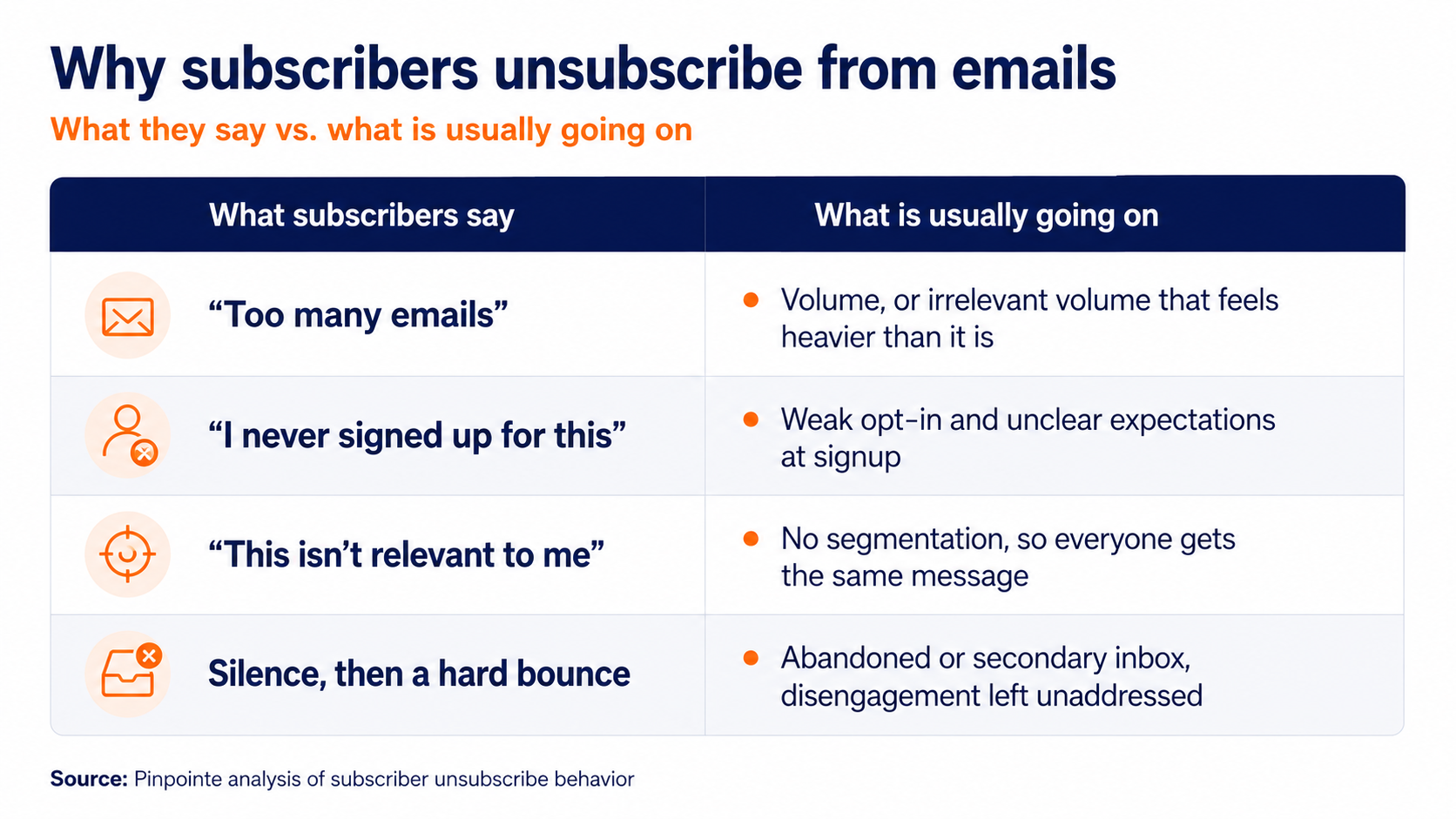
Sometimes the person is not even rejecting you on purpose. They set up a filter months ago and forgot. They signed up with a secondary address they check twice a year. You will not know that account is dead until it hard-bounces.
Catch the drift while you still can
The window to act on a drifting subscriber is wider than most marketers use. Email engagement rarely drops off a cliff. It slopes down over weeks, from opening most of your emails, to skimming a few, to letting them stack up unread. Each of those stages is a chance to change the trajectory if you are watching for it.
The practical move is to define what fading looks like on your own list and act on it early. Someone who has not opened in thirty days is a very different problem than someone who has not opened in six months, and the earlier you notice, the cheaper and easier the fix.
Why the quiet ones matter more
Active unsubscribes are visible, so they get all the attention. But the silent drift away is usually the bigger leak, because it is larger, harder to spot, and it degrades your deliverability the whole time it is happening. It also feeds your list churn without ever registering as a departure you can point to.
You cannot win back a subscriber you do not know you are losing. That is why engagement signals, not just the unsubscribe count, should be the thing you actually watch.
The Real Reasons People Hit Unsubscribe
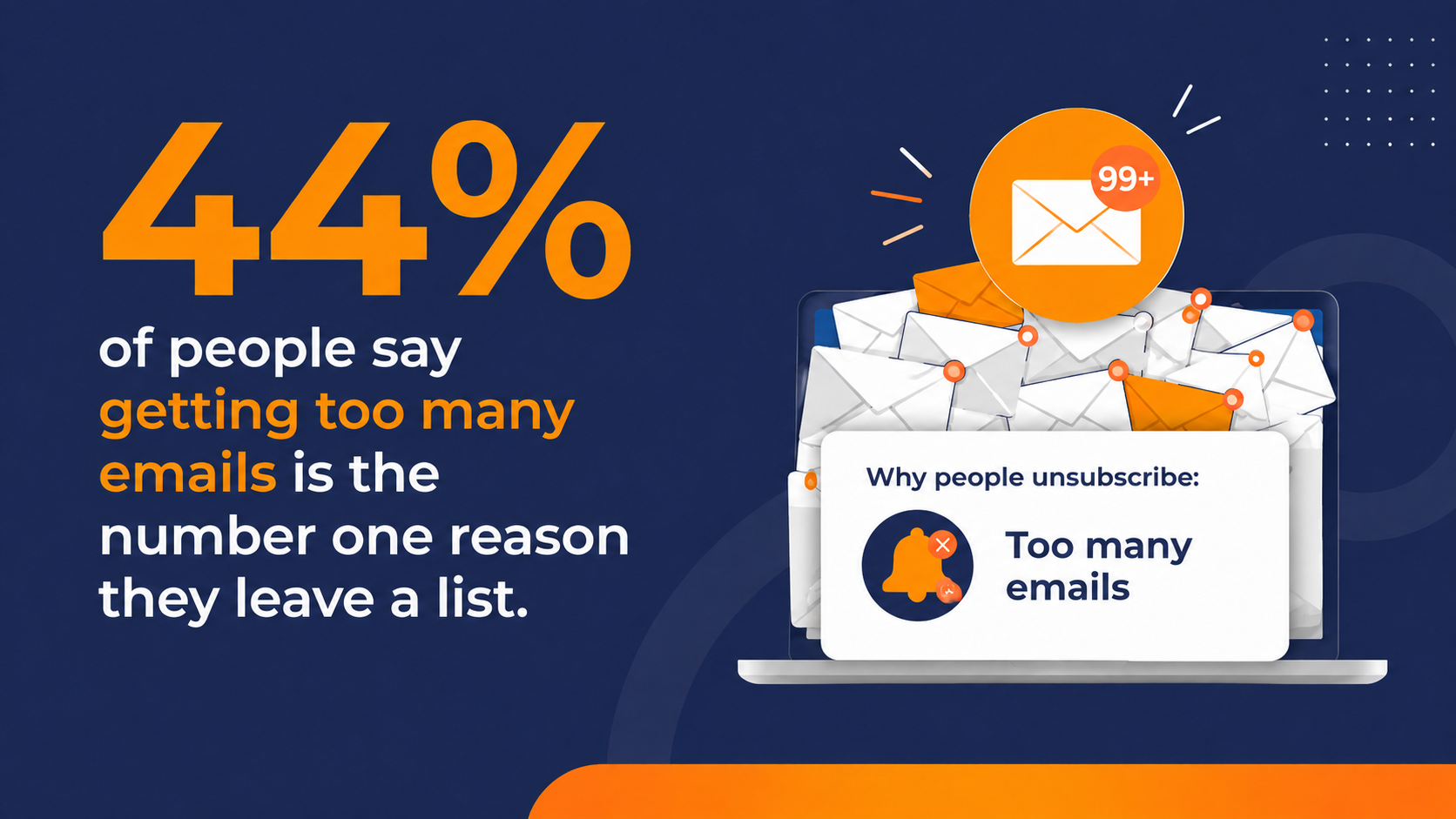
When someone does take the active step, it is worth understanding why, because the reasons are consistent and mostly fixable. Frequency tops the list every time. About 44% of people say getting too many emails is the number one reason they leave a list. Roughly a fifth point to never having agreed to the emails in the first place, and another sizable chunk say the content stopped being relevant to them.
Frequency is the loudest complaint
Notice what that top number tells you. The single biggest driver of unsubscribes is plain volume, ahead of bad copywriting, weak offers, or ugly design.
That does not mean you should mail less by default. It means you are probably guessing at a frequency that should be a decision your subscriber gets to weigh in on.
Relevance is the silent killer
Frequency gets the headlines, but relevance does the real damage underneath. Someone who feels every email was written for them will tolerate a surprising amount of volume. Someone getting generic blasts starts resenting the second or third one.
This is where the two problems connect. A lot of what reads as a frequency complaint is actually a relevance complaint wearing a disguise, because irrelevant email always feels like too much.
Test Your Email Frequency Instead Of Guessing At It
Since frequency is the top reason people leave, your email frequency deserves more than a gut call. The instinct when unsubscribes rise is to panic and mail less. Sometimes that is right. Often it costs you money you did not need to lose.
The trouble with email frequency best practices is that they are averages, and you do not send to an average. A daily cadence that exhausts one list keeps another perfectly happy, because the difference is not really the number of sends. It is whether each send was worth opening. Frequency and relevance are the same lever seen from two angles.
Watch revenue, not just opens
When you cut frequency, your open and click rates usually tick up, which feels like a win. But look at the metric that actually pays the bills, revenue per subscriber, before you celebrate. Fewer sends can mean fewer chances to convert, and a prettier open rate on a smaller revenue number is not progress.
The reverse surprises people too. One analysis of more than 500 million sends found that brands moving from two or three emails a week up to four to six saw a 23% average revenue lift for only a 0.3% rise in unsubscribes. For many lists, the bigger risk is mailing too little, not too much.
Run it as a real test
Split a segment of your list, hold one group at the current cadence, and move the other up or down. Give it a few weeks, because email fatigue takes time to show up in the numbers. Then compare revenue per subscriber, not just the vanity metrics, and let the result decide.
Pro Tip: Run frequency tests on one engaged segment first, never your whole list, so a bad guess does not torch deliverability everywhere at once.
Give People A Dial Instead Of A Door
The best way to keep someone who is annoyed by frequency is to stop making it all-or-nothing.
Right now, most unsubscribe flows offer one choice, leave or stay. So a person who would happily take one email a week instead of four has only the exit available to them. You lose the whole relationship over a volume problem you could have solved.
Let them opt down, not out
Add a preference step to your unsubscribe process. Offer a lighter cadence, monthly instead of weekly, or a single topic instead of everything. Plenty of people who reach for the unsubscribe link will take the dial-down if you put it in front of them.
One caution. Every frequency option you offer is another email track you have to actually produce, so keep the choices few and manageable rather than building ten variations nobody maintains.
The payoff is measurable. A preference center that catches even a fraction of would-be leavers pulls your unsubscribe rate down directly, and the people it saves are usually still engaged enough to be worth keeping. You are not clinging to dead weight, you are rescuing subscribers who only ever had a volume objection.
Reverse-segment by what they don't want
Segmentation usually happens at the front end, in the signup form. But you can also let people tell you what to stop sending, which is a faster route to relevance than most opt-in surveys.
Drop a link in the footer that lets someone mute a specific topic without leaving entirely. Someone who never wants your webinar invites can turn those off and keep the product updates they actually read. You keep the subscriber and sharpen your targeting at the same time, and every muted topic is a small signal about what that person does still want.
Do this at scale, and your list sorts itself into interest groups without anyone filling out a form. That is segmentation you did not have to beg for, built from the preferences people volunteered on their way toward the door.
Pro Tip: Put a one-click get-these-less-often option directly in your email footer, not just on the unsubscribe page, so people never have to consider leaving to lower the volume.
When They're Already Drifting, Act Before It's Too Late
Prevention beats recovery, and the numbers make the case bluntly.
Once someone has gone cold, a re-engagement campaign is your tool for pulling them back, and it works, but only up to a point. Most win-back campaigns recover somewhere between 14% and 29% of inactive subscribers even when they are run well. That means the majority stay gone.
Re-engagement has a ceiling
Read that range as a warning, not a plan. If your best case is winning back a quarter of the people who drifted, the smarter move is keeping them engaged before they ever slip into that bucket.
That said, a re-engagement campaign to lower bounce rates still earns its place, both for the subscribers you recover and for the list hygiene it forces. Cold addresses that never come back should come off the list, and a win-back sequence is how you sort the two groups cleanly.
Sunset the ones who won't come back
After a re-engagement attempt fails, let those addresses go. Keeping dead weight on your list drags down deliverability for everyone who does want to hear from you, and it inflates your list churn stats without adding a single engaged reader.
A sunset policy makes this routine instead of painful. Set a rule, for example, a subscriber who ignores a full re-engagement sequence gets suppressed, and let it run automatically. You stop making the same emotional keep-or-cut decision over and over, and your list stays honest about who is actually reading.
Removing unresponsive contacts feels like shrinking, but it protects the inbox placement of your engaged core. A smaller list that lands in the inbox beats a bloated one rotting in spam, every time, and your unsubscribe rate on the remaining list usually improves once the deadwood is gone.
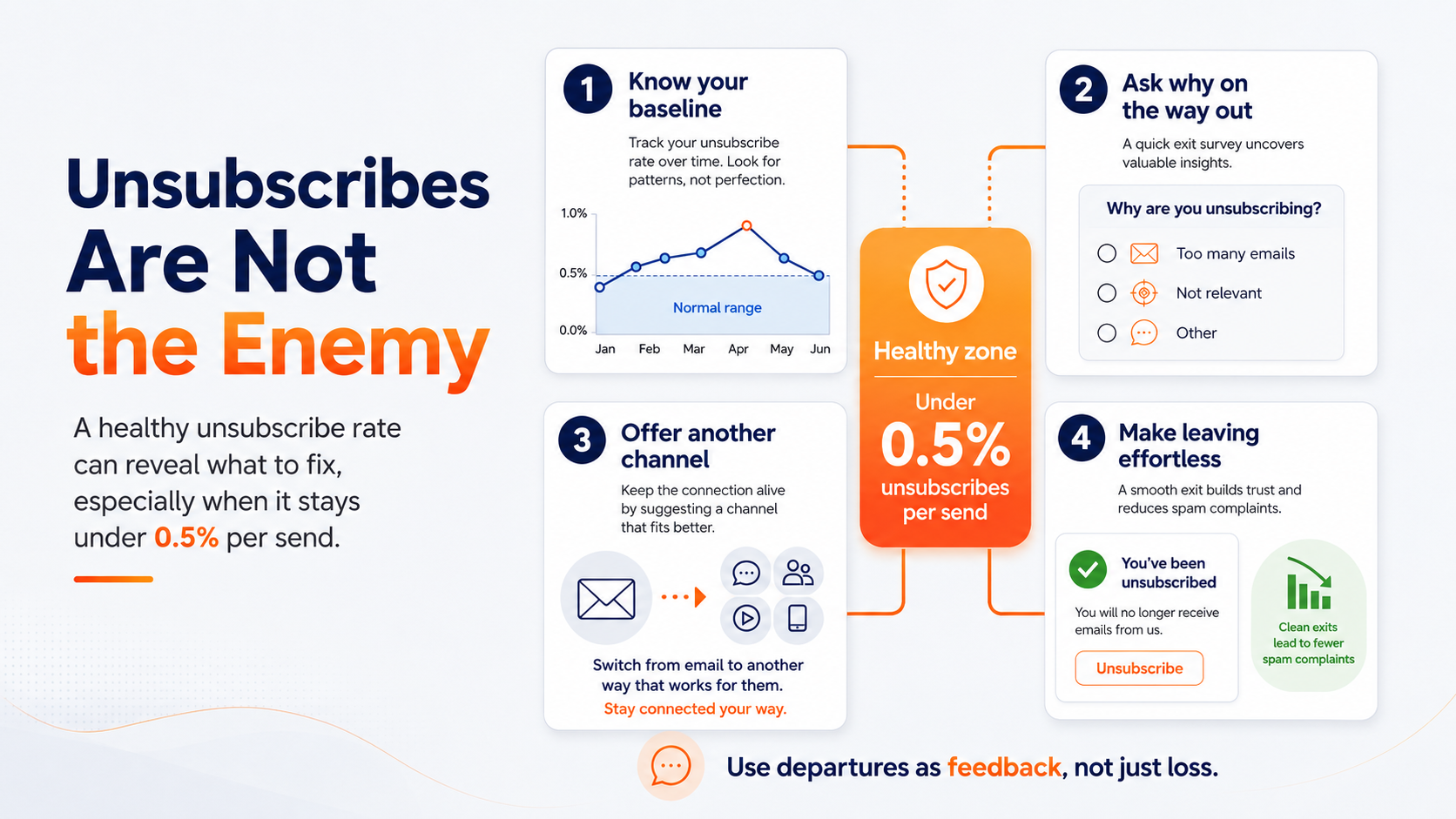
Make Every Exit Work For You
Some people are going to leave no matter what you do, and that is fine. As long as your unsubscribe rate stays under about half a percent per send, you are in healthy territory. The goal is to get something useful out of each departure.
Know your unsubscribe rate baseline
You cannot tell whether a campaign went wrong if you do not know what normal looks like. Pull your unsubscribe rate across the last three to six months and find your usual band. A single spike above it is a signal to go read that send again, not a reason to panic.
Watch the trend more than any single number. A slow climb in your unsubscribe rate over several campaigns usually means fatigue is setting in, and that is a frequency or relevance problem you can still catch before it compounds.
Ask why on the way out
An exit survey costs almost nothing and tells you exactly what your reports cannot. One question on the unsubscribe confirmation page, why are you leaving, turns a dead end into feedback you can act on across the whole list.
Patterns show up fast. If half your leavers cite frequency, you have your next experiment already chosen for you, and you did not have to guess to find it.
Offer a different channel
Someone clearing out their inbox does not necessarily hate your brand. They just want fewer emails.
Put your social links on the final unsubscribe page and invite them to follow you there instead. You may not keep them in the inbox, but you can keep the relationship alive somewhere they are more comfortable.
Make leaving effortless
Never make unsubscribing a chore. Process it instantly, never make someone wait days or hunt through a login. A frustrating exit is how a mild unsubscribe becomes a spam complaint, and complaints hurt you far more than a clean departure ever will.
Pro Tip: Honor unsubscribes the moment they are requested. Anything slower reads as disrespect and invites a spam-button click you cannot undo.
Turn Retention Into A System And Start This Week
Here is what all of this comes down to. Most unsubscribes are a decision made weeks before the click, driven by too much email or the wrong email, and the fix is catching the drift early rather than mourning it later. The problem was never that you sent one bad campaign. It was that no system was watching for the moment engagement started to slide.
That is exactly the gap worth closing, because reacting to unsubscribes one at a time will always leave you a step behind the people leaking out of your list. Watching behavior as it changes, and adjusting what each person receives before they reach for the exit, is what turns retention from a scramble into something that runs on its own.
Fix the gap between list growth and real engagement
That is the job Pinpointe's dynamic segmentation and behavioral automation are built for. We give you the engagement signals to see who is cooling off, and the triggers to adjust cadence or content automatically, so the right message reaches the right person without you tracking it by hand.
If your list is growing on paper but stalling in practice, that gap is usually where the leak is. Book a marketing automation audit, and we will map exactly where your subscribers are drifting and what to change first.