The core email marketing benefits are a strong return on modest spend, direct contact with people who asked to hear from you, messages you can personalize and segment, automation that keeps working after you build it, and results you can measure at the level of each send.
Most benefits lists stop there and repeat one flattened ROI number. The reports behind that number tell a more useful story, with a wide spread between programs that run well and programs that coast.
This guide covers each benefit with sourced data, real customer results, and the limits worth knowing before you put more budget behind the channel.
Key Takeaways
- Email marketing benefits start with ROI: Litmus's 2025 survey found 35% of marketing leaders earn $10 to $36 back per dollar spent on email, 30% earn $36 to $50, and 5% earn more than $50.
- Lower platform costs raise the return: All Things Cruise cut its monthly email software costs by 50% after migrating to Pinpointe, while growing its subscriber lists and reader engagement.
- A real list compounds fast: Byron Ltd. grew its subscriber list from 5,000 to 150,000 in just over a year through referrals, a jump that helped fund a $500,000 investment in new fabrics.
- Automation gives the team hours back: Valley View Casino and Hotel cut campaign deployment from more than five hours to under one, saving 100 to 120 person-hours a month.
- Segmentation sustains growth over time: The Gerson Companies grew its opt-in list 8-fold across a 10-year partnership using up to 25 targeted lists.
In this guide
Why Email Marketing Is Important
Email is one of the few marketing channels where you own the audience and you don't have to worry about a social algorithm changing things overnight.
When your list is built on real permission, subscribers chose to hear from you, so you can reach them without paying for each impression or waiting on an algorithm to show your post.
That makes email less of a tactic and more of an asset you keep building.
You control the contact relationship
Independent analysis from EmailToolTester treats email and social media as complements that do different jobs. Social helps new people find you. Email keeps you in touch with people who already raised their hand.
That control has conditions, and it looks a little different across different types of email marketing, from one-off promotional sends to always-on automated flows. You decide who gets which message and when, but your mail still has to clear mailbox provider filters to land in the inbox, which the limits section below covers.
Privacy changes favor data you collect yourself
The tracking picture is messier than the old "cookies are dying" headlines suggested. Google confirmed in April 2025 that Chrome will keep its current third-party cookie approach and will not roll out a new standalone cookie prompt.
Other browsers went a different direction. Firefox, for example, blocks cross-site tracking cookies by default and isolates the rest.
So third-party tracking is not disappearing on a schedule. It behaves differently from one browser to the next, which makes a permission-based list you collect yourself a steadier thing to build on.
Your list grows with your business
Byron Ltd., a custom tailoring business, spent decades booking fittings through direct mail postcards. After moving to email with Pinpointe, it added a Forward to a Friend form and embedded sign-up forms so existing clients could refer colleagues.
Using these strategies their list grew from 5,000 to 150,000 subscribers in just over a year, and the resulting sales lift led the company to invest $500,000 in new fabrics.
Referral-driven growth on a list you control compounds in a way that rented reach does not.
Strong ROI for a Modest Spend
Email has a reputation for strong returns. Survey data on email programs backs that up, with more spread than the usual headline admits.
What the ROI data shows
In Litmus's 2025 State of Email survey, 35% of marketing leaders reported a return of $10 to $36 for every dollar spent on email, 30% reported $36 to $50, and 5% reported more than $50.
That puts roughly seven in ten respondents at $10 or more back per dollar. It also means the $36 figure you see quoted everywhere works better as a dividing line in the survey than as a promised average.
The spread is the useful part. It tells you return depends on how the program is run, not on the channel alone.
Lower costs raise the return
ROI is a ratio, so the cost side matters as much as the revenue side. All Things Cruise, a travel publisher running several web properties, cut its monthly email software costs by 50% after migrating to Pinpointe, while growing its subscriber lists and reader engagement.
Platform spend is only one input to email ROI. When it falls and engagement holds or rises, the numbers move in your favor.
Personalization and Segmentation at Scale
Because you hold the subscriber data, and customer data shapes what you can do with it, you decide who gets which message instead of broadcasting one version to everyone. Out of all the advantages of email marketing, this one does the most to separate strong programs from average ones.
Relevance drives ROI
In its email ROI research, Litmus lists dynamic and personalized content among the strategies it recommends for raising returns.
That is a recommendation drawn from survey patterns, not proof that personalization alone moves the number, but it does line up with the spread in the ROI data above, where how a program is run matters more than the channel itself.
Segmentation in practice
The Gerson Companies, a wholesale importer of home decor and seasonal gifts, ran up to 25 targeted lists built around trade show attendance, territory, and product line. Over a 10-year relationship with Pinpointe, its opt-in list grew 8-fold while those segments steered retail buyers toward its online catalog and virtual showrooms.
Segments like these do not need to be elaborate. They need to reflect something real about why a person is on your list. The email marketing statistics roundup has more on how these numbers compare across tactics.
Automation That Keeps Customers Engaged
Automation is where email stops being a weekly check box on your to-do list. You build a sequence once, and it fires every time a subscriber does the thing that triggers it.
Get your time back
In a Forrester study commissioned by Salesforce, a composite organization modeled on five Marketing Cloud customers saved 60% of the time it had spent building and running campaigns.
Treat that as one vendor-commissioned model, not an industry average. The direction matches what operators see when manual uploads and one-off sends give way to automated flows.
Valley View Casino & Hotel saw it firsthand. After moving its loyalty program of more than 300,000 members to Pinpointe, the team cut campaign deployment from more than five hours to under one and saved 100 to 120 person-hours a month.
Lifecycle emails support retention
Retention is where automated email drives incredible value. In a 2017 survey of travel-industry marketers by WBR and Performance Horizon, 84% said they rely on email for customer retention, the highest of any channel in the survey.
That is one industry and an older snapshot, so read it as a signal rather than a current benchmark. The logic carries further, though. Welcome, onboarding, renewal, and win-back emails reach existing customers at the moments they decide whether to stay, which is the backbone of lifecycle email marketing.
Scale without rebuilding the program
Networld Media Group ran 10 trade publications and more than 20 weekly newsletters on Pinpointe, sending up to 7 million emails a month. Its CMS pushed drafted newsletter HTML into Pinpointe through the API, so publishing an issue did not mean rebuilding it by hand.
Pro Tip: If you are starting from zero, build one welcome sequence and one basic segment first. Add renewal and re-engagement flows once your list and your data have something to work with.
Results You Can Measure and Improve
Email reports on itself at the level of each send. You can see who received a message, who clicked, and who unsubscribed, which gives you something concrete to fix next time.
Track clicks and revenue, not only opens
Open rates have become a shaky signal since Apple's Mail Privacy Protection. Practitioner guidance from Wbcom Designs recommends judging email on click rate, conversion rate, and revenue per email instead.
Those numbers tie back to outcomes you can defend in a budget meeting. Opens still help as a rough health check, just not as the goal.
See our full article on Mail Privacy Protection for more insight!
Let the reports shape the next campaign
Sandy Paylor-Westra, Creative Director at The Gerson Companies, describes the loop plainly. "We look at the Reports in Pinpointe. We see, 'this is successful, this not so much,' and this helps to develop the messaging."
That habit is the measurable benefit in practice. Each send teaches you something about the next one.
Where Email Marketing Falls Short
None of these benefits are automatic because email works when the list is healthy, the messages are wanted, and your sending setup meets the rules mailbox providers enforce.
Lists decay without steady growth
Two different things wear a list down. Some addresses stop working as people change jobs or abandon inboxes, and some stay valid while the person behind them stops paying attention.
Sign-up forms, referrals, and regular list hygiene are part of the cost of keeping the benefits of email marketing high.
Mailbox providers set the bar for the inbox
Since February 2024, Gmail has required senders of 5,000 or more messages a day to personal Gmail addresses to authenticate with SPF, DKIM, and DMARC and to support one-click unsubscribe on marketing and subscribed messages. Google asks those senders to keep reported spam rates below 0.10% and never reach 0.30%.
Yahoo has similar authentication and unsubscribe requirements for bulk senders, though it does not publish a specific volume threshold.
These are provider policies, not laws, and the email authentication requirements behind them keep tightening. They still decide whether any of the benefits above reach a human being.
Email works best combined with other channels
Email reaches people already on your list. It does little for discovery, which is why independent comparisons pair it with social and other channels that bring new people in, and many teams round out the mix once a prospect is on the list by using email and SMS together.
Putting Email Marketing Benefits to Work in Your Program
The great thing about email marketing is that several of its advantages compound. You reach people who asked to hear from you, you can tailor messages by segment, automated flows keep working after launch, and results show up send by send.
The ROI data is strong but spread wide, and list health plus provider requirements decide whether any of it shows up.
Most of those benefits depend on one discipline, getting the right message to the right segment at the moment it matters, without someone rebuilding it by hand every week.
Separate brand accounts, centralized oversight, and automated flows
That is the work our platform handles. In Pinpointe, dynamic segments update automatically as contact data changes, and Journeys move contacts through multi-step email and SMS flows when they join a list, submit a form, open an email, or click a link, with SMS messages going through the same admin approval as any other send.
If you run email for several brands or clients, Pinpointe's enterprise platform gives each one its own brand account with its own data and journeys, while your central team oversees all of them from one login.
Every customer also gets hands-on onboarding, including help authenticating sending domains with SPF, DKIM, and DMARC.
Find the gaps in your own program
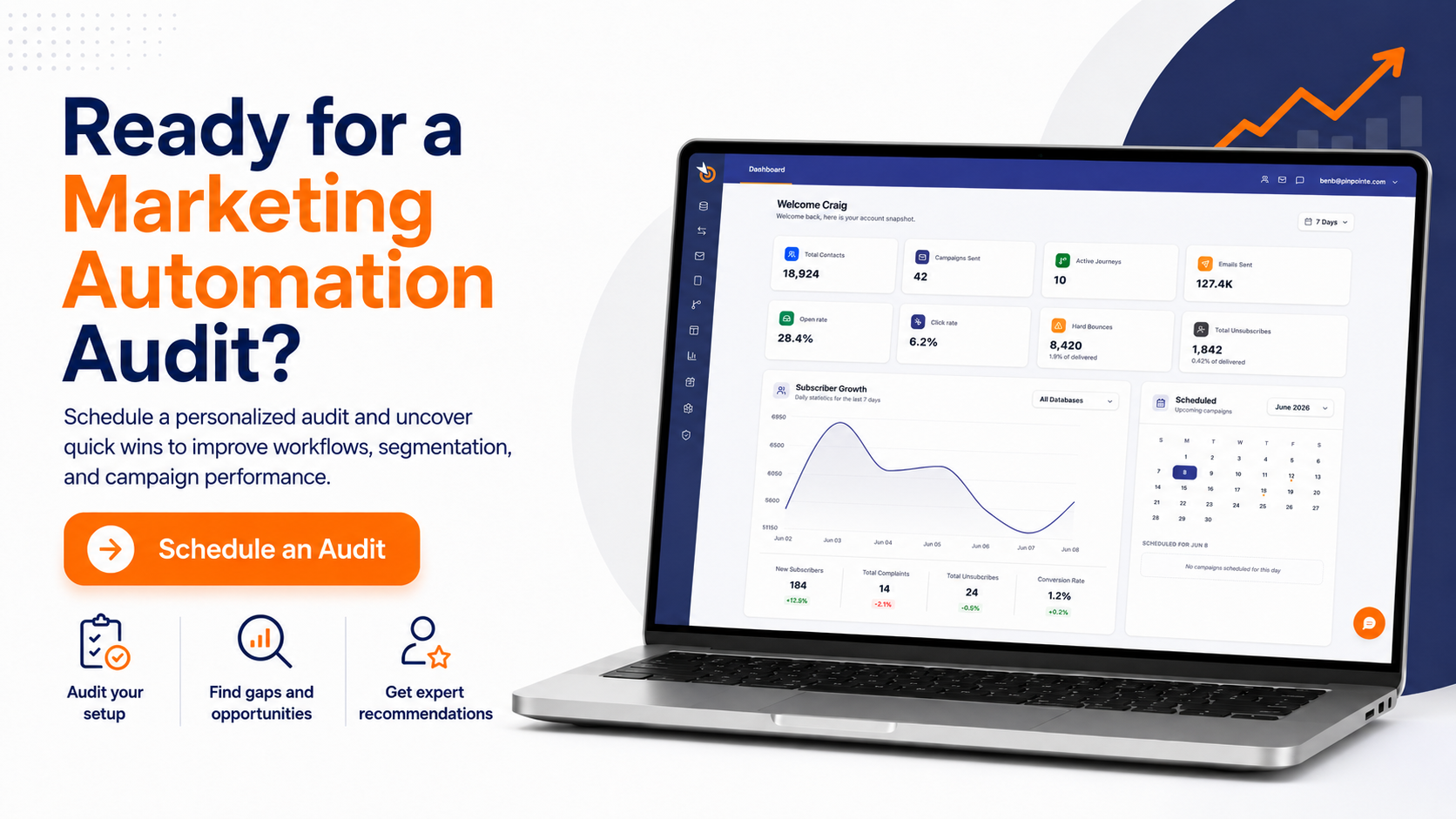
If you already send email and suspect you are leaving some of these benefits on the table, a free 1-on-1 marketing automation audit is a practical next step. We look for the manual work eating your team's time and the points where prospects drop out of your funnel, then give you an automation roadmap you keep either way.
Common Questions About the Benefits of Email Marketing
These are the questions that come up most when teams weigh how much to invest in email.
What are the main benefits of email marketing?
The main benefits are strong ROI, direct access to an opted-in audience, personalization and segmentation, automation, and detailed measurement. In Litmus's 2025 survey, 35% of marketing leaders reported $10 to $36 back per dollar spent and 30% reported $36 to $50.
Is email marketing still effective?
Yes, for teams that keep their lists healthy and their messages relevant. Surveyed marketers still report substantial returns from email, and browser tracking that varies widely, with Chrome keeping third-party cookies while Firefox blocks cross-site tracking by default, makes permission-based contact data more valuable. Results depend on list health, relevance, and meeting mailbox provider requirements.
Is email marketing better than social media?
Neither replaces the other. Email keeps you in touch with people who already opted in, while social helps new people find you, which is why independent analysis treats them as complements.
How should you measure email marketing performance?
Focus on click rate, conversion rate, and revenue per email. Open rates have become less reliable since Apple's Mail Privacy Protection, so they work better as a rough signal than a goal.
What can limit the benefits of email marketing?
List decay and deliverability are the two big ones. Addresses go stale and subscribers drift, and Gmail requires bulk senders to authenticate their mail, support one-click unsubscribe on marketing messages, and keep spam complaints low, with Yahoo enforcing similar rules.