Most brands run email marketing and SMS marketing as two separate programs, on two separate schedules, out of two separate tools. Then they wonder why the campaigns never seem to reinforce each other. The two channels spend their whole lives in different rooms of the same house, and the customer feels the disconnect even if they can't name it.
That breakdown is the real story with SMS marketing and email marketing. The question was never which channel wins. What almost nobody does is run the pair as a single coordinated motion, the way a deliberate email marketing program treats timing, so each one ends up carrying less weight than it should.
How to turn disconnected pings into a coordinated campaign
Does this sound familiar? You send a promo email in the morning, and a text goes out that afternoon from a different dashboard. Then your customer experiences two disconnected pings rather than one clear message arriving twice, in the right order.
If you've experienced this, you aren't alone, and the good news is it doesn't take a rebuild of your entire marketing campaign. It takes understanding what each channel is actually good at, then wiring them together so they hand off to each other rather than talk over each other. Let's get into how.
Why Email And SMS Work Better As A Pair
Start with something most marketers already half-know but rarely act on. Email and SMS solve different problems, and the entire reason to run them together is that their weaknesses cancel out. Lean on one alone, and you're accepting a ceiling you don't have to.
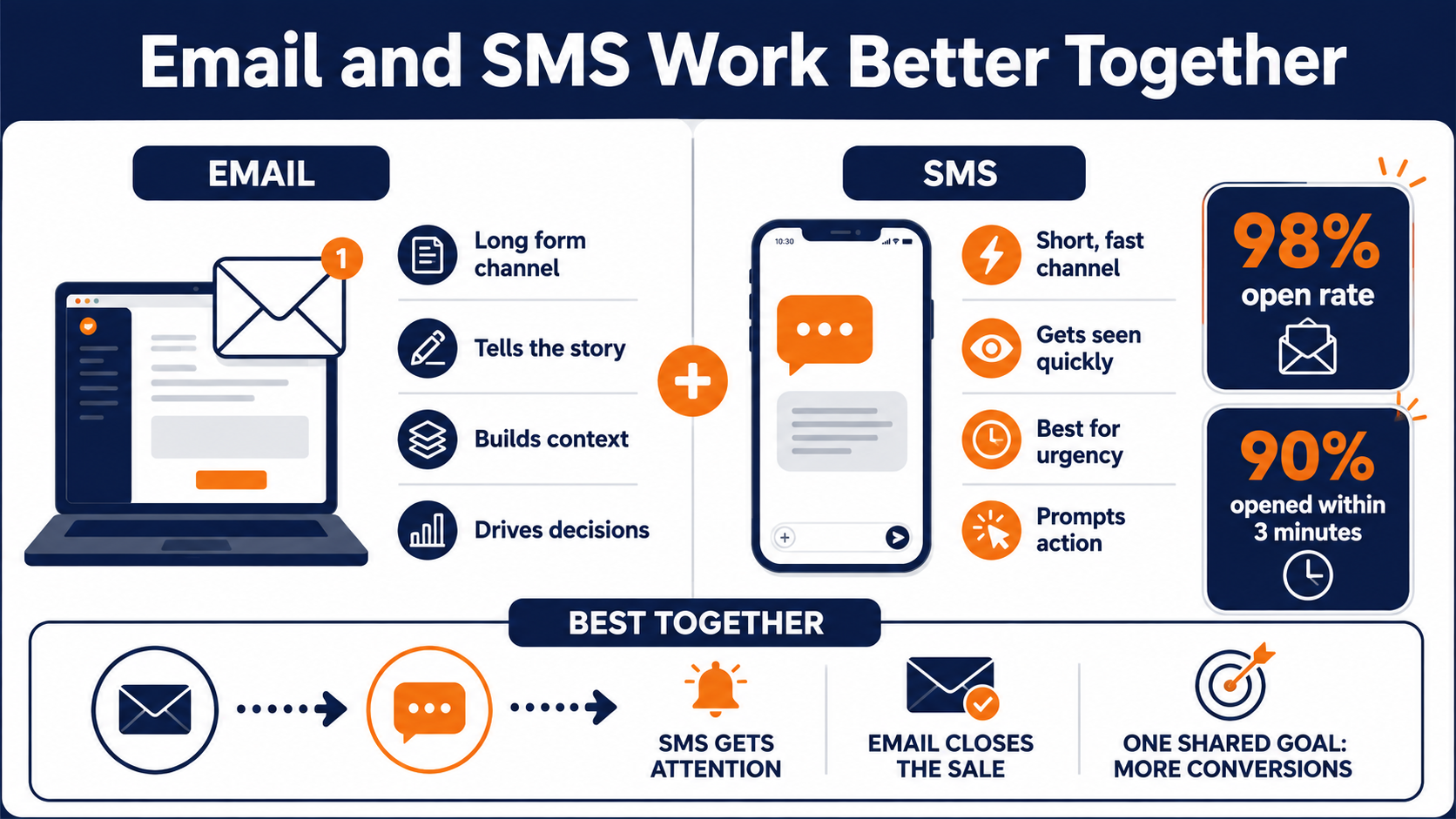
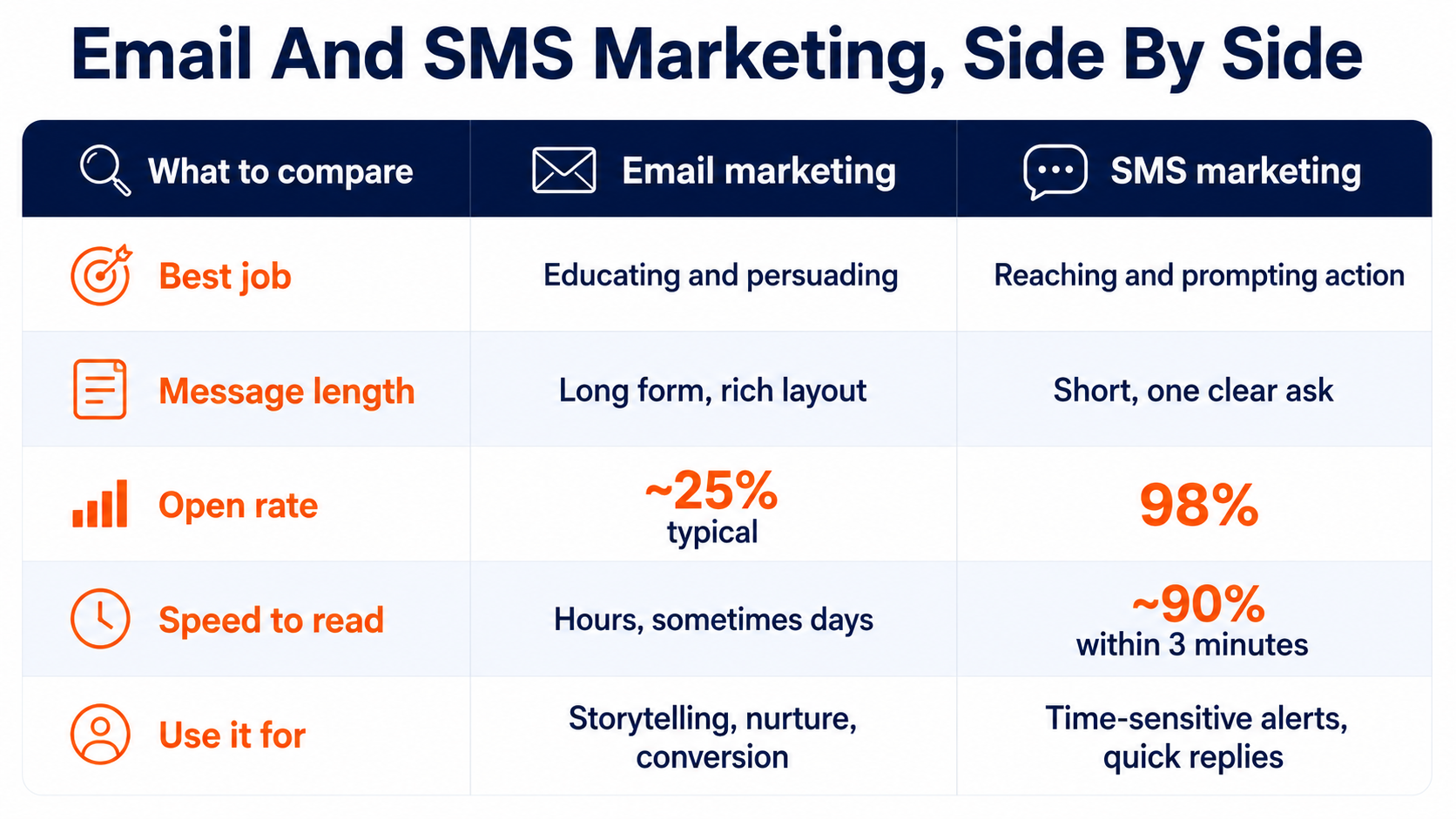
Email is your long-form channel. It holds a headline, body copy, several images, multiple links, and more than one call to action without ever feeling cramped. It's where you educate, tell a story, and give someone enough context to make a decision they weren't ready to make five minutes earlier.
Text messaging plays the opposite position. A message is short by design, usually a sentence or two and a single ask. What it gives up in room, it more than earns back in reach.
The difference in reach is bigger than most people realize
Here's the number that reframes the whole conversation. SMS lands a 98% open rate, against an email average that rarely climbs past the mid-twenties. Nearly every text you send gets seen. You wouldn't use that for every message you have, but it's the channel you reach for when something absolutely cannot be missed.
Speed stacks on top of that reach. Roughly nine in ten texts get opened within three minutes of landing, while an email might sit untouched for a day or two before someone gets to it. For anything time-sensitive, a flash sale ending tonight, a webinar starting within the hour, that lag between "sent" and "seen" decides whether the message mattered at all.
Where email still earns its keep
Speed doesn't make email the weaker channel. It makes it the deeper one. Email is where the actual persuasion happens, because you have the space to build a case instead of just firing off a reminder.
Think back to the last real buying decision you made from a brand. A text may have caught your eye, but the email is probably where you read the details, weighed the options, and clicked through. The two channels play different roles on the same team, and a coordinated email marketing program treats them exactly that way rather than forcing one to do the other's job.
Different strengths, one shared goal
There's a temptation to rank these channels, to decide email is "better" because it converts or SMS is "better" because everyone opens it. That framing misses the point entirely.
The value shows up in the seam between them, where a fast SMS touch sets up a deeper email follow-through, or an email teases something a text later confirms. Ranked individually, each looks incomplete. Sequenced together, they cover for each other's blind spots.
The Real Cost Of Running Them Separately
Running email and SMS out of separate tools on separate calendars doesn't just cost you a bit of polish. It leaves measurable revenue on the table, and the data on coordinated campaigns spells out exactly how much.
One analysis of omnichannel campaigns found that adding SMS made a campaign 47.7% more likely to end in conversion than a single-channel send.
Adding SMS marketing to the mix doesn't nudge conversion up at the margins. But keeping your channels walled off from each other is holding your results down.
Two channels, one customer, zero coordination
Why do separate tools underperform so badly? The answer isn't complicated. Your customer never experiences your "email program" and your "SMS program" as two distinct things. They experience your brand.
So when the morning email and the afternoon text don't reference each other, don't build on each other, and occasionally contradict each other outright, that fractured impression is what sticks.
Coordination is the entire game here. A text reading "check your inbox, the full details are in the email we just sent" converts two weak touches into one strong sequence. You simply can't orchestrate that handoff when the two channels live in tools that were never built to see each other.
Engagement climbs when the channels connect
The lift isn't confined to order rates. It shows up in engagement too. Coordinated, multi-channel campaigns pull far more engagement than single-channel ones, often several times more, from what is, in most cases, the very same underlying audience.
The audience didn't change. The coordination did. It means the distance between an average program and a strong one usually has nothing to do with a bigger list or slicker copy. It comes down to whether your channels are genuinely working together or just running in parallel and hoping for the best.
The compounding effect nobody budgets for
These gaps don't just add up, they multiply. A disconnected program loses a little at the awareness stage, a little more at engagement, a little more at conversion, and by the time you tally the full funnel, the coordinated competitor isn't ahead by a few points. They're ahead by a different order of magnitude. That’s how a modest engagement rate and a standout one turn into wildly different revenue lines even when the list sizes match.

Use SMS To Grow The List Email Can't Reach
One of the most underused plays in omni-channel marketing is pointing SMS and email at each other's growth. SMS feeds your email list, and email deepens the relationships SMS starts. Treat them as parallel channels, and you miss it. Treat them as each other's best acquisition engine and the whole thing compounds.
Picture a live event. Someone's standing in a crowd, phone already in hand, and you want them on your list before they walk out the door. Asking them to open a browser, hunt down your site, and fill out a form is friction most people won't fight through in that moment.
Text-to-join beats a landing page in the moment
A text-to-join keyword strips every step out. "Text JOIN to 12345 for the slides and photos from today" works on the spot, right there in the room, no browser required. You capture the contact at the exact peak of their interest instead of praying they remember to sign up hours later once the moment's gone.
That's precisely the scenario text messaging was built for. Low friction, high immediacy, one crystal-clear action. The second someone's in, email takes the baton for everything that needs more room than 160 characters allow.
Then email does the heavy lifting
A phone number is a starting line, not a finish line. The follow-up is where a coordinated program earns its keep. That fresh SMS subscriber gets a welcome email with the full recap, the resources you promised on stage, and a reason to stick around, exactly the kind of depth a text physically can't carry.
Now the same person is reachable on both channels, each doing what it does best. SMS pried the door open in a moment that would have otherwise slipped by. Email is what turns that open door into an actual relationship. Neither channel pulls that off on its own, which is the whole argument for running them as a set.
Consent is the asset you're really building
There's a payoff to this handoff worth naming. Every text-to-join and every email opt-in is a piece of earned permission, and permission is the scarcest thing in marketing right now.
A subscriber who chose to hear from you on two channels is worth far more than one you can only reach in a single place, because you've got redundancy the day one channel's deliverability dips or an algorithm shifts under you.
It shows up in the numbers too, with campaigns spanning three or more channels posting an 18.96% engagement rate against 5.4% for single-channel sends. Growing both lists together does more than tidy up your setup. It buys you insurance for the day one channel falters.
Cross-Channel Campaigns That Reinforce Each Other
This is where coordination stops being theory and starts moving the revenue line. A cross-channel campaign isn't the same message blasted twice through two pipes. Think of it instead as a deliberate sequence where each channel plays its position and the handoffs carry the weight.
The payoff isn't modest. Automated, coordinated messages made up just 2% of sends but drove 30% of revenue, earning many times more per message than one-off broadcasts.
The takeaway isn't simply "automate more." It's that sequenced, triggered messaging crushes the disconnected one-off, and a coordinated email-and-SMS flow is exactly that kind of sequence.
A sequence beats a broadcast every time
Take a product launch. The email does the storytelling, the full announcement, the imagery, the links to go deeper. Then a short text lands the next day for everyone who never opened it. "Did you catch the new drop? Details are in your inbox." One channel carries the depth. The other guarantees the reach. Together they cover ground neither reaches alone.
That's a fundamentally different animal than firing the identical promo at everyone twice. You're using each channel for what it's genuinely good at and letting the second touch mop up whatever the first one missed. More people see the core message, delivered through whichever medium was most likely to land with them personally.
Timing is a coordination problem, not a guessing game
The wrinkle is that email and SMS run on separate clocks. Email engagement tends to build across the course of a day, while text messages get read within minutes and act on their own late-afternoon and evening rhythm. Fire both at 9 a.m. from two different tools, and you've needlessly stacked them right on top of each other.
Coordinated timing means the email goes out when email works, and the text goes out when texts work, planned as one sequence rather than two calendar entries you're eyeballing across separate screens. That's genuinely hard to pull off by hand across two dashboards. It becomes almost trivial once both channels live inside the same system looking at the same customer.
Conversion is where the discipline pays off
Reach and engagement are the setup. Conversion is the point, and coordinated SMS holds up under that scrutiny. Pair SMS's closing power with email's ability to build the case first, and you've got a one-two punch where email warms the lead and the text lands the ask at the moment it's most likely to stick. That's the sequence doing what neither channel manages solo.
Let SMS Pull The Data Email Can't
There's a simpler use for text messaging that rarely makes the highlight reel, and it may be the most valuable of the bunch. Beyond promotion, SMS marketing is a fast, low-effort way to learn about your list, and every scrap you learn feeds smarter email down the road.
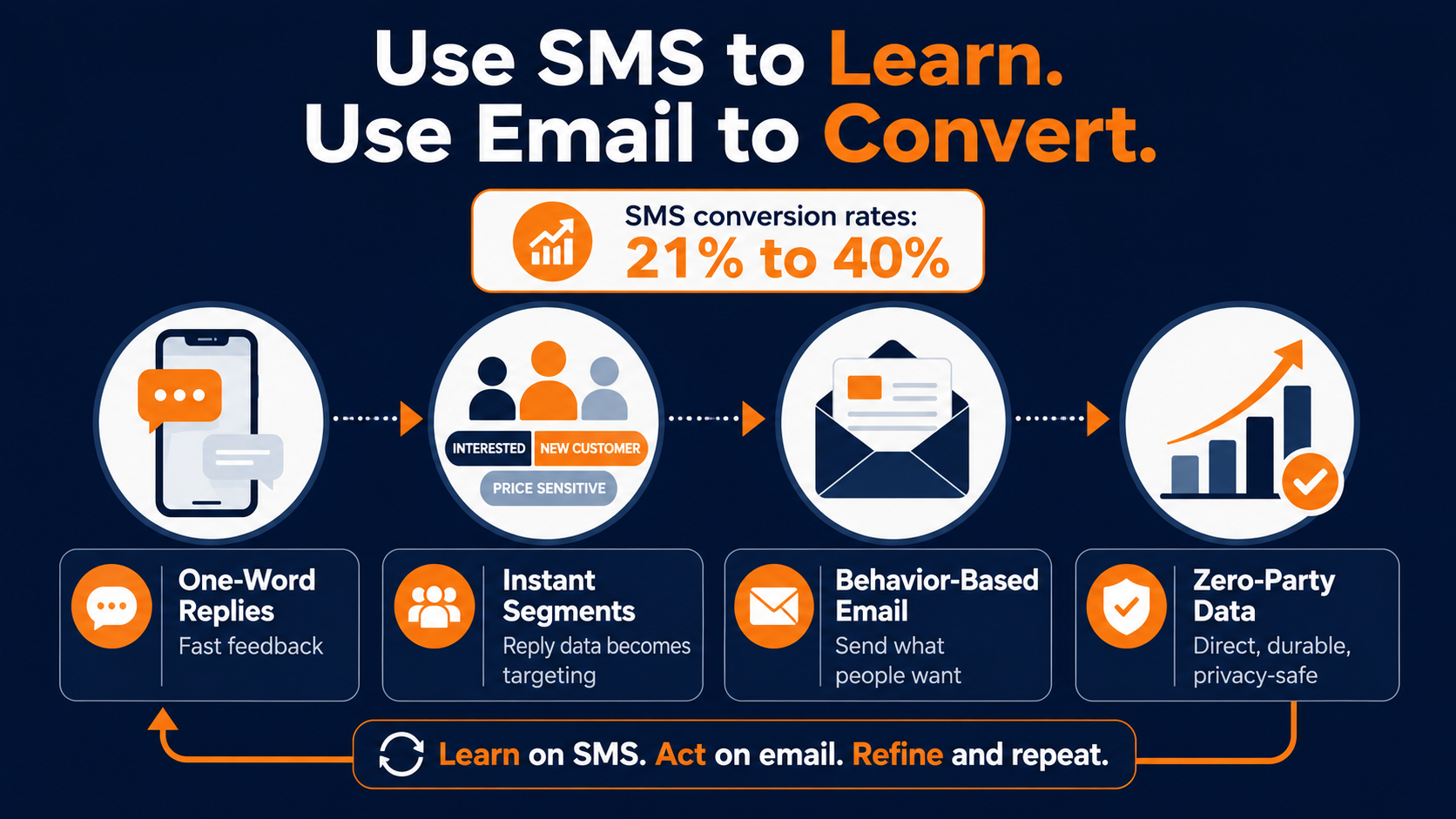
It's worth remembering the channel closes hard too, with SMS conversion rates running between 21% and 40% depending on the vertical, so the data you gather here routes straight into messages that convert.
Email surveys work, but they ask a lot of a person. Open the message, read the ask, click through, wait for a form to load, answer, submit. Every one of those steps sheds respondents. A text collapses the entire chain into a single reply typed without leaving the messages app.
One-word replies become instant segments
"Reply Y if you'd like early access to the sale" is a question anyone can knock out in three seconds. Because more people read texts than email, and because a one-word answer costs the reader almost nothing, you pull responses at a rate an email survey rarely sniffs.
Those replies do more than fill a spreadsheet. Each one is a live segmentation signal you can act on the same day it lands. Everyone who fired back "Y" becomes a segment you can route into a tailored email track, while everyone who stayed quiet holds on the standard path. The text gathered the signal. Email acts on it. That's the loop.
Behavior beats guessing every time
Here's where the two channels really compound. The more you learn through quick SMS touches, the sharper your email targeting becomes, and sharp targeting is the whole difference between a program that feels personal and one that reads like a blast. You stop shipping everyone the identical message and start sending people what their own behavior already told you they wanted.
That loop, learn on SMS, act on email, refine, and go again, is most of what "omni-channel" means once you strip away the jargon. It was never about piling on channels for the sake of the count. It's about channels that actually feed one another.
Small asks build the profile over time
You don't have to interrogate your list to make this work. One light SMS question per campaign, answered in a tap, assembles a richer picture of each subscriber over a few months than a single long survey ever could.
Preference here, a purchase intent there, a product interest somewhere else, and before long your email segments are built on what people actually told you rather than what you guessed about them. The channel that feels almost too simple to bother with turns out to be the one doing your research.
Zero-party data is the version that survives
There's a bigger reason this matters right now. The signals you infer from tracking pixels and open rates keep getting shakier as privacy protections tighten, and a chunk of what your email platform reports is already guesswork dressed up as data. A one-tap SMS reply is the opposite. The subscriber told you directly, on purpose, which is about the most durable kind of data you can hold.
Marketers call that zero-party data, information a customer volunteers rather than something you observed or bought. It doesn't decay when a browser kills third-party cookies or an inbox provider masks opens, and it doesn't carry the compliance baggage that scraped or inferred data does.
Why SMS-collected data outlasts inferred behavior
A text conversation is one of the cleanest ways to collect it at any scale, because the reply is the consent and the answer in a single tap.
The practical upshot is that the list you build this way ages well. Two years from now, the segments assembled from what people actually told you over SMS will still be accurate, while the ones stitched together from inferred behavior will have drifted out of date.
Building the habit now is what pays off later, long after the next privacy change reshuffles everyone else's targeting.
Run Email And SMS As One System, Not Two
Pull the whole argument together, and it lands on a single point. Email and SMS were never rivals, and they were never redundant. Email carries the depth and does the persuading. SMS carries the reach and gets seen within minutes.
SMS grows the list, email deepens it, and each one hands the customer to the other at the moment that channel does its best work.
Separate channels can cap your results, but when you unify them into one sequence, you turn higher engagement into real revenue.
Eliminate channel silos to boost campaign performance
The catch is that every play above assumes the two channels can actually see each other, and in most setups they can't. That blind spot is what holds the results down.
This is exactly what Pinpointe was built to handle, planning email and SMS as one coordinated journey off the same view of the customer, so a reply, a click, or a quiet stretch can fire the next message on whichever channel fits without anyone stitching it together by hand.
If your email and SMS marketing still live in separate systems that can't see each other, that's the first thing worth fixing. Schedule a marketing automation audit with our team, and we'll show you exactly where your channels are working against each other instead of together, and what it would take to finally run them as one.