Lead nurturing automation is the set of rules that decides which leads enter a follow-up sequence, what each one receives and when, which path it takes based on what it does, and when it leaves for sales or drops out. You set the rules once, and the system applies them to every lead, every day, without anyone remembering to hit send.
Across three studies of B2B sales, a 2025 Journal of Marketing paper found the average effect of automated nurturing on conversion ranged from zero percentage points in two studies to 23 percentage points in the third. The difference came down to context.
If you run nurture programs for several clients at once, that finding matters more to you than to almost anyone. Every client brings a different sales cycle, a different sales volume, and a different list, so the same automation can carry one account and do little for the next.
Key Takeaways
- Conversion effect varies widely: A 2025 Journal of Marketing study on B2B lead nurturing automation found average conversion effects of zero percentage points in two of three studies and 23 percentage points in the third, depending on sales cycle length and expected sales volume.
- Automation pays off at the category level: Nucleus Research reviewed 16 marketing automation ROI case studies from 2016 to 2020 and found organizations realized $5.44 in benefits for every dollar spent over three years.
- Agencies run lead nurturing automation at scale: Mudd Advertising managed 5,000 distinct client databases on Pinpointe and sent up to 2.5 million emails a month through automated lead nurturing for its dealership clients.
- Automated drip sequences recover stalled deals: 21st Mortgage Corporation uses automated drip campaigns to target homebuyers who start but don't finish a loan application, driving 2.5 million emails a year across more than 450,000 contacts.
In this guide
What Lead Nurturing Automation Covers
Researchers describe automated lead nurturing systems as software that tracks how leads behave online and nurtures them through personalized content.
That definition covers both sides of lead nurturing, the tracking and the response. Drop the tracking, and you're sending a newsletter. Drop the response, and you're keeping a spreadsheet.
Automation is the execution layer of a nurture program
Four ideas commonly get blurred together in most writing on this topic. Your lead nurturing strategy decides what you want leads to learn and in what order. Funnel stages describe where a lead sits right now in the buyer's journey.
Drip sequences are one way to deliver content on a schedule. Automation rules are what run all of it, deciding entry, timing, branching, and exit for each individual lead.
Your strategy has to come first, and your automation rules only execute what you've already decided.
Inbound lead nurturing describes where a lead came from
Inbound lead nurturing follows up with people who found you first. Some common ways to generate inbound leads could be through a search, a download, or a webinar sign-up. Outbound nurturing follows up with people your team contacted first.
Inbound and outbound tell you how a relationship started. Manual and automated tell you how the follow-up gets done. The two choices are independent, so an inbound lead can be nurtured by hand and an outbound lead can drop into an automated sequence.
The lead source also says less about readiness than people assume. A lead's next action tells you far more than where it came from.
How an Automated Lead Nurturing Workflow Runs
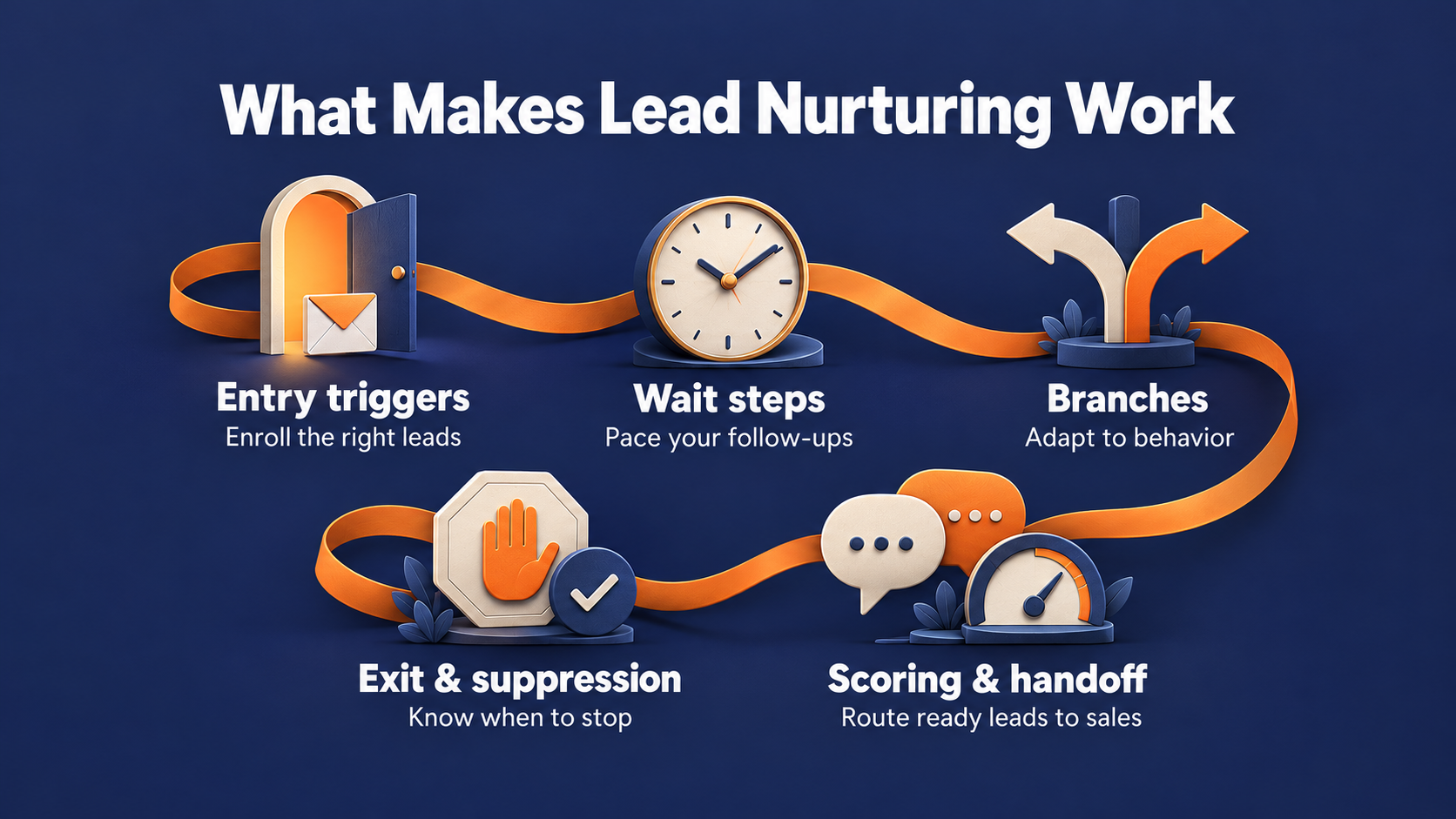
Every automated nurture program, whatever tool runs it, is built from the same handful of decisions. Get one of them wrong and the sequence misfires, often without anyone noticing for weeks.
Entry triggers decide who gets in
An entry trigger is the event that enrolls a lead. Common ones are a form submission, a content download, being added to a list, or a click on a specific link.
Be narrow here and match your trigger to the appropriate sequence. A lead who downloaded a pricing guide and a lead who subscribed to a newsletter should not land in the same sequence on day one.
Waits set the pace between touches
A wait or delay step holds the workflow until a set amount of time passes or a specific date arrives, which is how automation spaces follow-ups over days instead of firing them all at once.
The wait is what makes a sequence feel like a conversation rather than a pile-up. A drip email campaign is the simplest version of this pattern, one wait step repeated on a fixed schedule.
Pace matters more than most teams expect. Too tight and the sequence reads like a vendor chasing a quota. Too loose and the lead has forgotten why they signed up. Either end can drop conversions, so getting the spacing right is essential.
Branches send leads down different paths
A branch is a condition check. Did the lead click the case study link? Did they open the last two emails or ignore them?
Each answer routes the lead to a different next step. This is where automation is most valuable, because behavior picks the next message instead of a fixed calendar.
Exit and suppression rules stop the sequence on time
Exit rules pull a lead out when the job is done or the situation changes. A lead who books a meeting, becomes a customer, or unsubscribes should leave the sequence immediately.
Suppression rules keep specific contacts out of a sequence entirely, such as current customers or anyone already talking to sales. Skip these and a brand-new customer gets a "still thinking it over?" email a week after signing.
Lead scoring and handoff move ready leads to sales
Lead scoring adds points for behavior and fit, and the threshold you set decides when a lead becomes a marketing qualified lead. An MQL has met marketing's criteria but hasn't yet been validated by sales, so the handoff opens a sales conversation rather than finishing one. A clear email lead scoring model keeps that threshold consistent instead of a gut call.
From there, routing automation can score incoming leads and send qualified ones to the right rep without manual triage. Treat your threshold as a setting you adjust over time. Agree on it with sales in writing as part of your broader sales and marketing alignment, and revisit it when the leads sales receives stop matching what they expected.
Set the threshold with quality in mind. A threshold set too low floods sales with volume and teaches reps to ignore marketing's leads.
How the lead nurturing funnel maps to automation
In a lead nurturing funnel, top-of-funnel leads are still learning, middle-of-funnel leads are comparing approaches, and bottom-of-funnel leads are close to a decision. Automation treats those stages as states a lead moves between, and each move can change what the lead receives next.
Downloading a comparison guide might move a lead from early education into a sequence built around case studies. Replying to a sales email might trigger the handoff.
The stages are a model you configure for each program, so define them by the behaviors that matter for that business. If you haven't mapped yours yet, start with a simple email funnel and add automation rules once the stages are clear.
When Automated Nurturing Pays Off and When It Doesn't
Vendor claims about nurturing tend to promise a lift for everyone. The best recent evidence is more useful because it tells you where automation helps and where it doesn't.
What the 2025 Journal of Marketing study found
A 2025 study in the Journal of Marketing examined automated lead nurturing in B2B sales across three quantitative studies. The average effect on conversion probability was zero percentage points in two of the studies and 23 percentage points in the third, and it varied with the lead's sales cycle length, expected sales volume, and existing relationship with the seller.
Read those results carefully. They are averages across different study settings, not a range you can expect for any single lead, and zero was the more common result.
Automation works best on new leads and shorter cycles
According to the study authors' summary for the American Marketing Association, automated nurturing works best for new leads, short sales cycles, and lower-value deals, and its benefit declines for high-ticket purchases. That doesn't mean you skip automation on big deals. It means you stop expecting the sequence to close them.
The researchers also found that automated nurturing improved the quality of conversations between salespeople and leads, which in turn drove conversion. The sequence does its best work by making the sales call better informed.
Co-author Michael Ahearne advised that companies should make sure automated nurturing supports their sales teams rather than replacing personalized engagement, especially on high-value sales. For long, expensive deals, plan on automation and people working together.
What broader automation research measures
Research on marketing automation as a whole tells a steadier story, the kind you'd use to justify a broader marketing automation strategy rather than judge one nurture program. Nucleus Research reviewed 16 ROI case studies published between 2016 and 2020 and found deploying organizations realized $5.44 in benefits for every dollar spent over three years.
That figure covers marketing automation broadly, so treat it as evidence the category pays, not a forecast for one nurture program. It doesn't contradict the 2025 study. It describes an average, and your results depend on whether your leads look like the ones behind it.
Running Automated Nurture Programs Across Multiple Clients
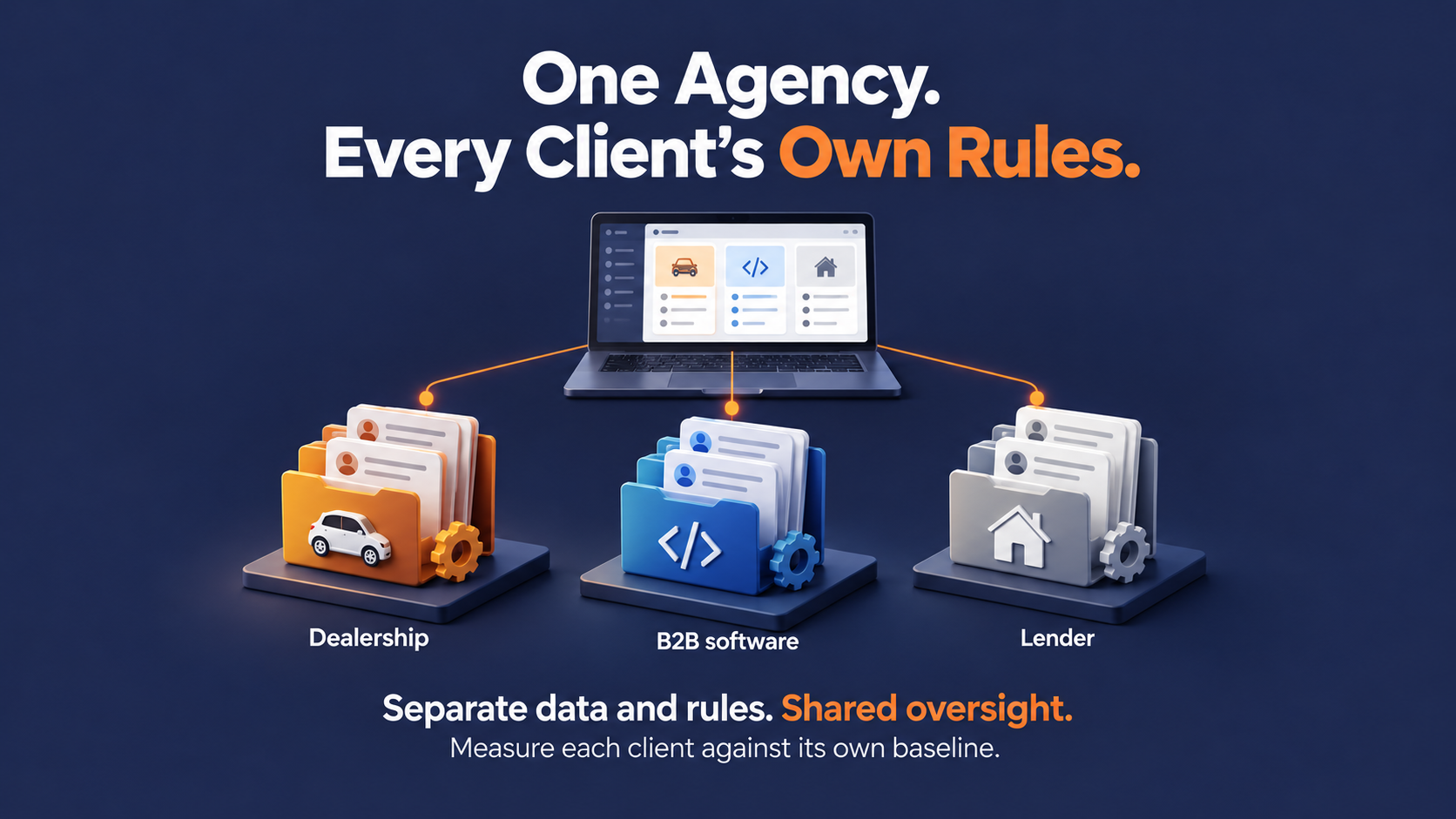
Agencies feel the context problem harder than anyone, because every client is its own context. A dealership, a B2B software company, and a lender can differ on exactly the factors the research flagged, such as sales cycle length and existing customer relationships, so one client's results won't necessarily carry over to the next.
Each client needs its own data and its own rules
The fastest way to break a multi-client program is to run every client out of one shared account. Segments can reach across clients, a suppression list built for one brand can block another, and one misfired trigger sends the wrong brand's email to the wrong list.
Keep each client's contacts, triggers, sender identity, and reporting separate, while your team still manages every client from one place. Mudd Advertising, an automotive agency serving more than 5,000 dealerships, managed 5,000 distinct client databases on Pinpointe and sent up to 2.5 million emails a month on behalf of its dealer clients.
The agency also pushes performance data from those sends into its own Salesforce reporting through Pinpointe's API. That lets it see results across clients without exporting them one account at a time.
Measure each client against its own baseline
The 2025 research gives agencies a practical rule. If automated nurturing's effect varies with sales cycle length, expected sales volume, and the existing relationship, a sequence that lifts one client's conversions may do little for another.
Compare each client's nurtured leads with that client's own non-nurtured or pre-automation results. An industry average or your best-performing client is the wrong yardstick.
Automation as the filter before the CRM
Multi-entity teams also use automated nurturing as a filter in front of more expensive systems. An enterprise SaaS company uses Pinpointe to nurture old trade show leads at the top of the funnel and passes only highly engaged leads to sales, which keeps unengaged contacts out of its more expensive CRM.
21st Mortgage Corporation, a wholesale lender managing more than 450,000 contacts across several sister companies, keeps each business unit's account separate while selectively sharing templates and assets. Its automated drip campaigns target homebuyers who start a loan application but don't finish, drive 2.5 million emails a year, and help the company close more loans.
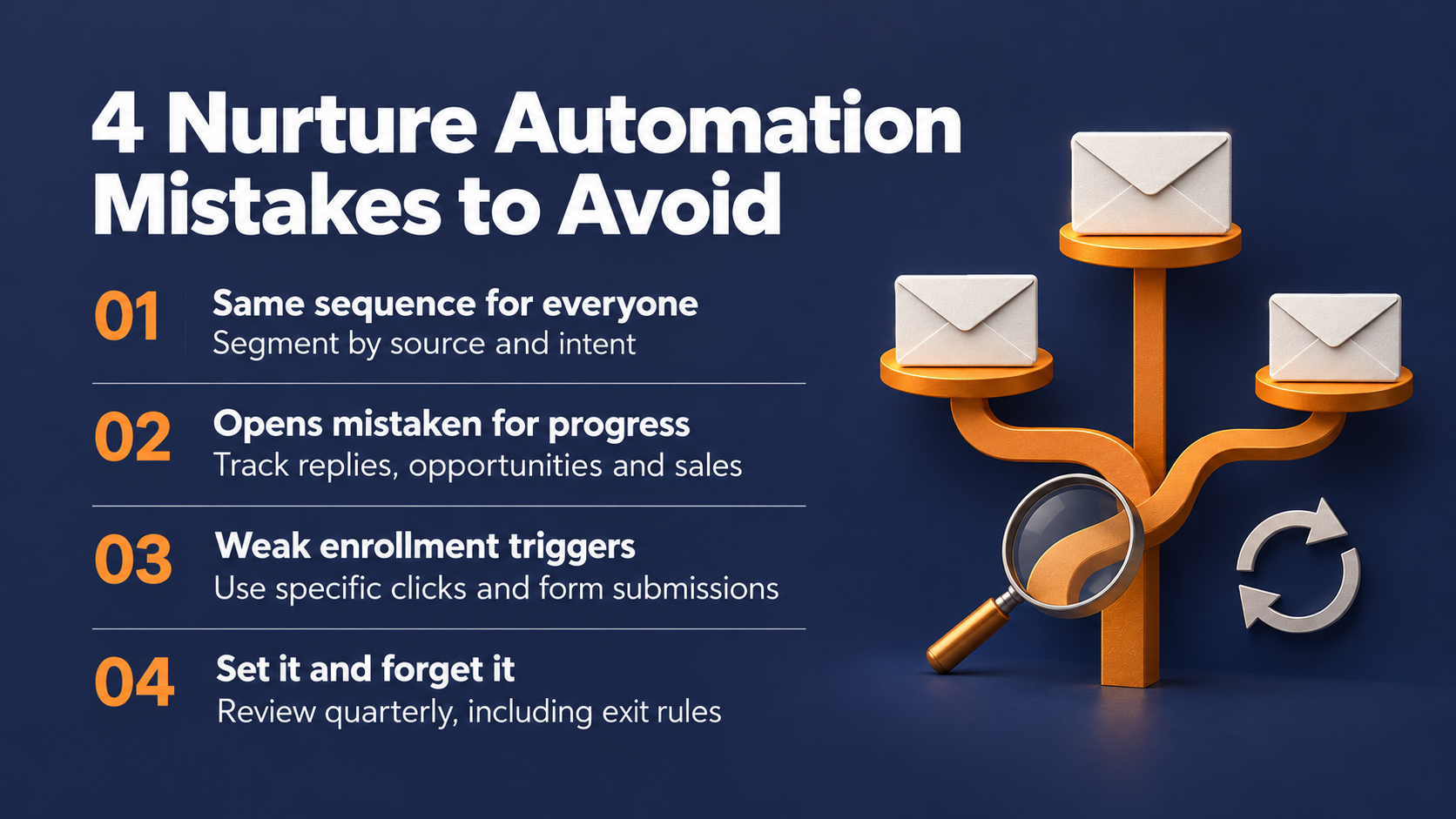
Mistakes That Quietly Stall Nurture Programs
Nurture programs can drift after launch as offers, content, and sales priorities change while the rules stay the same. The same discipline that keeps a nurture campaign fresh applies to the automation running it.
Sending every lead the same sequence
One sequence for every lead ignores the whole point of tracking behavior. Build separate entry points for different sources and intents, then let branches split them further.
Measuring opens instead of progress
A tracked open doesn't prove anyone read the email. Apple notes that Mail Privacy Protection can download remote email content in the background whether or not the recipient engages with it. Clicks, replies, and form submissions are stronger signals.
Even those are early signals. The metrics that show a nurture program is working track progression, such as opportunity creation, deal size, and time to close. A program can look healthy on a dashboard while doing nothing for pipeline.
Firing on weak triggers
A trigger like "opened any email" enrolls people who opened by accident and people whose mail app registered an open automatically. Use actions that signal intent, such as a click on a specific link or a form submission.
Setting it once and never revisiting it
Your sequences age. Offers expire, case studies go stale, and the client's sales team changes what it considers a good lead.
Put a review on the calendar for every client program, at least once a quarter, and include exit and suppression rules in it. Those rules decide who stops hearing from you, so a mistake there reaches customers directly.
Making Lead Nurturing Automation Work for Every Client
Lead nurturing automation comes down to five sets of rules, covering entry, waits, branches, exits, and handoff. Set them carefully, and the system runs follow-up for every lead without anyone babysitting it.
The research adds the caveat that it decides results, because the payoff depends on each client's sales cycle, expected sales volume, and existing relationships.
You probably already know what good nurturing looks like for each client. Where it gets hard is running a separate rule set per client without one client's contacts or triggers bleeding into another's.
Scale across multiple clients without cross-contaminating data
Pinpointe is a multi-brand marketing communications cloud, which means one platform runs many independent client accounts at once. On Pinpointe's enterprise platform, each client's account can be set up fully separate, with its own contacts, sender identity, journeys, and reporting, and your team manages all of them from one admin login.
Inside each account, our Journeys run the rules covered above. Behavioral triggers like form submissions, opens, and link clicks enroll or advance leads, conditional branches split them by what they do, and runtime settings can limit a journey to weekdays or an active date range. When a lead is ready, the API, webhooks, or Zapier push it into the client's CRM.
Find where your clients' nurture programs leak
If you want a second set of eyes on a client's program, book a free marketing automation audit. In a 30-minute 1-on-1 session, we'll look for the manual follow-up still draining your team's time and the points where leads drop out of the funnel. You'll leave with an automation roadmap you keep either way.
Frequently Asked Questions
Quick answers to the questions this topic raises most often.
Is automated lead nurturing the same as a drip campaign?
A drip campaign sends a fixed series of messages on a schedule. Automated lead nurturing adds behavior tracking, branching, exit rules, and handoff to sales, which is why researchers describe it as software that tracks how leads behave and responds with personalized content. A drip can be one piece of an automated program, but it's rarely the whole thing.
Does automated lead nurturing increase conversions?
It can, though results vary. Across three B2B studies, a 2025 Journal of Marketing paper found average effects of zero percentage points in two studies and 23 percentage points in the third, with the strongest results on new leads, short sales cycles, and lower-value deals.
When should an automated sequence hand a lead to sales?
Hand a lead off when it crosses the score threshold you and sales agreed on, which marks it as a marketing qualified lead. An MQL has met marketing's criteria but still needs sales to validate it, so send it over with its engagement history attached.
How do you measure lead nurturing automation?
Measure progression, not just engagement. Track opportunity creation, deal size, and time to close for nurtured leads, and compare each program against its own pre-automation baseline.