
AI email deliverability is your ability to reach the inbox and get noticed once you're there, now that the major mailbox providers use automated, machine-learning filtering to assess sender reputation, authentication, engagement, and content.
Spam filters often decide if your email goes to inbox or spam before a human ever sees it. Newer AI inbox features influence what gets summarized and surfaced after that.
A high delivered rate in your ESP dashboard feels like good news. It only means a receiving server accepted the message. Where it landed, and whether anyone saw it, are separate questions, and AI now plays a part in both.
If you run email for a B2B company, an agency, or a portfolio of brands, here is what the filters weigh, which AI inbox claims hold up, and the gaps worth fixing first.
Key takeaways
- Inbox placement varies sharply by provider: Validity's 2026 benchmark measured 87.2% global inbox placement in 2025, up 3.7 points year over year, with Gmail at 89.8%, Yahoo at 87.3%, Apple at 82.0%, and Microsoft at 77.4%, so a healthy AI email deliverability number at one provider can still mask trouble at another.
- Keep complaints under 0.1%: Validity's network averaged a 0.06% spam complaint rate in 2025 and recommends staying under 0.1%, below the 0.3% ceiling many senders used to treat as safe.
- Google's RETVec cut false positives by 19.4%: Replacing Gmail's previous spam-classifier component with RETVec improved spam detection by 38% and reduced false positives by 19.4%, part of how AI spam filters weigh legitimate mail.
- B2B mail faces a tougher filter: Validity found 83.0% inbox placement at hosting platforms like Google Workspace versus only 79.0% at corporate filtering companies such as Proofpoint, a gap tied to sender reputation and authentication breaking at the gateway.
- Spam filtering is still the top complaint: In a 2025 Kickbox survey of 421 US businesses, 60.3% named spam filtering as their biggest barrier to the inbox.
In this guide
What AI Email Deliverability Actually Measures
Three different results get lumped together under one word, but when you pull them apart, your reporting starts making sense.
Delivery, inbox placement, and visibility are separate results
Delivery means the receiving server accepted your message. Validity points out that the delivered rate in most ESP dashboards is a sent-minus-bounced calculation, which tells you nothing about whether the email reached the inbox or the spam folder.
Inbox placement is the share of mail that actually lands in the inbox. Visibility is the newer layer. It covers whether an AI summary, a priority view, or a relevance sort puts your message in front of the reader once it's there.
Spam filters control placement. AI inbox features mostly shape visibility. Mix the two up, and you'll spend a quarter fixing the wrong problem.
Where inbox placement stands right now
Validity's 2026 benchmark measured 87.2% inbox placement in 2025 across the campaigns in its seed-testing data, up 3.7 points year over year. That means 12.8% of tested messages never reached an inbox.
Those figures come from seed addresses Validity's customers use to test campaigns. Treat them as a strong benchmark, not a census of every email sent.
The provider matters as much as the program. Within the same benchmark data, Gmail averaged 89.8% inbox placement, Yahoo 87.3%, Apple 82.0%, and Microsoft 77.4%.
Each provider runs its own filtering. A program that looks healthy at Gmail can still be struggling at Outlook, and a blended number hides that.
How AI Spam Filters Decide Where Your Email Lands
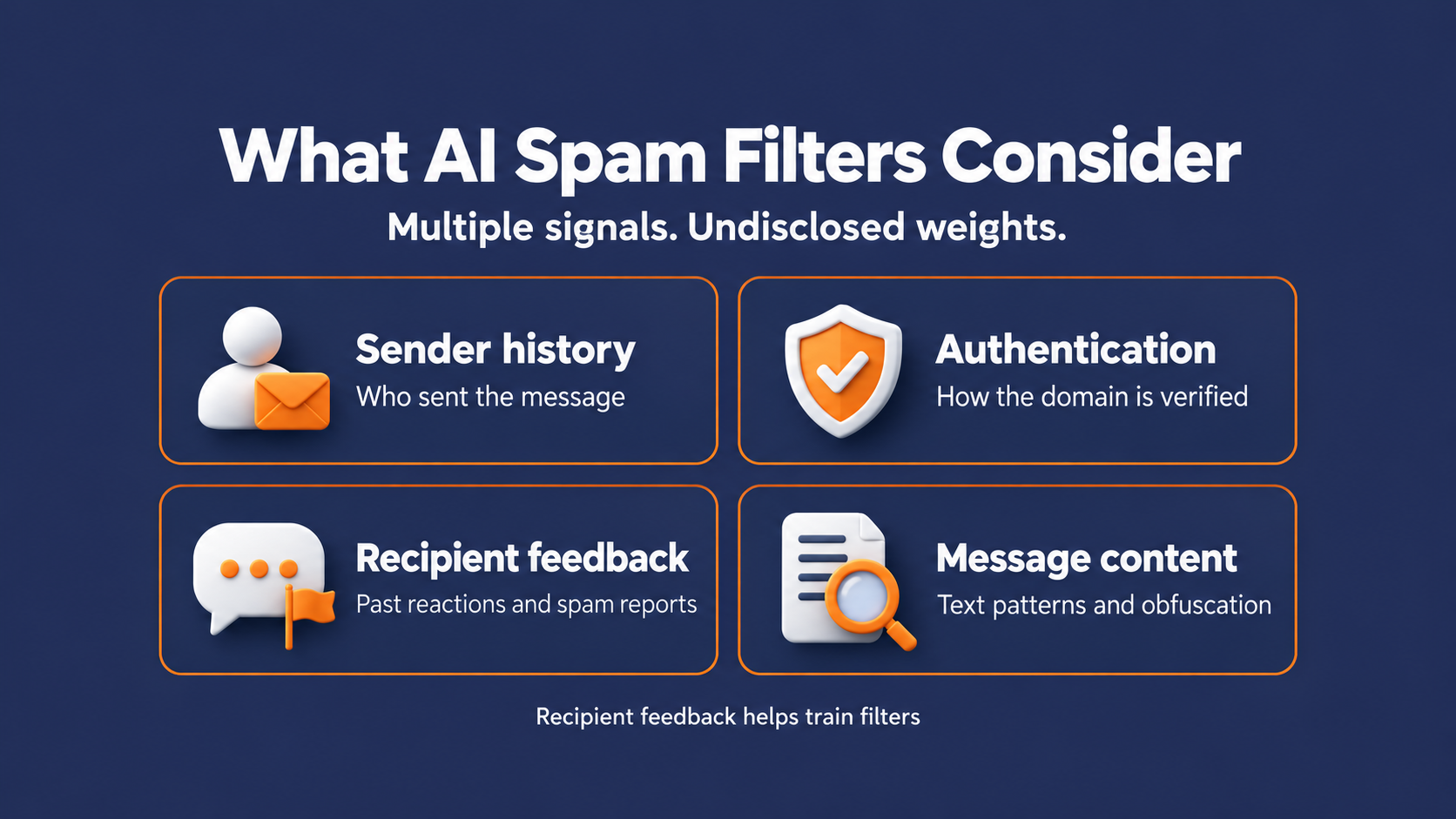
AI spam filters are machine-learning classifiers that weigh many signals at once, including who sent the message, how the domain is authenticated, how recipients treated past mail, and what the content looks like.
Nobody outside the provider sees the weights. What you can work from is what providers have chosen to disclose and use that to adjust your email marketing strategy.
What Google has disclosed about Gmail's text classifier
Google is one of the few providers to publish specifics. In late 2023, it reported that replacing the Gmail spam classifier's previous text vectorizer with one called RETVec improved spam detection by 38% and cut false positives by 19.4%.
RETVec is one component, the piece that turns text into something the classifier can score. Google built it to hold up against obfuscation, the swapped characters and deliberate misspellings spammers use to dodge older filters.
For senders, the practical read is that those tricks are less likely to slip through. It doesn't mean an honest typo sinks your campaign.
Recipient feedback still trains the filter
These models learn from people. Microsoft runs a Spam Fighters program that asks participants whether marketing emails they received are legitimate or junk, then uses the negative-response rate to calibrate its spam filters.
Validity notes that mailbox providers rely heavily on spam complaint rates when they make deliverability decisions, the same principle behind every individual "report spam" click, applied at scale.
Sender Reputation and Authentication in an AI-Filtered Inbox
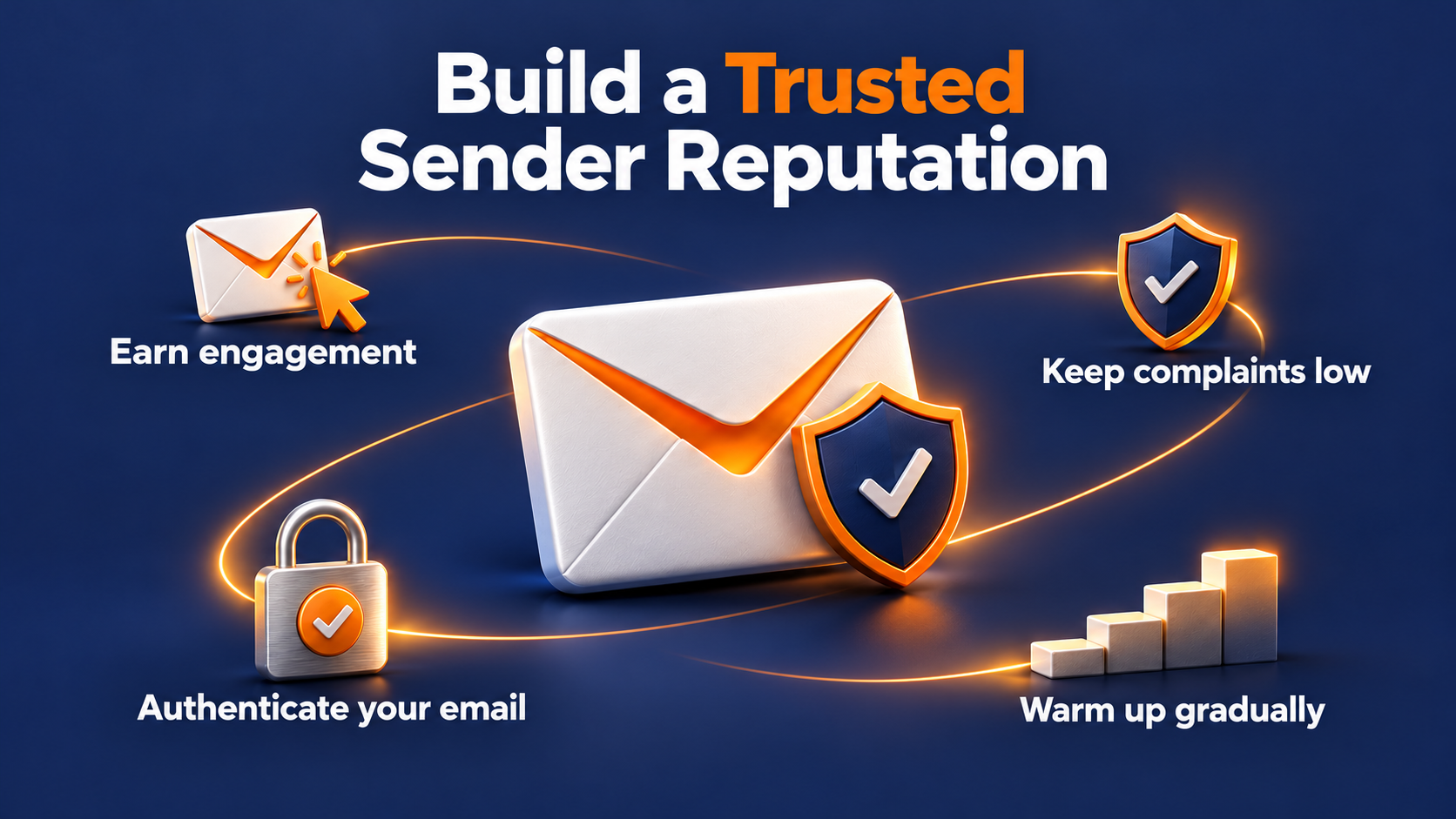
Sender reputation is the running record a mailbox provider keeps on your domain and IPs, and it's built from how recipients react and how cleanly you send. Providers don't publish their scoring weights or how often they update them.
Validity lists mailbox providers prioritizing user engagement as a primary trust signal among its key findings. If you're standing up a new sending domain or IP, that record starts from nothing, which is why warming up a new domain or IP deliberately matters before you lean on it for volume.
Why complaint rates matter
For years, the working rule was to keep spam complaints under 0.3%. Validity's latest benchmark says under 0.1% is now the expectation, and its network averaged 0.06% in 2025.
A reported spam rate of 0.2% is twice the recommended 0.1% threshold. Google calculates that rate as the share of messages delivered to engaged recipients' inboxes that those recipients then mark as spam, not a share of total campaign volume.
Engagement now feeds your reputation
Gmail offers a visible example. For personal Google accounts, Google added a Most relevant sort to the Promotions tab that surfaces senders and brands each user engages with most, rolling out first on mobile, with Most recent still available.
That's a visibility change inside Promotions, not a spam-filter rule, but it does show which way Gmail is heading.
Nobody outside Google publishes the exact weighting, so there's no formula to game. So your focus should be to send mail people want to open and act on.
Authentication is the entry ticket
None of the above matters if a provider can't confirm you are who you say you are. Google's sender guidelines require senders of roughly 5,000 or more messages a day to personal Gmail accounts to authenticate with SPF, DKIM, and DMARC, and their marketing and subscribed messages must support one-click unsubscribe.
If you want the full current rulebook rather than just the highlights, Pinpointe's 2026 guide to email authentication walks through SPF, DKIM, and DMARC end to end.
The B2B exception and the case for stricter authentication
There's a B2B wrinkle here. Google's sender guidelines FAQ says the requirements apply only to mail sent to personal Gmail accounts, not to Google Workspace business addresses.
Yahoo applies similar core requirements but explicitly declines to name a volume threshold. A program under Google's line can still count as a bulk sender at Yahoo.
AI raised the stakes on spoofing too. Validity notes that criminals now use AI to write more convincing fraudulent email, and recommends setting DMARC to at least p=quarantine, ideally p=reject. An enforced policy asks receiving servers to quarantine or reject mail that fails your domain's authentication checks, which cuts down on direct spoofing of your domain.
A regulated industry example
Senders with loaded vocabulary feel all of this first. Coastal Insurance Underwriters sends policy updates to agency partners in language full of words like coverage, liability, and property, which can trip generic spam filters. Using ReturnPath-certified dedicated IPs and direct HTML control, the firm has held a 96% to 99% inbox deliverability rate across more than five and a half years on Pinpointe.
The lesson for other regulated senders is to own the infrastructure and the HTML, then keep the sending record clean. That way, risky-looking words aren't the only thing a filter has to go on.
How to Format Emails for AI Inbox Features
This is where most of the hype lives, so we'll start with what's documented. Google describes AI Inbox as a view that surfaces to-dos and topics, not as a measure of inbox placement.
AI inbox views work after placement is decided
Gmail's AI Inbox is the headline example. Google announced on October 15, 2026 that it's rolling out to eligible paid Workspace plans, starting October 12 for Rapid Release domains and October 26 for Scheduled Release, limited to US users with English set as their language.
Its scope is narrow. Google's help page says AI Inbox only surfaces information from the Primary tab, not Social or Promotions, and filters out spam plus anything the user archives, deletes, mutes, or snoozes.
The rise of AI-driven inbox prioritization
This means a promotional email can land in the Promotions tab without ever appearing in AI Inbox. Its absence from that view doesn't tell you whether the message was delivered, filtered, or read. If this is the first you're hearing of AI reading into message handling, AI's growing role inside the inbox is worth a closer look on its own.
Other providers are moving the same direction. Validity describes Gmail's broader Gemini integration as lifting high-priority messages based on a user's contacts, response patterns, and engagement, and lists Yahoo's AI-powered Catch Up feature and Apple Intelligence's priority sorting among 2025's inbox changes.
Put the point in the first lines
If an AI is going to summarize your email, make the summary easy to get right. Validity recommends senders become "machine-readable" by front-loading key information, using semantic formatting, and adding inbox markup like Gmail Annotations.
That's writing advice borrowed from SEO, and nobody has shown it moves spam placement. Do it anyway, so the summary your subscriber reads says what you meant.
Build the HTML in the order a machine reads it
Knak's guidance argues that AI reads an email in the sequence the markup dictates rather than the layout you see.
How each AI inbox product processes content isn't public, so treat that as practical advice rather than a documented rule. Still, an image-only hero with the offer baked into the graphic leaves a text-dependent summarizer with very little to go on.
Live text, descriptive alt text, and headings in a logical order are the safer default.
Does AI-written copy get flagged
A 2024 study reported that 450 low-volume, plain-text AI-generated emails reached participants' inboxes under its test conditions.
The study didn't compare those emails against human-written ones. It can't tell you whether AI authorship helps, hurts, or does nothing to spam placement.
What is documented is the reader risk. Validity cautions that many audiences can identify AI-generated content and may engage less with it, and engagement is a signal that mailbox providers lean on.

The Deliverability Gaps Most Likely Hurting Your Reach
In a 2025 Kickbox survey of 421 US businesses conducted by Centiment, 60.3% named spam filtering as their biggest barrier to inbox delivery. Those numbers track with the broader state of email marketing benchmarks most teams are already measuring against. The gaps below are a practical place to start.
Reporting delivered rate as if it were inbox placement
If your monthly report shows delivered rate and calls it deliverability, you're grading yourself on the easy part. Validity's 2025 benchmark measured 87.2% inbox placement across its seed-tested campaigns, which is why accepted delivery and inbox placement should be measured separately.
Add inbox placement testing to the report and track the two numbers side by side. A climbing bounce rate is one of the clearest early warnings that your delivered rate and your inbox placement are starting to pull apart.
Mailing contacts who stopped engaging
Relevance-sorted inboxes reward mail people interact with. Validity's guidance pushes senders to focus on meaningful engagement rather than send-time tuning, since AI-driven inboxes sort more by relevance than by arrival time.
Re-engage or suppress the long-dormant segment before it drags down the contacts who still read you. Regular list hygiene is what keeps that segment from quietly growing in the first place.
Sending from a no-reply address
Give people a way to answer you. Validity reports that Microsoft's 2025 sender guidance asked that the From or Reply-To address be valid and able to receive replies, and predicts reply rate will become a primary KPI.
Neither point proves providers score each reply. A no-reply From address with no monitored Reply-To still shuts down the conversation, and that's reason enough to fix it.
Authentication that breaks inside corporate filters
B2B senders have it harder. Validity's data shows 2025 inbox placement of 83.0% at hosting platforms like Office 365 and Google Workspace, but only 79.0% at corporate filtering companies, where Proofpoint holds about half the market.
Many business recipients sit behind both layers. When a gateway reroutes or modifies a message, it can break existing authentication results along the way.
ARC, which Validity recommends for this problem, lets participating mail servers record each step's authentication results so later servers can see what the message looked like before it changed. It informs a receiver's decision rather than guaranteeing delivery, and much of the work happens at the gateways themselves.
If corporate filters are breaking your authentication, review forwarding, DKIM signing, and ARC handling with your ESP and, where you can, the recipient's mail administrators.
Skipping the data providers already gives you
Major providers including Google, Yahoo, and Microsoft offer tools that help senders monitor their email performance. Validity recommends joining Google Postmaster Tools, Yahoo Sender Hub, and Microsoft SNDS to see what your ESP dashboard can't.
If you've never logged into Postmaster Tools, start there. It's free, and it shows you Gmail's view of your spam rate.
Catching content problems after the send
A pre-send spam check catches the obvious problems while they're still cheap to fix. OES Global's marketing team runs campaigns through Pinpointe's Spam Checker as a guardrail and strips retail phrases like "free shipping" when the score climbs.
List-management agency LISTDATA uses the same pre-flight approach on far riskier work. Before re-engaging dormant lists of up to 1.5 million contacts, its team checks spam scores and previews rendering in the inbox preview tool, then exports the tested HTML to send on its own infrastructure.
Keeping AI Email Deliverability Strong as Inboxes Get Smarter
Mailbox providers lean on automated filtering, recipient complaints, and engagement to decide where your email lands, and they don't publish the weights. What they do publish points to a familiar checklist.
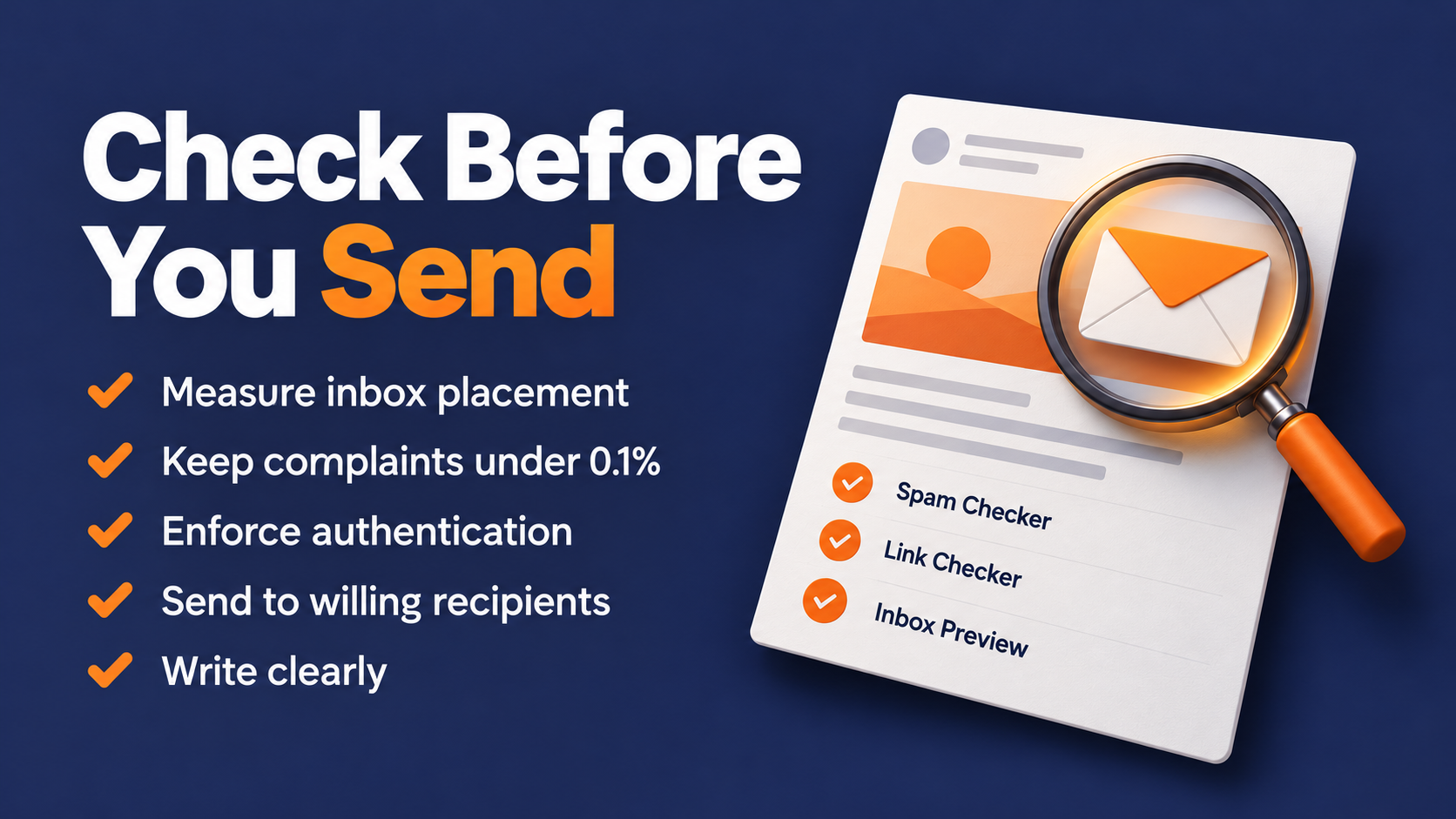
Measure inbox placement instead of acceptance, keep complaints under 0.1%, enforce authentication, mail people who want to hear from you, and write so a summary can't misread you.
Most of those signals pile up out of sight until a campaign underperforms. The programs that stay in the inbox check their record before a filter forces the issue.
Pre-send testing, multi-brand isolation, and hands-on support
That's where we spend much of our time with customers at Pinpointe. Each sending domain is authenticated through DNS records and verified before use, and campaigns can run through a Spam Checker, Link Checker, and inbox preview before they go out.
Behind the tooling is hands-on deliverability support. Hallmark Building Supply moved to Pinpointe from an overseas ESP after ISPs started blocking its mail, and after migrating, it eliminated the blocking and cut its opt-out rate to under 0.01%.
If you send for several brands or clients, each brand account has its own sender identities and sending domains, and admins can see and manage every brand account from one place. That makes it easier to spot which brand's program needs attention.
See your deliverability setup in a live demo
If you want to see how authentication, pre-send checks, and deliverability support fit together for your program, request a live demo. It's a 1-on-1 walkthrough built around your goals, so you can bring the gaps from this article and see how we'd approach them.
Frequently Asked Questions
A few quick answers before you go.
Does AI-written email go to spam?
A 2024 study reported 450 plain-text AI-generated emails reaching participants' inboxes, but it had no human-written comparison group, so it can't isolate authorship. The clearer risk is generic copy readers ignore, since Validity names engagement as a primary trust signal for mailbox providers.
Is Gmail's AI Inbox a spam filter?
No. Google's help page describes AI Inbox as a beta view that draws only from the Primary tab and filters out spam, Social, and Promotions. It affects what a reader notices, not whether a message reaches the inbox.
What spam complaint rate should I aim for?
Aim for under 0.1%. The long-standing ceiling is 0.3%, but Validity's benchmark data treats under 0.1% as the current expectation.
Do I need DMARC if I send fewer than 5,000 emails a day?
In practice, yes. Google's bulk threshold under its sender guidelines is roughly 5,000 messages a day to personal Gmail accounts, but Yahoo doesn't publish a threshold at all. Any program sending at meaningful volume should authenticate with SPF, DKIM, and DMARC.