Book a live demoAn email funnel is the set of stages a subscriber moves through by email toward one conversion you've defined, such as a purchase, a demo request, or a trial signup. It can start when someone joins your list, though a trial start or another action can kick it off too.
The emails are only half of the funnel while the other half is the rules that decide who enters, who moves forward, and who stops hearing from you once the job is done.
Most teams can show you their welcome email. Far fewer can tell you what happens to a new subscriber on day nine.
This guide covers how an email marketing funnel is structured, the rules that keep it working, where a newsletter funnel fits, and three funnel templates you can adapt. It's written for B2B marketers who already send email and want the sequence behind it to carry more of the load.
Key Takeaways
- Automated beats scheduled by a wide margin: among ecommerce brands sending through Omnisend in 2025, automated emails were about 2% of sends but generated 30% of email-attributed revenue, earning $2.87 per send against $0.18 for scheduled campaigns, a pattern worth building any email marketing funnel around.
- Welcome and cart flows carry the funnel: welcome series and abandoned cart flows together accounted for 76% of automated orders among ecommerce brands using Omnisend in 2025.
- Know which denominator you're reading: in the same 2025 Omnisend data, the conversion rate was 1.51% of delivered emails, while the click-to-conversion rate was 39.46% of the people who clicked, two very different numbers describing one email funnel.
- A tested cart-recovery cadence: a common ecommerce pattern sends the first reminder 30 to 60 minutes after abandonment, a second at 24 hours, and a third at 72 hours, a useful starting point for funnel templates aimed at any incomplete signup.
- Newsletters show up at the top: Litmus's 2026 State of Email research found the top 8% of email programs, those reporting 45:1 or better ROI, most commonly send newsletters and onboarding emails, a signal worth factoring into a newsletter funnel.
In this guide
What an Email Funnel Is and What It Isn't
The word funnel describes the shape. Plenty of people enter at the top, fewer make it through the middle, and a smaller group converts at the bottom.
An email funnel applies that progression to the inbox. The campaigns and workflows you build are designed to guide people from one stage to the next, and automation is one way to run them.
A hand-scheduled series of broadcasts can move people through a funnel too. The downside is that it can't react to what each person does in real time like using behavioral triggers can.
What counts as a conversion
The bottom of the funnel is whatever action you need next. As an example, for an ecommerce brand, that could be a purchase. A SaaS funnel might aim at a trial start or an upgrade to a paid plan, and a B2B funnel could target a demo request or an event registration.
Pick one conversion per funnel. A sequence that tries to sell, book demos, and fill a webinar at the same time gives the reader three exits and no clear path. A confused mind does nothing.
Email funnel, drip campaign, and marketing funnel
These three terms get swapped constantly. A marketing funnel spans every channel a buyer touches, including ads, search, social, and sales conversations. An email funnel is the part of that journey that runs strictly through the email inbox.
A drip email campaign is a way of sending. This guide treats a drip, a triggered flow, and a scheduled broadcast series as different ways to carry part of a funnel, while the funnel itself is the progression toward a defined outcome.
The Stages of an Email Marketing Funnel
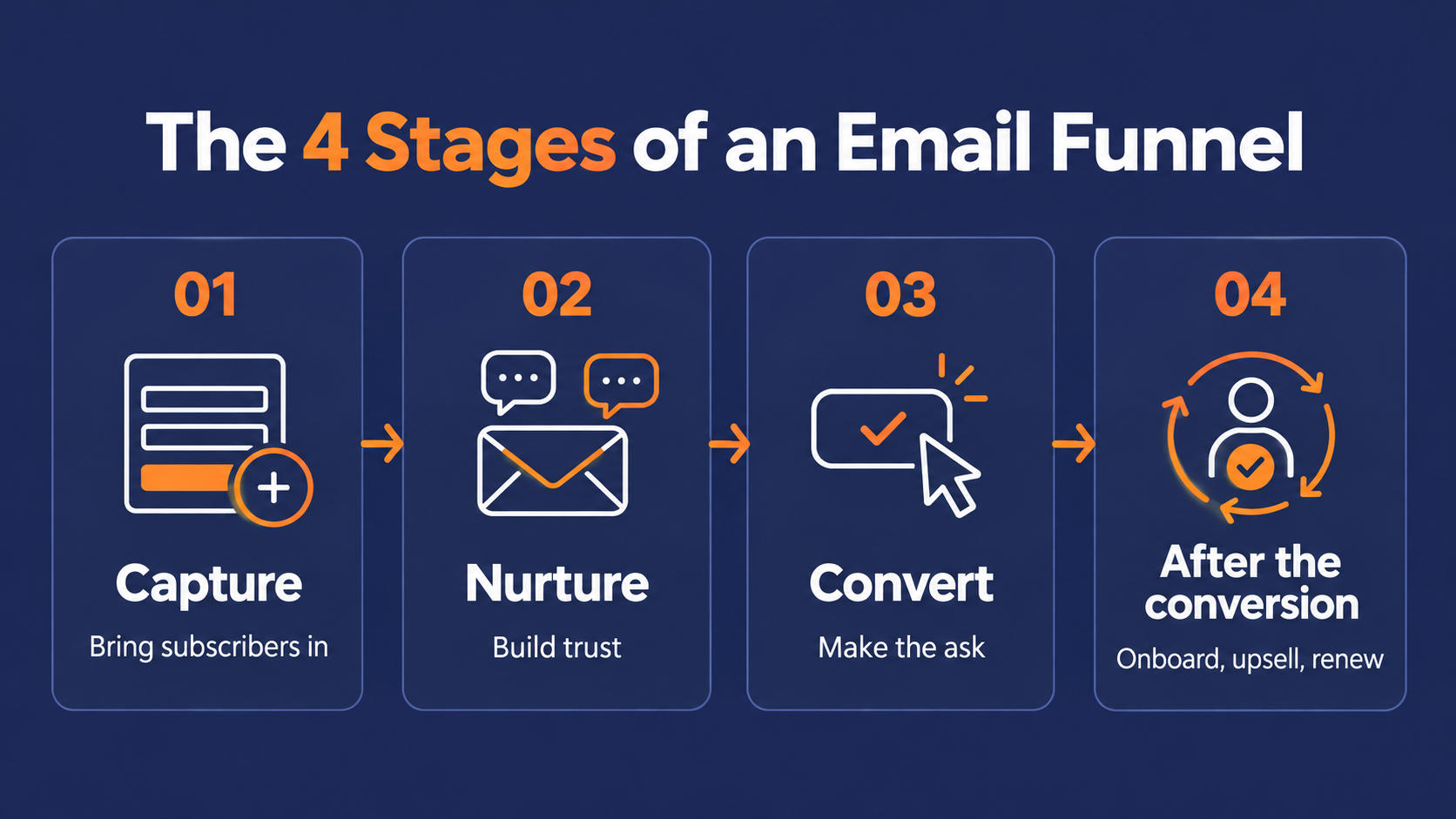
This guide splits an email marketing funnel into four stages. Other teams use different names or more steps, but these four cover the main jobs that your email markeitng funnel should do.
Capture
Someone joins your list through a form, a lead magnet, a trial start, or a newsletter signup. What happens next depends on your entry rules, so capture is as much a routing decision as a signup.
Nurture
Nurture is where the funnel earns the right to ask for the next step in your sales process. Each email should handle one question or objection standing between the subscriber and the conversion, the same discipline behind good lead nurturing emails.
This is also where funnels sag. If an email doesn't move the reader closer to the ask, it's taking up a slot.
Convert
Conversion emails make the ask directly. Some are tied to a moment of intent, such as the reminder after an abandoned cart or the nudge after an unfinished application.
According to Omnisend's 2026 ecommerce marketing report, among ecommerce brands using Omnisend, welcome series and abandoned cart flows together accounted for 76% of automated orders in 2025.
That's ecommerce data, so don't read it as a B2B benchmark, but it does suggest a sensible place to start to maximize conversions. Use conversion focused emails closest to the moment someone showed interest.
After the conversion
A funnel keeps working even after someone converts. Onboarding, upsell, and renewal sequences pick up where the first conversion left off.
Innovation Arts & Entertainment, a producer of live events and national tours, has used trigger and drip campaigns in Pinpointe to retarget past ticket buyers for seat upgrades across more than 300 live events. The buyer already said yes once. The next email asks for a slightly bigger yes.
In most cases, it's easier to make another sale from an existing customer rather than converting a brand new customer because existing customers typically already know, like and trust your business.
How an Email Funnel Works Behind the Scenes
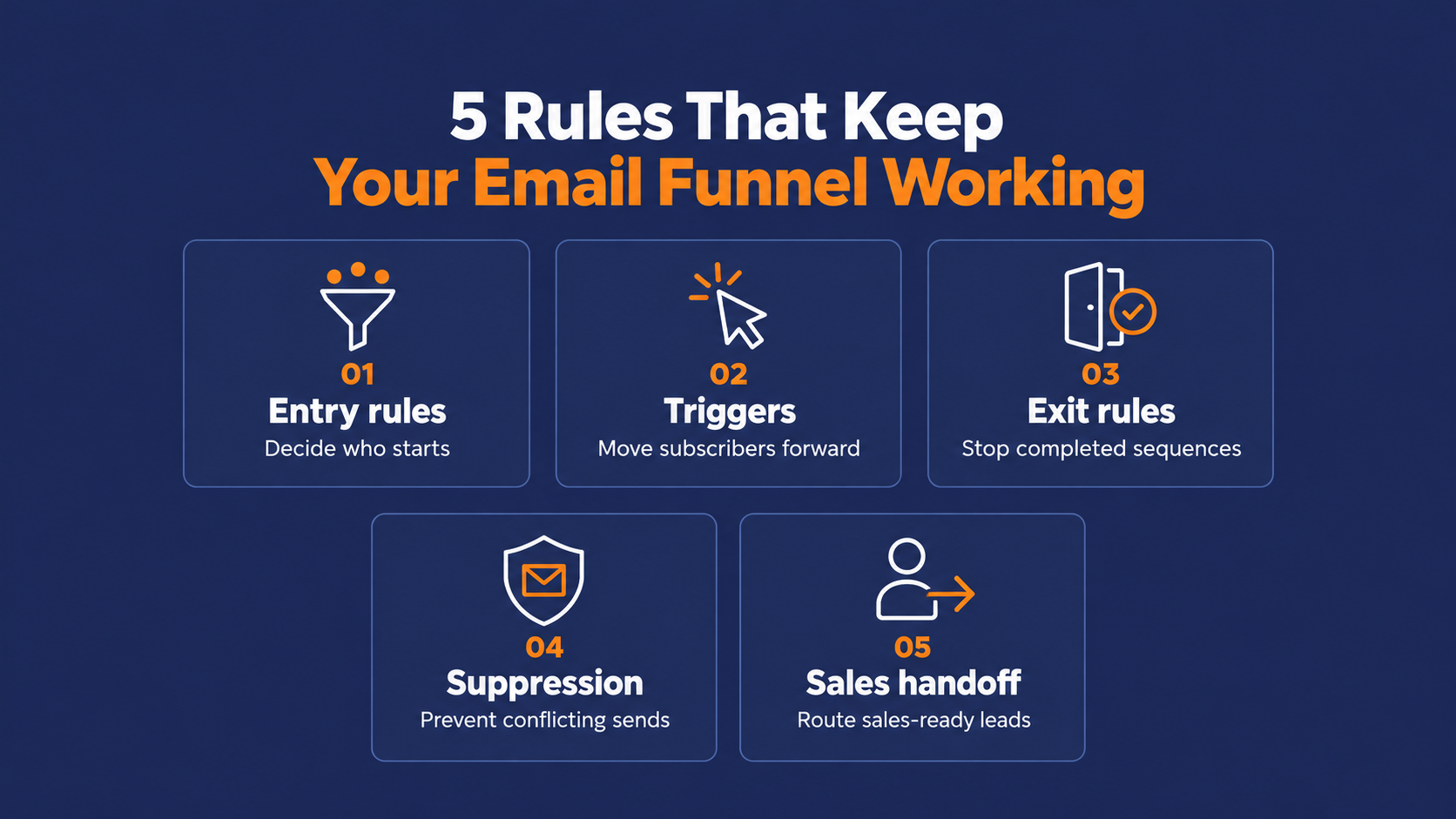
Funnel stages describe where a subscriber is in their buyer's journey. Rules decide what happens to them next. Five sets of rules do most of the work, and a gap in any one of them is how a funnel ends up sending the wrong email to the wrong person.
Entry rules decide who starts
Entry criteria, which can include membership in a list or segment, decide who enters a workflow in the first place. A contact who doesn't match never starts the sequence.
Write entry rules using specific criteria vs general starting points. "Downloaded the buyer's guide and isn't already a customer" will route far better than "joined the list."
Triggers move people forward
Triggers advance subscribers based on what they do, such as clicking a link, submitting a form, or reaching the end of a wait period, the mechanics behind what's usually called behavioral email marketing.
Among ecommerce brands sending through Omnisend in 2025, automated emails were about 2% of sends but generated 30% of email-attributed revenue, earning $2.87 per send against $0.18 for scheduled campaigns.
The report doesn't isolate specifically why, but timing is a likely part of it, since a triggered email reaches someone shortly after they acted. At the same time, automated flows also reach a different audience than scheduled campaigns, so the comparison isn't apples to apples.
Some platforms can also recheck eligibility before each send. In Twilio SendGrid, if you choose the exit option for contacts who no longer meet the entry criteria, it checks that each recipient is still on the entry list or segment before every email, and anyone who isn't won't get it.
Exit rules stop the funnel once it has done its job
Exit criteria remove a contact from a workflow once they've completed the objective, like clicking a link or making a purchase, so they stop getting follow-ups that no longer apply.
In cart recovery, the shopper drops out of the flow the moment they buy.
Few things erode trust faster than a "still thinking it over?" email that lands an hour after someone bought.
Suppression keeps funnels from overlapping
Exit rules manage one funnel and suppression rules handle the space between funnels. Suppression rules can hold a contact out of a triggered sequence if they received another email recently or are already active in a conflicting sequence.
Skip this layer and a brand-new lead can get your welcome email, a webinar invite, and a promotion in the same afternoon.
Handoff to sales or the CRM
In B2B, the bottom of an email funnel can involve a handoff to a salesperson. The rule that defines "sales-ready" matters as much as any email in the sequence. A mismatch here can quickly erode sales and marketing allignment.
An exmaple of keeping this sales and marketing allignment strong, is one enterprise SaaS company uses Pinpointe as the top-of-funnel nurturing layer for its trade show leads, sending webinars and newsletters and appending URL tracking so click data flows into its CRM. Only highly engaged leads pass to sales. That keeps unengaged contacts from taking up paid CRM seats.
Pick the engagement signal that means a lead is ready, write it down, and let the funnel route on it. A documented lead scoring rule beats a gut-feel threshold everyone reads differently.
Newsletter Funnels as an Entry Point
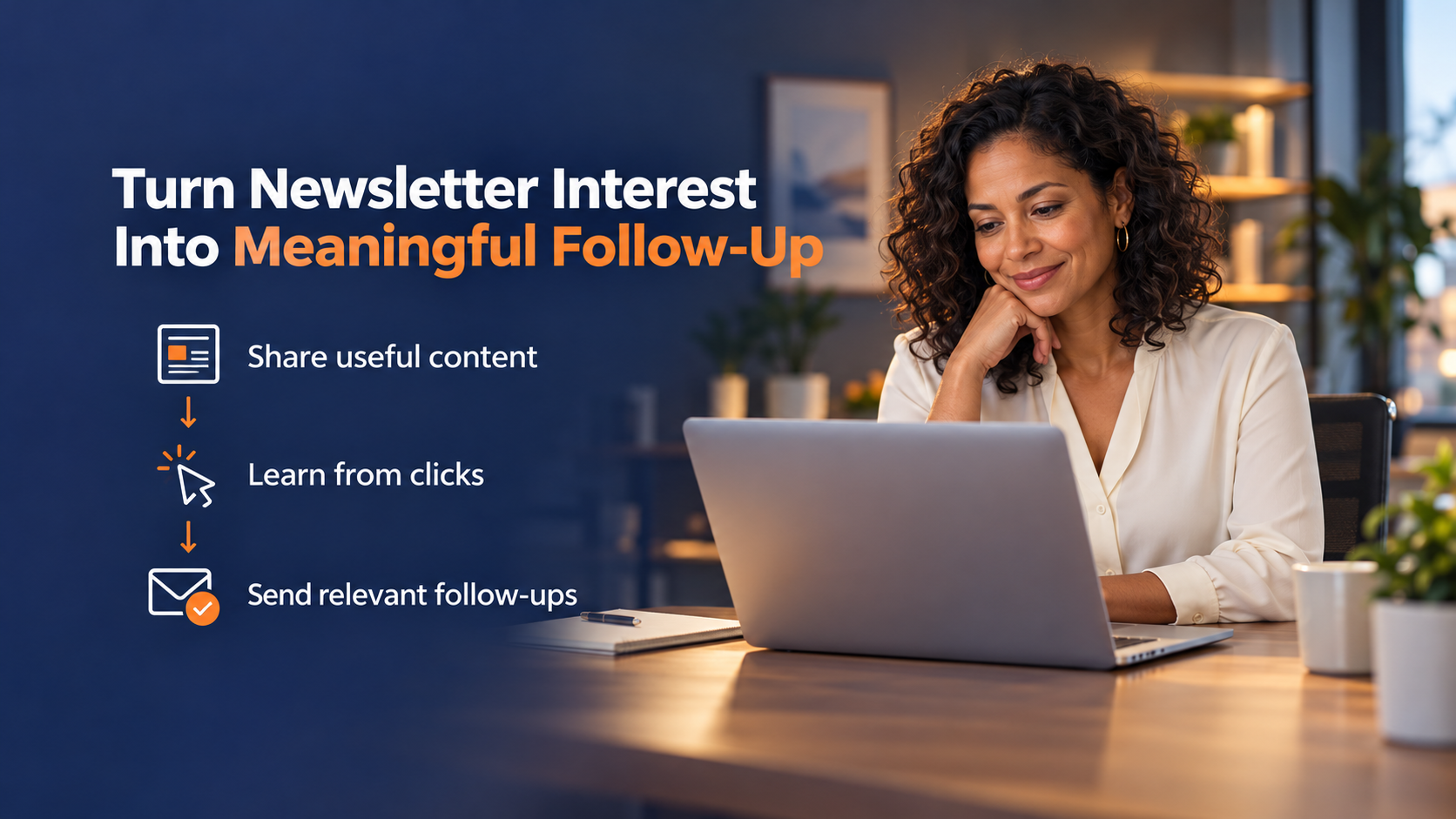
A newsletter funnel uses your newsletter as one of the doors into a broader email funnel. Readers subscribe for the content, and the engaged ones get moved into a nurture or offer sequence.
There's a reason to take the newsletter seriously here. Litmus's 2026 State of Email research found that the top 8% of email programs, those reporting 45:1 or better ROI, most commonly send newsletters and onboarding emails.
Read that as a correlation. It does suggest the newsletter belongs inside your funnel planning rather than off to the side. Check out our blog on email newsletter ideas if you need some ideas to get you started.
Use the newsletter to sort readers
Every click in a newsletter tells you something, and that pattern is the raw material of real newsletter engagement, not just a vanity open rate.
A reader who clicks three articles on the same topic has told you what they care about, and that click pattern can become the entry rule for a narrower sequence.
Let the sequence make the ask
Readers signed up for the newsletter to learn something. A newsletter that pitches in every issue teaches people to stop opening it.
Let the newsletter build the relationship and let the sequence that follows do the selling.
Email Funnel Templates You Can Adapt
The three funnel templates below are starting structures. Swap in your own offer, your own proof, and your own timing, and treat each cadence as a default to test.
Each runs three or four emails. Add an email only when you can name the objection it answers.
Lead magnet to demo request funnel template
Use this when your conversion is a sales conversation, and your top-of-funnel offer is a guide, checklist, or report. Start the sequence when someone downloads the guide and isn't a current customer or already in another sequence. End it when they request a demo or reach the last email.
| When | Subject line | Job | |
|---|---|---|---|
| 1 | Immediately | Your [guide name] is ready | Deliver the guide and say what's coming next |
| 2 | Day 2 | The [topic] mistake that costs teams the most | Teach one idea from the guide |
| 3 | Day 5 | How [customer type] fixed [problem] | Show proof with a short customer story |
| 4 | Day 8 | Worth 20 minutes on your [topic] setup? | Ask for the demo with one clear link |
If you don't have a formal case study for email 3 yet, a specific before-and-after from a customer conversation works.
Newsletter to offer funnel template
Use this to move engaged newsletter readers toward a specific offer. Start the sequence when a reader clicks newsletter content on a topic tied to the offer. End it when they convert or unsubscribe.
| When | Subject line | Job | |
|---|---|---|---|
| 1 | Same day as the click | More on [topic], since you clicked | Go one level deeper on the topic |
| 2 | Day 3 | A [topic] checklist you can use this week | Give a practical resource |
| 3 | Day 6 | [Offer] for teams working on [topic] | Make the offer |
Decide up front whether readers in this sequence keep getting the regular newsletter. If they do, set suppression so a newsletter and a sequence email don't land on the same day. Too many emails, especially on the same day, can get your emails quickly flagged for spam, even if the information is useful.
Incomplete signup recovery funnel template
Use this when someone starts a form, application, trial request, or checkout and doesn't finish. Start the sequence when the step is started but not completed. End it the moment they complete it.
Omnisend's guidance for cart recovery is a first email 30 to 60 minutes after abandonment, a second at 24 hours, and a third at 72 hours, with the contact leaving the flow as soon as they buy. For a B2B application or signup, test whether a longer first delay suits a slower decision. If you want to see the pattern in action first, these cart abandonment email examples show the format this template borrows from.
| When | Subject line | Job | |
|---|---|---|---|
| 1 | A few hours after they stop | You left off at [step] | Plain reminder with one link back to where they stopped |
| 2 | Day 1 | Questions about [form or application]? | Answer the most common reason people stall |
| 3 | Day 3 | Still want [outcome]? | Final nudge, with a person they can contact for help |
An example of this is how 21st Mortgage Corporation built this pattern in Pinpointe for homebuyers who start a loan application and don't finish it. The company launched automated drip campaigns aimed at those applicants, and these campaigns led to more closed loans.
The "cart" doesn't have to hold products. Any half-finished form marks a moment of intent worth following up on.
Measuring an Email Funnel Stage by Stage
You can't fix a leak you can't see, so measure each email and each stage rather than the funnel as a single number. Omnisend's automation reports, for example, break performance down by individual email, showing where customers convert and where they lose interest.
Use the same lens on your email marketing funnel. A sharp drop in clicks at email three points you straight at email three as the likely cause.
Name the denominator before you report a rate
A conversion rate means nothing until you say "of whom." In Omnisend's figures for its users' abandoned cart emails in 2025, the conversion rate was 1.51% of delivered emails, while the click-to-conversion rate was 39.46% of the people who clicked.
Both numbers describe the same flow. Confuse them and you'll either panic or celebrate for the wrong reason.
Set a measurement window
Conversions don't always happen the same day as the click. Omnisend's attribution model credits sales to emails within an adjustable time window, and it recommends tagging links with UTM parameters so email-driven purchases don't get counted as direct traffic in Google Analytics.
Pick a window that fits how long your buyers take to decide. A cart funnel can use a short one, while a demo funnel with a multi-week buying cycle needs a longer one.
What to track at each stage
Keep the scorecard short and tied to each stage's job. If you've never measured a funnel this way before, running a full email marketing audit first will show you where to start.
- Capture. Entry volume by source, and how many new contacts match an entry rule
- Nurture. Click rate per email, and how many contacts progress to the next step
- Convert. Conversion rate, with the denominator and window stated
- After conversion. Onboarding completion, repeat purchase, or renewal
- Every stage. Unsubscribes and spam complaints, which show when a funnel is sending too often or missing on relevance
Fixing the Leaks in Your Email Funnel
An email funnel is a progression toward one conversion, and it runs on rules as much as on emails. Entry rules decide who starts, triggers move people forward, exit and suppression rules keep them out of messages that no longer fit, and stage-level measurement shows where they fall out.
The emails are usually written already, and the leaks show up in the logic between them. This can be things like the subscriber who never gets routed, the buyer who gets one more reminder, or the lead who sits in a sequence for weeks after going quiet.
Intelligent workflow automation and audience management
That logic is what Pinpointe's Journeys handle. You set a journey to start when someone is added to a list, submits a form, opens an email, or clicks a link, and conditional branching sends different contacts down different paths. Separately, dynamic segments keep your audiences current on their own as contacts meet or stop meeting your criteria, so the groups your sends draw on don't need rebuilding by hand.
Our suppression tools cover the space between funnels, with global, per-database, and transient suppression lists plus a Master Unsubscribe list that keeps opted-out contacts out of every send from that account. And if you run funnels for several brands or clients, each brand account runs its own journeys from its own segments.
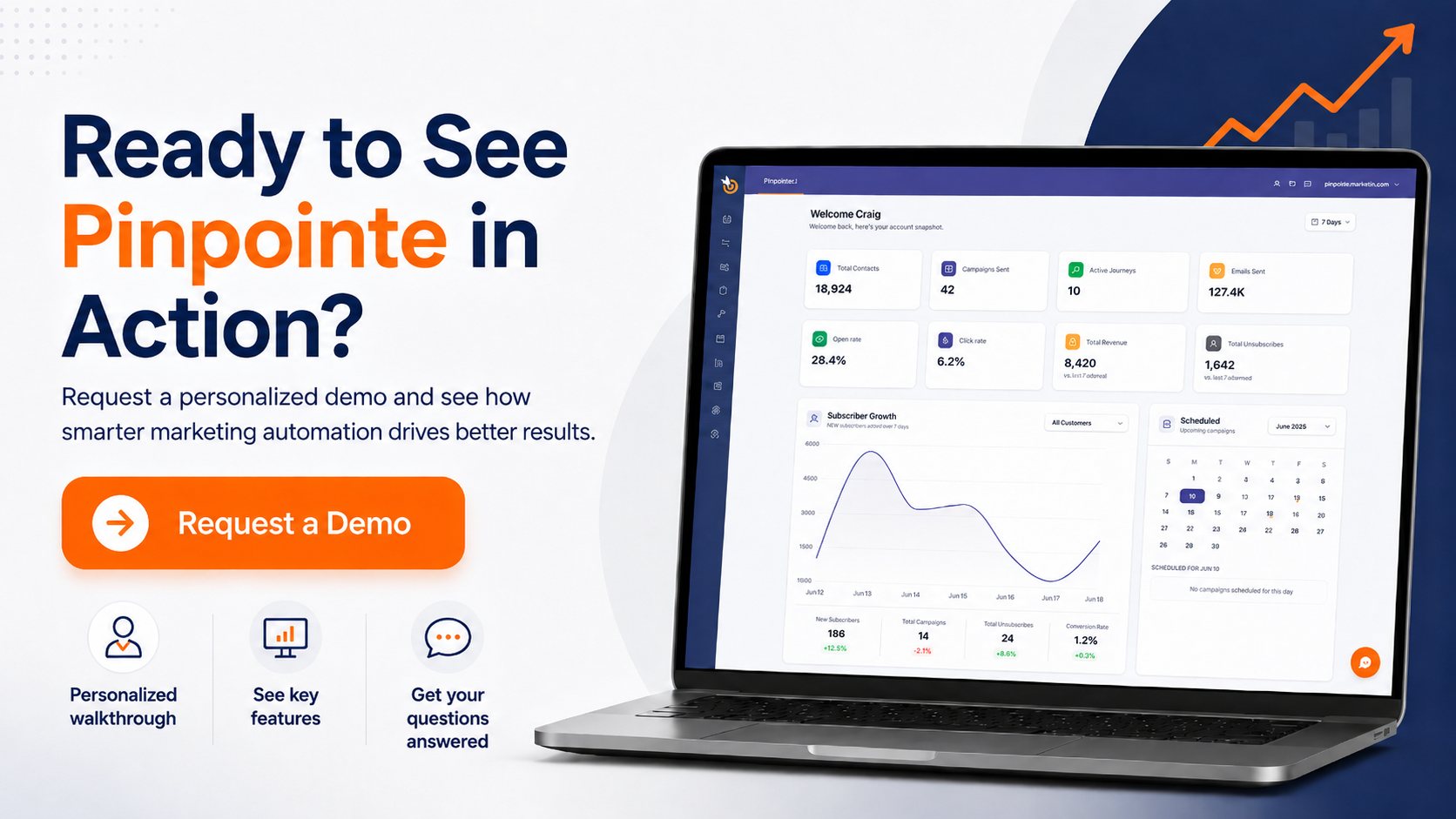
Find where your funnel leaks with a free demo
Want to see how this fits into your existing tech stack? Book a live demo. In a 30-minute one-on-one session, we’ll map your current funnel into automated journeys and show you how dynamic segmentation works in real time. You’ll walk away knowing exactly how much time your team can save.
Frequently Asked Questions About Email Funnels
Quick answers to the questions that come up most when teams build their first email funnel.
How many emails should an email funnel have?
There's no fixed number. Use the fewest emails that cover the objections between signup and conversion, and add one only when you can name its job. For reference, a three-email sequence is standard practice for ecommerce cart recovery flows.
What's the difference between an email funnel and a drip campaign?
A drip campaign is a way of sending emails on a schedule. An email funnel is the progression toward a defined outcome, and a drip is one way of sending the emails that support it.
Is an email funnel the same as a marketing funnel?
They overlap, but the scope differs. A marketing funnel covers every channel a buyer touches, from ads to sales calls. An email funnel is the part of that journey carried by email campaigns and workflows, usually starting once someone opts in.
Does an email funnel have to end in a purchase?
No. The conversion is whatever your business needs next. A SaaS funnel might aim at a trial start or a paid upgrade, and a B2B funnel could aim at a demo request or a registration.