Most newsletters don’t die from bad design. They die because the person writing them runs out of things to say by week six and starts recycling the same three announcements with a new subject line.
You’ve probably felt that wall coming. The blank draft sitting open. The cursor blinking next to “This week at [Company]…” while you try to remember if you already covered the product update last month.
That wall comes down to a simple gap: you’ve run out of things to say, not the ability to say them. Fix the supply and the writing takes care of itself.
You probably already have all of the newsletter content ideas you need
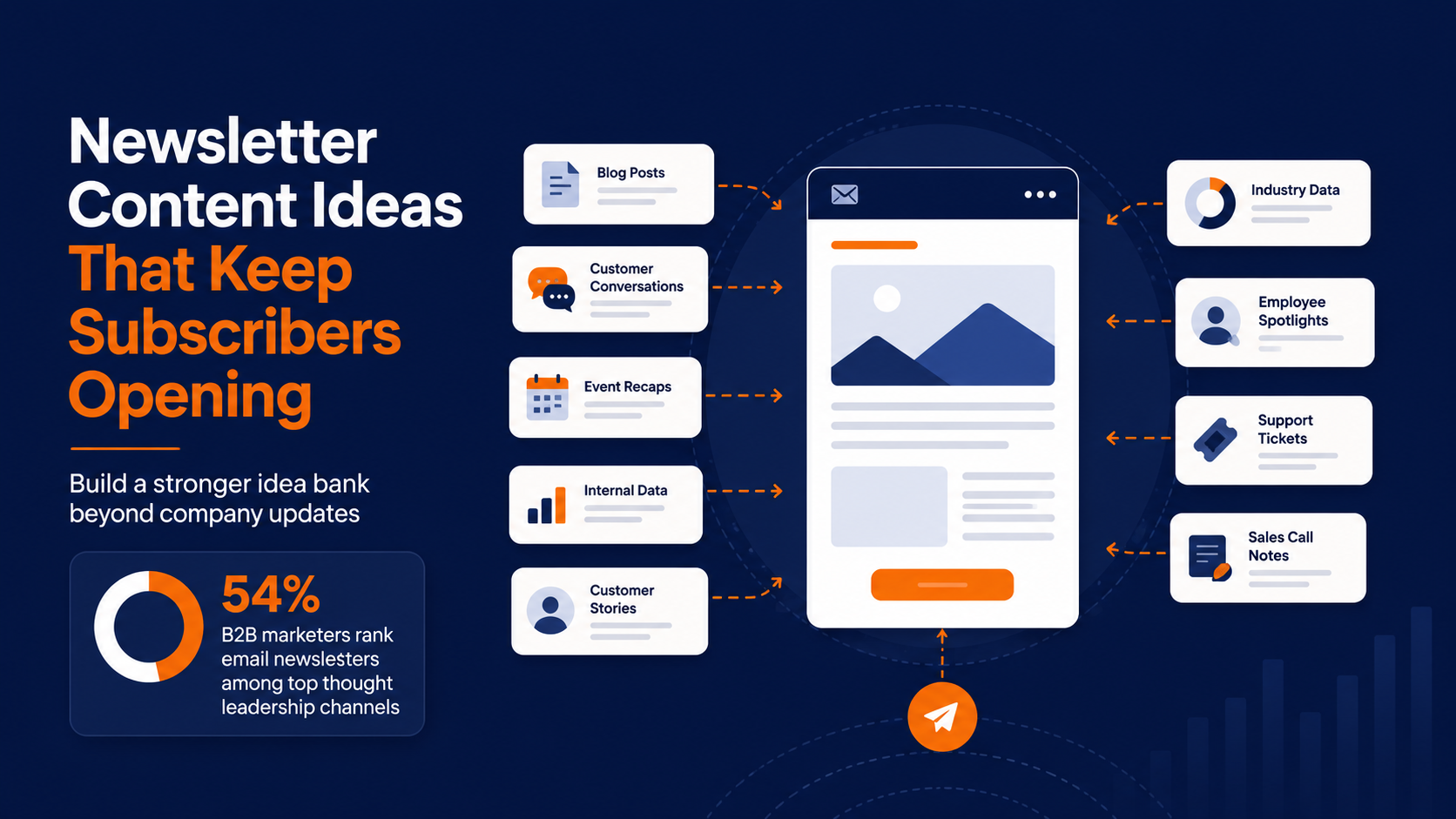
The good news is you almost certainly have more raw material sitting around than you realize. Blog posts, customer conversations, event recaps, and internal data all count as newsletter content once you stop treating “company news” as the only category worth pulling from.
That’s really what this list of newsletter content ideas is: a wider set of buckets to pull from, so you’re never stuck starting from a blank page.
Why Your Newsletter Content Runs Dry Faster Than You Think
Most teams start a newsletter with one format in mind: company updates, wrapped in a template, sent on a schedule. That format works for exactly as long as the company keeps producing updates worth sharing. Usually that’s a few months.
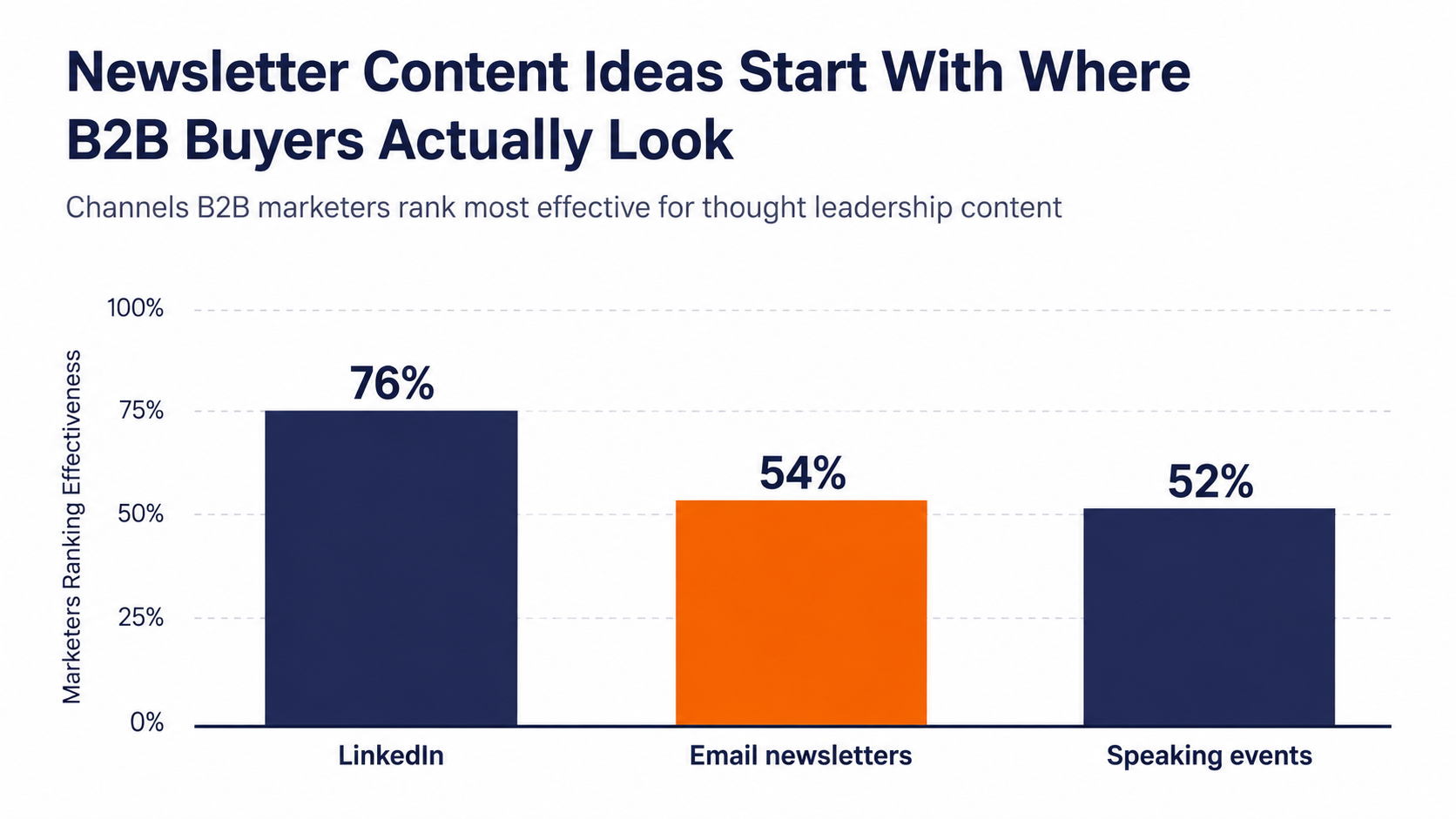
Content Marketing Institute’s 2026 B2B research found that fifty-four percent of B2B marketers rank email newsletters among their most effective thought leadership channels. Thought leadership doesn’t come from announcements. It comes from a wider mix of content types working together, which is exactly what separates forgettable sends from strong B2B newsletter content.
Rethink volume as the enemy
Usually the problem comes down to tunnel vision: you’re only looking at one bucket for content, internal news, when plenty of things happening at your company could count.
Widen the bucket and the well doesn’t run dry. Customer stories, industry data, employee spotlights, and even your own archive of blog content all count as newsletter material.
How to write a newsletter that never runs out of ideas
Most guides on how to write a newsletter focus on subject lines and send times. Those matter, but they’re the easy part. The hard part is having something worth saying in the first place, which is why the idea supply matters more than the polish.
Build a content idea bank before you need it
Keep a running list of ideas as they occur to you, not the night before send day. A shared doc with one line per idea beats a blank page every single time.
Pull ideas from customer support tickets, sales call notes, and questions your team answers on repeat. Those are proof someone out there wants the answer.
Match content type to subscriber intent
Not every subscriber wants the same thing from your newsletter. Some want to learn something. Some want proof your product works. Some just want to feel like they’re part of something.
Rotating through the content categories below keeps you covering all three without overthinking it every send.
Set a rhythm before you set a topic
Before you brainstorm a single headline, decide how often the newsletter actually needs to go out. Weekly and monthly rhythms need very different amounts of raw material, and picking the wrong one is often what causes the dry spell in the first place.
A monthly send can lean on a roundup format and still feel fresh. A weekly send needs a wider rotation of content types just to avoid repeating itself, which is exactly why the categories below exist.
Give yourself permission to reuse, not just create
New content isn’t the only kind of content. An idea you covered eight months ago is new again to anyone who subscribed since then, and it’s a fresh reminder to everyone else.
Treat your archive as a resource, not a graveyard. A quick refresh of an older piece, updated with a current example or a new stat, often performs just as well as something built from scratch.
Give Your Email Newsletter Subscribers Something They Can Actually Use
The newsletters people actually open are the ones that treat the inbox like a place to help, not a place to pitch.
Turn your best blog posts into micro-guides
If you’ve already written a how-to article on your blog, don’t just drop a bare link. Pull out the single most useful step, put it in the email itself, and let the link take readers deeper if they want the rest.
A furniture brand might pull “how to get pet stains out of upholstery” down to three sentences and a photo, then link to the full walkthrough. A travel agency could do the same with a honeymoon planning checklist.
Build a running FAQ subscribers didn’t know they needed
Your sales team and support inbox already know the five questions that come up constantly. Turn one into a newsletter section every few sends instead of letting that knowledge sit in a shared Slack channel.
This format works especially well as a recurring feature. Subscribers start to expect it, which gives you a reason to open the email even when nothing else in it grabs them right away.
Repurpose case studies as proof, not pitches
A good case study already has the structure a newsletter needs: a problem, a specific result, and a real customer’s words. Don’t summarize the whole thing. Pull the single most surprising outcome and let curiosity do the rest of the work.
Turn a free resource into a reason to click
If your team has already built an ebook, guide, or template, your newsletter is one of the best places to remind people it exists. Resources you built two years ago don’t stop being useful just because the send date has passed.
Make sure the resource still holds up before you promote it again. A quick pass to update any outdated screenshots or references goes a long way, and readers can tell when something’s been dusted off versus refreshed.
|
Content Type |
Effort to Produce |
Best For |
|---|---|---|
|
Micro-guide from existing blog post |
Low |
Driving traffic back to owned content |
|
Recurring FAQ feature |
Low |
Building a habit, reducing support load |
|
Case study excerpt |
Medium |
Proving results without a hard sell |
|
Custom data visualization |
Medium to high |
Standing out in a crowded inbox |
|
Podcast or event recap |
Low to medium |
Extending the life of existing content |
Let Your Data and Visuals Do the Talking
Most email newsletters lean heavily on text, which makes them a chance to stand out with something visual instead.
Turn a spreadsheet into a scroll-stopping infographic
Year-end sales numbers, customer satisfaction scores, or usage trends all make for stronger content as a simple chart than as a paragraph of numbers. A tool like Canva gets you there without a design team.
Recap your best-performing content on a schedule
A short roundup of your top blog posts, most-shared social updates, or best customer questions from the past month gives subscribers a low-effort way to catch up on everything they missed.
Keep the list tight. Five items beats fifteen, and titles alone are often enough if the topics are compelling.
Close the loop on surveys people already answered
If you’ve sent a survey, tell people what you found. A short “here’s what you told us, and here’s what we’re changing” update closes a loop that most companies leave hanging open.
Surveys tend to undersell themselves in a single send anyway. Mentioning results in your regular newsletter reaches people who scrolled past the original ask.
Give a chart the same care you’d give a headline
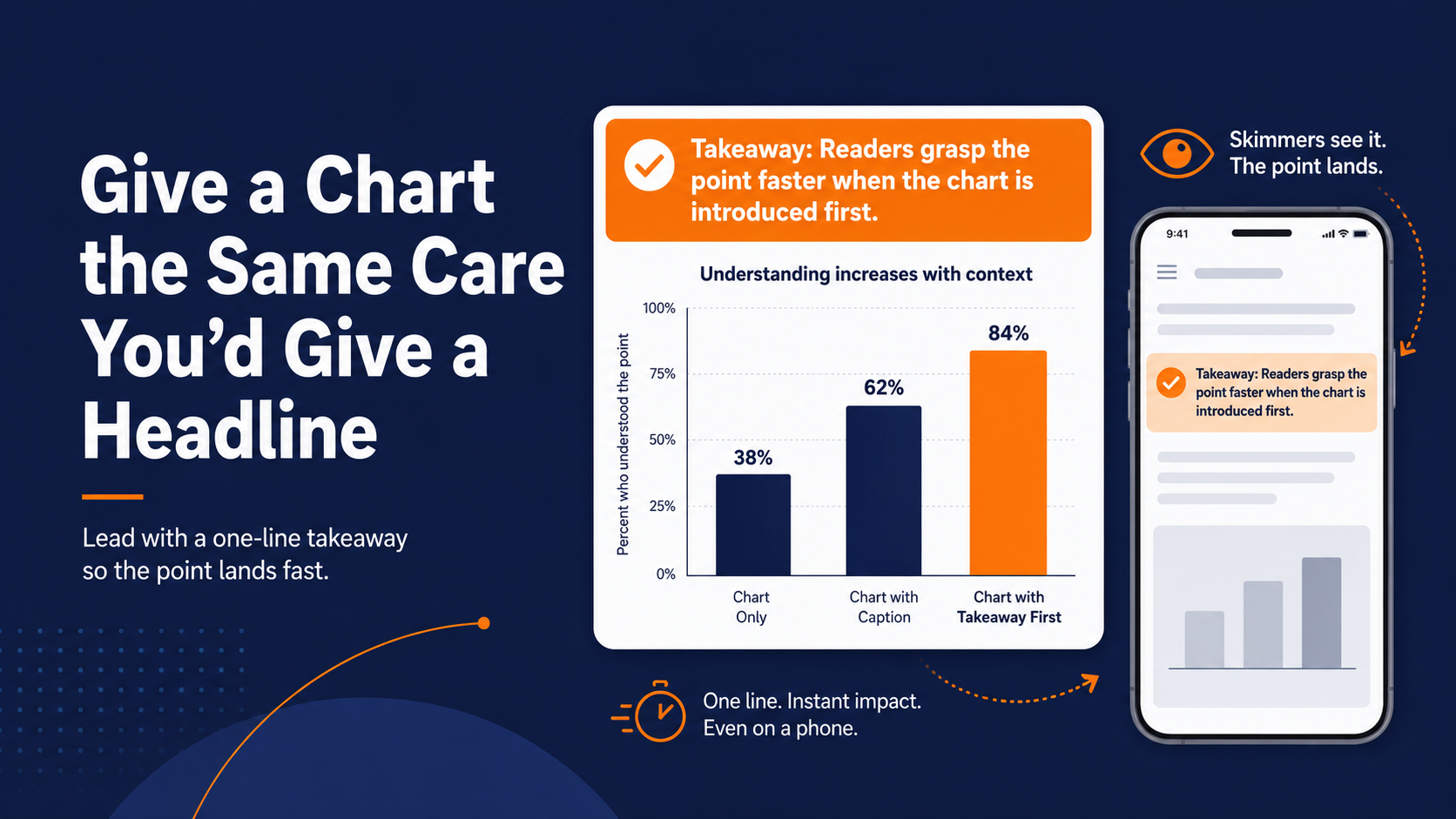
A chart that’s dropped in without context does about as much work as a stat with no source. Give every visual a one-line takeaway above it so readers know what they’re looking at before they look at it.
This matters more than it sounds like it should. A reader skimming on their phone will absorb the takeaway sentence even if they skip the chart entirely, so the sentence needs to carry the point on its own.
Build your own library of email newsletter examples
You don’t need to look outside your own send history for email newsletter examples worth studying. Pull your three best-performing sends from the last year and figure out what they had in common, whether that’s subject line style, content type, or send time.
That internal library beats a folder of bookmarked examples from other brands, because it’s already proven to work with your specific list.
Borrow Credibility From Events, Podcasts, and Partners
You’re probably already investing in things beyond your newsletter. Events, podcasts, and partnerships all generate content that’s sitting there waiting to be reused.
Use your newsletter as an event invitation, not an afterthought
More than two-thirds, 78%, of B2B marketers now allocate budget to experiential marketing. If your team is one of them, your newsletter is free real estate for driving registrations.
Share the details early, then follow up closer to the date with a practical tip, like the best time to arrive or what to bring. Spreading the reminder across two or three sends works better than one big push.
Give podcast episodes a second life in the inbox
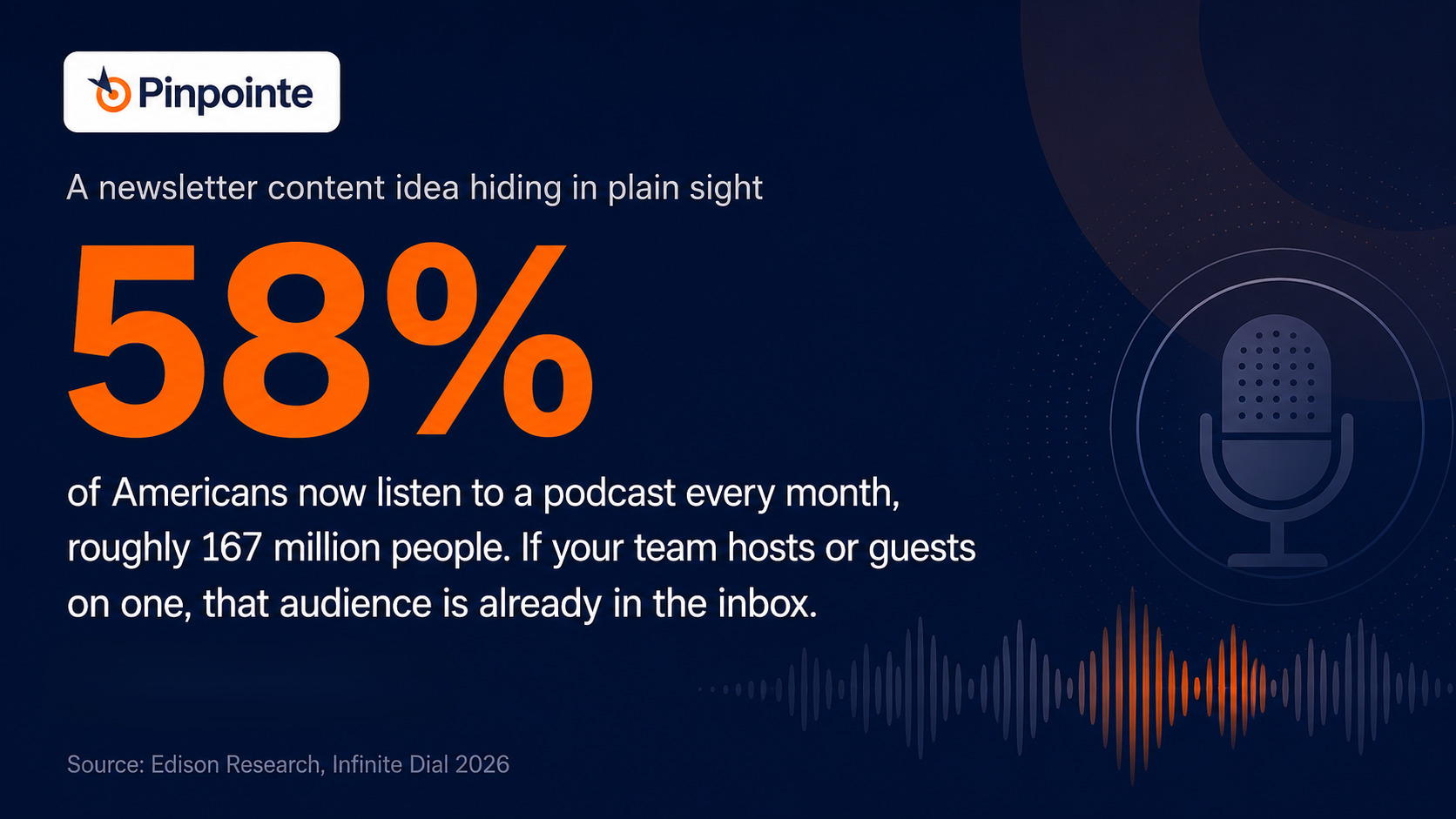
Edison Research puts monthly podcast consumption in the US at 58%, an estimated 167 million people. If you host a show, or even guest on one occasionally, your subscribers are very likely already listening to something.
Pull one quote or one insight from a recent episode instead of just linking to “our latest episode.” Give people a reason to click that doesn’t require them to already be a fan of the format.
Spotlight partnerships that benefit the reader, not just you
Whether you’re teaming up with a nonprofit or the business next door, frame the update around what the partnership means for the subscriber. “We partnered with X” is forgettable. “Here’s a discount from our new partner” gets read.
Recap the event after it happens too
Most teams promote an event, then go quiet the moment it ends. A short recap with a few photos and one useful takeaway gives the event a second moment in the inbox, and it works even better for the people who couldn’t make it.
Include a link to any recorded sessions or a summary of what was announced. Readers who skipped the event still want the highlights, and giving it to them keeps the next invitation from feeling like the first ask.
Let Your Company’s Personality Come Through
The email newsletters that build real loyalty over time are the ones that feel like they’re written by a person, not a department.
Share the story behind the business
Drip your company history out over several sends instead of cramming it into one long article. A single detail, like why you chose your name or what the first version of your product looked like, is plenty for one email.
Let a real person write the update
A short note from a founder or team lead adds a layer of trust that a polished brand voice can’t fake. Keep it short, keep it honest, and don’t dress it up as a press release.
Spotlight the people doing the work
An employee spotlight, done well, tells subscribers something about your culture without you having to say “we have a great culture” outright. Keep it brief and always include a photo.
Answer the questions your team already gets every week
If your company is going through a change, whether that’s new leadership, a renovation, or a shift in how something works, your newsletter is a better place to explain it than letting customers find out secondhand.
This is one of the most overlooked email newsletter ideas for business updates specifically, since most teams only reach for the newsletter when there’s good news to share.
Show a behind-the-scenes glimpse instead of a polished shot
A quick photo of your team prepping for a busy season or setting up a new display does more for trust than another stock image ever could. It doesn’t need to be professionally shot. It just needs to be real.
Video works even better here if you have thirty seconds to spare. A short clip of the workspace or the process behind your product gives subscribers a sense of scale and effort that a paragraph of text can’t replicate.
Address a problem before customers have to ask about it
If people have been complaining about the same thing, whether that’s a shipping delay or a feature that’s been buggy, get ahead of it in your newsletter. Explain what happened and what you’re doing about it.
Keep the tone steady and specific. Vague reassurance reads as evasive, while a clear timeline for a fix reads as accountable.
Use Social Proof and Promotions Without Selling Out
A newsletter that only sells will get muted fast. Used sparingly, though, promotional content still has a place.
Turn social buzz into inbox content
If you’re running a giveaway or contest on social, your newsletter list is an easy way to boost participation. Include the details and a direct link to enter, and treat it as a bonus rather than a headline.
Save the hard sell for a dedicated section
Seventy-three percent of customers expect better personalization as technology advances. A generic coupon dropped into every send doesn’t meet that bar. Save promotions for subscribers who’ve shown intent, and keep the rest of the newsletter focused on value.
Reward referrals instead of just asking for them
Letting subscribers forward your newsletter is free distribution. Giving them a reason to, like a discount for both parties, turns a passive feature into an active one.
Let a new launch speak mostly through the product itself
When something new is coming, resist the urge to explain every feature in paragraph form. Most of the B2B newsletter content we see ends up being just a bunch of feature lists instead of leading with value.
A clean product photo with a release date and a single sentence about what’s different does more work than three paragraphs of copy.
Save the full feature breakdown for your product pages. The newsletter’s job is to make someone curious enough to click, not to close the sale on its own.
Where the Right Platform Takes Your Newsletter Content Ideas Further
None of these ideas require new software to try once. But if you’re building a real content rotation across email and SMS, the platform underneath it matters more than most teams expect.
Behavioral triggers mean a case study excerpt can go out automatically to someone who just visited your pricing page, while a first-time subscriber gets the FAQ feature instead.
Dynamic segmentation means your event invitation reaches only the people in driving distance, and your podcast recap goes to the segment that’s already clicked a podcast link before.
Knowing how to write a newsletter matters, but who it goes to is equally important
That’s the gap between a newsletter that goes to everyone and one that goes to the right person. Pinpointe’s omni-channel journey builder lets you build that logic once and let it run, pairing email content with SMS reminders for time-sensitive sends like event registrations.
Real-time engagement data then tells you which content types are actually earning opens, so your idea bank gets smarter every month instead of staying a static list.
Your Best Newsletter Content Ideas Are Already Sitting in a Folder Somewhere
The newsletters that survive past month six aren’t the ones with the best design. They’re the ones built on a wide enough content base that no single send depends on something newsworthy happening that week.
Pull from your blog, your data, your events, your team, and your customers, and you’ll never be staring at a blinking cursor wondering what to write about.
Start with the FAQ feature or the case study excerpt this week. Pick whichever one you can pull together with content you already have sitting in a folder somewhere.
Ready to Build a Newsletter Content Engine That Runs Itself?
If keeping up with content ideas across email and SMS is stretching your team thin, schedule a marketing automation audit with Pinpointe and we’ll map out where behavioral triggers and segmentation can take the manual work off your plate.