Seven out of ten people who add something to their cart walk away before paying. That's not just a fluke or a bad quarter. The average cart abandonment rate sits at 70.22% across fifty separate studies, and it has barely moved in a decade. So the question isn't whether you're losing carts, the question is what happens in the hours after someone leaves?
Most brands answer that question by offering a discount. They see an abandoned cart and reach for a coupon, as if the only reason anyone leaves is price. Certainly, sometimes it is, but usually it's something else, and the coupon is a reflex rather than a strategy.
Why the best cart abandonment emails still fail
This post is about the part almost everyone gets wrong with abandoned cart emails, the timing and the sequence. Get those right and you recover carts you'd typically have written off.
Get them wrong and even a perfect email lands too late to matter. And the way to solve this issue has almost nothing to do with the offer inside the email.
Why Shoppers Actually Leave Before Paying
Before you write a single recovery email, it helps to know what you're recovering from. Shopping cart abandonment is really a dozen different problems wearing the same label. A shopper who abandons a cart hasn't necessarily changed their mind. Often they got interrupted, hit sticker shock at checkout, or ran into a moment of doubt they couldn't resolve on the spot.
The reasons break down in ways that should change how you write. Among shoppers who were actually ready to buy, extra costs at checkout, shipping, tax, and fees, drive the single largest share of abandonment at roughly 40%.
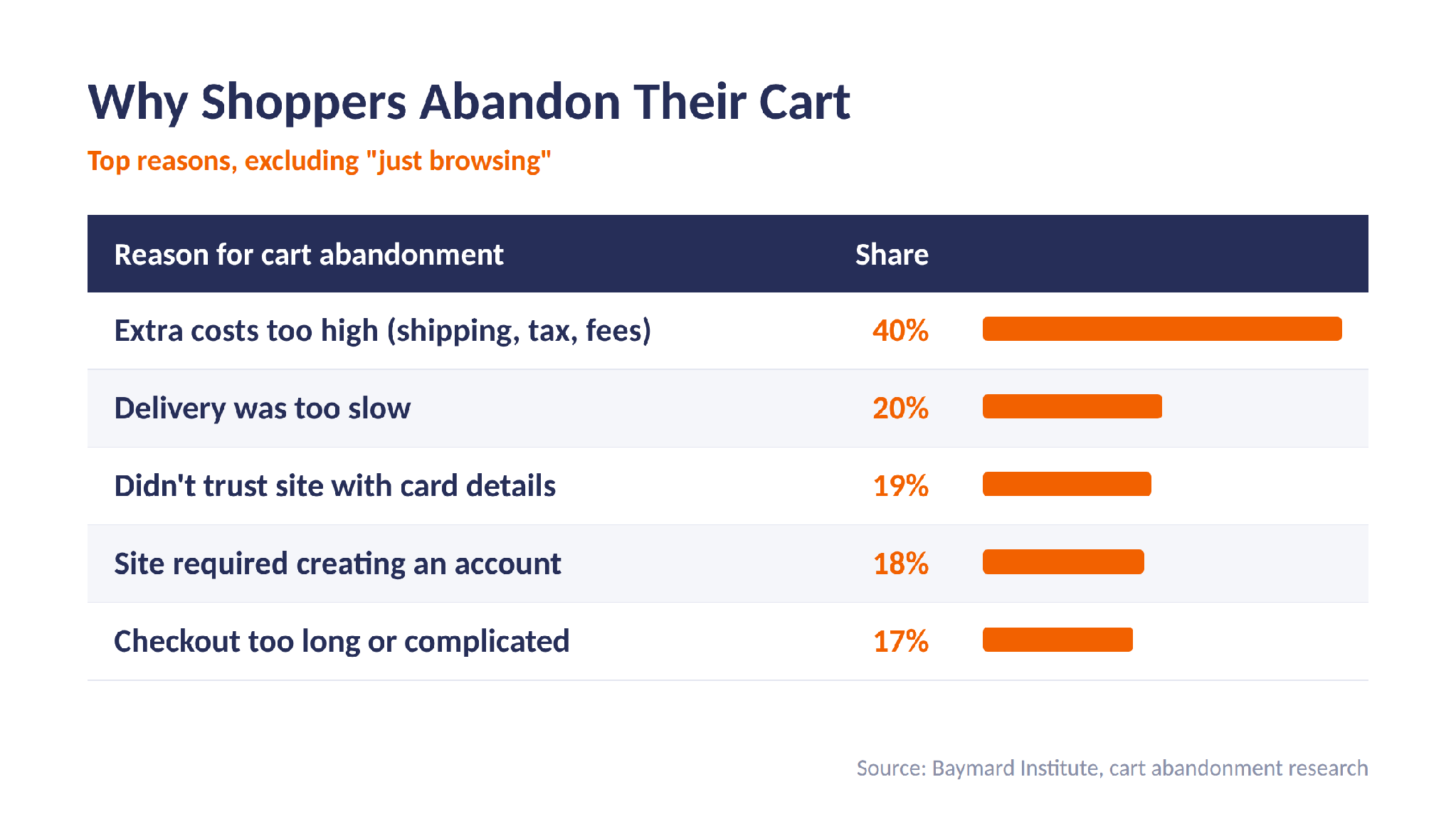
Slow delivery estimates push out another one in five. Close behind are the shoppers who didn't trust the site with their card details, and the ones who bailed the moment they were forced to create an account.
Notice what's missing from that list. Almost none of it is “your product is too expensive.” The friction sits at the finish line, not in the desire to buy. People aren't leaving because they stopped wanting the thing. They're leaving because something in the last few steps got in the way.
Your email's real job is answering an objection
Once you see abandonment as a collection of specific objections, the recovery email stops being a nag and becomes an answer. The person who left because shipping surprised them needs a different message than the person who got pulled into a meeting mid-checkout.
A reminder that just says “you left something behind” treats every abandoner the same. It ignores the reason they left, which is the one piece of information most likely to bring them back. You already have a strong hint about what went wrong. Wasting it on a generic nudge is the most common unforced error in cart recovery.
Stop thinking of cart abandonment emails as reminders and start treating each one as the reply to a question the shopper never got to ask out loud.
Determining the real signal behind the exit
Every abandoned cart carries a little bundle of context, what they added, how far they got, whether they've bought before, what time it was. Most brands throw that context away and send one flat reminder to everyone. The brands that recover more lost carts read the signal and respond to it.
A returning customer who abandons a full cart at 11 pm is telling you something different than a first-time visitor who dropped a single item and vanished. Treat those two the same and you'll underwhelm one and annoy the other.
The KPI that Explains Why Abandoned Cart Emails Work
Here's what makes abandoned cart emails different from almost everything else you send. The person already told you what they want. They picked the item, they reached the cart, they left a trail. That intent is why these emails outperform nearly every other automated message in your account.
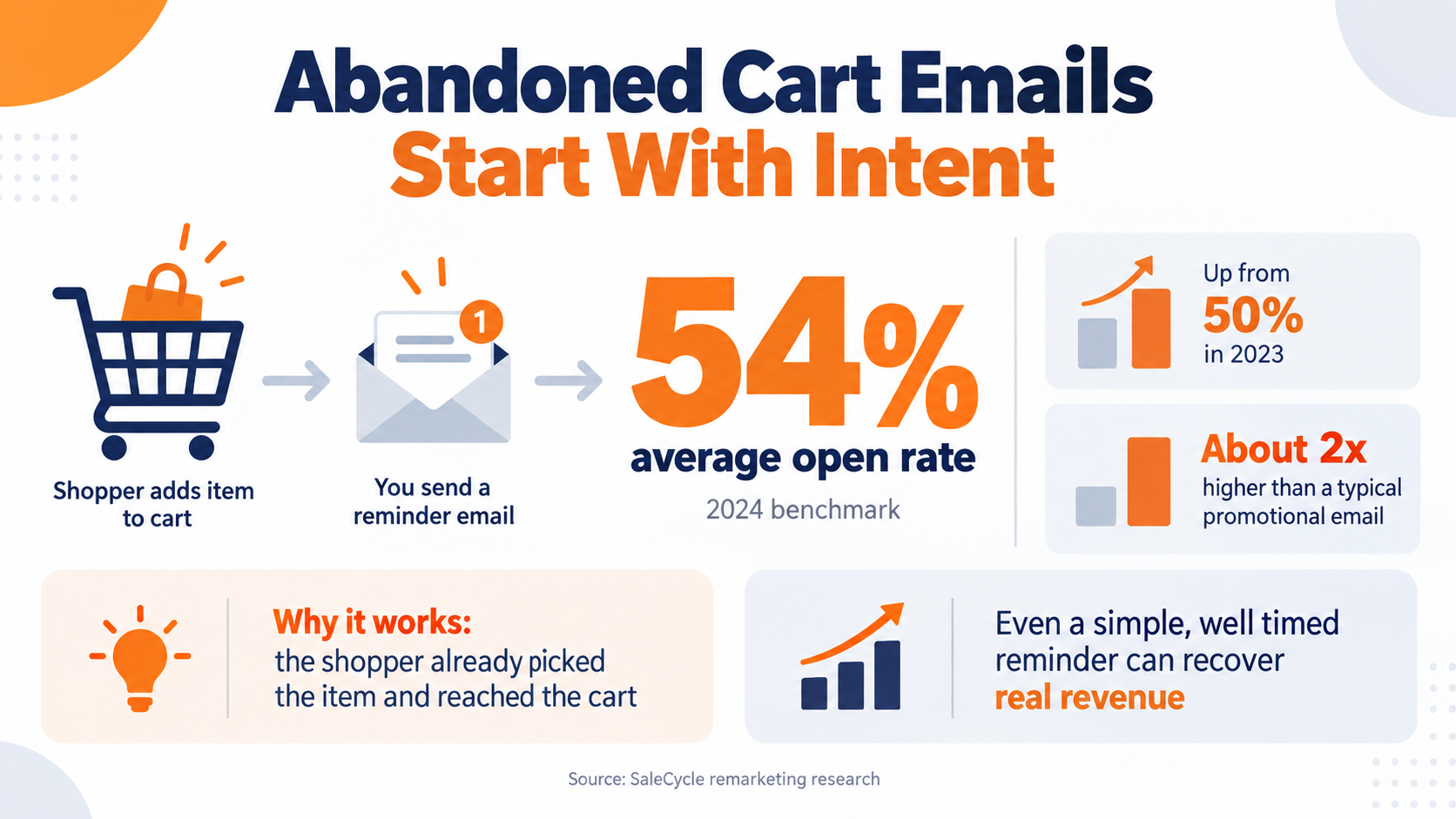
Independent remarketing research put the average abandoned cart email open rate at 54% in 2024, up from 50% the year before, and roughly double what a standard promotional send earns. Put that next to a typical promotional blast and it isn't close.
The psychology of the cart recovery email
A promo email goes to people who may or may not want anything today, but an abandoned cart email goes to someone who already reached for their wallet an hour ago.
The high open rate makes sense once you think about it from the inbox perspective. When the subject line references the exact thing you were just looking at, you open it. This type of email comes across as useful, not as marketing. That attention level is the whole reason these emails convert at a rate a broadcast campaign never comes close to.
You don't need to be perfect, just consistent
Another thing to consider is that because the intent is already there, the distance between a basic abandoned cart email and a heavily optimized one is smaller than almost anywhere else in your program. Even a plain, well-timed reminder performs respectably.
That's an encouraging thing if you're just getting started. It means you don't need an elite, heavily optimized program to see real money from cart recovery. You need one that exists, fires reliably, and follows a sensible structure. The floor here is higher than almost anywhere else in your email program.

Not Every Cart Is Worth the Same Follow-Up
Averages hide a lot of variation. A recovered cart in one category is worth many times a recovered cart in another, because higher-priced, more-considered purchases produce more valuable abandoned carts in the first place. A recovered furniture order and a recovered phone-case order are not the same event, even though the email that recovered them looks nearly identical.
The reason is simple once you say it out loud. Higher-priced, more-considered purchases produce more valuable abandoned carts, and shoppers of those items tend to research, pause, and come back rather than impulse-buy. That pause is the exact moment your abandoned cart email strategy can be most effective.
|
Pro Tip: Segment carts above your average order value into their own sequence, and reserve your richest incentives for the ones where the recovered margin truely justifies them. |
Match the effort to the cart's value
What that variation should tell you is that not every abandoned cart deserves the same treatment. A recovered $400 cart is worth chasing with a full three-message sequence and maybe an SMS layer. A recovered $30 cart might warrant a single reminder and nothing more, because the cost of the follow-up starts eating the margin you're trying to protect.
The stores getting the most out of cart recovery aren't running one blanket sequence for everyone. They're spending their recovery effort where the return justifies it, and easing off where it doesn't.
Why One Email Leaves Most of the Money on the Table
Almost every brand that runs cart recovery sends exactly one email. It's the obvious move. Someone leaves, you remind them, done. The problem is that one reminder catches only the easiest fraction of abandoners, the ones who were probably coming back anyway.
The people worth recovering are the ones on the fence. They need a nudge, then a reason, then a little urgency, and those three jobs don't fit inside a single send. Spreading the message across a short sequence is what separates a recovery program that works from one that technically exists.
Additional reminder emails still get opened
You might assume the second and third emails get ignored, that everyone who was going to open did so on the first send, but the data says otherwise.
A short drip campaign in a cart sequence keep pulling respectable open rates, because the people still in the sequence are exactly the ones who haven't resolved their reason for leaving yet.
In other words, the shopper who ignored your first reminder isn't necessarily a lost cause. They might just have needed the message that spoke to their specific hesitation, which was email two, not email one.
Abandoned cart email best practices for the sequence
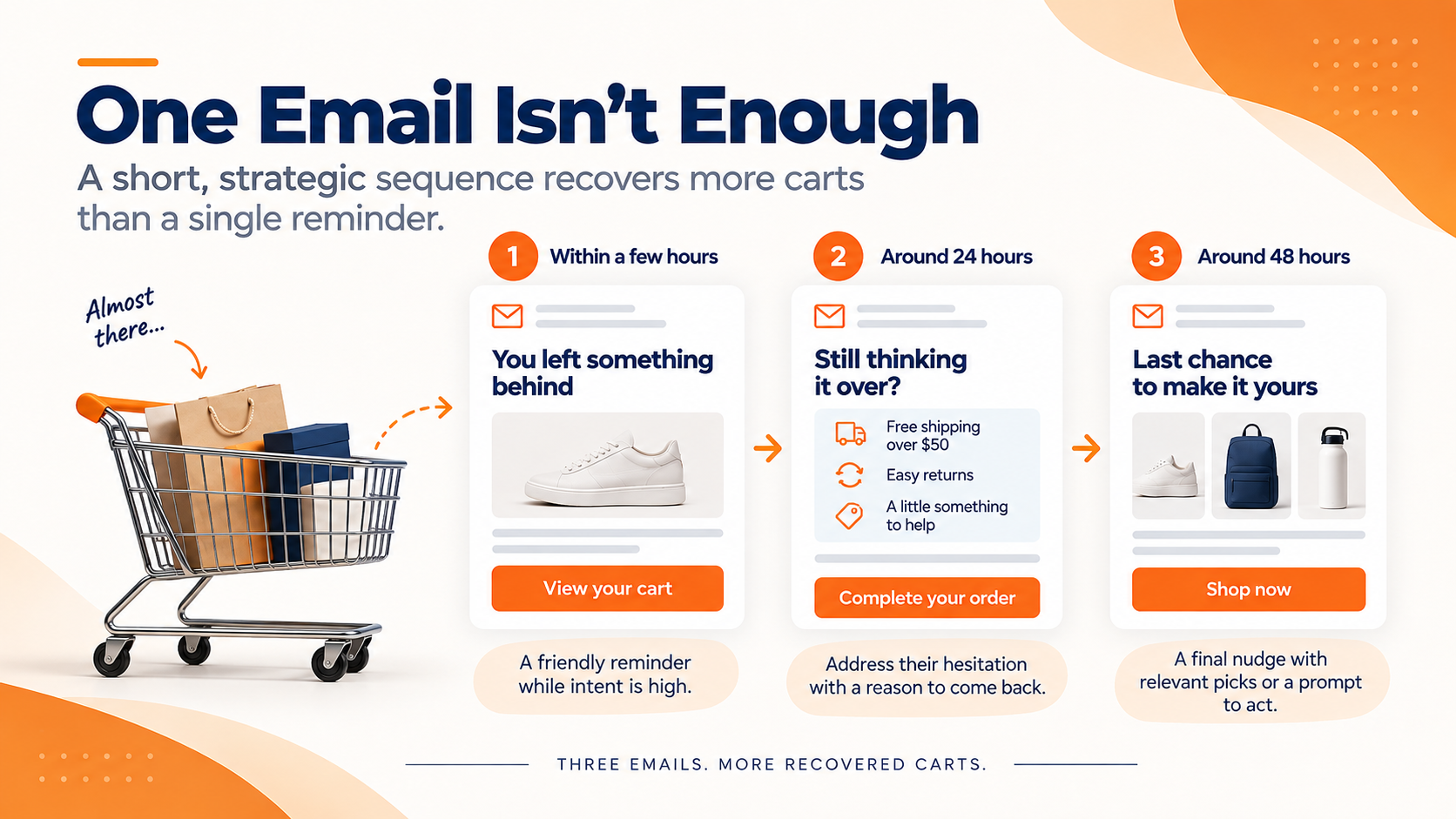
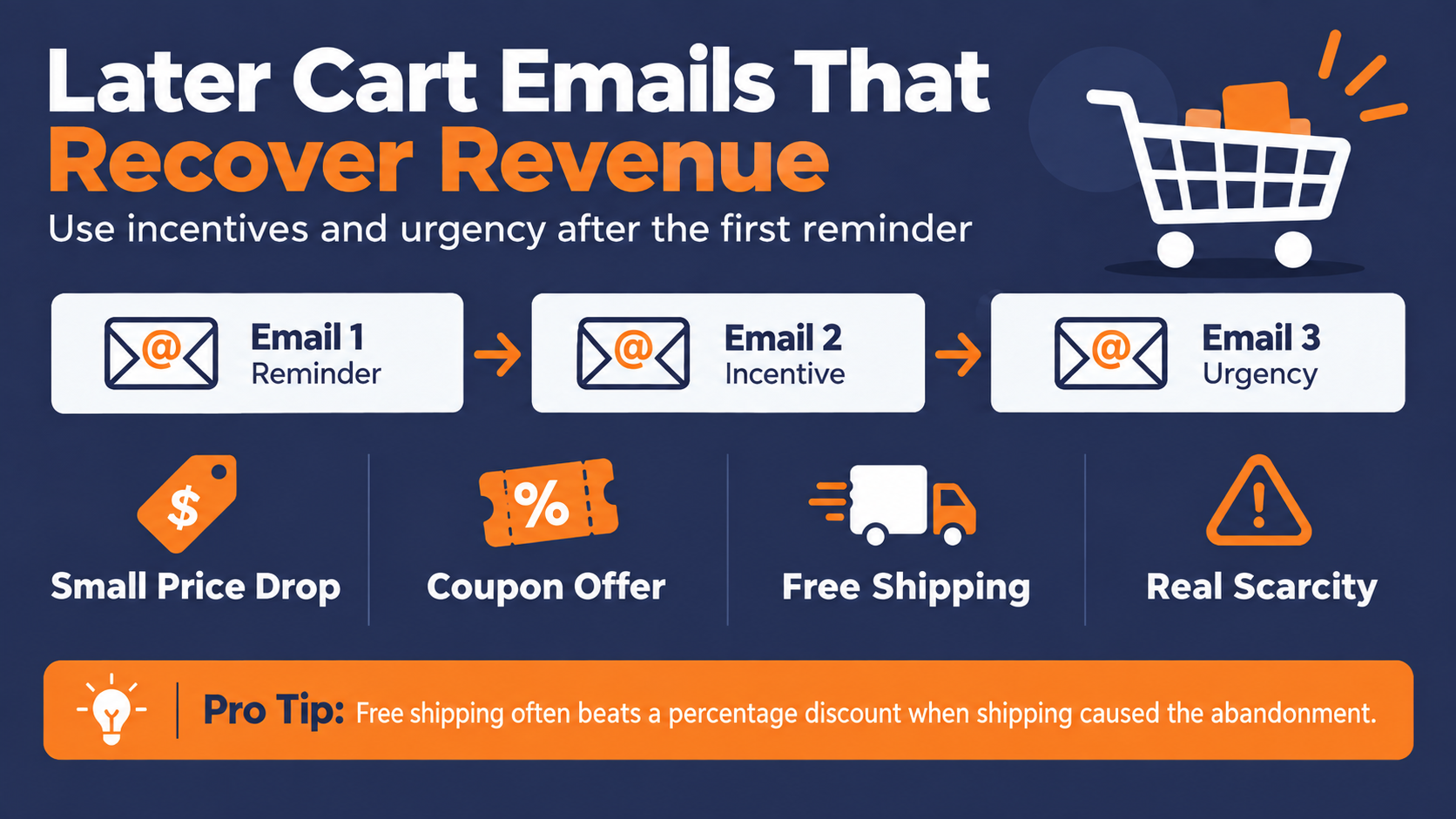
A good sequence isn't the same email sent three times. Each message does a distinct job. The first is a fast, clean reminder with no discount attached, sent while intent is still high. The second, a day later, handles the objection, whether that's a shipping question, a return policy, or a small incentive on the carts worth incentivizing. The third closes the window with product recommendations or a final prompt to act.
The structure most benchmark data points to is a reminder within a few hours, a follow-up around the 24-hour mark, and a final message near 48 hours. Three touches, spaced deliberately, then stop. A fourth email tends to add unsubscribes faster than it adds revenue, so the discipline to end the sequence matters as much as the discipline to run it.
|
Pro Tip: Hold your discount for the second email, never the first. Lead with a coupon and you teach shoppers to abandon on purpose just to trigger one. |
Discounts Are the Lazy Answer, Not the Only One
The reflex to open with a coupon is understandable but unfortunately isn't the best strategy. Every dollar you discount is a dollar off a sale the shopper was already close to making. Worse, once customers learn that abandoning a cart summons a discount, they start doing it deliberately, and you've unknowingly trained your best buyers to cost you more on every order.
Discounts have a place. They just belong later in the sequence, aimed at the carts where the math actually works, not sprayed at everyone who happened to pause.
Better levers than price
Most of the reasons people abandon don't get solved by shaving 10% off. Someone who left over slow shipping wants a delivery date, not a coupon. Someone who bailed at account creation wants a guest checkout, not a promo code. Someone who simply got interrupted wants the easy path back to their cart and nothing more.
Match the recovery message to the reason and you often close the sale without touching your margin at all. The email that reassures beats the email that discounts, because it removes the actual obstacle instead of paying the shopper to overlook it. That's the best cart abandomnet strategy you can use. Focus on removing the friction that stopped them, instead of bribing them past it.
Here are a few abandoned cart email examples of what abandoners are really telling you, and what answers them:
|
What made them leave |
What brings them back |
|---|---|
|
Surprise shipping and fees at checkout |
An upfront total or a shipping-included offer |
|
Delivery felt too slow |
A clear delivery date or a faster option |
|
Didn't trust the site with card details |
Trust signals, reviews, a visible return policy |
|
Forced to create an account |
A guest checkout path straight back to the cart |
|
Just got interrupted |
A simple, friction-free link back to checkout |
None of these strategies require discounting. They require knowing why the cart was left and answering that specific thing, which is only possible if your marketing automation system knows something about the shopper beyond their email address.
Abandoned Cart Email Examples That Rebuild The Reminder
The best abandoned cart emails don't all lead with a coupon. The strongest first messages in a sequence do the work of reminding, reassuring, and re-selling the thing the shopper already wanted, which is why the open rates on these sends run so far ahead of a normal campaign. Here are the abandoned cart email examples that belong at the front of your flow, before any discount enters the picture.
Show the exact items they left behind
This is the one element every cart recovery email should include. Pull the product image, name, and price straight into the message so the shopper sees what they were about to buy, not a generic “you left something behind” line. The picture does the remembering for them.
A clean product grid with the item photo, a short name, and a button back to the cart is the whole email in a lot of cases. When you're first learning how to set up cart abandonment emails, start here. Save this layout as your base abandoned cart email template and treat everything else as a layer on top of it.
|
Pro Tip: Link the product image and the button straight to the pre-filled cart, not your homepage, so the shopper lands one click from checkout. |
Reassure the hesitant buyer by building trust
Some shoppers didn't leave over price. They left because they weren't sure about you, the return policy, or handing over a card to a store they'd never bought from. For those carts, the best cart abandonment emails sell confidence, not discounts.
High-end brands can run initial cart recovery emails that skip discounts entirely, relying instead on origin storytelling and clear trust signals. This strategy succeeds because premium products justify their price point once consumer hesitation is removed.
Including customer reviews, a transparent return policy, direct support contacts, and a concise brand statement often drives more first-time conversions than a standard 10% discount.
Cross-sell and inspire with related products
A cart email is a chance to grow the order, not just save it. If someone abandoned a single item, showing a few related products or the accessories that pair with it can bring them back for the whole set rather than the one thing.
Say a shopper left a camera in their cart. A short row of matching cases, an SD card, and a strap gives them a reason to return and a reason to spend more once they do. Keep the abandoned item front and center, then add the suggestions below it so the cross-sell never buries the original intent.
Abandoned Cart Email Examples That Add A Reason To Act
When the reminder and the reassurance don't land, the later emails in your sequence can bring an incentive or a deadline. The order matters here. These abandoned cart email examples work best as email two or three, after you've given the shopper a chance to come back on their own terms first.
A reminder nudge with a small price drop
A modest discount on abandoned cart items can nudge hesitant shoppers without destroying profit margins. Offering a minor 5% price cut, combined with a simple "the price on your cart just changed" alert or a short-lived 24-hour promo code, is often all it takes to trigger a purchase.
The reason this belongs later in the sequence is simple. Lead with it and you teach shoppers to abandon on purpose. Hold it until email two or three and it rewards the ones who actually hesitated instead of training everyone to wait.
Offer a coupon only when the cart justifies it
If you'd rather not touch individual product prices, a percentage off the whole order is easier to run and easy for the shopper to understand. The staggered approach works well, a basic reminder first, then 5% at the 24-hour mark, then 10% on the final email for the carts still open.
Reserve the richer coupon for the carts where the recovered margin actually justifies it. A cart above your average order value can carry a real incentive. A small one usually can't, and forcing a coupon onto it just hands away profit you'd have earned anyway.
Remove the main objection with free shipping
Extra costs at checkout are the single biggest reason carts get left, so free shipping answers the objection more directly than a discount does. For a shopper who bailed when the shipping line appeared, an email offering to cover it removes the exact thing that stopped them.
If you can afford to offer it year-round, it becomes a genuine edge, since a large share of shoppers say they're more likely to buy from stores that ship free. If you can't, holding free shipping as an occasional cart-recovery incentive still does the job on the carts that need it.
|
Pro Tip: For carts that stalled at the shipping line, an email that leads with free shipping usually beats one that leads with a percentage off. |
Create scarcity and the fear of missing out
If a product is running low in stock or selling quickly, saying so gives the shopper a reason to act now instead of later. Scarcity only works when it's true, but when it is, a line like “only a few left” or “these are selling fast” can move a cart that's been sitting for a day.
Timing abandoned cart emails to coincide with actual clearance events creates authentic urgency rather than manufactured pressure. Pairing genuine scarcity with a "check availability" button transforms a quiet reminder into a compelling reason to buy before stock runs out.
The Real Bottleneck Is Sending at the Right Moment
Everything above depends on one capability most teams don't actually have, sending the right message the instant it matters, without a human pressing the button. A recovery email that has to wait for someone to notice the abandonment, write the note, and hit send is already too late by the time it goes out.
Real recovery runs on triggers. This is the same machinery behind any well-built event-triggered drip campaign, where an action, not a calendar, decides when the next message goes.
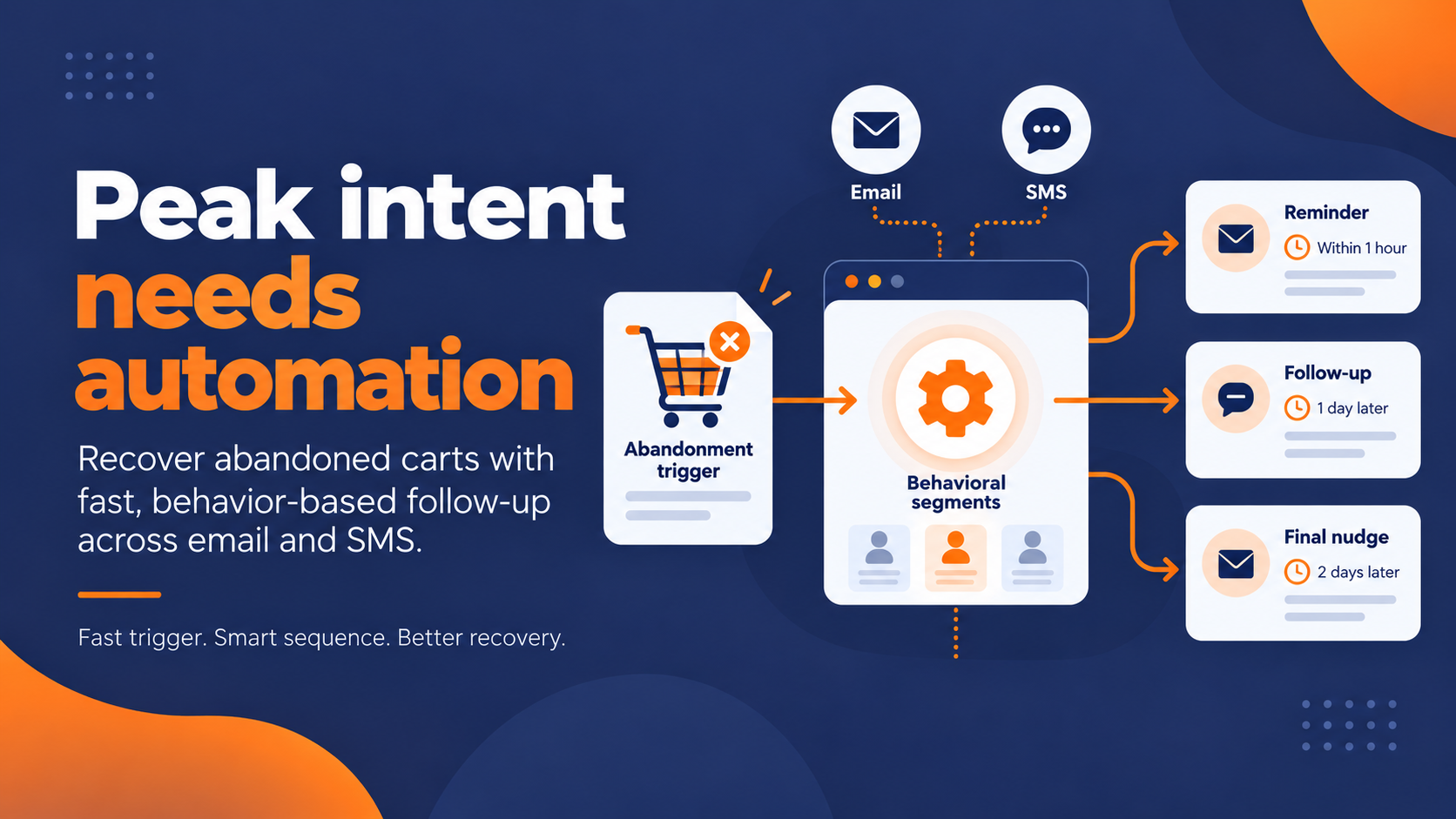
The shopper abandons, and the first email fires automatically within the hour. A day passes without a purchase, and the second one goes on its own. The sequence runs itself, keyed to what the shopper did and when they did it, not to whenever your team next happens to check a dashboard.
Manual sending can't hit the window
You cannot hand-send your way to good cart recovery. The window is too short and the volume is too high. By the time a person manually spots an abandoned cart and drafts a reminder, the intent that made the email worth sending has already faded, and you're now competing with everything else that landed in that inbox since.
This is the difference between having recovery emails and having a recovery system. One depends on someone remembering. The other depends on a rule that fires every single time, at the moment that counts, whether it's 2 pm on a Tuesday or midnight on a holiday.
Segmentation is what makes the trigger smart
A trigger that fires the same email at everyone is better than no trigger at all, but it's leaving money behind. The real gain comes when the sequence branches on who the shopper is and what they left, the first-time visitor and the loyal repeat buyer moving down different paths, the $40 cart and the $400 cart handled differently.
That's not extra work once it's built. It's a set of rules you define once and let run, sorting every abandoner into the follow-up most likely to bring them specifically back.
Recover more carts by addressing different reasons for leaving
And the branching doesn't have to be elaborate to pay off. Even two or three paths, one for new visitors, one for repeat buyers, one for high-value carts, will outperform a single flat sequence sent to everyone.
You're not building a maze, just making sure the loyal customer who abandons monthly stops getting the exact same apologetic reminder you send a first-timer who wandered off. Those two people have different reasons for leaving and different thresholds for coming back, and a system that knows the difference recovers more of both.
Where to Start Recovering Lost Revenue Quickly
Here's what this comes down to. Cart abandonment is a permanent feature of selling online, not a problem you'll ever fully solve, so the win comes from what you do in the hours after, not from stopping it.
The reasons people leave are specific and mostly fixable, the emails that recover them work because intent is already high, and the single biggest lever is a timed sequence rather than a one-off reminder or a reflexive coupon.
The brands pulling real revenue out of abandoned carts are the ones with a system that fires fast, follows up in order, and matches the message to the reason someone left.
Lock in peak intent with multi-step behavioral workflows
Almost none of that is realistic to run by hand. The whole value of cart recovery lives in the first hour and the two days after, and no manual process reliably hits that window. This is what a marketing automation platform is for, setting the abandonment as a trigger and the sequence as the response, so the first reminder fires on its own while intent is high, the follow-up goes a day later, and the final nudge lands as the window closes.
Behavioral triggers and segmentation are what let the person who left over shipping and the person who got interrupted receive different messages instead of the same flat note, and running email and SMS from one system is what carries that sequence across both channels rather than betting everything on a single email getting seen.
Schedule an audit to find and close your sequence gaps
If your recovery today is one email sent whenever someone gets around to it, that's the easiest money you're leaving on the table, and it's very fixable this week.
Get a free marketing automation audit, and we'll show you exactly where your follow-up sequence is losing sales and how to close the window that's costing you.