Most subscribers decide whether your newsletter is worth opening again within the first two sends. Not the tenth. Not the twentieth.
Real email newsletter engagement gets decided that early, long before most teams start measuring it.
That second send lands before a reader has fully decided you're worth the inbox real estate. That's the moment most newsletter programs quietly lose people, and most teams never notice because the unsubscribe doesn't happen for another six weeks, by which point the real cause is long buried under whatever campaign shipped that week.
Why newsletters are outperforming promotional blasts
We've watched this pattern play out across our own list and our customers' lists for two decades now, and it hasn't changed shape much. What's changed is how unforgiving the inbox has gotten about it.
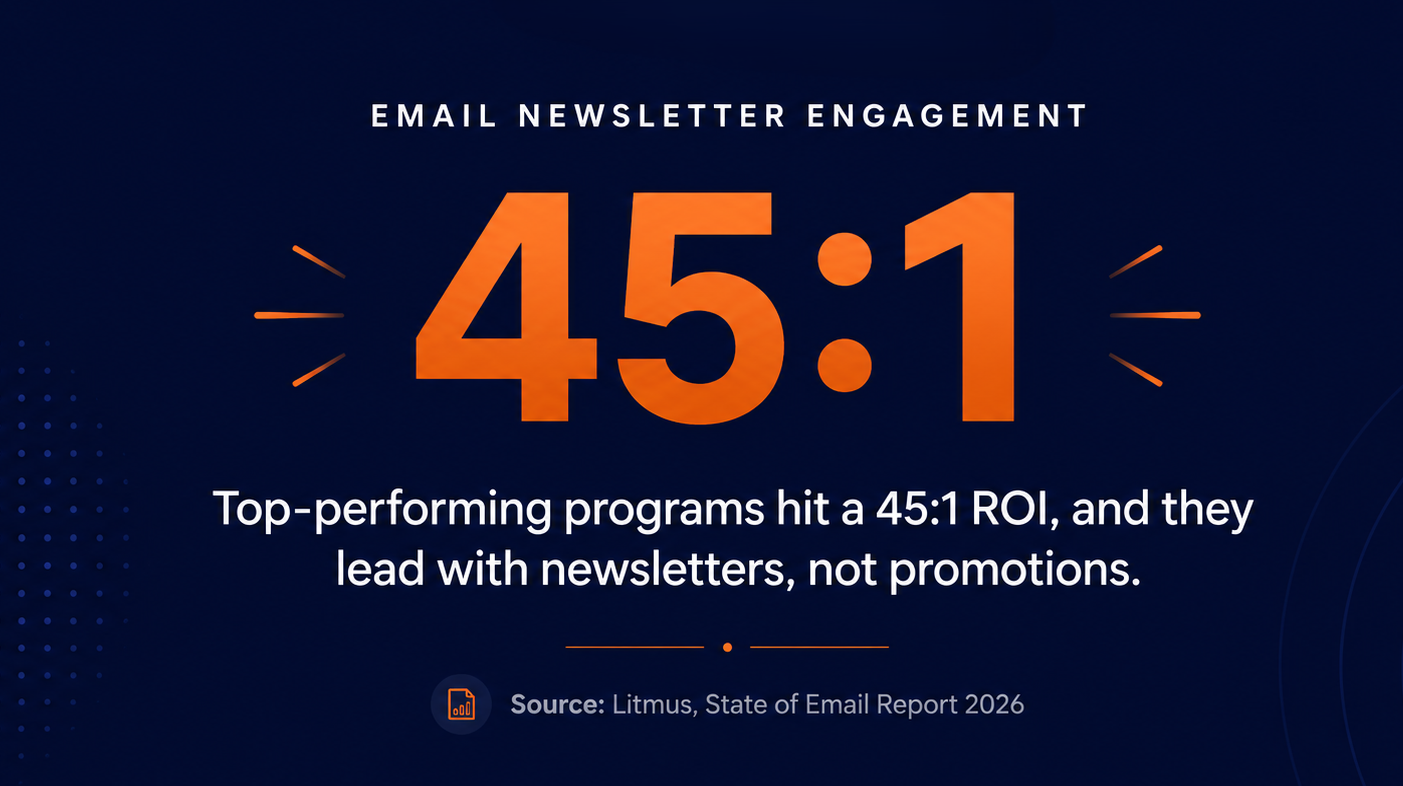
The top-performing email programs today aren't the ones blasting the most promotions. They're the ones leaning hardest into newsletters and relationship-building sends, and it's paying off: the top 8% of programs hitting 45:1 ROI or better are most commonly sending newsletters and onboarding emails, not promotional blasts, with newsletter volume up 12% year over year across the industry.
Align every part of your email strategy around reader response
So if you're building or rebuilding a newsletter right now, the goal hasn't moved. Get people engaged with what you offer. Everything else, the subject line, the design, the send time, is in service of that one thing.
Everything in this refresh, from content depth to personas to the tools behind it, is really just an email newsletter best practices checklist for that single goal.
How much should you actually give away in the newsletter itself?
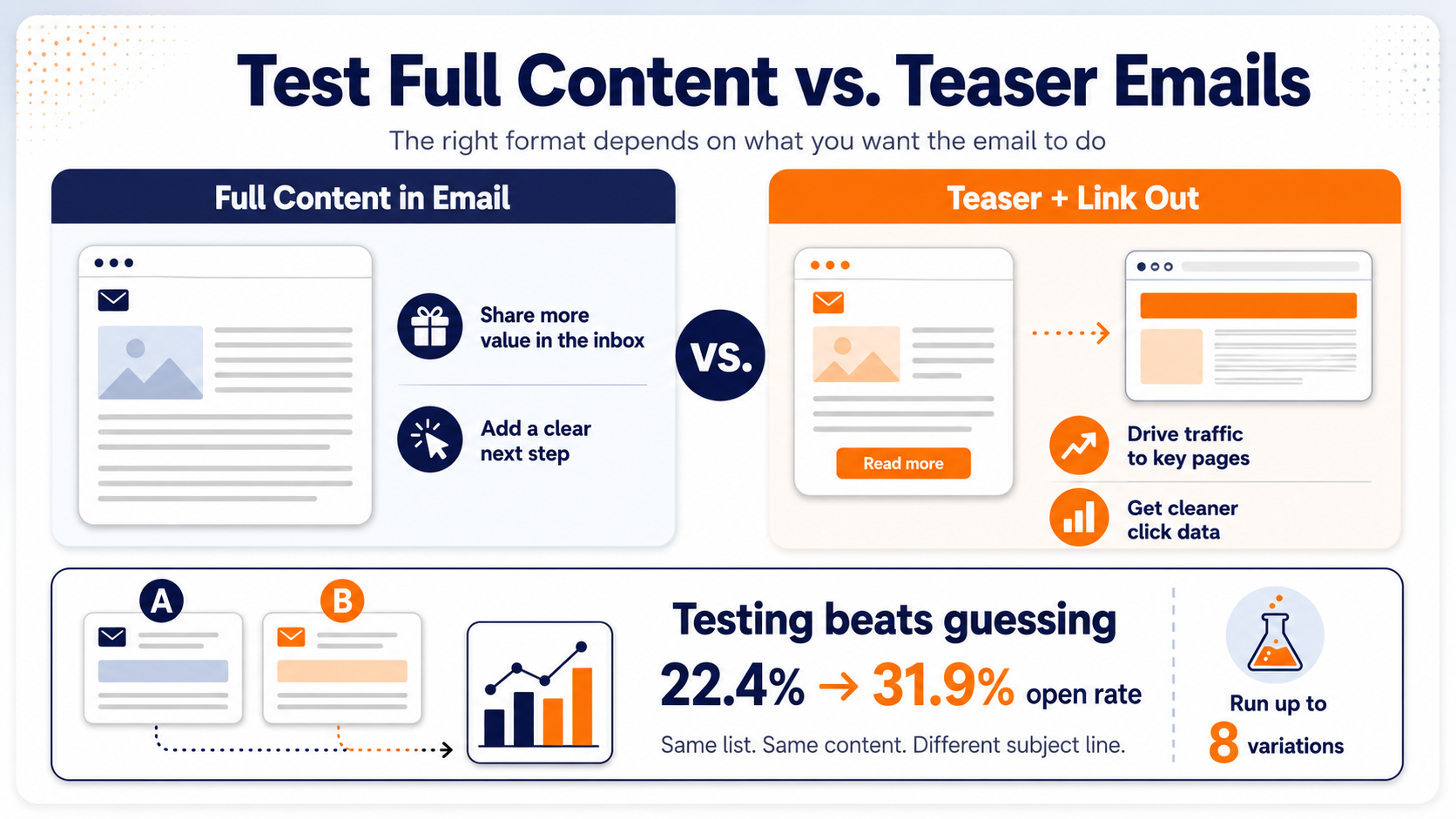
Here's the tension every newsletter eventually runs into: full articles inside the email, or a teaser that sends people somewhere else. Neither one is the "right" answer. It depends entirely on what you're actually optimizing for.
Want traffic to a specific page? Tease it and link out.
Have something useful to share and no real funnel behind it? Give more of it away right in the inbox.
The mistake isn't picking one. It's picking one and never testing whether the other would actually perform better for your specific list.
"But I don't have the data to know which one works"
You don't need a hunch here. You need a test. Split testing is one of the more underused tools in most newsletter programs, and it's not complicated: send version A to a slice of your list, version B to another slice, and let the open and click behavior settle the argument instead of an internal debate.
We've seen a single subject line change move a client's open rate from 22.4% to 31.9% on the same list, same day of week, same content underneath. That's the whole argument for testing over guessing, in one number.
Pinpointe lets you run up to eight variations of a single campaign this way, and the results come back without any manual spreadsheet work on your end.
What each approach actually costs you
If you go the full-content route, don't let the article just end. Every piece of shared content needs a next step attached to it, a report, a demo request, something that gives the reader a reason to raise their hand. Skip that step, and you've handed over your best material for nothing in return.
If you go the teaser route, the trade-off flips. You get much cleaner data on what people actually care about, click by click, but the pressure shifts hard onto your subject lines and your first two sentences.
That's a fixable problem, not a fatal one. Companies do this well constantly. It just takes more discipline on the headline than the full-article approach demands, and that discipline is learnable in a few send cycles once someone owns it.
The mobile tax nobody budgets for
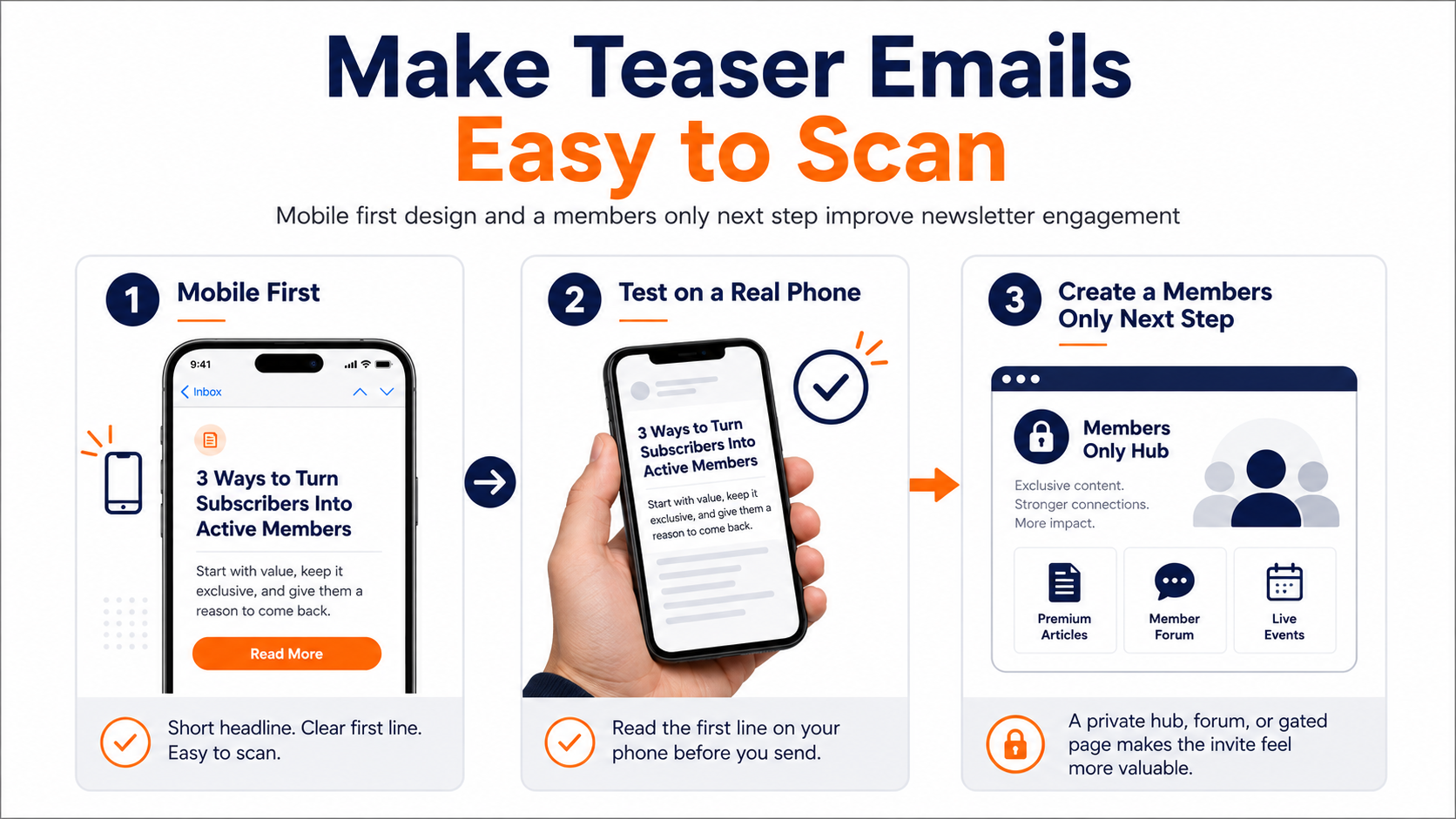
Teasers put more weight on scannability, and scannability lives or dies on a phone screen now. Most of your list is opening on mobile whether your design assumes that or not, which means a headline that reads clearly on a 27-inch monitor can still fall apart at 375 pixels wide.
This isn't a reason to avoid the teaser approach. It's a reason to test your actual sends on an actual phone before you hit send on the email campaign, not just in a preview pane that renders everything a little too generously.
Grab your own phone, open the draft the way a subscriber would, and read only the first line before deciding whether you'd keep going. If you wouldn't, rewrite it before it goes anywhere near the send button.
When teasing works better than a full inbox dump
One pattern worth stealing: instead of treating every subscriber the same, some of the sharpest newsletter programs create a gated layer entirely.
A members-only forum, a private Slack, a password-protected hub, something that turns "read this" into "come be part of this." The scarcity does real work. People show up differently when the room feels earned rather than open to anyone with an email address.
Build an exclusive community feel on a low-lift budget
You don't need a full membership platform to borrow this. A simple gated landing page or a private community group creates the same psychological shift at a fraction of the build, and it's often the fastest route to a more engaging email newsletter without a bigger production budget.
The protection isn't really about security. It's about signaling that this space wasn't built for everyone, which, counterintuitively, makes the people inside it pay closer attention.
Personalization that's actually personal, not just a first name
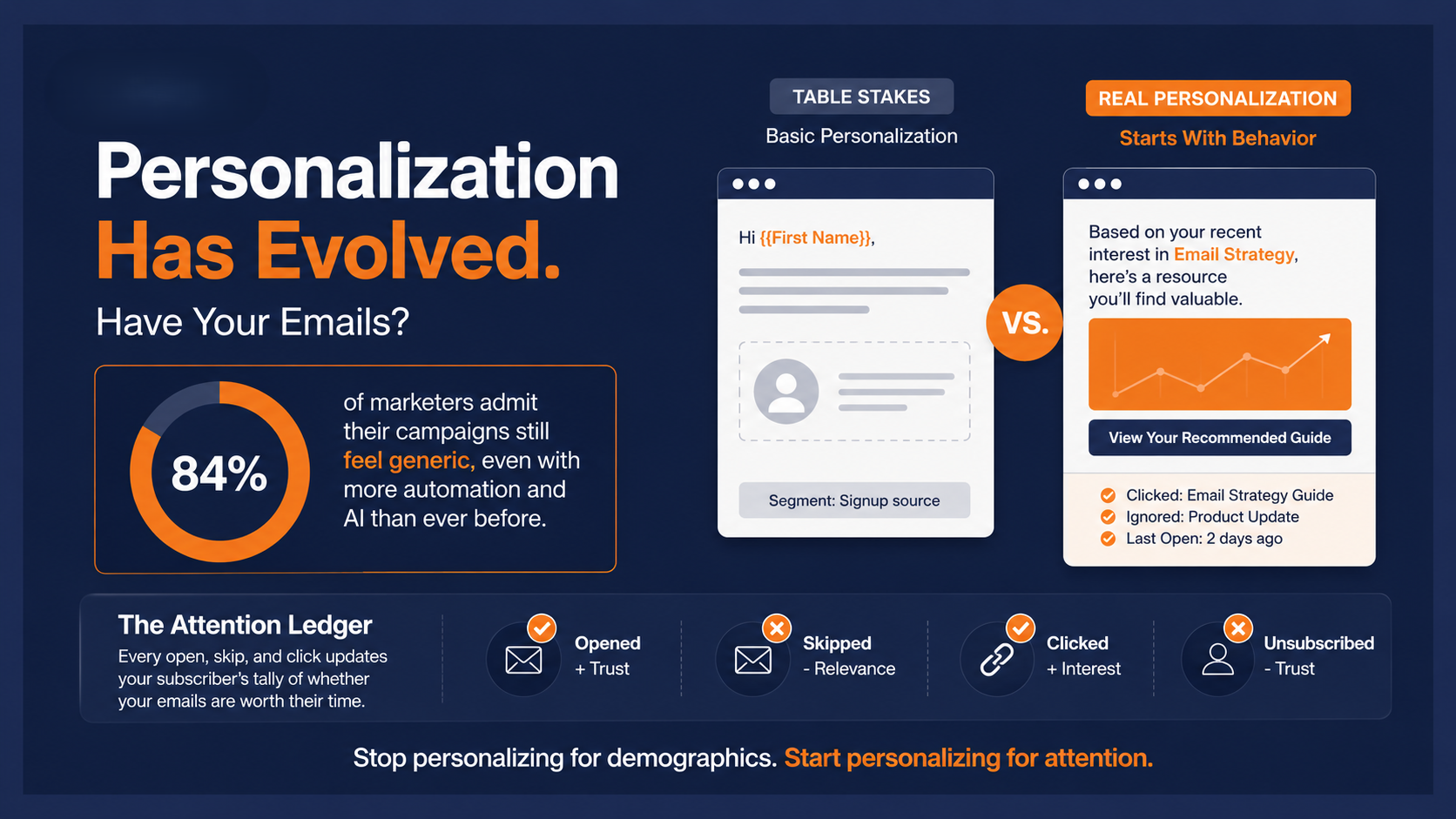
Most marketing teams have already crossed the basic personalization threshold. First name in the subject line, maybe a segment based on signup source. That's table stakes now, not a differentiator, and real email personalization has moved well past it.
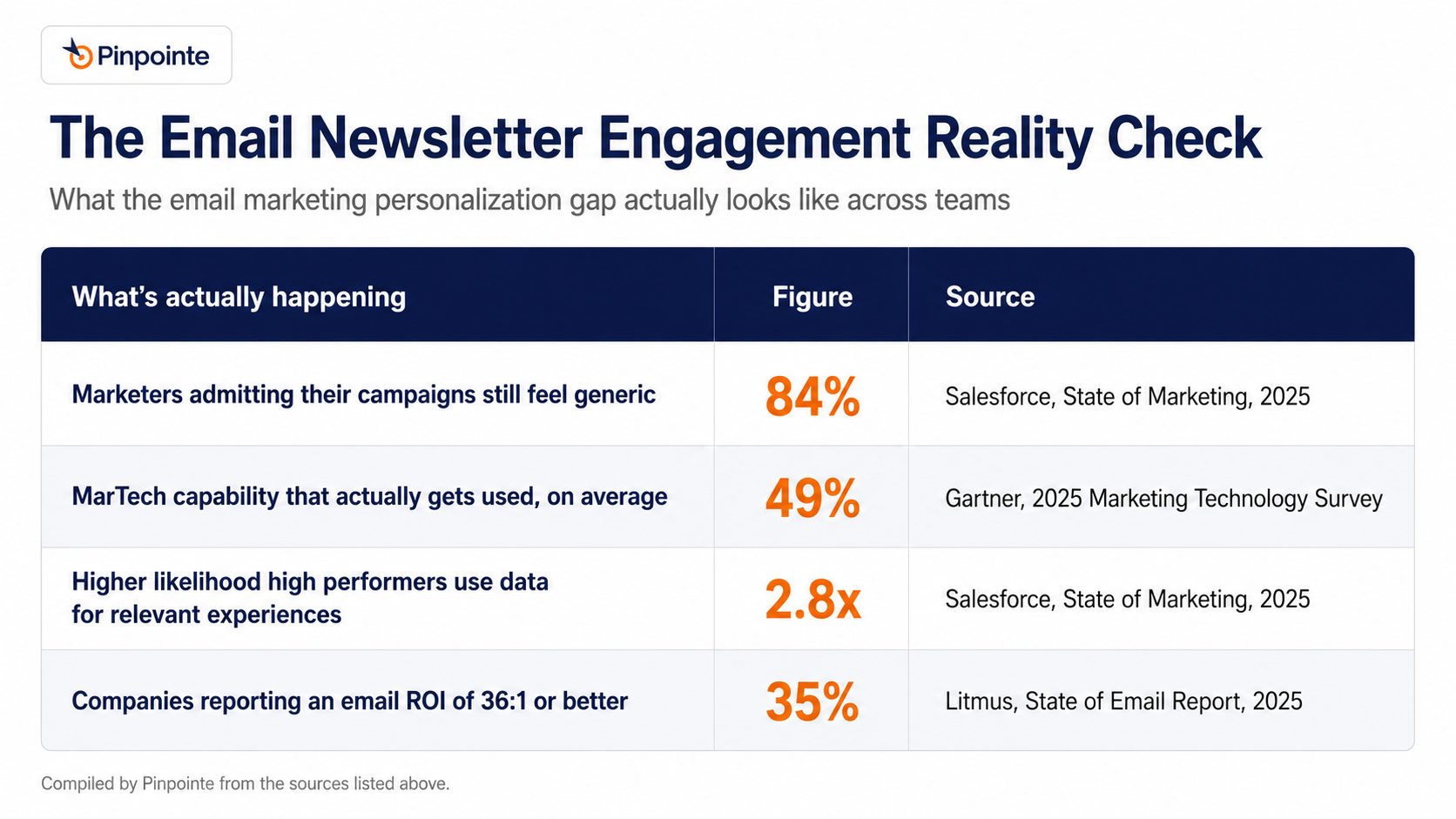
The data on where teams are actually stuck is blunt about it: 84% of marketers admit their campaigns still feel generic, even with more automation and AI in the stack than ever before.
Why the gap isn't really a technology problem
Here's the part that surprises people. That gap usually isn't a technology problem. It's a decision problem.
Teams have the tools to personalize deeper. They just haven't decided what "personal" actually means for their specific list, so the automation defaults to the shallowest setting available by default.
That shallowest setting is a name merge tag. Real personalization starts with what someone actually does, what they clicked last time, what they ignored, how long since they last opened anything from you at all.
We call this the Attention Ledger.
Every subscriber is quietly running a tally in their head of whether your emails have been worth their time lately, and that ledger updates with every open, every skip, every unsubscribe click they almost made but didn't. Segmentation that ignores the ledger and only tracks demographics is optimizing for the wrong signal entirely.
Getting personal without a bigger budget
A lot of teams assume deeper personalization means a bigger martech line item. It doesn't, and the data backs that up in an odd direction: high-performing marketers are 2.8 times more likely to use customer data to create relevant experiences than everyone else, which sounds like a resourcing gap until you notice the real difference is discipline about which data actually gets used, not how much of it exists.
You don't need to allocate your entire marketing budget to get more personal with your list. You need the right handful of signals, tracked consistently, and a plan for what to do with them. That's a workflow decision before it's ever a purchasing decision.
What the AI adoption gap actually tells you
There's a second layer to this that's easy to miss if you're only looking at the personalization headlines. On the email side specifically, advanced AI adopters are seeing meaningfully stronger returns, not because the AI is doing anything mystical, but because it's applied to the unglamorous parts of the program: subject line testing, send-time optimization, segmentation logic that would otherwise take a person hours to maintain by hand every week.
That's a useful reframe if your team has been treating AI in email as a content-generation shortcut and nothing more. The actual lift shows up in the plumbing, not the prose.
"Isn't behavioral tracking just surveillance with better branding?"
Fair question, and worth taking seriously rather than waving away. There's a real line between personalization that serves the reader and personalization that just feels like being watched. The difference usually comes down to whether the behavior you're tracking changes what you send, or just proves you were watching.
If someone hasn't opened anything from you in ninety days, sending them a re-engagement note that acknowledges the gap is personalization. Sending them the exact same weekly blast with their name inserted is surveillance dressed up as strategy. The reader can tell the difference even when they can't articulate it.
Audit your tools before you audit your content
If you've been doing this long enough, you already know how martech stacks tend to grow. Nobody sits down and plans twelve overlapping tools. They accumulate one decision at a time, each one reasonable in isolation, until the stack outgrows anyone's ability to actually use it.
The numbers on this are sobering. Gartner's 2025 Marketing Technology Survey found that only 49% of MarTech capability actually gets used across the average stack, which means roughly half of what teams are paying for sits there unused, quietly renewing every year on autopilot.
That's not a technology failure. It's an accountability failure that happens to show up on a software invoice.
Running the audit that actually matters
Think of your tools in terms of the campaign they support, not the category they fall into. What creates the message? What sends it?
What does the reader do after they click? Line your tools up against that path instead of a generic feature list, and the redundancies tend to surface fast, usually inside the first hour of the exercise.
Stop paying for tools your team hasn't opened in years
Pay closest attention to the tools causing more friction than value. Write down what each one actually costs your team, not just in dollars but in setup time and maintenance headaches, and let that comparison guide what stays.
A basic spreadsheet handles this fine. You don't need a procurement consultant for a newsletter-sized program. You need an honest afternoon and a willingness to admit that the tool three people championed in a meeting two years ago hasn't been opened since.
|
PRO TIP: Before you cancel anything, pull login activity for the last 90 days on every tool in the stack. Silence is the fastest tell. |
Testing before you migrate anything
If a migration to something leaner makes sense, don't leap without testing first. Run the new system against live data during a trial period before committing, so you know it fits your actual workflow rather than a demo environment built to impress you. Most platforms worth switching to will offer a free trial window specifically so you can do this before signing anything.
Watch how the new tool handles your messiest list, not your cleanest one. The messy list is where the real answer lives.
Build personas from conversations, not assumptions
Segmenting a list without a clear reason behind the segments is how newsletter programs end up with fifteen groups that all get roughly the same content anyway. Persona work has to start before the segmentation, not after.
That means actual conversations. Sit down with sales, with support, with whoever talks to customers daily, and ask who the ideal reader really is. Narrow that down to four or five personas you can hold in your head without a spreadsheet, then go one step further most teams skip entirely.
The fifteen-minute call that beats a quarter of open-rate data
Call the customers who match those personas. Ask what's actually working and what they're tuning out. It's a short conversation, usually under fifteen minutes, and it routinely surfaces more useful direction than a quarter's worth of open-rate data.
One isolated thing tends to happen every time we run these calls.
The customer says something about their actual workflow that completely reframes the segment they were assigned to.
That's the moment persona work stops being a guess and starts being a plan you can actually build a newsletter calendar around. Once you've got that plan, segmenting the list and writing to a specific reader instead of an abstract audience gets dramatically easier, and it shows up fast in how the numbers move.
Keep the persona list short on purpose
Four or five is a ceiling, not a starting point to expand from later. Every additional persona is another set of content decisions your team has to make every single send, and most teams don't have the bandwidth to serve more than a handful well. A newsletter trying to speak to nine personas usually ends up speaking clearly to none of them.
Stop trusting the open rate on its own
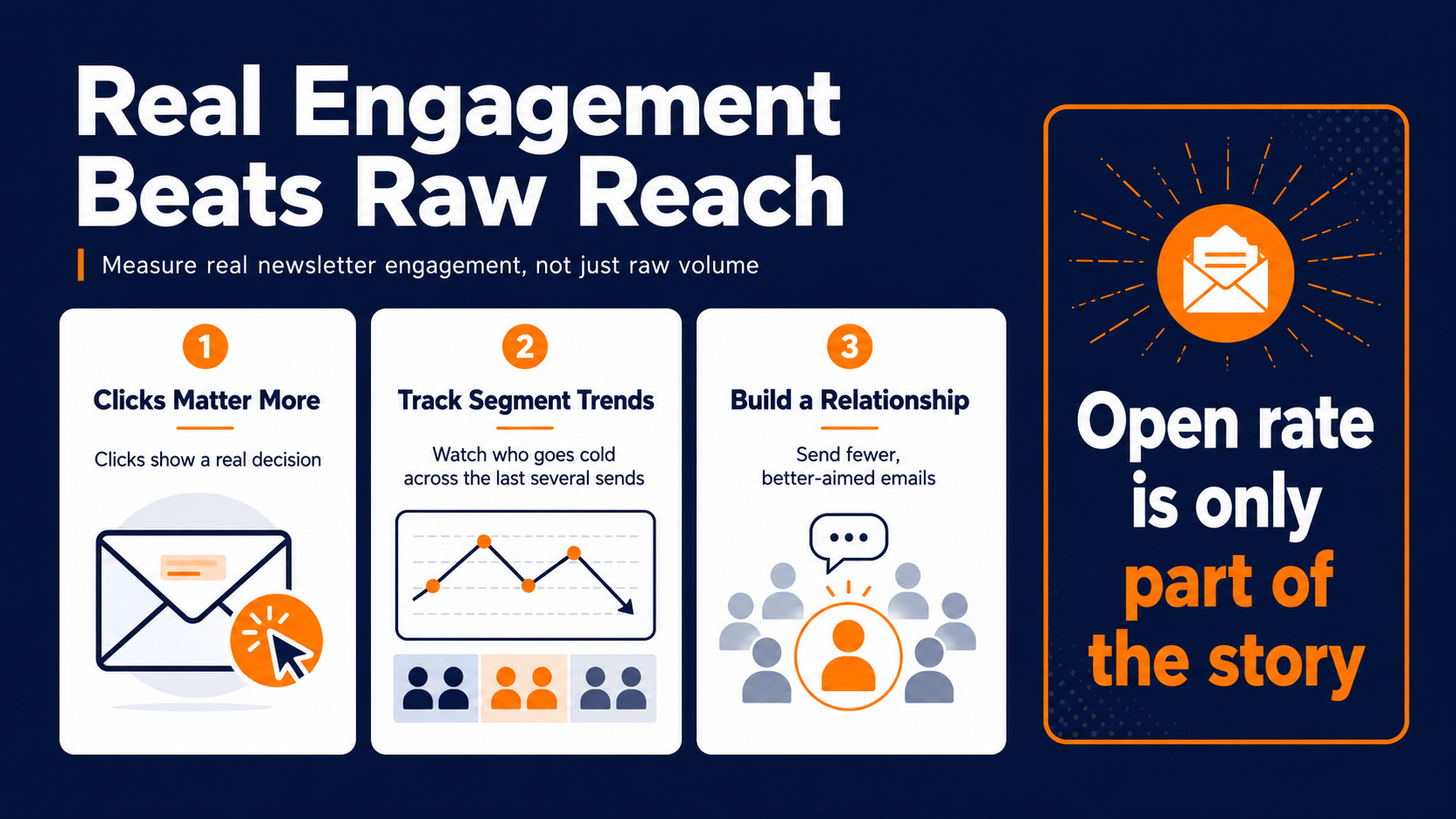
Here's the thesis underneath everything else in this piece, so it doesn't get lost in the tactics: engagement earned beats reach purchased, every time, and the metrics you track should reflect real email newsletter engagement instead of rewarding raw volume.
Open rate used to be the headline number everyone reported up the chain. It's a much shakier signal now than it was even a few years back.
Image pre-fetching, privacy protections, and inbox providers doing their own filtering before a human ever sees the subject line have all muddied what an "open" actually means. Treating it as gospel is how teams end up optimizing for a number that no longer reflects real attention.
What to watch instead
Clicks are a cleaner signal than opens, because a click requires an actual decision. Beyond that, look at how quickly engagement drops off after each send, and whether specific segments are quietly going cold before they ever hit the unsubscribe link. A subscriber who hasn't clicked anything in four sends is telling you something, even if they technically still "open" every email.
None of this means throw out open rate entirely. It means stop treating it as the whole story. Pair it with click behavior and with how a segment's engagement trends over the last several sends, not just the last one, and you get a far more honest read on whether the newsletter is actually building the relationship it's supposed to.
Your newsletter is a relationship, not a broadcast
Every piece of this, how much you give away, how personal you actually get, which tools earn their place, comes back to the same underlying question: are you building a relationship with this list, or just filling a send calendar? Real email newsletter engagement is always the former.
The teams pulling ahead right now have already answered that question. They're not sending more. They're sending fewer, better-aimed emails that a specific reader actually wants to open, and letting the data tell them when that's working instead of guessing.
What would your next newsletter look like if you wrote it for the one subscriber who almost unsubscribed last month instead of your entire list at once?
Stop treating your welcome sequence as an afterthought
It all comes down to a shift in priorities. Give the first message a new subscriber receives the same intentional focus as a major quarterly campaign, instead of treating it as a template you set up once and forgot about.
The behavioral triggers and omni-channel journey builder in Pinpointe exist to handle exactly this kind of first-moment timing, so the welcome sequence adjusts to what a subscriber actually does instead of running the same three emails at everyone regardless of engagement. It's the same email marketing automation logic that should be running your whole newsletter program, not just the first three days of it.
If your welcome series is still one generic email sent to every new signup the same way, schedule a marketing automation audit and see exactly where the gaps are sitting. We'll walk through it with you.