
Open rate stopped being an honest number a while ago, and most advice on the best email subject lines hasn’t caught up.
The tactics that used to be safe bets, a number here, a name there, a little urgency, now perform close to average because everyone’s doing the same thing in the same inbox.
The bar didn’t disappear. It moved, and it moved toward specificity, which is exactly what separates real email subject line examples from filler.
The Old Email Marketing Playbook Was Built for an Inbox That Doesn’t Exist Anymore
A few years back, email subject line best practices were refreshingly simple. Add a number. Create a small information gap. Drop in a first name. Every guide said some version of the same three moves, and for a while, they worked.
They don’t work the way they used to, and it’s not because marketers got lazy. It’s because the inbox itself changed underneath the advice.
Apple quietly broke the metric everyone optimized for
Apple Mail Privacy Protection didn’t just nudge open rates up a little. Based on Litmus’s own email client tracking, Apple’s mail apps now account for 64.66% of all email opens as of May 2026, and Litmus estimates that Mail Privacy Protection now touches roughly 55 to 60% of all opens across the inbox.
That’s not a rounding error. That’s the majority of your list generating an open signal that may have nothing to do with whether a human looked at your email.
The addition of mail tabs made things more complicated
Gmail and Outlook complicate things further, sorting mail into tabs and categories before a subscriber even scrolls past the preview pane. None of that means subject lines matter less.
It means the number most teams still lead with in their reporting decks was quietly hollowed out, and most testing programs haven’t adjusted.
Click-to-open and reply rate held up better
If your subject line testing still lives or dies by raw open rate, you’re optimizing for a metric Apple partially broke.
Click-to-open rate and reply rate compare what happens after the open, which is exactly where privacy proxies can’t interfere.
A/B testing is still worth doing. Just measure the outcome that reflects a person acting, not a tracking pixel loading because Apple pre-fetched it.
What Actually Moves Email Open Rates Today
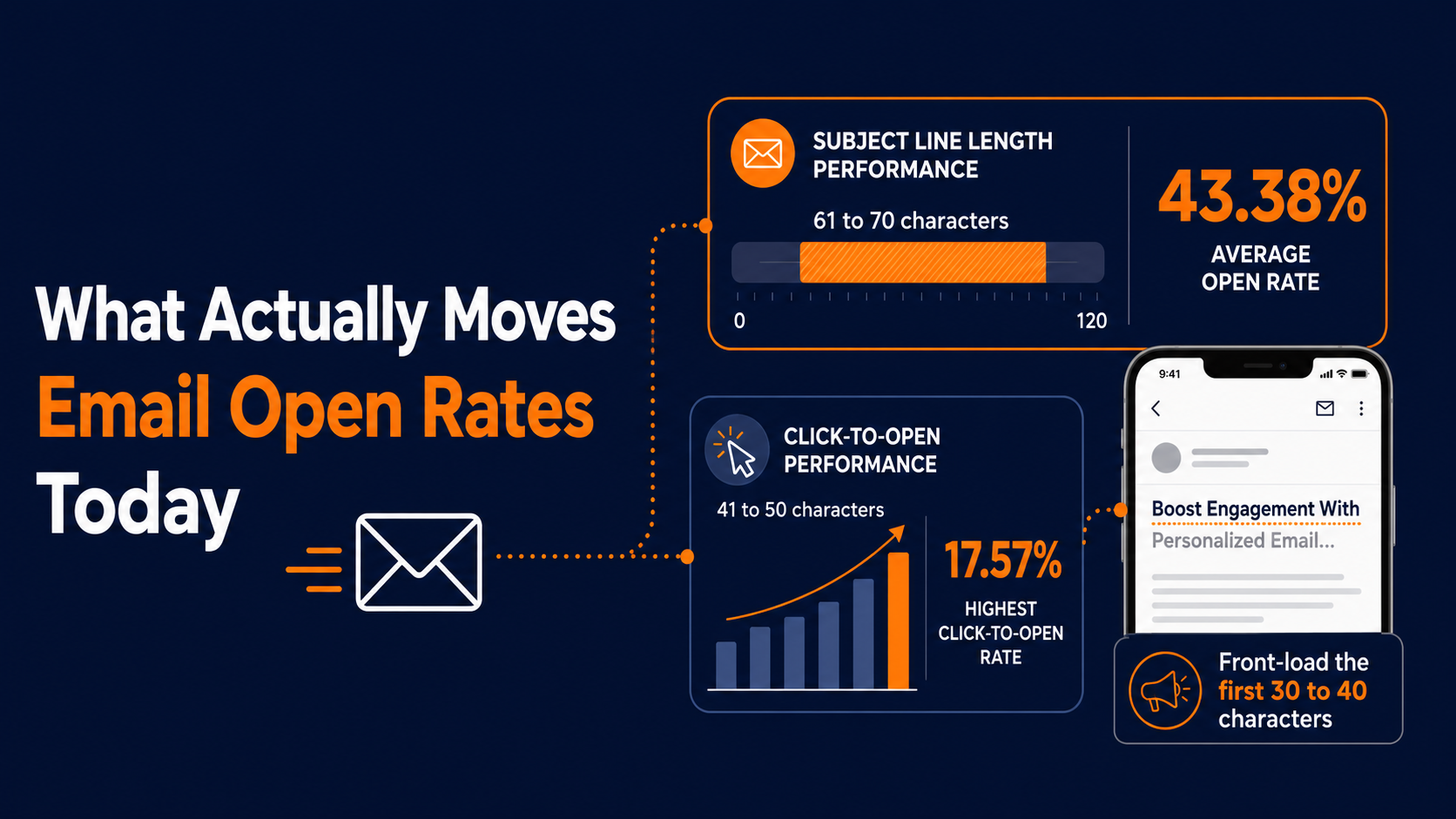
Once you stop treating open rate as gospel, the length and personalization conversations look different too. If you’re figuring out how to write email subject lines that hold up under this data, length and personalization matter more than cleverness. Here’s what the current benchmark data actually supports.
The length sweet spot is longer than most style guides admit
Recent GetResponse benchmark data, aggregated in HubSpot’s subject line research, found that subject lines between 61 and 70 characters posted the highest average open rate at 43.38%. That’s a wider window than the “keep it under 40 characters” advice most teams still follow.
Interestingly, the same data set found something different for clicks: subject lines in the 41 to 50 character range produced the highest click-to-open rate, at 17.57%.
Longer subject lines can win the open. Shorter, tighter ones tend to win the click. Which one you optimize for depends on whether your program lives or dies by opens or by what happens after.
Mobile truncation hasn’t gone anywhere
None of this means write longer for its own sake. More than half of email opens happen on a phone, and most mobile clients still cut a subject line off well before 60 characters.
Front-load the specific, meaningful part of your subject line into the first 30 to 40 characters regardless of total length, because that’s often the only part guaranteed to survive the cut.
Personalization Graduated Past the Merge Tag, But Most Programs Haven’t
“Hi [First Name]” used to be the whole personalization playbook. It’s the floor now, not the ceiling, and the email personalization statistics below show a gap between teams who know that and teams who actually act on it.
Only a third of marketers are doing real personalization work
Here’s the part that should sting a little. Only 36% of marketers say they personalize the subject line or preview text most heavily, out of every lever available to them.
Most teams already agree personalization works. Most still aren’t putting real effort into the one line that decides whether the rest of the email gets read.
That gap is usually a tooling problem more than a strategy problem. The behavioral data needed to personalize a subject line properly already sits inside most marketing platforms.
The missing piece is a way to pull it into the subject line at send time without a developer sprint attached to every campaign.
AI is already writing a lot of these subject lines
The same research found that 45% of companies now use AI to help with some part of their email marketing, subject lines included. That’s a real shift, and pretending it isn’t happening at this point is just stubbornness. It’s also not a reason to hand the keyboard over completely.
AI-drafted subject lines tend to converge on the same phrasing across brands using the same tools, which creates its own kind of sameness problem.
The job now is editing for a voice a model can’t fake on its own, and picking which of its ten drafts actually sounds like your brand instead of every other brand running the same prompt.
|
Practice |
Then |
Now |
|---|---|---|
|
Subject line length |
Shorter was safer, under 40 characters was the common rule |
61 to 70 characters post the highest open rate at 43.38%, while 41 to 50 characters win on click-to-open rate |
|
Personalization |
Name-only merge tag was the whole strategy |
Only 36% of marketers personalize subject lines or preview text heavily, leaving real upside on the table |
|
Primary success metric |
Open rate |
Click-to-open rate and reply rate, since Apple’s Mail Privacy Protection distorts raw opens for the majority of the inbox |
|
Subject line drafting |
Written manually, one option at a time |
45% of companies use AI to help draft and test subject line variants |
|
Apple Mail’s share of opens |
A significant but manageable slice |
64.66% of all opens as of May 2026, with privacy-impacted opens touching 55 to 60% of the total |
Preview Text Is Doing More Work Than It Gets Credit For
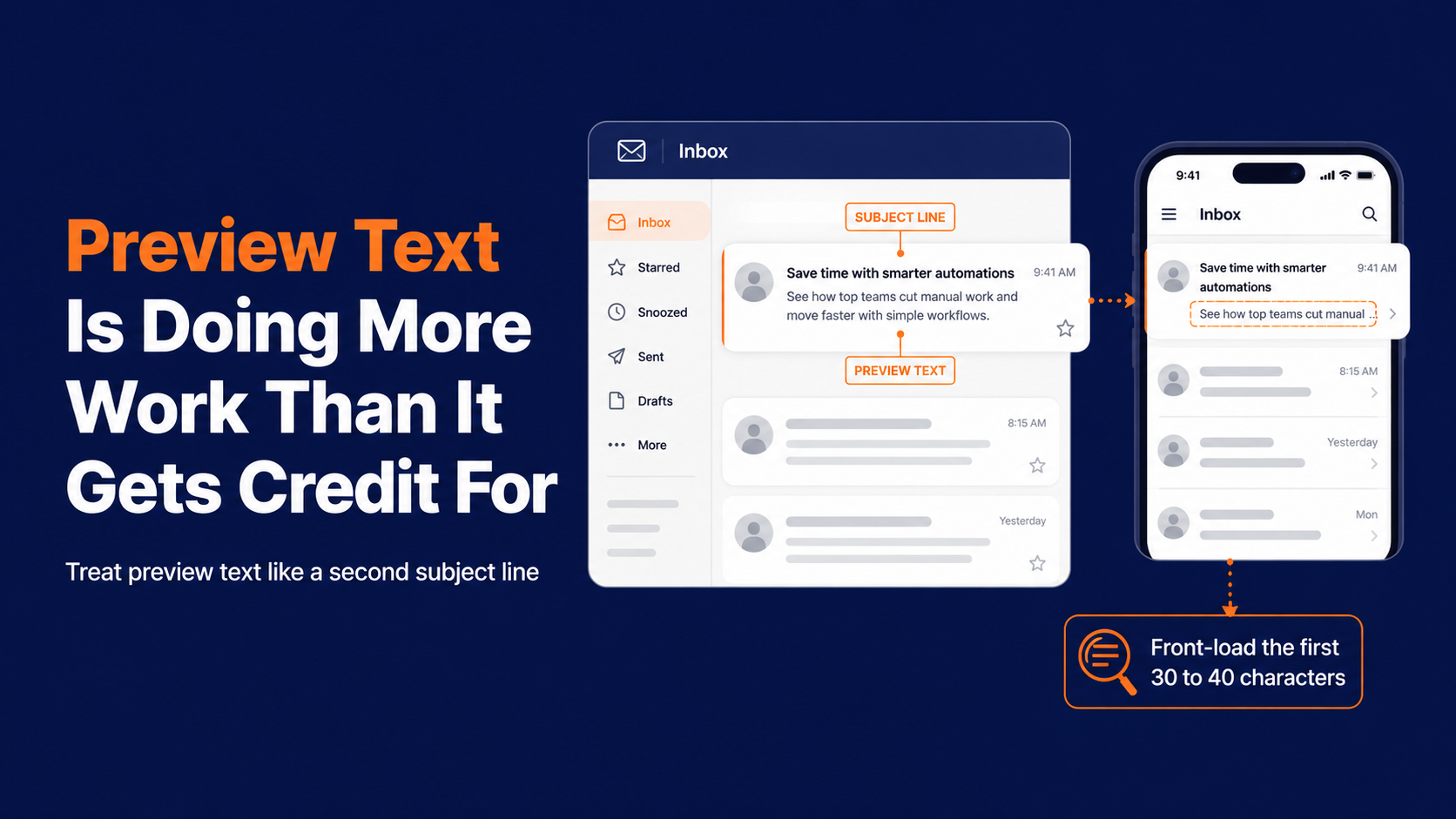
Subject lines don’t operate alone. Every major inbox client pairs the subject line with a preview snippet, and plenty of marketers still leave that real estate to chance.
When preview text is left blank, clients default to pulling the first line of body copy, or worse, a generic fallback line about viewing the email in a browser.
Treat preview text like a second subject line
That default fallback is a wasted opportunity every time it shows up. Preview text should extend the promise the subject line made, or add a detail the subject line didn’t have room for.
If your team tests subject lines without testing the preview text sitting right next to them, you’re only optimizing half of what a subscriber actually sees before deciding to open.
Think about the two lines as a single unit instead of two separate fields in your ESP. The subject line earns the glance. The preview text either confirms that glance was worth it or wastes it on a line nobody wrote on purpose.
You’ve probably scrolled past plenty of your own sends and noticed the preview text was just whatever sentence happened to load first, not something anyone actually chose. That’s the gap worth closing before you spend more time tweaking the subject line itself.
What this looks like on mobile
More than half of all email opens now happen on a phone, where the visible character count is even tighter than on desktop.
A subject line built around the longer 61-to-70-character sweet spot still needs its most important words front-loaded into the first 30 to 40 characters, because that’s often all a mobile client shows before truncating.
Write for the full length, then check what actually survives the cut before you send.
Six Email Subject Line Examples Worth Testing This Quarter
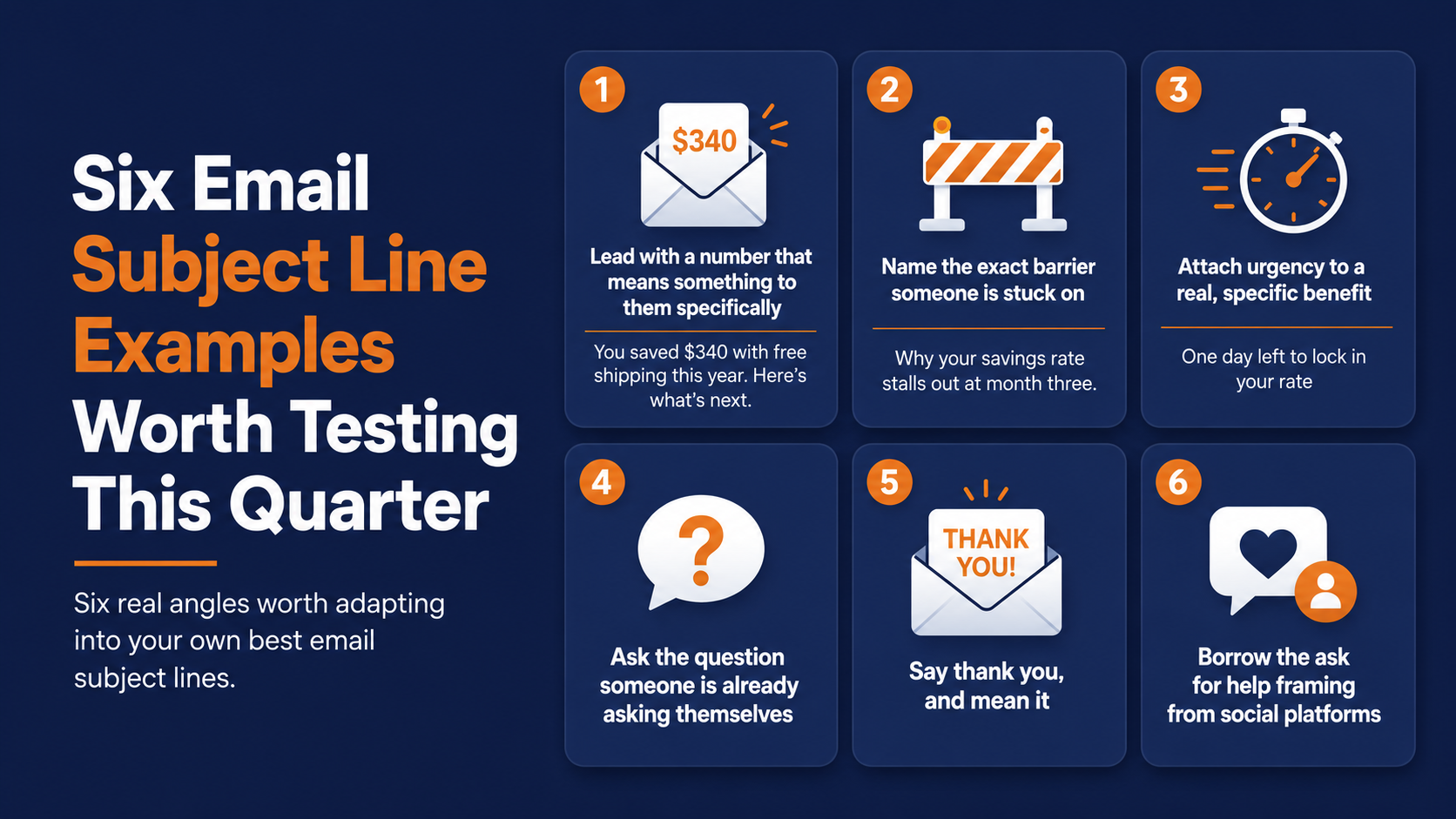
The core instinct behind a good subject line hasn’t changed in years. What’s changed is how much specificity it takes to earn a click today. These are six real angles, not templates, worth adapting into your own best email subject lines.
Lead with a number that means something to them specifically
A generic number in a template doesn’t move anyone anymore. A number pulled from someone’s own account activity, order history, or usage data still does, because it can’t be copy-pasted into a competitor’s send.
Save the placeholder numbers for internal drafts, not the version that reaches an inbox. Example: “You saved $340 with free shipping this year. Here’s what’s next.”
Name the exact barrier someone is stuck on
“Reason why” subject lines have outlasted every algorithm change because they solve the oldest problem in marketing, showing up right when someone is already frustrated.
The specificity has to come from real customer language, not a guess at what the barrier might be. Pull the phrase straight from a support ticket if you can. Example: “Why your savings rate stalls out at month three.”
Attach urgency to a real, specific benefit
Urgency still works, but only when the deadline is real and the benefit belongs to the reader, not to you.
“One day left to lock in your rate” earns more trust than “one day left to sign up.” The difference is which side of the transaction the subject line is written from.
Ask the question someone is already asking themselves
Question-format subject lines work because the curiosity is already there. The reader doesn’t have to generate it.
The trick is making sure the question sounds like it came from someone who understands the actual problem, not a template with an industry buzzword swapped in.
Say thank you, and mean it
Gratitude-based subject lines have consistently outperformed cleverness for years. Pair a genuine thank-you with a specific reason, a milestone, an anniversary, a completed action, rather than a vague appreciation note. It reads as sincere because it is.
Borrow the “ask for help” framing from social platforms
People respond to requests for input more warmly than they respond to being sold something, which is part of why survey invites and feedback requests often outperform promotions. Keep the ask small and the reason obvious. A subject line that names what the feedback is for beats a vague “we need your help” every time.
Testing Only Works If You Give It Room to Breathe
Every stat in this article came from a test somewhere, and most subject line tests inside individual companies never reach a result that means anything. The fix isn’t more testing. It’s more disciplined testing.
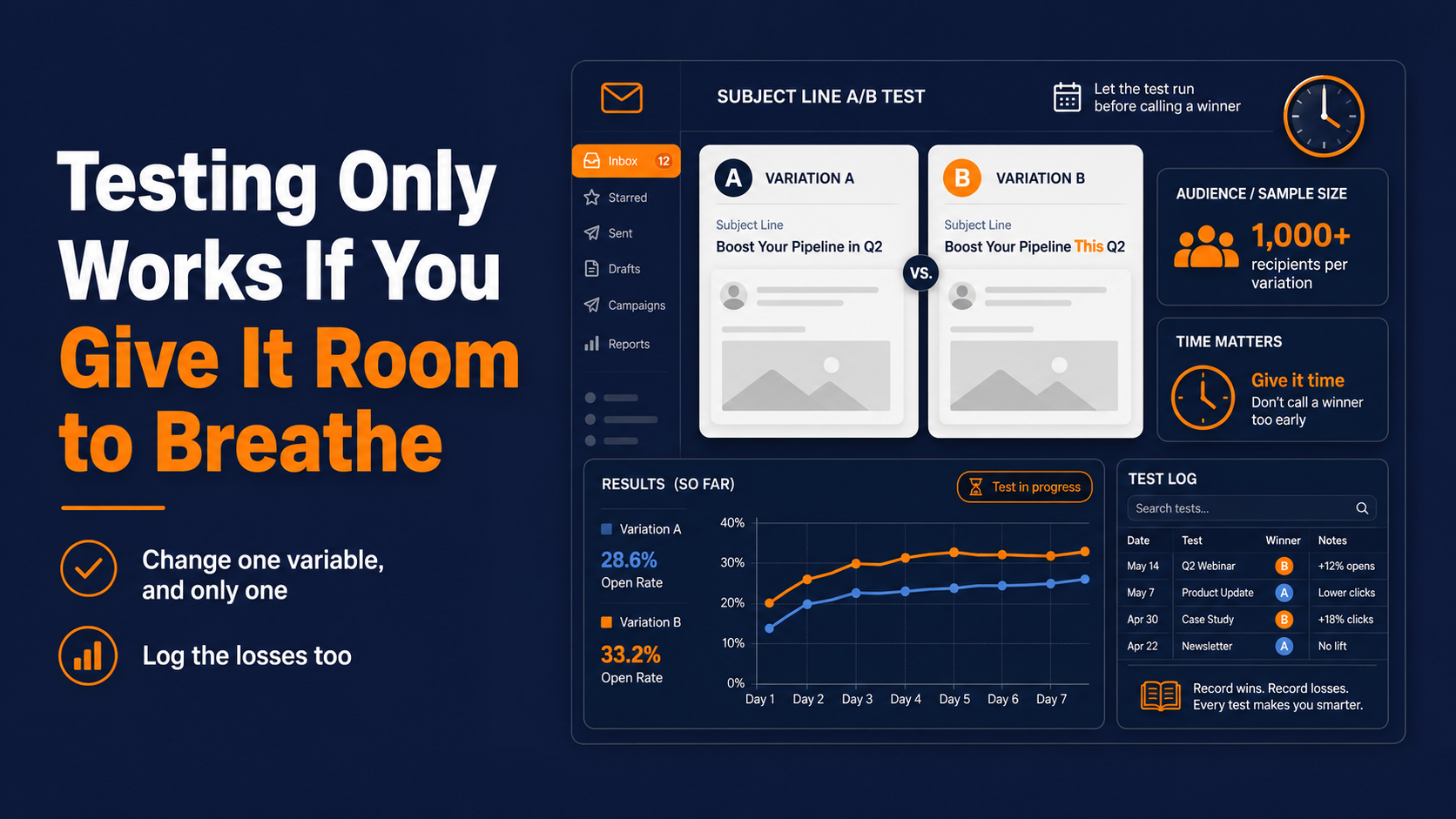
Change one variable, and only one
If you’re comparing a personalized subject line against a generic control, don’t also change the length or the tone in the same test, or you won’t know which change actually moved the number.
A common rule of thumb is at least a thousand recipients per variation before trusting the result instead of chalking it up to noise, and plenty of sends never reach that threshold on a single campaign.
Give the test time before calling a winner, too. A test called an hour in reflects whoever happens to check email fastest, not your actual audience.
Log the losses too
The losing subject lines tell you almost as much about your list as the winning ones do, but only if someone actually writes them down.
A rolling log of what you tested, what won, and by how much becomes the fastest way to brief the next campaign instead of starting from a blank page every single time.
Most teams keep this information in someone’s head instead of somewhere searchable, which means the lesson gets relearned every time that person is out sick or moves teams.
The Same Discipline Applies the Moment You Add SMS
Pinpointe customers building journeys across email and SMS run into this exact problem in a different shape. SMS doesn’t have a subject line, but it has the same bottleneck: the first few words of a text are the only thing standing between a read and an ignore, just like the first 30 to 40 characters of an email subject line.
The instinct that makes a message worth opening doesn’t change by channel, even where the tooling does. Treating email and SMS as two separate disciplines is how a team ends up carefully testing subject lines for months while the SMS step in the same journey gets written once and never revisited.
How Pinpointe Turns This Into Practice
We built Pinpointe’s marketing automation tools around this exact problem, because customers kept telling us they were tired of guessing which subject line would land. Run variants against real engagement data, and you’re testing against click-to-open and reply behavior instead of an open-rate number that Apple’s privacy settings have already distorted for well over half your list.
Dynamic segmentation inside Pinpointe pulls in the behavioral and account-level detail this article keeps circling back to, the kind that separates a name-only merge tag from a subject line that actually reflects what someone did last week.
Paired with behavioral triggers, that means a subject line referencing a real action a subscriber took, sent automatically, without a developer needed for every campaign.
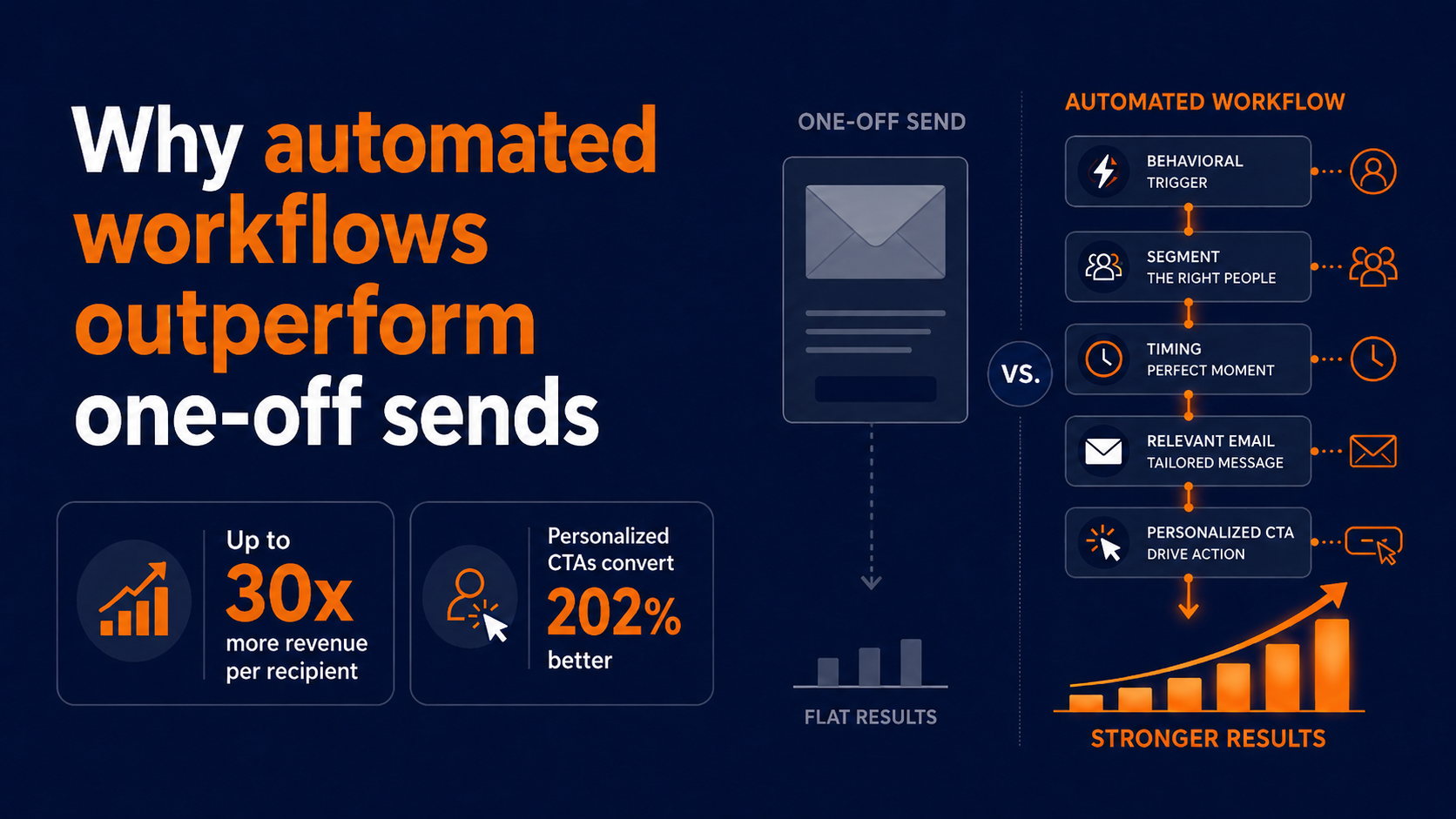
Why automated workflows outperform one-off sends
That same infrastructure is a big part of why automated flows outperform one-off sends so consistently. Automated email workflows generate up to 30 times more revenue per recipient than one-off campaigns. A subject line only gets you the open.
What happens after that, the behavioral trigger, the segment, the timing, is where the revenue actually lives, and it’s also where personalized CTAs tend to outperform generic ones by a wide margin, converting as much as 202% better.
Use a real-time engagement feedback loop to further optimize email subject lines
Real-time engagement data feeds back into that same loop inside Pinpointe. A subject line that wins a split test in one quarter doesn’t get treated as settled forever.
The platform keeps surfacing how it performs as your list, your competitors, and the inbox itself keep shifting, which is the part a static best-practices guide can’t do for you.
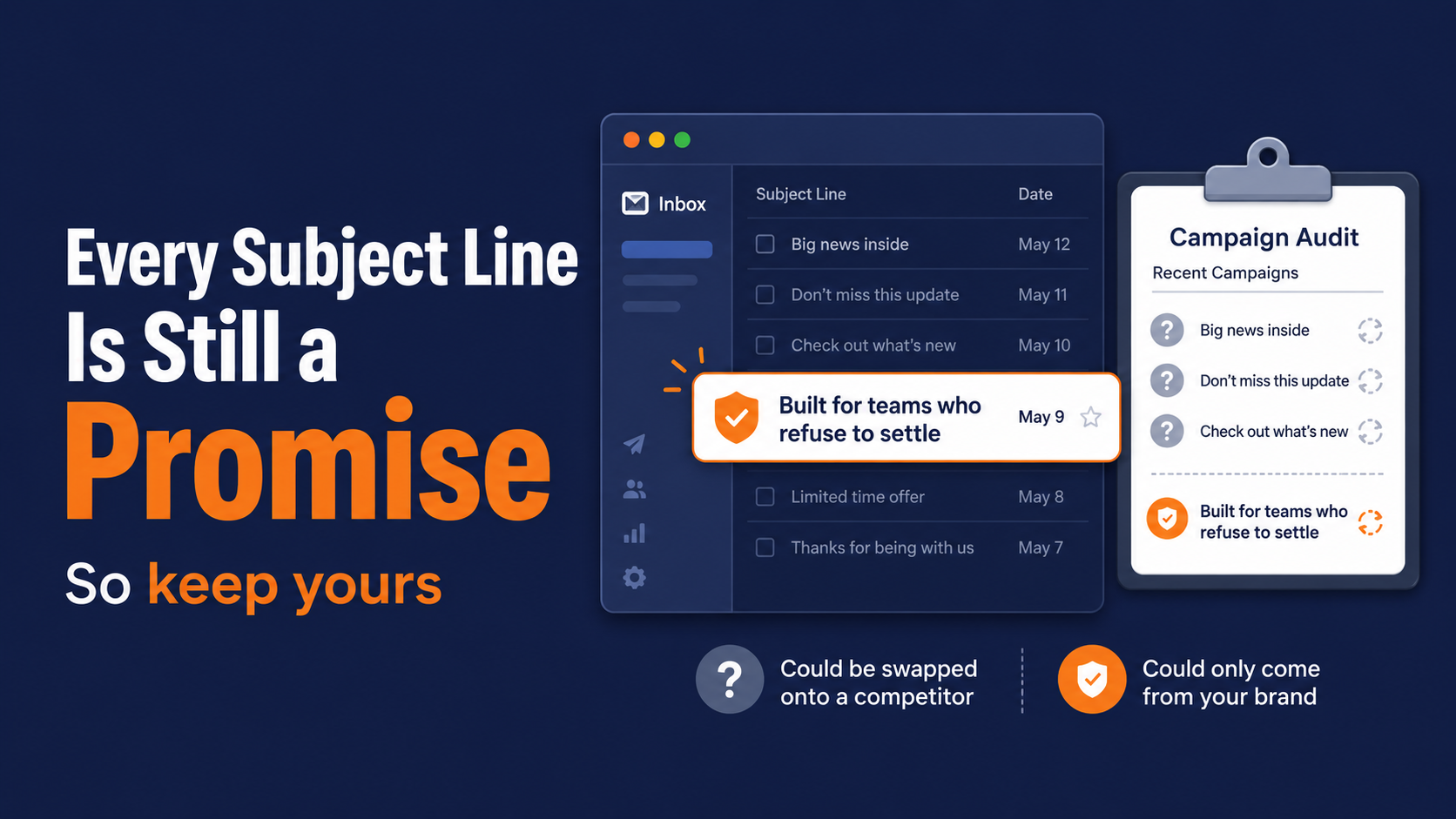
Every Subject Line Is Still a Promise, So Keep Yours
The mechanics behind subject lines will keep shifting. Privacy protections will keep muddying open-rate data, AI will keep getting better at drafting, and whatever’s working today will get copied into irrelevance eventually, the same way numbers and urgency words did before it.
None of that changes the one thing that’s held steady since the first cold email: a subject line is a promise about what’s inside, and subscribers unsubscribe fast when that promise doesn’t hold up.
The programs that win aren’t running the cleverest template. They’re testing constantly, measuring the metric that reflects a human acting, and writing lines that could only have come from their brand and no one else’s.
The best email subject line examples match your brand voice
The best email subject lines and email subject line examples in this piece all share that same trait: none of them could be swapped onto a competitor’s send.
Pull your last twenty campaigns and check how many of your subject lines could be swapped onto a competitor’s send without anyone noticing. If the answer is more than a couple, that’s worth fixing now, and the audit itself only takes an afternoon. Most teams avoid it because the answer is uncomfortable. Do it anyway.
Ready to Test Subject Lines Built on Real Behavioral Data?
Guessing which subject line will land is optional at this point. Schedule a demo with our team, and we’ll show you what subject line testing looks like when it’s built on click-to-open and reply behavior across both email and SMS, instead of an open-rate number that Apple’s own tracking has already distorted.