A lead nurturing strategy is your plan for staying useful to leads who aren't ready to buy yet. It decides which track each lead enters, what they receive at each stage, how often they hear from you, and which signal sends them to sales.
It's easy to build a sequence before you have a plan. One welcome series, one newsletter, and every lead gets both, whether they downloaded a checklist yesterday or asked about pricing last quarter.
This guide is for B2B marketers who already generate leads and want more of them to reach a sales conversation. It covers the lead nurturing best practices that matter most, and how they fit together into one system you can run.
Key Takeaways
- Plan for the silent stretches: Gartner research reported in 2018 found B2B buyers spent just 17% of their buying time meeting with potential suppliers, so your lead nurturing strategy has to carry the conversation between sales touches.
- Segment into tracks: Split leads by persona, industry, solution interest, location, activity level, or buying-cycle stage, and give each track one job.
- Set cadence by stage: Try two to three emails over seven days right after conversion, then three to five emails spaced 10 to 14 days apart for evergreen education. Cap touches per seven days and pause nurture during active sales conversations.
- Start and end tracks on behavior: 21st Mortgage manages more than 450,000 contacts on Pinpointe, and its drips for unfinished loan applications send 2.5 million emails a year. Move engaged leads out early to sales instead of making them finish the sequence.
- Hand off on shared definitions: Define MQL, SAL, and SQL in writing, alert sales only on explicit hand-raises like demo requests, and judge nurture by SQL conversion within a fixed window, not opens.
In this guide
- What Is a Lead Nurturing Strategy
- Segment Leads Into Tracks With Different Jobs
- Write Entry, Exit, and Recycle Rules for Every Track
- Match Content and Cadence to the Buying Stage
- Hand Leads to Sales on Shared Definitions
- Lead Nurturing Mistakes That Stall Good Leads
- Frequently Asked Questions About Lead Nurturing Strategy
What Is a Lead Nurturing Strategy
Lead nurturing is the work of building a relationship with prospects through relevant content and timely follow-up until they're ready to make a purchase decision. You want this strategy to turn manual work into rules, so it runs the same way in a busy week as it does in a planning meeting.
Without the rules, nurture drifts into whatever someone had time to send and tanks your results.
How lead nurturing differs from lead generation
Lead generation gets someone to raise a hand. Lead nurturing decides what happens after the hand goes up.
Generation is counted in new contacts. Nurturing is counted in how many of those contacts reach a real sales conversation, and how quickly they get there.
The two share a database and often a team, which is why they blur together for most organizations. But you want to keep them separate in your planning. A program that is great at capture and weak at follow-up just fills the database faster than it moves anyone forward.
Why B2B buying makes nurture necessary
The reality is that B2B buyers do a lot of their deciding without you. Gartner research reported in 2018 found that B2B buyers spent just 17% of their buying time meeting with potential suppliers and 45% researching on their own. With three suppliers in the running, Gartner estimated each one got roughly 5 to 6% of that time.
Since this study came out a few years ago, you want to treat the exact figures as dated research, but what they point to is the job nurture has to do. Your nurture campaigns should carry part of the conversation during the long stretches when no rep is involved.
Segment Leads Into Tracks With Different Jobs
A single nurture sequence forces one message on people with different problems. Before you write anything, split your leads into tracks and give each track one job.
Heinz Marketing recommends segmenting your database into nurture tracks by persona, industry, solution interest, location, activity level, and where each lead sits in the buying cycle. Treat that list as a menu to pick from and how each journey should differ based on what is ordered from the menu.
Choose segments that change what you send
A good segment changes the context of the email. If knowing a lead's industry wouldn't change a single subject line, leave industry out of your track design for now.
Start with the two or three distinctions that change your content the most. For many B2B teams, that means persona and lead source. A VP who downloaded a benchmark report and a practitioner who grabbed a checklist are asking different questions, even on the same topic. If you write both emails the same, neither will land effectively.
Give each track a single job
Heinz lists the kinds of cadences worth building, including a welcome program for new leads, re-engagement for contacts who have gone inactive, bottom-funnel sales enablement, customer retention, and partner education.
You don't need all of them immediately. A welcome track, an education track for leads who aren't close to buying, and a re-engagement track for disengaged contacts will cover most of your database. Add a bottom-funnel track once you have enough late-stage content to fill it.
Personalize without a large team
Pipeline360 recommends segmenting nurture by persona, industry, or lead source rather than engagement behavior alone, and using dynamic content to personalize messaging at scale. That second part is what makes personalization workable for a small team. You maintain one email per track with a few swappable blocks built with dynamic email content, instead of a separate email for every combination of role and industry.
Generic sends start behind. In McKinsey's 2021 consumer research, 71% of people said they expect companies to deliver personalized interactions, and 76% said they get frustrated when that doesn't happen.
That's consumer data, so don't present it as a B2B conversion benchmark. It illustrates what people expect in general, so test personalization with your own B2B audience before assuming the same effect.
Write Entry, Exit, and Recycle Rules for Every Nurture track
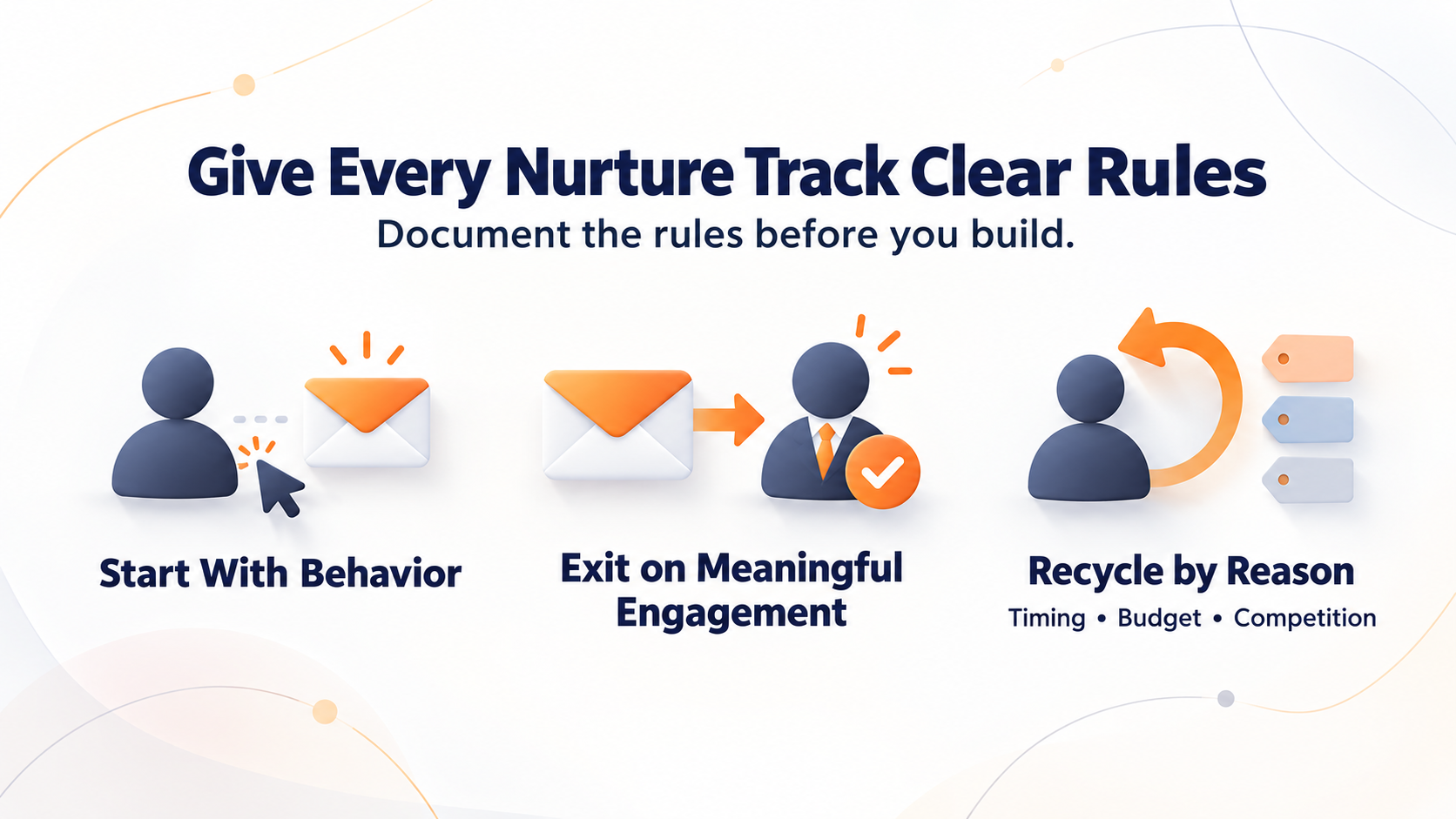
Nurture tracks without rules turn into a pile of sequences nobody fully understands. Pipeline360 advises documenting each track's entry and exit points, triggers, wait times, and rules.
Write those rules down before you build anything. A one-page spec per track saves you from reverse-engineering your own automation six months from now.
Let behavior start a track
A lead can enter a track because of a date, a form, or something they did. Use specific behaviors to identify what a lead is interested in, and let that decide which track they start.
21st Mortgage is a useful example. The lender manages more than 450,000 contacts across its sister companies on Pinpointe and built automated drip campaigns for homebuyers who start a loan application but don't finish it. Those drips send 2.5 million emails a year and have significantly increased the number of loans the company closes.
Notice how narrow that trigger is. An unfinished application tells you exactly what the next email should be about.
Decide what gets a lead out early
Leads shouldn't have to sit through every email in a track. Heinz Marketing advises using engagement to decide when a lead exits, routing people who engage with several nurture emails to sales or into a bottom-funnel stream with direct calls to action like scheduling a call.
Set exit rules as carefully as entry rules, and tie them to meaningful engagement, because a single click doesn't make anyone sales-ready. A lead who replies to email two with a pricing question and still gets emails three through seven looks like a lead nobody is paying attention to.
Two related habits keep a track from feeling repetitive. Pipeline360 suggests skip logic, so leads aren't sent content they've already consumed, and progressive profiling, so you gather details over time instead of through one long form.
Recycle leads who weren't ready
Some leads reach sales and stall. Pipeline360 recommends a structured recycled-lead nurture, segmented by disqualification reason such as timing, budget, or competition.
One thing to keep in mind is that this only works if sales records why a lead was disqualified. A lead lost on timing and a lead lost to a competitor need very different follow-up. Leads who simply went quiet are a separate case, and re-engagement campaigns are built for them.
Match Your Content and Cadence to the Buying Stage
What you send and how often you send it are the same decision seen from two different angles. Both depend on how close the lead is to buying.
You'll often find that cadence advice seems to contradict itself. Most of it describes a different moment in the lead's journey, which is why the guidance below takes those moments one at a time.
Lead with value first and pitch later
Top-of-funnel nurture should educate and lead with value. Heinz Marketing calls CTAs like "Request a Demo" or "Talk to Sales" too aggressive early in the buying journey and saves them for leads who have already engaged with other content.
Early emails earn attention by solving a small problem the reader already has. Case studies and comparisons fit once the lead is weighing options, and our breakdown of the best content for each stage of the sales funnel helps you map them. The demo ask belongs near the end, after the lead has shown real interest. Demo asks should feel like a natural progression for the reader to get better results vs. an out-of-nowhere pitch.
Move fast in the first week
The days right after someone converts are one stretch where a faster pace makes sense. Pipeline360 suggests a short, high-frequency sequence, such as two to three emails over seven days, paired with timely outreach from your sales development team.
After the initial sequence, consider moving leads who are not sales-ready into an evergreen education stream. Pipeline360 describes that stream as running continuously, with room to pause for live campaigns like webinars. If you're building that first sequence from scratch, this guide to a drip email campaign walks through the build.
Space out evergreen education
For the education track, Heinz Marketing recommends sending nurture emails every one to two weeks, with three to five emails spaced 10 to 14 days apart as a simple starting point. For buying cycles of three months or more, it suggests stretching the cadence so you stay present through research, consideration, and decision.
Heinz frames it as a starting point to test. Treat it the same way, and adjust once you see how each track responds.
Speed up when intent shows up
The Pedowitz Group's default cadence is one to two touches per week in early-stage nurture, two to three per week during active evaluation, and one every two to four weeks for long-cycle re-engagement. It also says plainly that there is no universal best cadence.
Read "touches" carefully. Pedowitz counts email, retargeting, sales outreach, and webinars together, so three touches a week doesn't mean three emails a week. This could also include using SMS and email marketing together to improve results.
Put guardrails on frequency
Whatever rhythm you pick, set limits so you don't annoy potential customers with too many messages. Pedowitz recommends capping touches per seven days, suppressing nurture while a lead is in an active sales conversation, and pausing after a set number of unanswered touches.
The suppression rule is the easiest one to overlook. Nothing undercuts a rep faster than an automated check-in email landing the morning after a good discovery call. It often works best for bird's-eye view marketing to pause when one-to-one sales conversations are happening.

Hand Leads to Sales on Shared Definitions
The handoff from marketing to sales is where a nurture program turns into pipeline or turns into an argument. Both teams need the same definition of ready, and it needs to be written down. If your teams are still pulling in different directions, start with sales and marketing alignment.
Agree on MQL, SAL, and SQL in writing
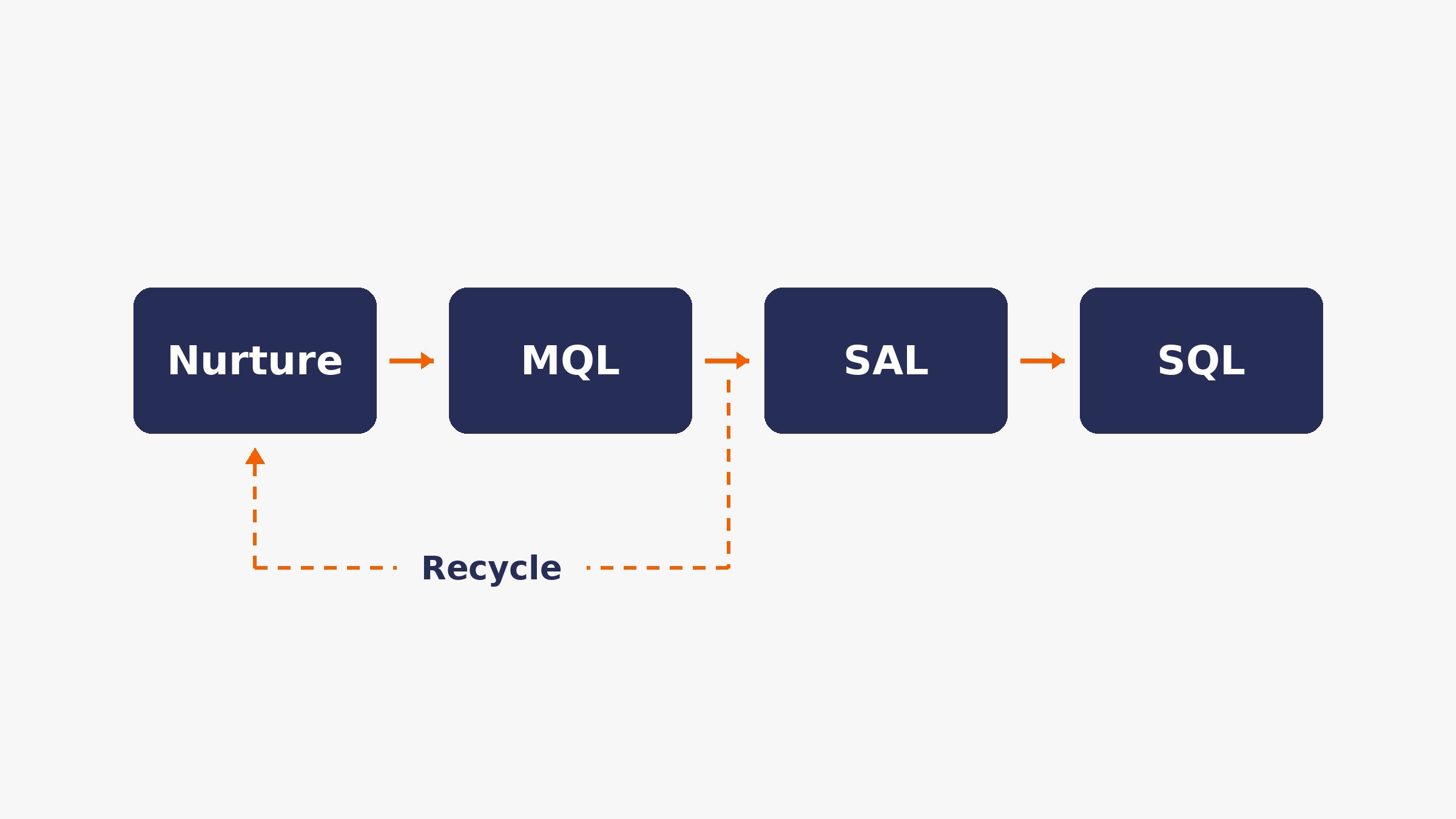
Have marketing and sales jointly define what counts as a marketing qualified lead (MQL), a sales accepted lead (SAL), and a sales qualified lead (SQL). Put the definitions in writing, agree on how quickly sales follows up, and require a reason whenever sales rejects a lead.
That last field is what feeds your recycle tracks. Without it, a rejected lead quickly disappears.
Alert sales on real hand-raises
Pipeline360 advises agreeing on what counts as a "hot lead" and triggering real-time alerts for sales when high-intent activity happens.
Keep the alert list short and explicit. A demo request or a contact-sales form should reach a rep right away. A newsletter signup or a content download should not, and those leads stay in nurture until they meet the criteria you agreed on.
Keep unready leads out of expensive systems
An enterprise SaaS company uses Pinpointe as an affordable top-of-funnel nurturing engine for its old trade-show leads. It sends webinars and newsletters with URL tracking so click data flows into its CRM, and only highly engaged leads pass to sales. That setup keeps its CRM from filling up with contacts who haven't engaged.
Nurture can happen upstream, so sales sees the leads that earned its attention. Whether that also lowers your software costs depends on how your CRM bills for contacts.
Lead Nurturing Mistakes That Stall Good Leads
Most nurture problems trace back to a few habits. Each one is easy to fix once you can see it.
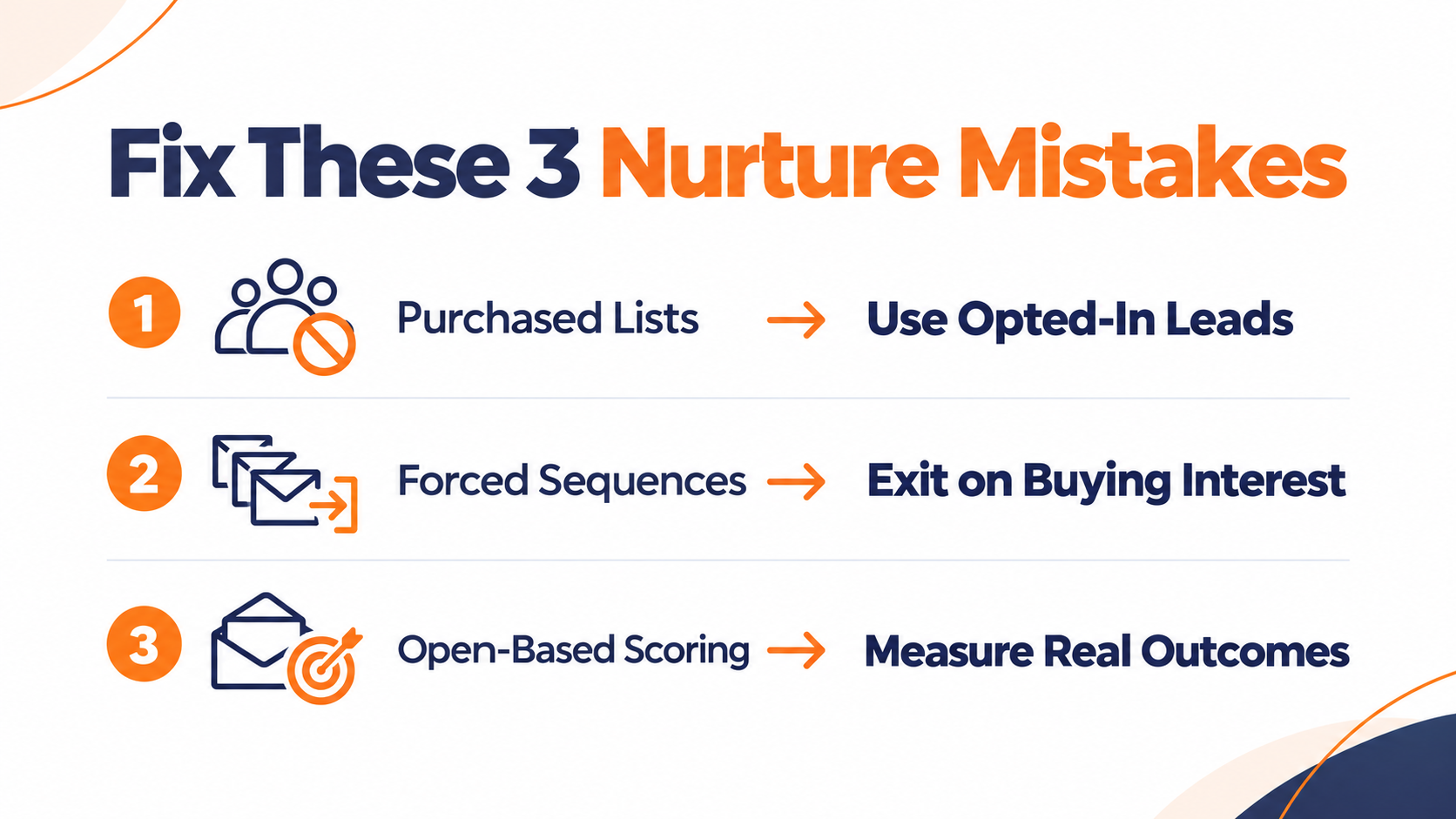
Putting cold purchased lists into nurture shouldn't be done
Heinz Marketing notes that cold purchased lists added to nurture programs typically see lower response rates and higher bounces and unsubscribes than leads from organic inbound channels. Buying lists and putting them into your marketing automation system carries a massive risk to your company, deliverability, and sender reputation and is something you shouldn't do.
Marketing to your old lists is another risk factor and should be treated carefully. The enterprise SaaS company above emailed its backlog of trade-show leads through a previous provider, hit spam traps, and got its domain blocklisted. Pinpointe's customer success team helped it scrub the list and put strict email list hygiene in place to protect it's future sends.
Making every lead finish the sequence
If your exit rules only fire at the end of a track, engaged leads wait while the automation finishes its script. Go back to the exit rules above and move people out as soon as they show buying interest.
Don't force a continued nurture sequence when the lead is ready to take action. Strike while the iron is hot and move leads that are ready to your sales team to maximize conversions.
Grading the program on opens
Opens are a weak scorecard for a nurture campaign. Pedowitz recommends judging cadence by downstream outcomes like reply rate, meetings, opportunity creation, stage progression, and unsubscribes.
One practical way to measure it is by cohort. Take every lead that entered a track in a given month, pick a fixed measurement window such as 90 days, and count how many became sales qualified inside that window. If 400 leads entered and 48 reached SQL, that cohort converted at 12%.
Then compare cohorts across tracks and months. When you change a cadence, test it against a holdout group, as Pedowitz suggests, to assess whether the change improves downstream outcomes.
Turn Lead Nurturing Best Practices Into One Working Strategy
Each of these lead nurturing best practices works better connected to the others. Tracks give leads a relevant path, and entry, exit, and recycle rules move them along it.
Stage-matched content and guardrailed cadence keep leads engaged without wearing them out. Shared definitions get the ready ones to sales, and cohort measurement tells you which part to fix next.
The pieces usually exist somewhere already. What tends to be missing is the wiring that lets a behavior start a track, a click pull a lead out of one, and a hand-raise reach a rep the same day.
Pinpointe covers each of those connections with a few specific tools.
Our nurture journeys and behavioral trigger campaigns can start and advance paths from actions like clicks, form submissions, and website activity. Smart dynamic segments and Dynamic Content Tags let one email adapt by persona or lead source. With URL tracking and webhooks connected to your CRM, sales can see which leads earned attention.
Find the leaks in your nurture program with a free audit
If you want a second set of eyes first, book a free marketing automation audit. In a 30-minute 1-on-1 session, we'll look at where leads drop out of your current nurture and which manual steps are eating your team's time. You'll leave with an automation roadmap you can use whether or not you work with us.
Frequently Asked Questions About Lead Nurturing Strategy
Here are short answers to four questions that come up when you start putting these steps into practice.
How often should you send lead nurturing emails?
It depends on the stage the lead is in. Heinz Marketing suggests every one to two weeks for evergreen education, Pipeline360 suggests two to three emails in the first seven days after a lead converts, and The Pedowitz Group raises the pace to two to three touches a week, across channels, during active evaluation. Start there and let engagement set the pace.
How do you measure whether lead nurturing is working?
Measure how many leads reach sales qualified status, by cohort. A practical method is to track every lead that entered a track in a set period and count how many became SQLs within a fixed window. Alongside that, watch downstream outcomes like replies, meetings, opportunity creation, and unsubscribes, as Pedowitz recommends, since opens alone won't tell you much.
Do you need marketing automation software to nurture leads?
You can run a small program by hand, but entry triggers, exit rules, suppression, and alerts get hard to manage manually as volume grows. Nucleus Research reviewed 16 marketing automation ROI case studies published between 2016 and 2020 and found an average of $5.44 in benefits per dollar spent over the first three years. That's an average from a small, dated set of case studies, so treat it as directional rather than a benchmark for your program.
When should a lead leave a nurture track?
A lead should leave a track when its behavior shows the track no longer fits. Heinz Marketing recommends routing leads who engage with several nurture emails to sales or a bottom-funnel stream. A lead who goes quiet can move to a slower re-engagement rhythm, which Pedowitz puts at one touch every two to four weeks.