The moment you hit send, your static campaign starts lying to your prospects. Prices change, inventory vanishes, and links go dead, and yet your frozen email sits in their inbox pretending it’s still gospel.
That gap isn't just sloppy, it's a silent killer that burns up your response rates and bleeds cash out of your business. Generic, lazy sends pay a hefty tax for that mistake every single day.
Dynamic content is how you stop the bleeding and force those lost profits back into your bank account.
Start With What Personalization Actually Does To Engagement
Every email marketer runs into the same wall. You build a campaign, you hit send, and the second it leaves your outbox, it starts drifting out of step with the real world.
Personalized, dynamic campaigns consistently beat static one-size-fits-all sends on the metrics that decide whether an email earns attention or gets filed as noise. That's not a marginal lift you have to squint to see.
Email personalization has moved a long way past dropping a first name into a subject line. The version that actually shifts revenue changes what a subscriber sees based on their behavior and timing, and it does that at the moment they open, not the moment you build the send.
A clean, like-for-like number on the lift
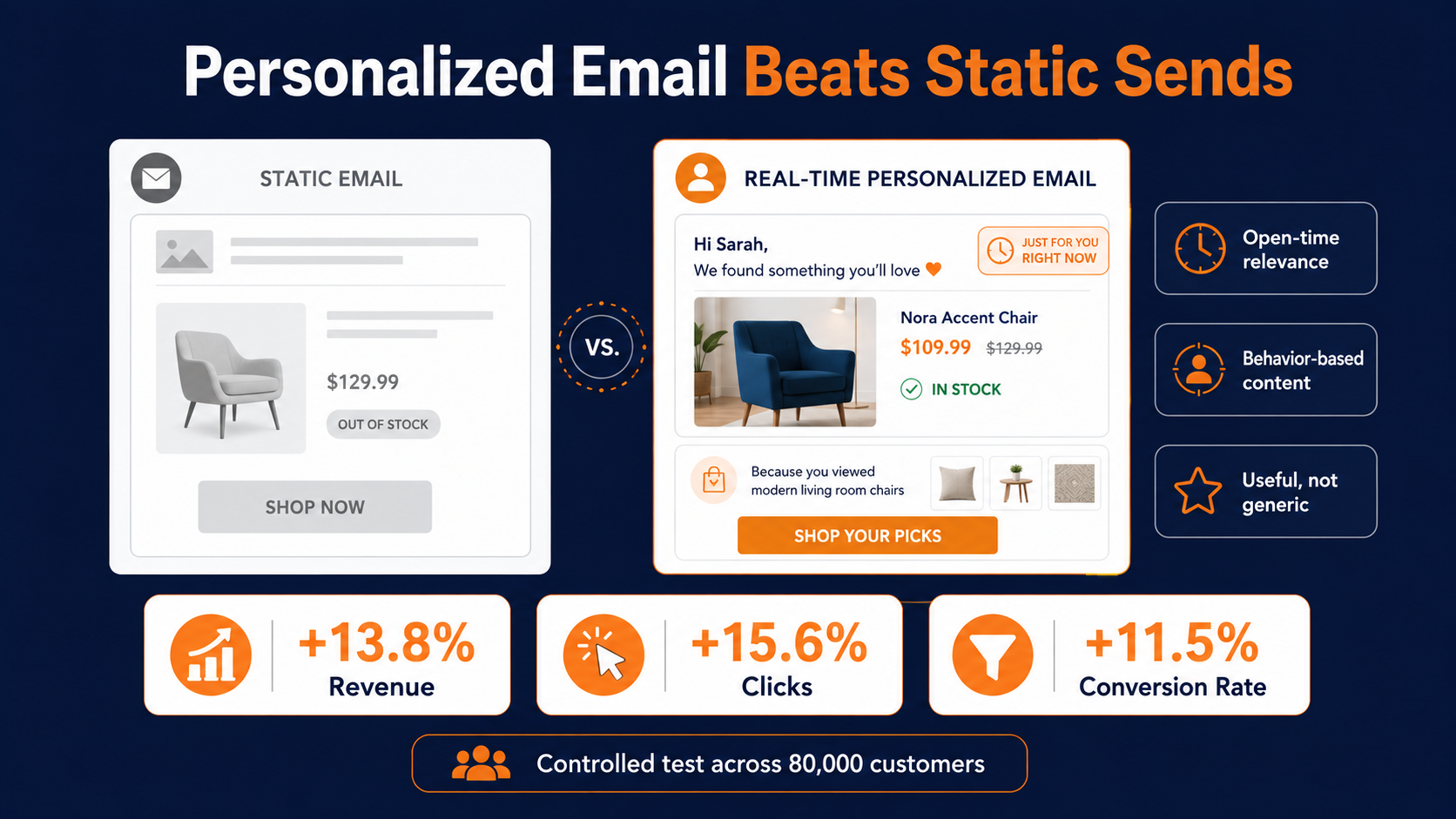
In a controlled test across 80,000 customers, the personalized version drove a 13.8% increase in revenue, a 15.6% lift in clicks, and an 11.5% improvement in conversion rate against a non-personalized control.
Same audience, same offer, split down the middle. The only variable was relevance, and relevance won by double digits on every metric that matters.
That's the kind of evidence worth trusting over a splashy one-off case study. It isolates the thing you actually care about instead of celebrating a number that could have come from anywhere.
Why the gaps compound for B2B teams
For teams juggling multiple products, segments, and campaigns at once, those small engagement gaps don't stay small. They stack into pipeline problems over a quarter.
When your email carries current pricing, accurate stock, and timely content, people read it as useful instead of skippable. That single perception shift often decides whether you land in the inbox or get filtered into the promotions void nobody checks.
Real-Time Means Current At Open, Not Current At Send
Here's a distinction many marketers fail to learn. There's a real difference between content that's accurate when you hit send and content that's accurate when someone actually opens the thing.
In email, that gap can stretch to days. And most "dynamic" content ignores it.
Walk the timeline out
You send on Tuesday morning. Half your list opens within the hour. The other half opens on Thursday, Saturday, and next Monday, whenever they finally get to their inbox.
Traditional dynamic content pulls its data at send time. So that in-stock badge and that price point are already stale by the time your late openers show up, showing numbers that were true for you and nobody else.
True real-time personalization queries the data feed at the moment of open, not the moment of send. Everyone sees what's actually true for them right now, whether that's an hour later or four days later.
The test that separates real from fake
This is the line between platforms doing it properly and the ones running fancy merge tags with a new name. If your real-time content can't survive someone opening the email three days late, it was never real-time to begin with.
Build for the late opener, not the fast one. The fast opener was always going to be fine. It's the Saturday-afternoon reader who exposes whether your content is actually live or just dressed up to look that way.
|
Pro Tip: Preview your dynamic elements as if it's three days after send, not one minute after, because that's where stale data actually shows up. |
The Three Things Every Personalization Setup Needs
Effective marketing automation and personalization sit on three legs. Data infrastructure, content flexibility, and deployment efficiency. Knock one out and the whole thing wobbles.
The old way forces you to rebuild campaigns by hand every time the source data changes. That burns time, invites errors, and slows how fast you can get a campaign live.
Data feeds are the real shift
Instead of editing individual templates every time a price moves, you connect an external source once and configure merge tags that pull current information into every send automatically. Set it up, then stop touching it.
That separates your content structure from your customer data. One template can then deliver different, always-current information to each recipient based on their behavior, preferences, and timing, without you cloning it a dozen times.
Flexible editors keep tooling from becoming the ceiling
The technical side needs two things working together. Solid data connectivity and content editors that don't fight you. Your team should be able to drop real-time data in, whether they're in a raw HTML editor or a drag-and-drop builder.
When your tooling caps your creativity, that's a problem you feel on every campaign. Designers should be able to implement personalization without pulling a developer into the room for every send.
What this means for your business
You get three wins at once here. Less production time per campaign, fewer errors from stale information, and the room to scale timely, personalized messaging across far more segments than you could touch by hand.
You stop choosing between personalization and speed. You start shipping both, which is the whole point.
The Real-Time Content Types Worth Knowing
Dynamic content is one of those phrases that means everything, but when executed poorly, can result in nothing. Let's get concrete about what actually moves the needle.
Countdown timers
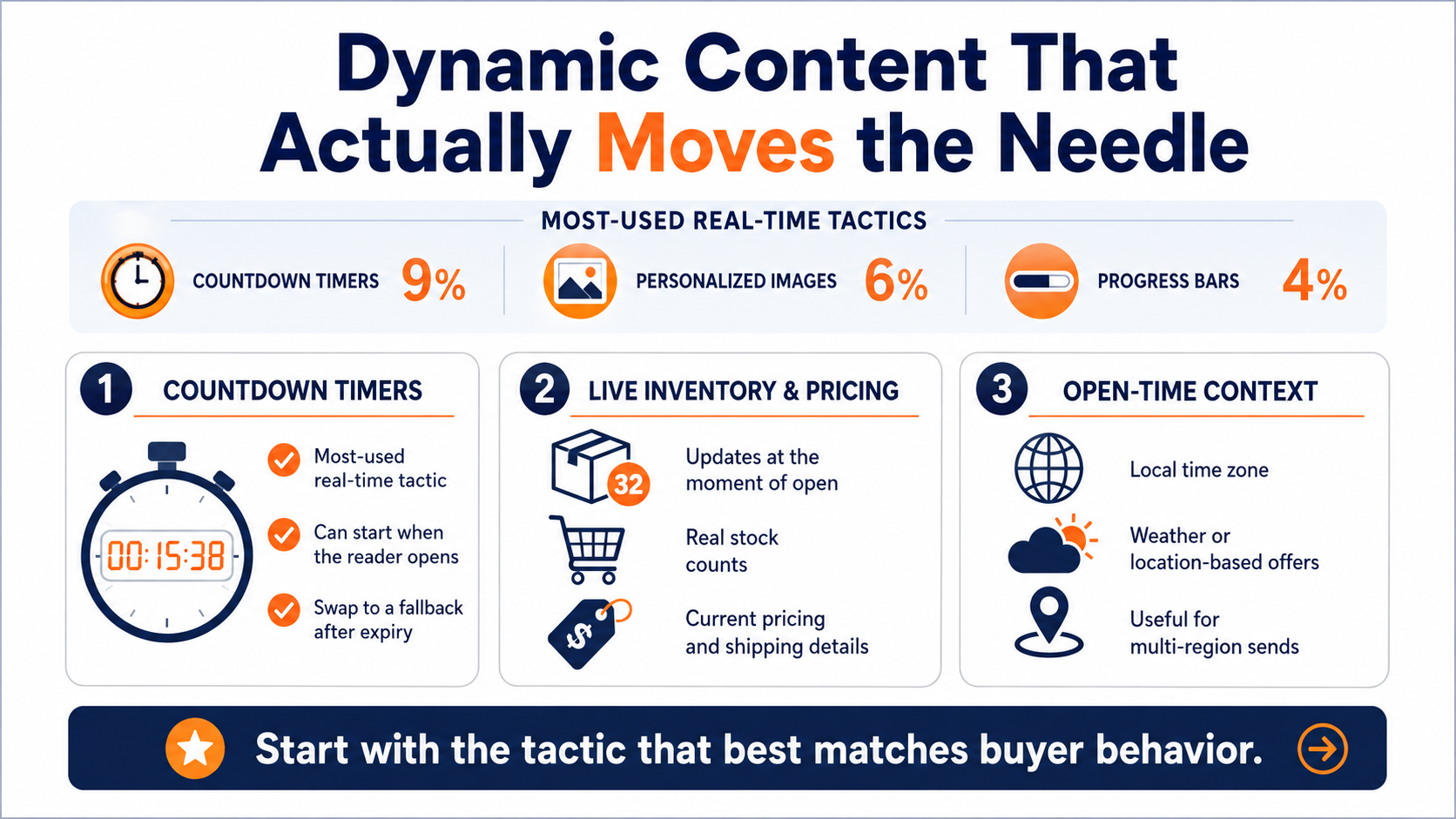
The classic, and for good reason. Countdown timers were the single most-used real-time tactic at 9%, ahead of personalized images at 6% and progress bars at 4%.
The smart version renders live every time the email opens. The clever version starts the clock when the individual recipient opens, so a 48-hour offer runs 48 hours from their open, not yours.
The best version swaps to a fallback message after expiration, instead of showing a dead 00:00:00 that announces you forgot about them.
Live inventory and pricing
This is the data-feed story applied to the exact moment of open. A cart-recovery email can carry live product images, real stock counts, and a shipping countdown, all pulled fresh when the person actually looks.
"Only 3 left" hits completely differently when it's true at the moment they read it. Show a stale number, and you've taught that subscriber not to believe your urgency next time.
Open-time context
Local weather, time zone, location-specific offers. Dynamic timers can adjust to the subscriber's local time zone at open with no separate regional sends to manage.
If you've ever wrangled a multi-region send calendar, you know that it solves a real headache rather than adding a nice-to-have. You don't need all three of these running at once. Pick the one that maps to how your buyers actually behave and let the rest wait.
|
Pro Tip: Always configure an "Offer Expired" fallback banner for your countdown timers so late openers see a fresh message instead of a dead 00:00:00 clock. |
Segmentation Strategies That Actually Drive Results
Good segmentation changes how you apply personalization at scale. Instead of building a separate marketing campaign for every audience subset, sharp segmentation lets one campaign framework deliver tailored content to many segments at once.
That takes precise targeting rules paired with dynamic content blocks that adapt to recipient attributes and behavior. The rules do the sorting, the blocks do the talking.
Behavioral segmentation is the B2B workhorse
Track website visits, engagement patterns, content downloads, and product interactions, and you can segment on demonstrated intent instead of demographic guesswork. What someone does tells you more than who they are on paper.
Someone who hit your pricing page three times this week is a fundamentally different opportunity than someone who's gone quiet for six months.
They've earned different messaging, and sending both the same email wastes the signal one of them just handed you. This is where solid email segmentation stops being theory and starts driving revenue.
Interest and lifecycle segments
Interest-based segmentation matches content to the specific offerings a contact has already explored. If you sell multiple product lines, blasting everyone the same generic newsletter wastes the attention of decision-makers who already told you what they care about.
Lifecycle segmentation recognizes that new prospects, active evaluators, current customers, and at-risk accounts each need different communications. Automation rules plus dynamic content let you hold one campaign architecture while delivering stage-appropriate messaging, which cuts the drag of running dozens of separate campaigns.
Implementing Dynamic Content Without Losing Your Mind
Start by naming which campaign elements benefit most from real-time updates. Product catalogs, pricing, inventory, blog content, event details, promotional offers, anything that changes often.
Each of those introduces lag between the change and your campaign, reflecting it when you update by hand. That lag is exactly the mismatch that dynamic content in email was built to close.
Not every element needs to be live, though. Pick the two or three fields where staleness actually costs you a click, usually price, stock, and any deadline, and wire those to feeds first. Trying to make everything real-time at once is how implementations stall before they ship anything.
Merge tags do the heavy lifting
The whole thing centers on data-feed connections between your external sources and your email platform. Instead of hard-coding values into templates, you insert merge tags as placeholders.
When the campaign deploys, the system queries the connected source and injects current information into every individual send automatically. No rebuild, no copy-paste, no praying the intern updated the right cell.
Content-block architecture decides your flexibility
Well-built templates use modular blocks you can show or hide based on recipient attributes, with the interior populated from data feeds. Conditional display plus dynamic insertion gives you emails that look completely custom to each person while running off one shared template.
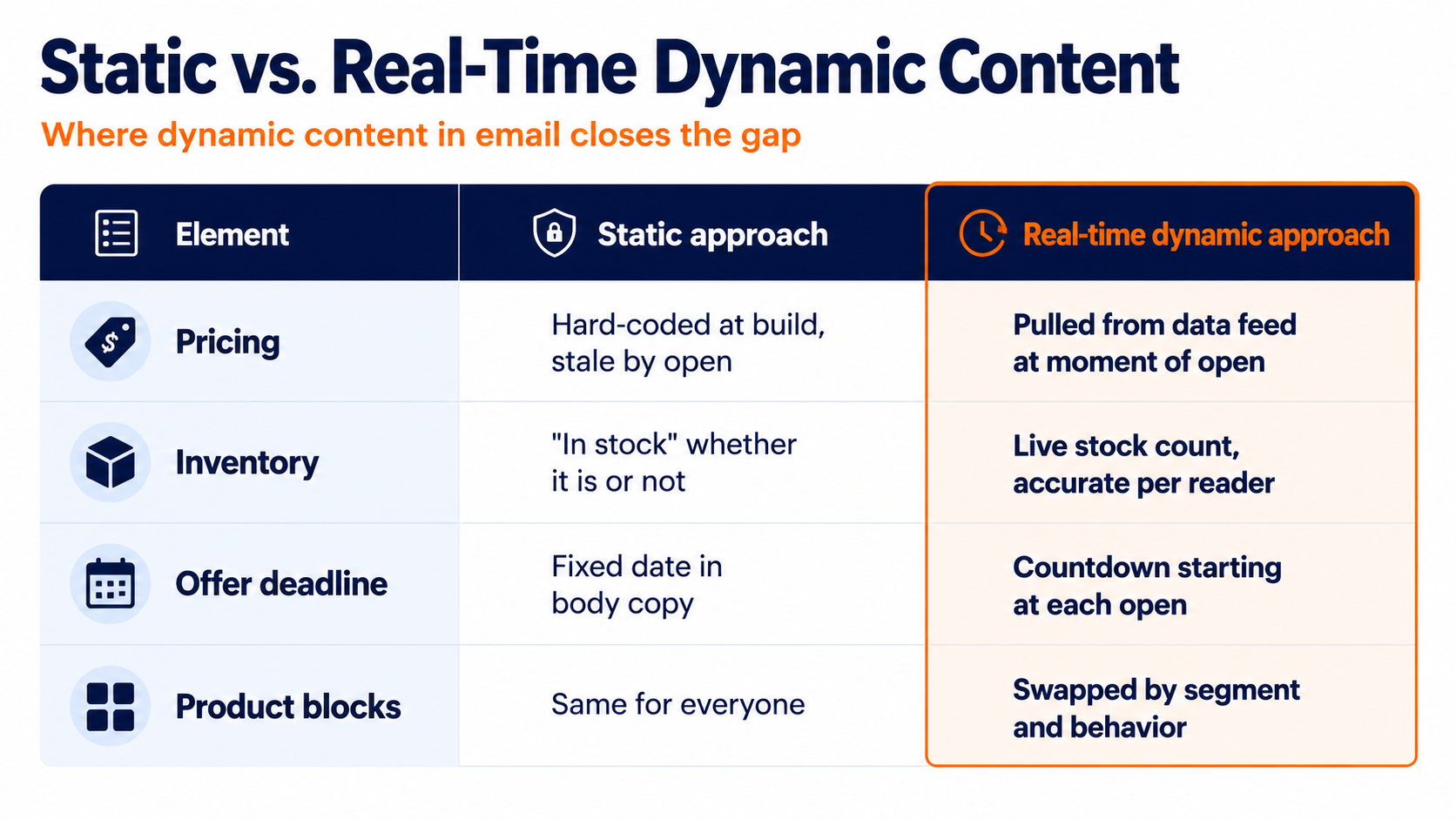
Testing matters on both fronts, the data connections and the logic choosing what shows. Run representative samples across your key segments to confirm that merge tags populate, conditional logic surfaces the right blocks, and fallback content handles the edge cases cleanly.
Where Dynamic Content Breaks, And How Not To Get Burned
We'd be doing you a disservice if we made this sound frictionless. A few hard-won notes from watching real sends go sideways.
Rendering is inconsistent across clients
GIF-based timers are simpler and broadly compatible, but they can glitch in privacy-focused clients like Apple Mail with Mail Privacy Protection on. Server-side dynamic content updates in real time for accuracy and hold up better under those conditions.
Test across clients before you trust a real-time element in a flagship send. What looks flawless in preview can fall apart in Outlook, and finding that out after you hit send is the expensive way to learn it.
Always build a fallback
This is the one your QA process lives or dies on. Every real-time element needs a graceful default for when a feed hiccups or a value falls out of range.
A static image, a collapsed block, a sensible default message. Anything but a broken merge tag staring your customer in the face where a live price was supposed to be.
Your Open Rates Are Lying To You, And That Helps The Case
Any senior marketer reading a personalization piece is already thinking it. Fine, let's say it out loud. Your open rates are mostly garbage data now, and you're right to be suspicious of them.
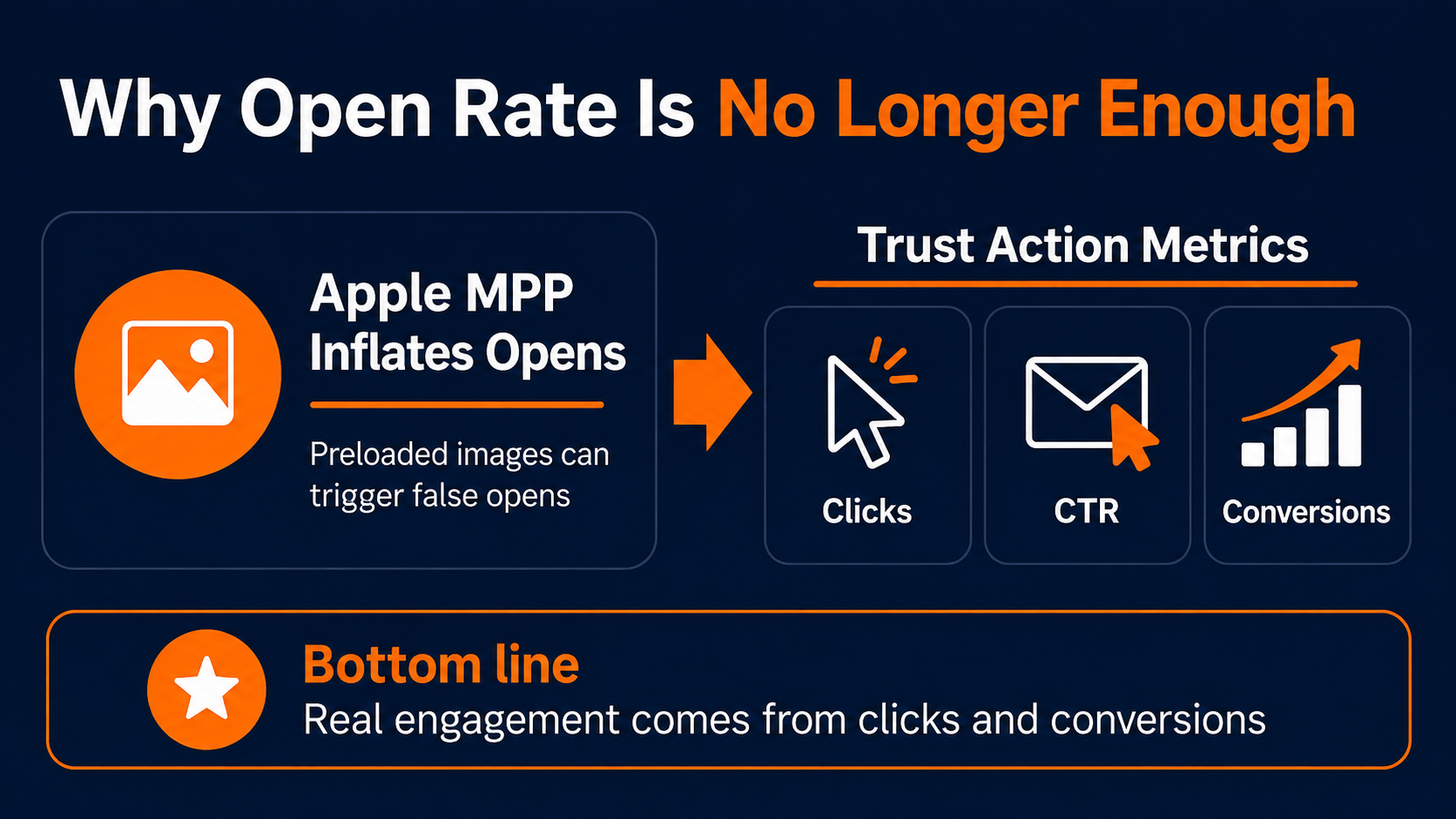
Apple's Mail Privacy Protection preloads email content and images even when the recipient never opens the message. Because Apple Mail holds a large share of email opens, this has skewed open-rate data upward across the board.
Why unreliable opens strengthen the argument
Marketers now lean on click-through, click-to-open, and conversion metrics over opens when they judge performance. Here's why that helps the case for dynamic content instead of hurting it.
If opens are unreliable, the metrics that survive are the ones tied to action. Clicks and conversions. And action is exactly what relevant, current, real-time content drives.
When the offer in front of someone is accurate and timely, they click. Static content was always coasting on inflated open numbers, and now that the numbers are exposed, dynamic content is what earns the metrics that still mean something.
Measuring Success And Optimizing On A Loop
Measuring dynamic content means connecting your personalization variables to actual engagement outcomes. Opens, clicks, conversions still matter, but they get far more useful once you segment them by content variation.
Knowing which blocks drive engagement and which fall flat is what lets you optimize iteratively. Those small gains compound over a year of sends into a real edge.
A/B testing gains a new dimension
Instead of testing only subject lines or send times, you test which data-driven personalization approaches land with which segments. Do recently viewed products beat category-level recommendations? Do inventory alerts drive more urgency than general updates?
Systematic testing answers that with data instead of vibes. And because you're testing the real-time personalization logic itself, the wins carry across every future campaign that uses the same blocks.
The compounding is often the part nobody talks about. A subject-line test helps one campaign. A test that proves recently-viewed products beat category recommendations for your mid-funnel segment helps every send you build on that block from then on. That's the difference between optimizing an email and optimizing a system.
Set an ongoing review cadence
Long-term, dynamic content should move lifecycle metrics beyond a single campaign. Is personalization accelerating prospects through the funnel? Is it reducing churn by staying relevant across the whole relationship?
As behaviors evolve and offerings change, your personalization logic should move with them. Teams that treat dynamic content as a living system instead of a set-it-and-forget-it pull the most value out of it and keep their edge over everyone still shipping static.
|
Pro Tip: Segment every performance metric by content variation from day one, because an aggregate open rate hides the exact block that's winning or losing. |
An Honest Word On Urgency And Trust
Real-time content hands you powerful urgency levers, and it's worth being a grown-up about them. Use a countdown for a real deadline, not a manufactured one.
False urgency erodes trust and can even raise your spam-filter risk. Your sharpest customers can smell a fake timer from a mile off, and they remember which brands tried it on them.
How to be relevant without being a stalker
The same caution applies to over-personalization. There's a line between "this is relevant" and "how do they know that," and crossing it costs you more than the click was ever worth.
The brands that win with dynamic email long-term treat the data as a way to be useful, not a way to manufacture pressure. Useful earns the next open. Creepy becomes the reason people unsubscribe.
Turn Real-Time Relevance Into Results
Here's what this all comes down to. Static email is a liability hiding in plain sight, accurate for a moment and then drifting out of step with reality, while your subscribers open on their own schedule, days after you hit send.
You already understand the strategy. Personalization moves real metrics, real-time means current at open rather than send, and the content types that earn their place map to how your buyers behave. Where most teams stall isn't the idea, it's the execution, the feed connections and block architecture and fallback logic and cross-client QA that turn a good plan into a running system.
That's the part we built for at Pinpointe. So you can keep every subscriber getting content that's current at the moment they open, across email and SMS, without you rebuilding the flow by hand each time reality shifts.
If you want to see exactly where static content is costing you clicks and conversions before you change a thing, schedule a marketing automation audit, and we'll map the highest-impact places to deploy real-time personalization first.