
Four out of five people won't buy from a brand that doesn't talk to them in their own language. Not "prefer not to." Won't.
That's the number sitting under every global email marketing campaign you've ever sent, whether you measured it or not. You translated the subject line, swapped in a local currency, and hit send to your list in Berlin or São Paulo or Osaka. And somewhere in there, a big chunk of the audience decided you weren't really speaking to them.
Make Every Global Email Feel Written for the Reader
Email localization is the solution, and it's a lot more than just a translation. It's the work of adapting a campaign so it reads like it was written for the person opening it, in their language, on their schedule, inside the norms they actually live by. Get it right, and your global list starts behaving like a real audience instead of a spreadsheet of addresses in other time zones.
Why translation alone leaves conversions on the table
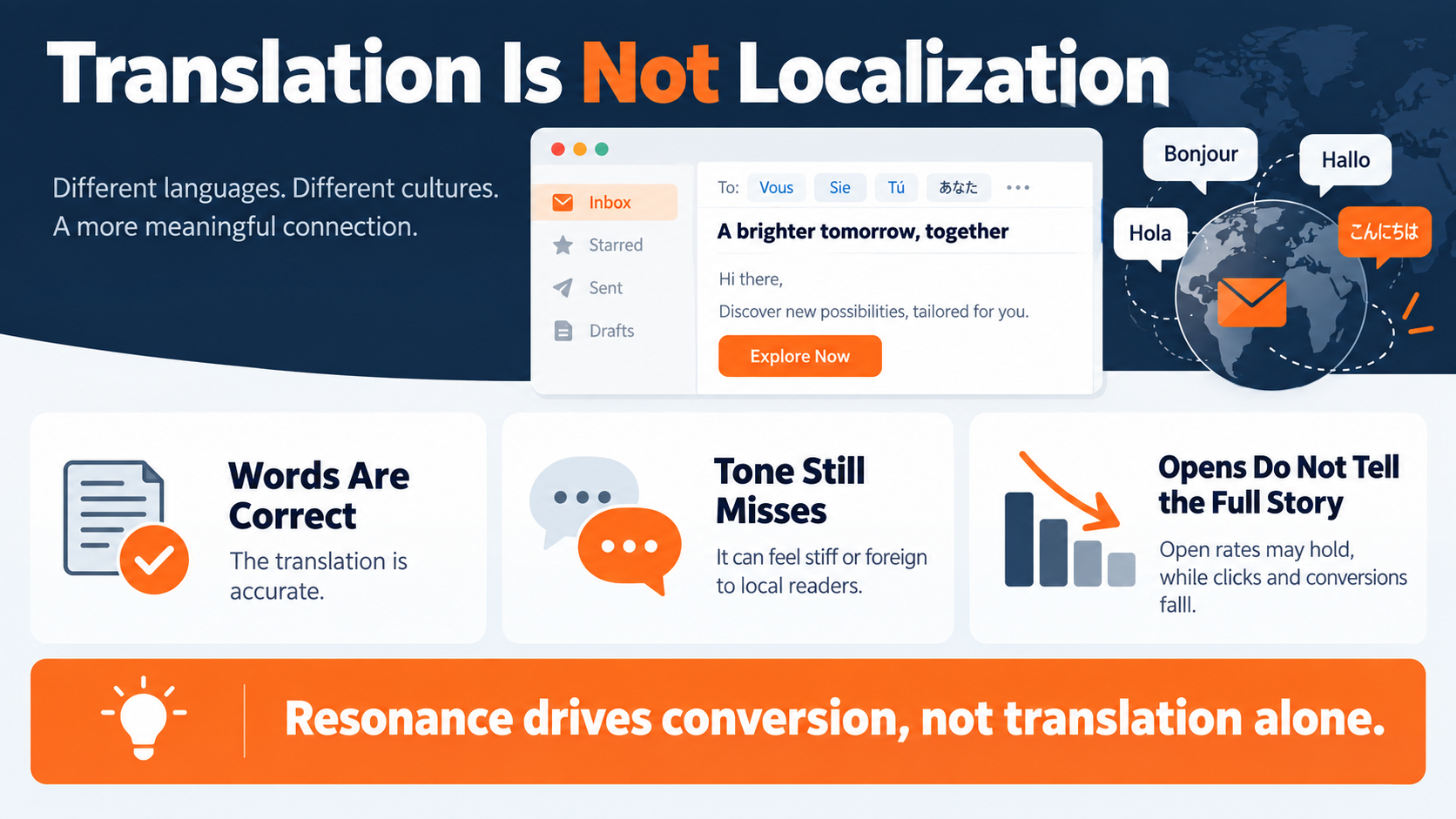
Does this email localization scenario sound familiar? You run the copy through a translator, human or machine, and assume the job is done. The words are correct. The grammar holds up. And the email still lands flat.
Correct language and resonant language are two different things. A translated email can be technically accurate and still feel foreign, stiff, or vaguely off, the way a tourist speaking textbook phrases feels off to a native ear. That distance between "understood" and "convinced" is where your open rates hold up but your clicks break down.
And it's easy to miss, because the surface email metrics can look fine. The subject line was translated well enough to earn an open. It's on the second and third read, the part where someone decides whether this brand actually gets them, that costs you the conversion. You end up with a campaign that looks healthy on the open-rate dashboard and bleeds revenue everywhere it counts.
|
Pro Tip: If a translated email reads fine but converts worse than your English version, look past the translation itself to everything around it you left unlocalized. |
What Email Localization Really Means
Localization is adapting your content for a specific audience, not just a specific language. Language is one input. Culture, context, timing, and expectation are the rest of it.
Think of translation as swapping the words and localization as rebuilding the experience. You might look at it like, "What does this say?" versus "Does this land the way it would for someone who grew up here?"
A marketer sending to twelve countries with one translated template is doing the first and skipping the second, which is exactly why the campaign underperforms the effort that went into it.
Language, culture, and context are three separate jobs
Start with language, because it's the obvious one. Even inside a single language, regional differences matter. For example, American English, British English, and Australian English are mutually understandable and instantly distinguishable. Spelling, vocabulary, idiom, and rhythm all signal where a message came from. And your reader will tell the difference in seconds.
Then there's culture, which is the part most marketing teams underestimate. Color carries meaning that shifts across borders. Formality expectations change what "friendly" even means. A cheerful, first-name, exclamation-point tone that performs well in the US can read as pushy or unserious somewhere else.
Another factor is the email context, which is everything else about the moment the email arrives. What time is it where they are? What holidays are they in the middle of? What regulations govern the message before it even hits the inbox? Each of those is a place a generic campaign breaks.
The demand for native-language content is not subtle
This isn't a fringe preference you can safely ignore for the sake of a simpler workflow. The overwhelming majority of consumers said they should be able to deal with a company in their preferred language, and a clear majority want that consistency across every channel a brand uses, all the time.
Read that as a mandate, not a nice-to-have. This means that your subscribers are deciding, fast, whether you feel like a brand that belongs in their market. That decision happens before they've even read your offer.

The Business Case Hiding In Your Global List
Email localization looks like a cost until you look at what generic sending is already costing you. You're paying for every send whether it converts or not. The list, the platform, the copywriting, all of it costs the same whether the message lands or gets archived unread.
So the real question isn't "can we afford to localize?" It's "can we afford to keep paying full price for global email marketing sends that half the audience mentally files under spam?"
Email marketing is still one of the highest-return channels you have, which is exactly why an unoptimized send can cost so much. A channel that reliably outperforms most of your paid spend is worth protecting. This means sending unlocalized global campaigns is like buying a first-class fare and then leaving half the seats empty. The return is there, but you just aren't collecting the international share of it.
Unlock maximum engagement by localizing every message
The mechanism here is relevance, and relevance is the single biggest multiplier in email. When a message maps to what someone actually wants, in language and framing they recognize, they act on it. When it doesn't, they don't. Localization is relevance applied at the level of language and culture.
You already know this instinct from segmentation. Marketers who move from one-size-fits-all blasts to targeted, segmented campaigns have reported revenue lifts as high as 760 percent over the generic version.
Localization is segmentation's international cousin. You're segmenting by language and market, then treating each group like the distinct audience it is rather than a footnote to your home market.
Localization is personalization at the market level
This is the same principle behind email personalization, just scaled up from the individual to the region. Getting personalization right has been tied to meaningful revenue lift for years, and localization applies that logic to language and culture instead of first names and browse history.
We've watched this play out across campaigns for years. The brands that treat a French subscriber like a French subscriber, not an English subscriber who happens to read French, are the ones whose global numbers actually climb. The insight may be old, but what's new is how little tolerance readers have left for brands that skip it.
It helps to see where translation stops and localization takes over, because all too often, the two get collapsed into one line item on most project plans. They're doing different jobs, and only one of them moves conversion.
|
What it handles |
Translation |
Email localization |
|---|---|---|
|
Words and grammar |
Yes, this is the whole job |
Yes, as the starting point |
|
Slang, humor, local idiom |
Rarely, and often literally |
Core to getting the voice right |
|
Layout and text expansion |
Not addressed |
Designed around each language |
|
Send timing by local zone |
Out of scope |
Built into the schedule |
|
Local compliance rules |
Out of scope |
Checked before every send |
|
The reply experience |
Out of scope |
Planned as part of the journey |
Look down that right-hand column, and you're looking at a conversion checklist, not a translation brief. Every row translation skips is a place a global subscriber can decide you're not really talking to them.
Where Localization Goes Beyond The Words
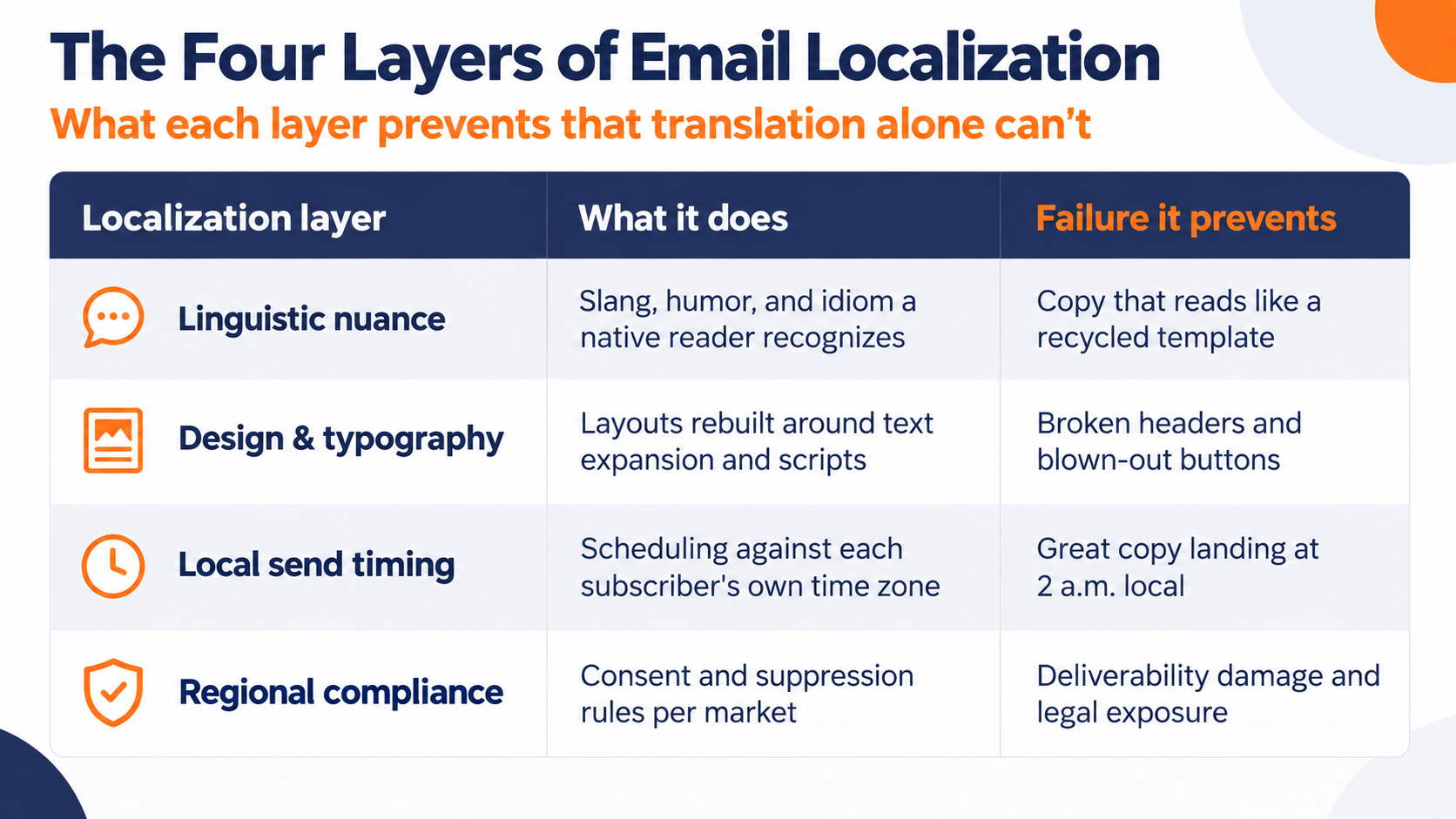
Once you accept that translation is step one, the real localization work opens up. Four areas do most of the work, and none of them are about vocabulary.
Linguistic nuance is what separates human from template
Slang, humor, idioms, and local expressions are the layer machine translation can't touch, and stale master templates flatten out. A native reader can spot a recycled template from a mile away, the same way you can spot a phishing email that almost gets the tone right.
The goal is to create a feeling of a localized conversation, not a localized document. That means someone with real local knowledge deciding which phrases feel natural and which feel imported. It's the difference between an email that sounds like a person and one that sounds like something that someone ran through AI software.
How local knowledge turns cultural risks into revenue
This is also where humor and reference either build a connection or backfire. A joke that lands in one market can confuse or offend in another, and a pop-culture nod that feels current at home can mean nothing abroad. Local knowledge is what tells you which risks are worth taking and which ones cost you the reader.
It's the difference that makes personalization worth a documented revenue lift of roughly 5 to 15 percent when it's done at the level of the individual, and the same logic rewards you when you do it at the level of the market.
Design and typography break in ways you won't expect
Text expansion can be a silent killer. Translate from English into German, Spanish, or Russian and your word count balloons. Sentences that fit neatly in your English layout spill over, wrap awkwardly, or blow out a button. Other languages use entirely different writing systems, which changes spacing and line height on top of length.
If your emails lean on tight visual layouts, image-based headers, or character-sensitive design, this isn't cosmetic. A layout that looked clean in English can look broken in translation, and a broken-looking email gets trusted less. Your designer and your localizer need to be in the same conversation, not handing files back and forth after the fact.
How inconsistent email tone erodes market brand loyalty
There's a subtler failure than a bad translation, and it's inconsistency inside a single market. The welcome email nails the local tone, the promo two weeks later reverts to a stiff machine translation, and the subscriber will quickly notice the difference. That flip-flop reads as carelessness, and carelessness is its own kind of message.
Pick a voice per market and hold it across every send. A consistent, slightly-imperfect local voice beats a mix of one great email and three generic ones, because trust compounds when the experience stays steady and erodes the moment it doesn't.
Send times live in the reader's time zone, not yours
There are windows for the best time to send emails for when people actually open email, and those windows are local. A send timed perfectly for your morning is landing at 2 a.m. for a subscriber halfway around the world, buried under everything else that arrived overnight by the time they wake up.
Global sending means scheduling against each subscriber's local clock, not blasting everyone the instant your workday starts. The right message at the wrong local hour is still the wrong message.
|
Pro Tip: Schedule global sends against each subscriber's local time zone, not your office clock, or your best copy shows up while half the list is asleep. |
Local email regulations are not optional reading
Plenty of markets run their own rules on commercial email, and they don't care that you were compliant back home. The US has CAN-SPAM. Canada has CASL, which is stricter than most teams expect. The EU has the ePrivacy rules layered on top of GDPR. Countries across Asia, from Japan to South Korea to China, each maintain their own frameworks.
You don't need to memorize all of them, but you do need to know which apply to each segment before you send. Getting this wrong carries a hard cost. Think deliverability damage, legal exposure, and a fast way to torch sender reputation in a market you were trying to win.
Simplify cross-border compliance with one centralized system
This is one more reason a multilingual email marketing program benefits from being run out of a single system rather than stitched together market by market.
When your consent records, suppression rules, and send logic all live in one place, staying compliant across borders becomes a setting you configure rather than a fire you fight every send.

Localization Is A Two-Way Street
One part that stops a lot of teams before they start is when people reply to your global email marketing campaigns but in another language. The reality is that when you send a great localized email, you need to be prepared for what to do when you get a response in a language you might not be fluent in.
The reply is where trust is won or lost
A subscriber who gets a warm, native-language email and then hits a wall of English support has just learned your localization was a costume.
The trust you built in the inbox evaporates at the first reply. Consistency across the whole interaction is the point, and it's exactly what readers say they expect.
That expectation is measurable, and it's loud. Roughly two-thirds of consumers say they'd switch to a competitor that offers support in their own language. Your localized campaign opened the door. A monolingual follow-up experience walks them right back out of it.
You don't need a huge in-house team to pull this off
No multilingual staff on payroll? Not to worry. Plenty of brands handle native-language support through partners and scale it to the channels their audience actually uses, whether that's live chat, email, or something lighter.
You're not building a global call center overnight. You're making sure the conversation doesn't die the moment the subscriber talks back.
Match support investment directly to market volume
If one market drives a fraction of your replies, a lightweight setup covers it. If it's a growth market you're betting on, staff the response experience the way you'd staff the campaign.
What you can't do is localize the outbound message and then leave the inbound half to chance, because that's the exact moment a subscriber decides whether the whole thing was real.
Consistency across the journey is the actual product
The key to pulling this off effectively is consistency. This doesn't mean you need perfection in every single email, but you should strive to create a reader experience that holds its shape from the first subject line to the reply and every message after. A subscriber can forgive an awkward phrase. They rarely forgive the sense that the personalization was a front.
Consistency also means covering every layer, not just the one you're best at. Translation handles the words. These four layers handle everything a native reader actually reacts to, and skipping any one of them is where a campaign loses the market.
That's why localization is a program, not a project you finish. Markets shift, language drifts, regulations update, and the brands that stay relevant are the ones treating localization as something they maintain, not something they translated once and shipped.
The teams that keep it running are almost never the ones doing it by hand. They're the ones who built the language, timing, and channel logic into their sending system once, so consistency is the default state instead of a thing someone has to remember to enforce on every campaign.
Where Your Global Email Program Goes From Here
Here's what we covered and how to put it to work. Translations are the basics, and it's not enough on its own. Real email localization means adapting language, culture, design, timing, and compliance together, then keeping that consistency all the way through to the reply.
The demand is there, but most brands still run their global email marketing on translated templates and nothing more, which means the ones that go further stand out immediately.
Unifying language, time zone, and channel preferences
The localization work only pays off if your sending system can act on it. All of this comes down to whether one platform can hold a subscriber's language, behavior, local time zone, and channel preference in a single record and send against them automatically, or whether your team is stitching that together market by market every week.
If your system treats each market as a separate manual chore, it will undo the localization you paid for. A marketing automation system that runs email and SMS from a shared customer record, fires behavioral triggers in each subscriber's language on their own schedule, and keeps segments current as people move between them is what turns a translated campaign into a coherent global journey.

Scale global growth on autopilot
The brands that win globally are rarely the ones with the cleverest single translation. They're the ones whose localized journeys keep running while the team sleeps.
So start by auditing what you're already sending globally, and find where a translated template is doing the work localization should be doing.
If you want to see exactly where your program is losing international subscribers before you change a thing, schedule a marketing automation audit, and we'll map the highest-impact places to localize first, market by market.