A well-written email can outperform a mediocre one by a wide enough margin that it's worth stopping and asking why most campaigns still read like they were assembled by committee.
Word choice, structure, and who you're actually talking to on the other end of that inbox make a bigger difference than most marketers give them credit for. You're busy. Your subscribers are busier.
So here are the email copywriting tips that actually move the needle when you sit down to write your next campaign.
Copywriting is a skill, not a formatting task
The best email copywriting tips have almost nothing to do with clever wordplay and almost everything to do with respecting the reader's attention.
Treating copy as an afterthought, something to bang out after the template and the send list are ready, is how you end up with emails that get opened and immediately forgotten.
The words are the campaign. Everything else, the template, the send time, the subject line testing, is just the container the words travel in.
Treat everyday email sends with the same care as major launches
Most of these email copy best practices aren't secrets. Every marketer already half-knows them and still skips them under deadline pressure. Memorizing a checklist won't fix that.
Building a habit of writing copy that respects the reader's time and your own goals, campaign after campaign, will, not just on the launches that get extra attention from leadership.
Solve A Problem, Don't Sell A Product
Nobody actually wants a plunger. They want a toilet that isn't clogged anymore.
That distinction matters more than it sounds like it should. Your copy needs to show the reader how your product or service removes a specific headache from their day, not just describe what the product does.
Stop listing features and start solving real problems
This is the single biggest gap between email marketing copy that gets ignored and copy that actually gets acted on. One describes a thing, the other describes a change in the reader's day.
Solving a problem in your copy also does something else. It builds the reader's trust that you actually know your subject, instead of just knowing your catalog.
Give readers a reason to open
Instead of pushing your offer directly, answer real questions your audience already has.
Your pitch should become almost secondary to the value on the page, and that's exactly why it works.
Readers open the next issue because the last one actually helped them, not because a discount code expired that week.
You don't need a lifestyle brand's budget to pull this off
Any product category has a handful of recurring questions its buyers are quietly Googling. Answer those questions in your emails before your competitors do, and you become the trusted source instead of just another sender fighting for inbox space.
A quick gut check for any feature-heavy line
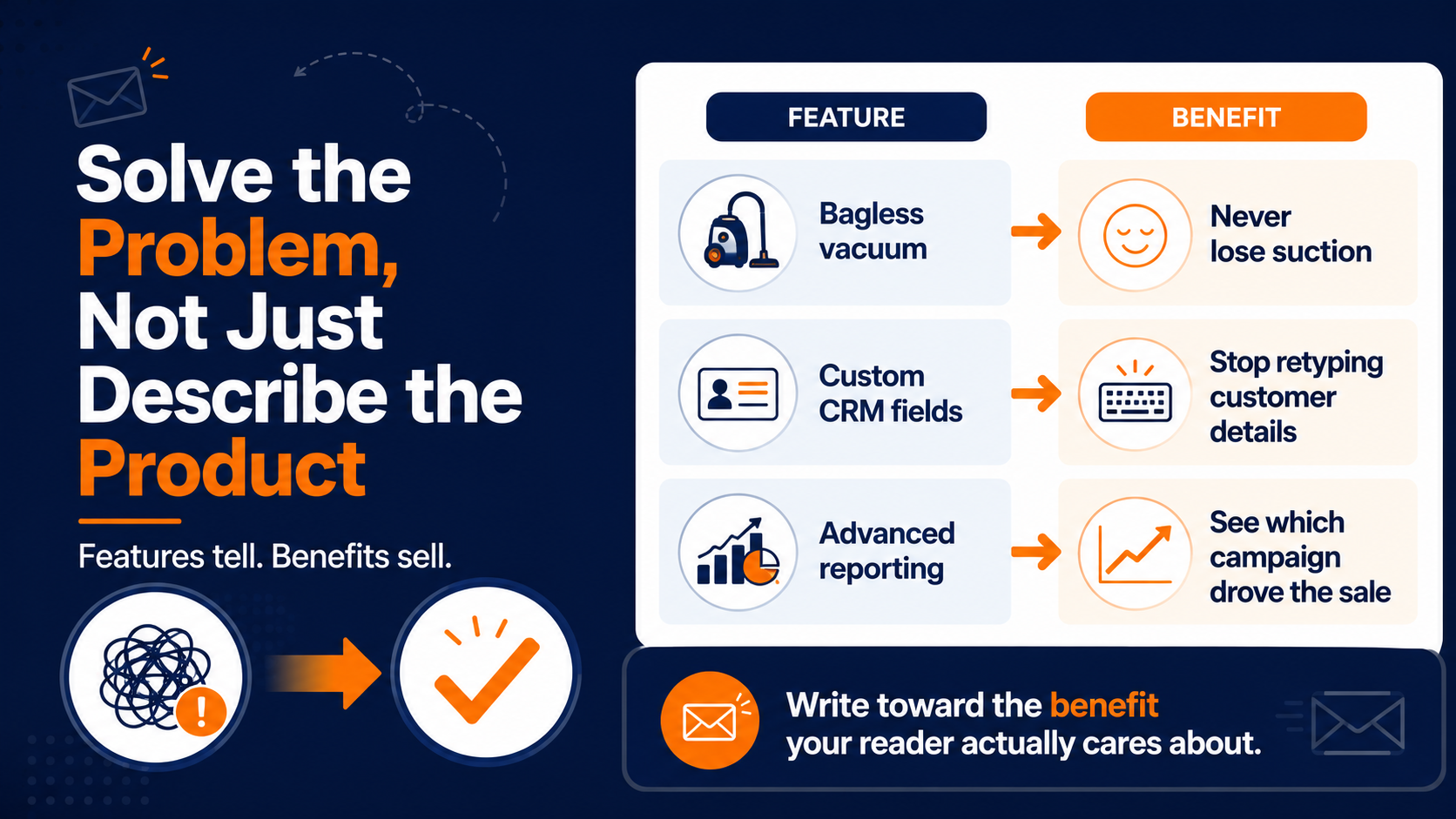
When you're stuck between describing a feature and describing a benefit, default to the benefit every time. For a vacuum, your product being bagless is a feature. Never losing suction is the benefit your reader actually cares about.
A CRM having custom fields is a feature. Never re-typing the same customer detail into three different tools is the benefit. Write toward the second half of each of those sentences, not the first.
Turn product specs into clear reader benefits
One quick way to test whether a line is doing its job: read it and ask “so what?” If the sentence doesn't survive that question, it's describing the product instead of the problem it solves. A line like “Our tool has advanced reporting” doesn't survive it. “You'll stop guessing which campaign actually drove the sale” does.
Say One Thing, And Say It Well
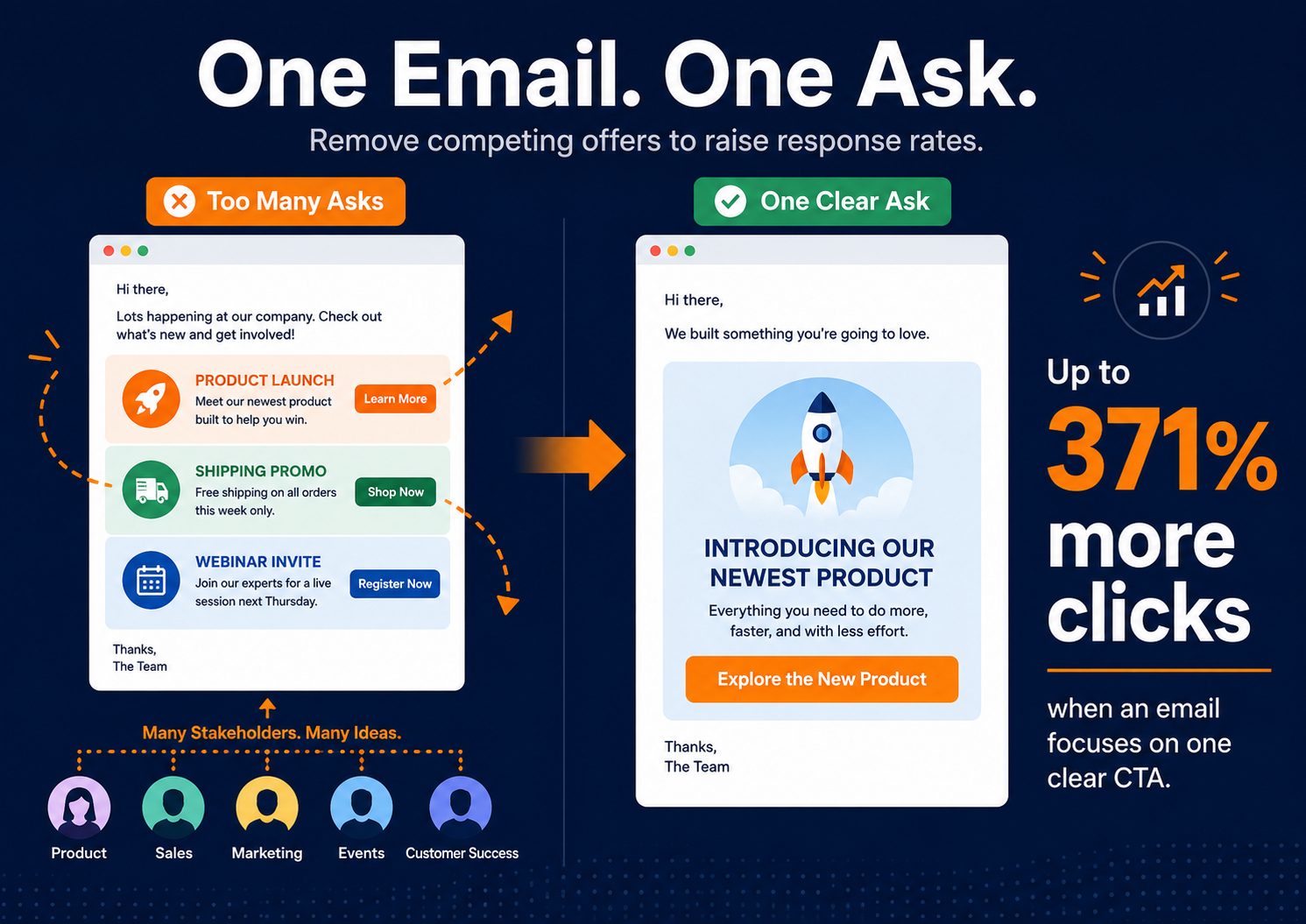
Trying to fit a product launch, a shipping promo, and a webinar invite into one email dilutes all three messages at once. Pick a single topic and build the entire email around it.
The clicks back this up. Emails built around a single, clear call to action can drive up to 371% more clicks than emails asking readers to choose between competing actions.
Drive higher response rates by removing competing offers
Every extra choice you add to an email is a chance for the reader to do nothing at all, because decision fatigue is real even inside a 200-word marketing email.
If you've got three things to say this week, that's three emails, not one crowded one. It feels inefficient in the moment. It isn't. A cluttered email asking for three different actions usually gets zero of them.
Why this gets harder as your team grows
This gets harder to enforce the bigger a team gets, because every stakeholder wants their update included in whatever's going out next. A better template won't solve it. A standing rule will: one email, one ask, decided before the draft gets written, not negotiated after it's already crowded.
Give Readers An Honest Reason To Act Now
Email copy needs to move people to act while they're still reading, not sometime later when the moment's passed. A deadline does that better than almost anything else in your toolkit.
Every promotion should end. Every coupon should expire. Limited-time offers can boost sales by as much as 226% compared to open-ended ones, and that lift comes almost entirely from the psychological weight of a real deadline.
State it in the subject line. State it again in the copy. If the deal's about to close, a second “last chance” email is fair game, and it usually converts a meaningful slice of people who saw the first one and simply meant to come back later.
Build urgency with real logic instead of arbitrary timers
Here's the part that trips people up. The deadline has to be real. A fake countdown or a coupon that mysteriously never actually expires gets noticed eventually, and once a reader catches you bluffing on urgency, they stop trusting your next deadline too. That kind of trust doesn't come back with an apology email. Use urgency because it's true, not because it's a trick.
Give the reader a reason the deadline exists, too, even a simple one. “Ends Sunday because that's when the vendor discount expires” reads as a fact. A bare countdown with no explanation reads as a manipulation tactic, even when it's completely true.
B2B deadlines work the same way retail ones do
This applies just as much to B2B sends as it does to retail flash sales. A webinar seat count, a pilot program with a limited number of onboarding slots, a discount tied to a fiscal quarter closing out, all of these are legitimate deadlines that happen to also drive urgency. You don't have to manufacture pressure. Most businesses already have real constraints sitting right there, unused in the copy.
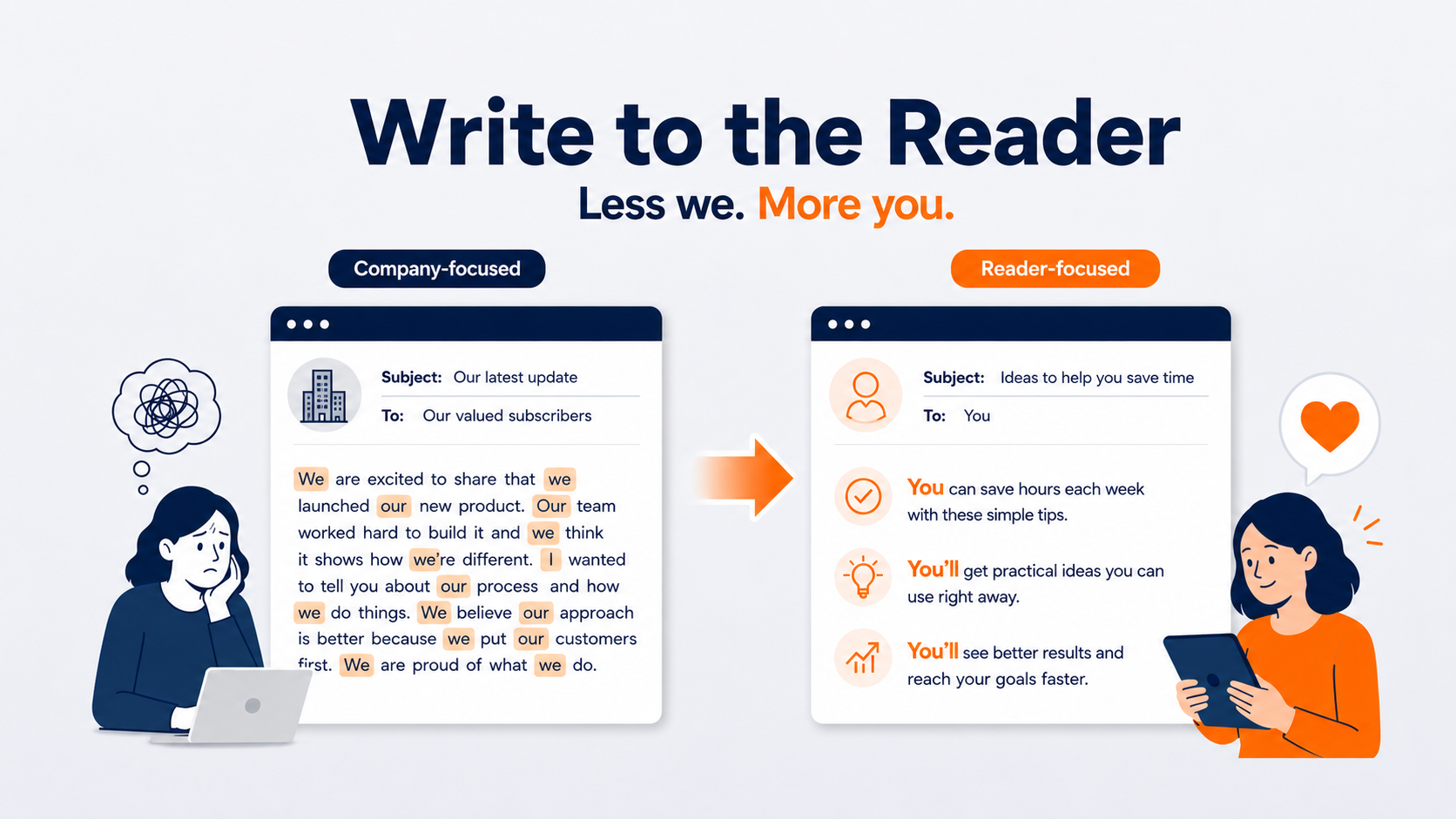
Write Like You're Talking To One Person
Nobody wants to get cornered at a dinner party by the person who only talks about themselves. The same rule applies to your inbox. Copy stacked with “we,” “our,” and “I” reads like a company talking at someone. Copy built around “you” reads like a person talking to someone.
Draft from the reader’s vantage point, not your own
Writing in second person does something for you as the writer too. It forces you to picture an actual reader and their actual situation instead of drafting from your own vantage point, which almost always produces sharper, more relevant email marketing copy.
Try rewriting a paragraph from “we” to “you” and watch how many vague, self-congratulatory sentences suddenly become impossible to write.
Where to draw the line between plain language and sloppy copy
Personalized 1:1 experiences average a 76% increase in click-through rate compared to one-size-fits-all sends. A name field alone doesn't get you there.
Copy and content that actually reflects where the reader is, and what they've already told you about themselves through their behavior, does. If you want to go deeper on what real behavioral email personalization looks like beyond a first name, it's worth building into your next few sends.
|
Feature-focused line |
Benefit-focused line |
|
“Our platform includes automated triggers.” |
“Stop manually sending the same follow-up 40 times a week.” |
|
“This vacuum is bagless.” |
“You’ll never lose suction halfway through a job again.” |
|
“We offer real-time segmentation.” |
“Send the right message before your list even notices they’re being tracked.” |
Answer "What's in it for me?"
Every row on the right answers the same silent question the reader is asking. What does this actually do for me? That question should sit behind almost every sentence you write, even the ones that aren't explicitly about a feature.
Run this test on your last three sends. Count how many sentences describe what your company or product does versus how many describe what changes for the reader. If the first column wins, that's usually where opens turn into deletes.
Make Every Call To Action A Specific Instruction
“Click here” tells the reader to click, but not why, and not what happens next. Vague CTAs are one of the most common ways an otherwise strong email loses its own momentum in the last three words.
Compare “Learn More” against “See Your Custom Pricing” or “Get the Template.” Looking at real email call to action examples side by side like this makes the gap obvious. The second version tells the reader exactly what's waiting on the other side of the click, which removes the small flicker of hesitation that a vague CTA always creates. That hesitation is where clicks quietly die.
Placement matters as much as wording
The same rule applies to the CTA's placement, not just its wording. Put it once near the top for people who already know they want in, and once at the bottom for people who read the whole email first. Both point to the same single action, so they never compete with each other the way two different offers would.
Buttons tend to outperform plain text links for this, especially on mobile, simply because a button reads as an action and a link reads as a reference. If your email currently ends on a plain “learn more” hyperlink buried in a paragraph, pull up a handful of email call to action examples from brands you actually admire and notice how few of them bury the ask in a sentence at all.
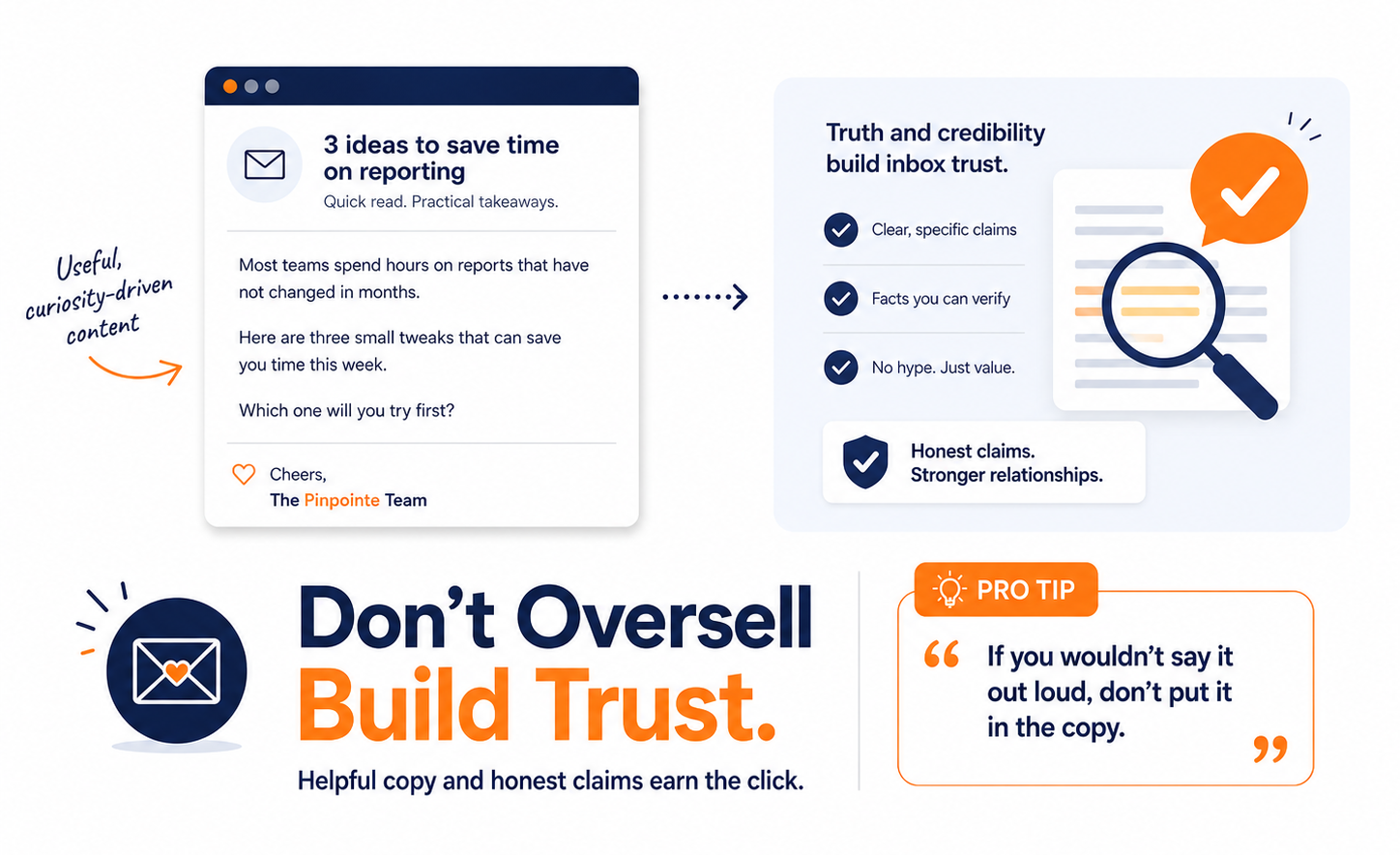
Earn Trust By Not Overselling
You can build an entire brand moment around dropping the hard sell, and it works because the absence of pressure is itself the pitch.
Your copy can do the same thing. Write something actually useful, add your logo, and let the reader decide they're curious enough to click.
The flip side of restraint is honesty
If you promise a product will never break, or that a result is guaranteed, and it isn't, that gap gets noticed and remembered. Customer retention takes the hit, and word of mouth about a broken promise travels a lot faster than word of mouth about a kept one. No subject line trick recovers the trust lost from one overreaching claim.
PRO TIP: If you wouldn't say a claim out loud to a customer standing in front of you, don't put it in the copy either.
There's a version of this that trips up even well-meaning teams: rounding a “typically” into an “always,” or a customer's individual result into a promised outcome for everyone.
It's rarely intentional dishonesty. It's optimism that outran the facts. Read every claim back and check whether it's still true for the reader who has the worst possible version of your typical outcome, not just your best case study.
Format For The Way People Actually Read Email
Assume every recipient is scanning, not reading word for word, because that's usually exactly what's happening. Short paragraphs, clear subheads, and your most important point in the first two sentences all do more work than clever phrasing ever will.
Every section should stand on its own, which means a reader who only skims one paragraph still walks away with something useful.
Let structure do some of the persuading
A short list of options can do more work than a paragraph trying to describe all of them at once. Take an example for a vacation rental company.
Breaking up categories such as those below can help people quickly find what they are looking for in the email.
- Fewer than 10 people
- 11 to 15 people
- 16 to 20 people
- More than 20 people
Mark Twain's advice to kill your adjectives applies just as much to email as it does to fiction. Fewer descriptive words, more links for the reader to explore further if they want to. Skip the clichés too. Phrases like “think outside the box” or “every cloud has a silver lining” don't add meaning, they just take up space a real sentence could have used instead.
And go easy on the exclamation point. Marketers tend to believe everything they're announcing is thrilling, which is how inboxes end up full of punctuation that oversells a 10% discount. Your copy should sound like a conversation. Most conversations end in periods.
Paragraph length is not a cosmetic detail
A wall of four-sentence paragraphs feels like effort to open on a phone screen, even before the reader's absorbed a single word of it.
Among email copy best practices, this one gets skipped the most because it looks cosmetic. It isn't. Cap paragraphs at three sentences, and let plenty of them run shorter than that.
A single blunt sentence, standing alone, often lands harder than the same idea buried in the middle of a longer paragraph.
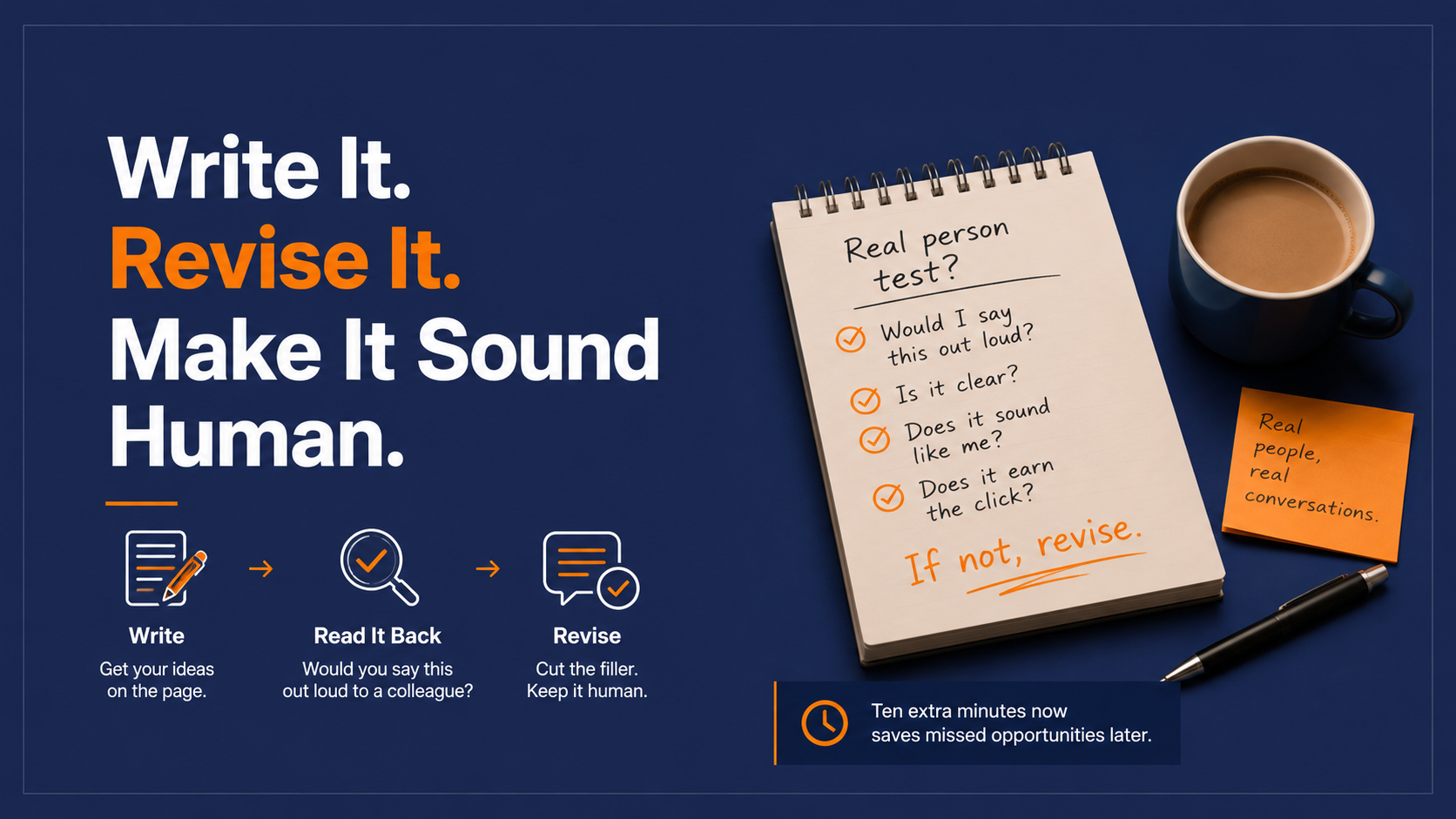
Stop Treating Your First Draft Like Your Only Draft
The tips above only work if you actually revise against them. Write the email, then read it back and ask whether a real person would say it out loud to a colleague. If the answer's no, it needs another pass.
This is where most of the damage from templated phrasing happens. A first draft written fast will lean on filler, hedge words, and the same sentence shapes over and over. A second pass, read out loud, catches almost all of it.
That single habit does more for your email marketing copy than any tip on this list in isolation, and it costs nothing but ten extra minutes before you hit send.
Stop Letting Good Copy Get Lost In An Inconsistent Send
None of this matters if the email carrying your best copy shows up late, goes to the wrong segment, or gets buried behind a dozen other messages competing for the same inbox that week.
Pinpointe's behavioral triggers and dynamic segmentation exist to handle exactly that problem: matching your best copy to the reader who's actually ready for it, at the moment they're ready for it, instead of blasting it to everyone at once and hoping the writing does all the work alone.
Fix where and when your email lands before sentence-level polish
Great copy sent to the wrong segment still underperforms. Mediocre copy sent to the exact right person at the exact right moment still does better than it should. Following every one of these email copy best practices to the letter still won't fix a list problem.
The goal is obviously both, but if you can only fix one this quarter, fix where and when the email lands before you fix the sentence-level polish.
Why great email copy fails without the right send strategy
Knowing how to write marketing emails that convert only gets you halfway there. The other half is making sure the right person is actually the one reading them.
If your last campaign had strong copy but still underperformed, the issue probably wasn't the writing. Schedule a demo and find out whether it's your send strategy quietly holding your copy back!