
Your CFO does not care that your last campaign hit a 44% open rate. They care whether the company made more money because you sent it, or whether those buyers would have purchased anyway.
How To Connect Email Marketing Directly To The Bottom Line
Most email marketing reporting is missing ROI as a tracked metric. Opens and clicks tell you an email got attention. They say nothing about whether the channel is actually moving the business, and when budget season comes around, attention is a hard thing to defend.
Why opens and clicks stall out in the boardroom
Open rate has been a shaky number since Apple's Mail Privacy Protection started pre-loading images and inflating the count. Click rate is better, but it still only measures interest, not outcome. Neither one answers the question that decides your budget. Did email make the sale happen, or did it just happen to be nearby when it did?
The email marketing metrics that answer that question are less glamorous and a lot more persuasive. They tie email to revenue, and they hold up when someone senior starts poking at your numbers. That is the difference between a report that gets skimmed and one that protects your budget.
What this piece will actually give you
Five email marketing metrics that connect your program to the bottom line, plus the one measurement technique that turns all five from a nice correlation into here is the revenue we caused. To determine the true value of your email marketing, you'll need to take a slightly different approach than most marketers. And you'll need to have a willingness to withhold email from a small slice of your list long enough to prove a point.
Start With A Holdout, Not A Dashboard
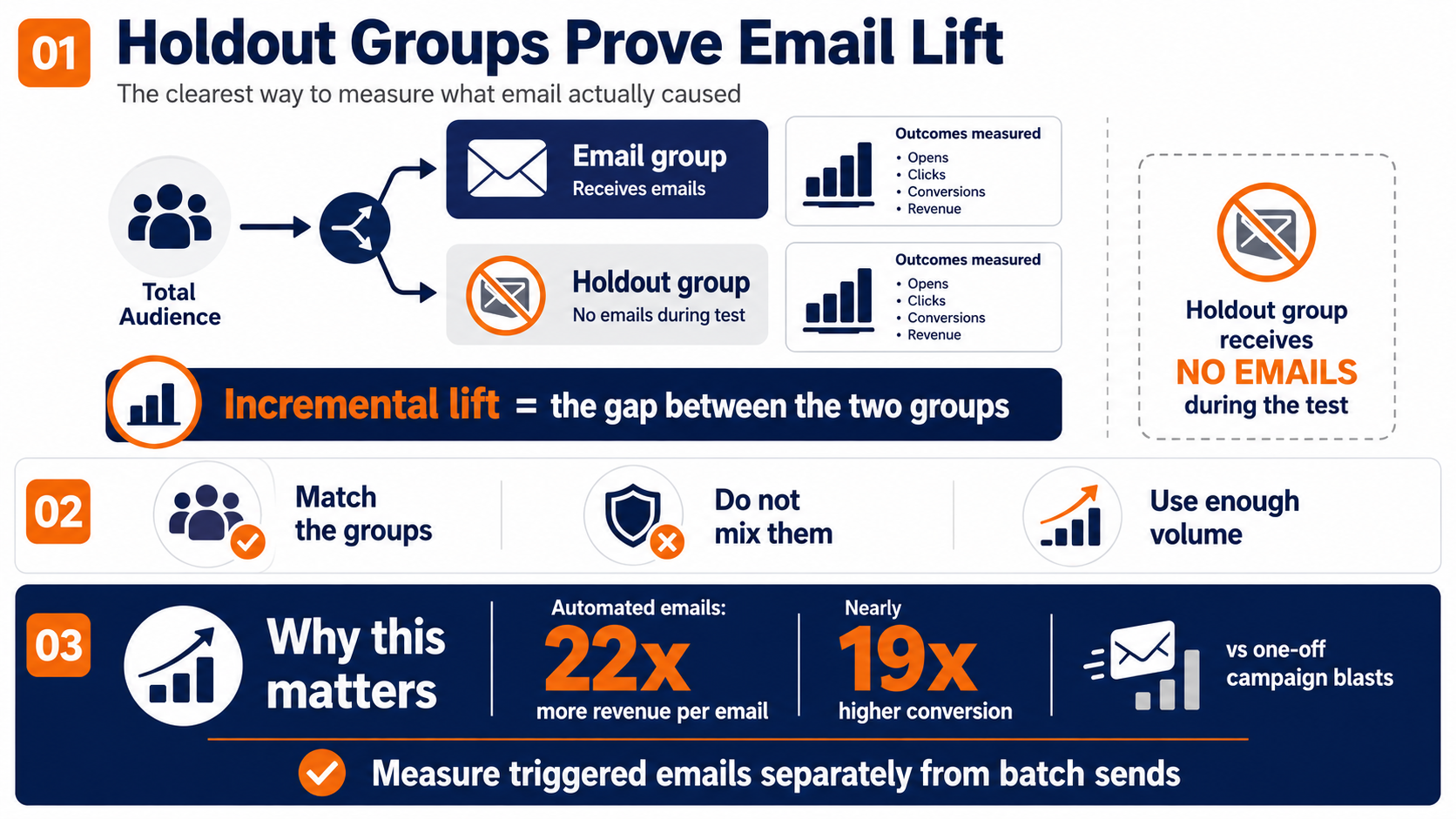
Before any of the five metrics mean anything, you need a way to prove email caused the result instead of just showing up next to it. That is what a holdout group does, and it is the single most underused tool in email measurement.
Most teams have every dashboard imaginable and still cannot answer the causation question, because a dashboard reports what happened, not what would have happened otherwise.
The idea is simple. You split your audience into two matched groups. One keeps getting your emails as normal. The other, the holdout, gets nothing for the duration of the test. Everything else stays identical. Then you compare what each group did.
How a holdout group actually works
Whatever gap opens up between the two groups is your incremental lift, the revenue you can fairly attribute to email and nothing else. Holdout testing has become the accepted way to measure a channel's true causal contribution precisely because it answers the counterfactual no attribution model can, which is what would have happened if you had done nothing.
The rule that keeps the test honest is that the two groups cannot mix. Once someone is in the holdout, they stay there for the whole test. Move people back and forth, and you have contaminated the result. A contaminated holdout is worse than no holdout at all, because it hands you false confidence in a number that is really just noise.
Size matters too. The groups need to be big enough that the difference between them is real and not a fluke of a few large orders landing in one bucket. You do not need a statistician for this, but you do need enough volume that a single whale customer cannot swing the whole read.
One number that reframes the whole exercise
Here is the finding that makes the case for testing at all. Automated, behavior-triggered emails generate 22 times more revenue per email than one-off campaign blasts, and convert roughly 19 times higher.
A blast to your whole list and a triggered message to the right person at the right moment are not the same activity, and they will not produce the same lift in a holdout.
The same channel, measured two ways, produces wildly different returns depending on whether it is timed to behavior or sprayed on a schedule. If you are not separating the two, your average is hiding both your best work and your worst, and your holdout will feel disappointing for reasons that have nothing to do with whether email works.
Conversion Rate That Means Something
Conversion rate is the percentage of your audience that takes the action you actually wanted, a purchase, a booked demo, a signed contract. It is simple to calculate and easy to misread, because most people report the raw number without asking the follow-up question that matters.
The follow-up question is: compared to what? A 2.3% conversion rate sounds fine until you learn the holdout group converted at 1.4% on its own. Now you know email drove a real lift, and you can put a percentage on it instead of a shrug.
Conversion rate lift is the version worth reporting
That comparison is the whole game. The treated group's rate minus the holdout's rate is the piece email actually caused. Report the lift, not the raw rate, and you have turned a vanity number into a defensible one that survives contact with a skeptical finance team.
Sending the right message to the right slice of your list moves conversion far more than another round of subject-line tweaks. A well-targeted send to a warm group will out-convert a generic blast every time, and the holdout will show you exactly by how much rather than leaving you to guess.
Why the benchmark chase is a trap
Chasing an industry-average conversion rate is a losing game anyway, because good swings enormously by sector and sales cycle. A B2B SaaS company with a three-month cycle and an impulse-buy retailer live in different universes, and comparing your number to a blended average tells you almost nothing actionable.
Your own holdout is a better benchmark than anyone else's average, because it is measured against the one audience that matters, yours. It also updates every time you run it, so you are tracking your own progress rather than a static figure someone published two years ago.
|
Pro Tip: Run your first holdout on your automated flows, not your newsletter, since that is where the incremental lift is largest and easiest to prove to a skeptic. |
ROI You Can Defend Line By Line
Return on investment is the metric that ends arguments, and email happens to be very good at it. The average return on email marketing sits around $36 for every dollar spent, higher than any other channel most teams run. That is the headline number, and it is a strong one to open a budget conversation with.
But a headline average is not your number. Your number comes from your own costs and your own incremental revenue, and that is the version worth calculating, because it is the version nobody can wave away as an industry vanity stat.
Build the ROI figure from your holdout
The clean way to do it is to subtract the holdout group's revenue from the treated group's revenue. What is left is the money email actually generated, not the money that would have shown up regardless. Divide that by what you spent, and you have an ROI figure built on caused revenue instead of credited revenue.
Most attribution gives email credit for any sale it touched on the way to checkout. That inflates the number and, worse, makes it fragile the moment a skeptical finance person asks what attributed really means. Incremental ROI does not have that weakness, because it is defined by what happened when email was absent.
Even a rough version beats no version
If you cannot capture every cost, do not abandon the metric. Run it on marketing costs alone. You will lose the direct tie to net profit, but a slightly imperfect ROI you actually report beats a perfect one that stays trapped in a spreadsheet nobody opens.
Get the number in front of leadership first, then refine it over the next few cycles. The teams that wait until the calculation is flawless usually never present anything at all, and the channel stays undervalued by default because no one made the case out loud.
The Value Of A Lead, Measured Against A Holdout
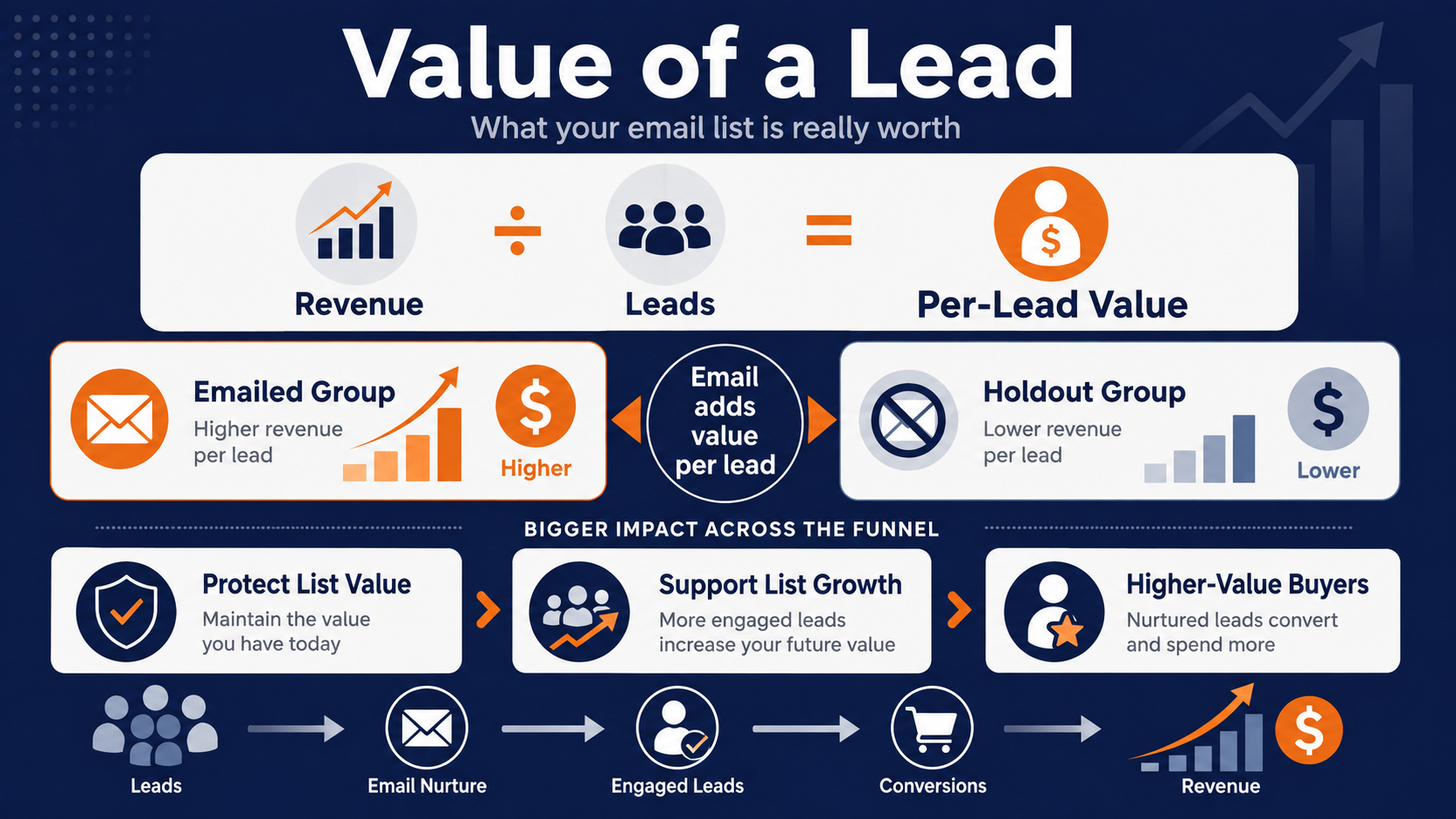
Every email address on your list is worth something, and most teams have no idea what. Value of a lead fixes that. Divide the total revenue a group generated by the number of leads in it, and you have a per-lead dollar figure you can plan around.
The insight shows up the moment you run it on your treated group versus your holdout. Two numbers, one comparison, and suddenly your list has a price tag.
What the holdout reveals about lead value
The leads receiving your emails will almost always carry a higher per-lead value than the ones who do not, and that difference is the dollar value email adds to every address you collect. Your list stops being a soft asset and becomes a number, and that number justifies what you spend to grow and keep it.
This reframes list growth entirely. If each nurtured lead is worth measurably more than an unnurtured one, then list hygiene, re-engagement, and consistent sending stop looking like maintenance chores and start looking like direct revenue protection. Letting a list decay is not neutral. It is throwing away a per-address value you have already proven exists.
Where lead value connects to the bigger funnel
There is a compounding effect here that pure conversion rate misses. A buyer who has been nurtured properly does not just convert more often, they tend to make larger purchases as well. That shows up in lead value as a higher ceiling on every address.
It is the kind of pattern your holdout will confirm over a full quarter. The emailed group does not just buy at a higher rate, they buy bigger and negotiate less, and the per-lead figure captures all of that in one honest number you can take to a planning meeting.

Average Order Value And The Length Of The Sale
Two email marketing metrics left, and they are the ones teams most often forget to attribute to email at all. The first is average order value, total revenue divided by number of orders. The second is how long the deal took to close. Both move in email's favor when the program is built well, and both are measurable against a holdout.
Average order value is a bottom-line lever in disguise
AOV does not feel like a revenue metric because it is a ratio, but it drives the bottom line hard. Making the same revenue on fewer, larger orders is cheaper to service and easier to scale than grinding out a higher volume of small ones.
When the treated group's average order runs higher than the holdout's, email is doing more than closing sales. It is making each one bigger, usually because a well-sequenced program has room to introduce the right add-on or the higher tier at the moment the buyer is actually receptive rather than at the moment your calendar happened to fire.
Shorter sales cycles are worth real money
Now the one almost nobody measures. Time. Even when two groups eventually generate the same revenue, the group that gets there faster wins, because money in hand now is worth more than the same money later. You can reinvest it, and the compounding starts sooner.
Email compresses that timeline by doing the repetitive education a rep cannot do at scale for every lead. Teams whose email and sales efforts are tightly coordinated report sales cycles running roughly 30% shorter than teams working in silos. A holdout makes that speed visible as a dollar figure instead of a vague sense that things move quicker when the emails are flowing.
Reading all five metrics together
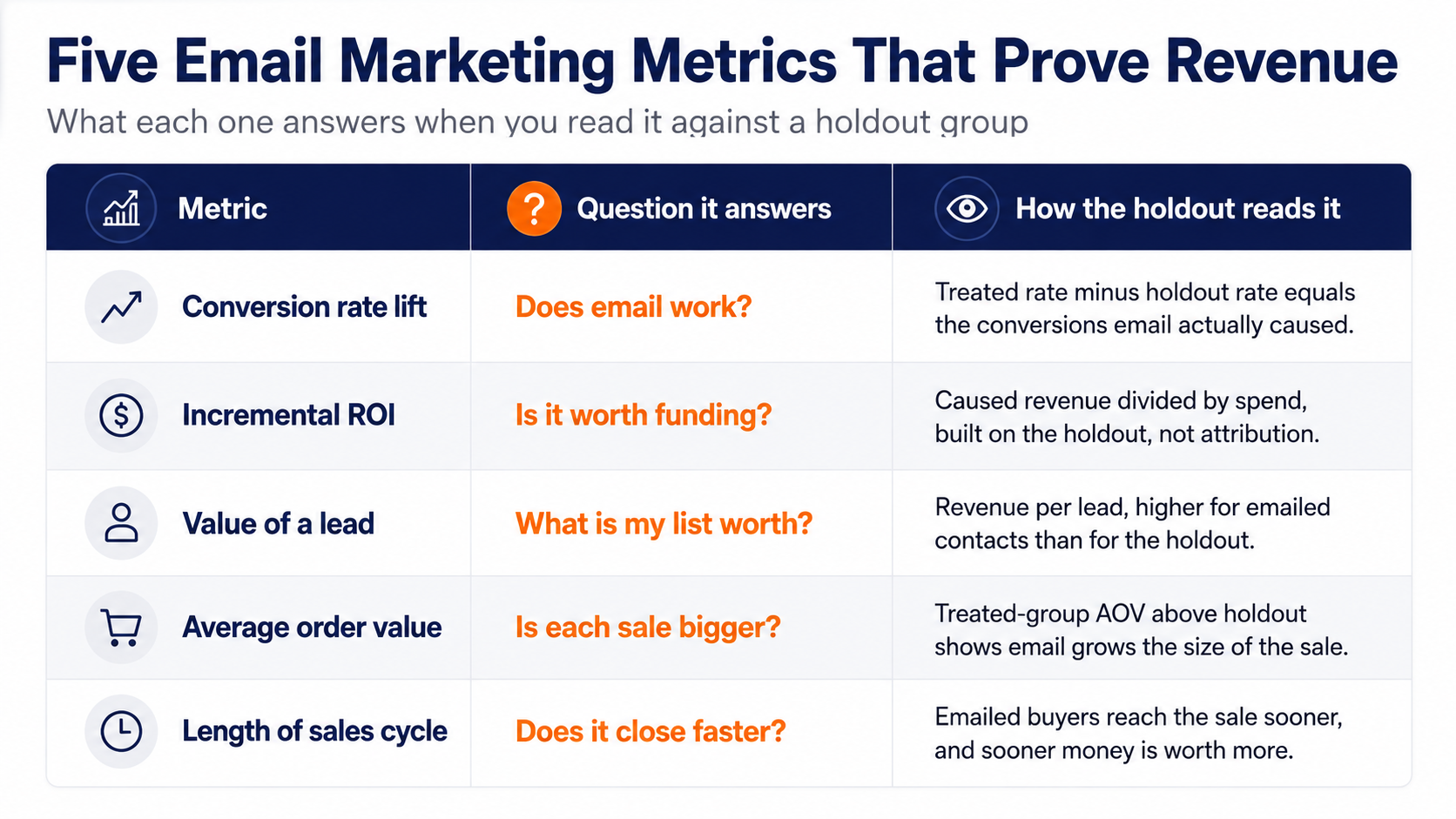
No single metric tells the whole story, and that is the point. Conversion lift shows email works. ROI shows it is worth funding. Lead value prices your list. AOV shows email grows each sale. Cycle length shows it does all of that faster.
Measured against a holdout, the five stop being separate stats and start being one coherent case. Any one of them can be argued with in isolation. Together, read against a group that got no email, they are very hard to dismiss.
Why the measurement is easier inside a real automation setup
There is a practical reason these five numbers are so hard to produce in most programs, and it has nothing to do with the math. It is that the data lives in too many places. When your sends, your engagement records, and your revenue all sit in separate tools, holding a group out cleanly and tracing what they did afterward turns into a manual reconciliation job nobody has time for.
This is the reason a real marketing automation setup pays for itself before you have optimized a single subject line. It is not only that automation sends better emails. It is that automation gives you a controlled environment where these revenue metrics can actually be measured, because the platform already knows who got what and when, and can hold a group out without you tracking it by hand in a spreadsheet.
Where To Start Proving Your Email Revenue This Quarter
Opens and clicks describe activity. Conversion lift, incremental ROI, value of a lead, average order value, and length of sales cycle describe revenue, and a holdout group is what turns each of them from a correlation you hope is real into a number you can defend. But all five depend on one thing being true: that your email program is timed to what buyers actually do, not to a calendar.
A holdout on a batch-and-blast newsletter will show weak lift, because the sends are not tied to intent. The lift lives in the behavioral triggers, which means the measurement problem and the performance problem have the same fix.
The shift worth making is from sending on a schedule to sending on a signal. Do that, and every one of these email marketing metrics improves in the same direction at once, because each of them is really measuring whether the right person got the right message at the right time.
Turn the holdout into a habit, then read the five together
Build the holdout first, then read the five metrics against it, and start with your automated flows where the lift is largest. You do not need to measure all five at once. Pick conversion lift and ROI this quarter, prove the channel pays, then layer in lead value, order value, and cycle length as you get comfortable withholding email from a small group without flinching.
The first holdout will feel like an event. The tenth should feel like routine, and that is the goal, because a standing holdout tells you whether a new sequence or a change in cadence is actually adding lift or just moving numbers around. The teams that make this switch stop arguing about whether email works and start reporting exactly how much it is worth.
If you want to find out which of these five numbers your current program is leaving unproven, schedule a marketing automation audit with our team, and we will show you where the incremental revenue is hiding.