You never get a second chance to make a first impression. In email, you don't even have to worry about eye contact or a bad handshake. You just have to show up.
Most B2B companies don't show up. Go check your own inbox. Sign up for ten competitor lists right now and count how many of them send you anything at all in the first day.
If your experience matches what shows up in most audits, you'll be surprised how many say nothing.
Why the simplest B2B growth win is yours for the taking
Some of these are companies with sizable marketing teams. Agencies whose entire job is convincing other people to do better marketing. And still, the first message a lot of them send a brand-new subscriber is nothing at all, or a generic newsletter three weeks later that's already forgotten the context it arrived in.
That's the whole opportunity in one sentence. A B2B welcome email is one of the easiest wins in marketing, and almost nobody claims it.
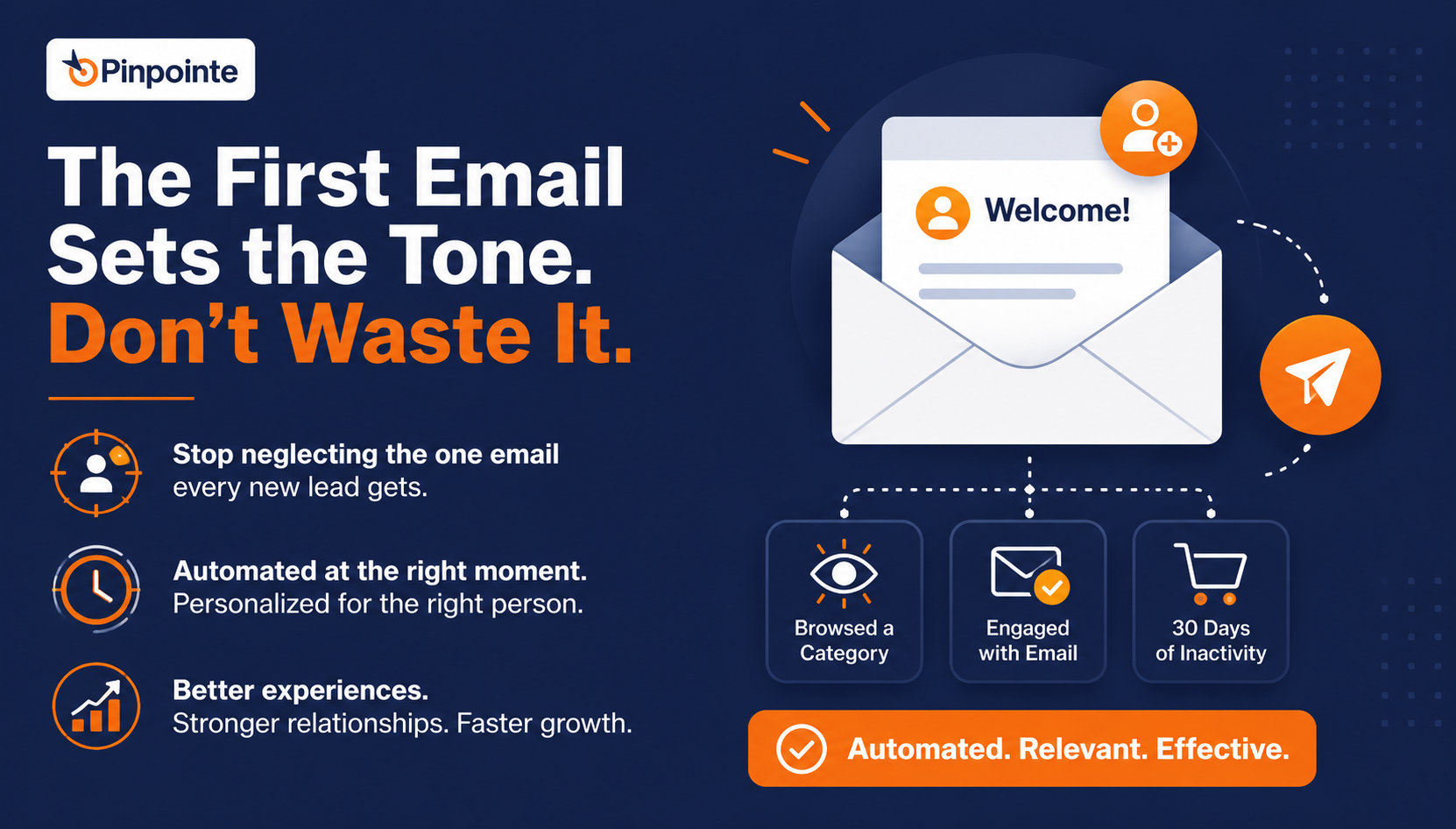
Stop neglecting the one email every new lead gets
It's a strange gap. B2B marketing teams will spend weeks debating a landing page headline, then let the very next touchpoint, the one guaranteed to reach every single new contact, go out as nothing at all.
Fixing that doesn't require a bigger budget or a new tool. It requires deciding that the first email actually matters, and applying a handful of welcome email best practices that most lists still skip entirely.
Why the best copy fails without automated triggers
Most of what's broken here isn't a writing problem. It's an email marketing automation problem.
The message itself matters less than whether it goes out at the right moment, to the right person, without someone having to remember to click send.
Why Welcome Emails Outperform Almost Everything Else You Send
A B2B welcome email isn't a nice-to-have add-on to your list. It's the single most impactful message you'll ever send to that contact.
Automated flows like a welcome series make up a tiny slice of total email volume but carry an outsized share of revenue. Flow-based sends generate close to 41% of total email revenue from just 5.3% of total volume, which tells you where the actual impact sits in your program.
Welcome emails capture intent; newsletters capture routine
That gap exists because timing beats almost everything else in email. A welcome email lands the moment someone raises their hand. A newsletter lands whenever it lands.
New subscriber attention is not the same thing as customer attention. It's higher, and it fades fast.
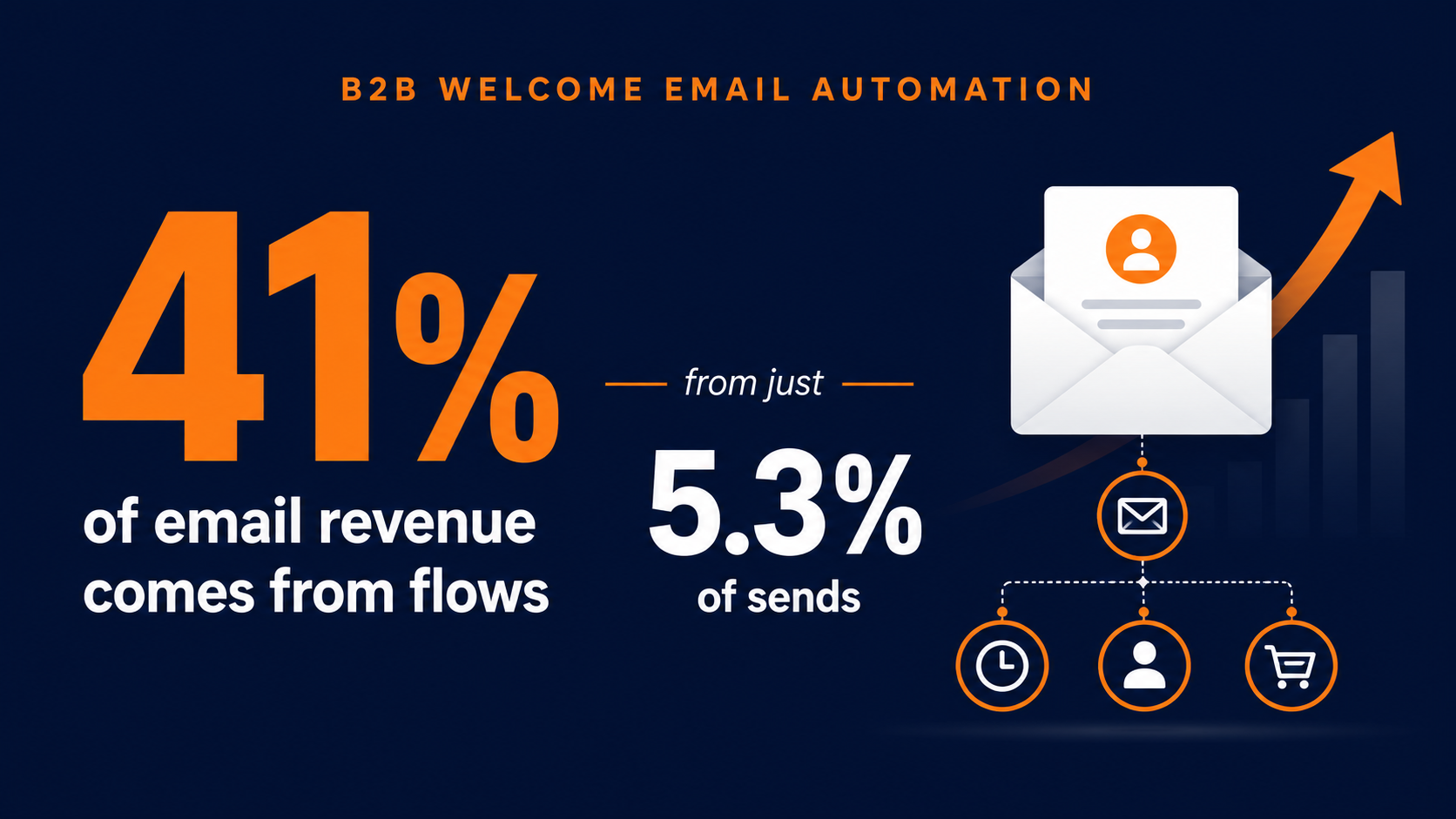
B2B welcome email automation: 41% of email revenue from flows, from just 5.3% of sends.
The revenue math nobody talks about
Here's the part that should reshape your priorities: nearly half of all revenue generated by automated flows comes from brand-new contacts, not existing customers, well above the share credited to broader campaign sends. That skew toward new buyers is the opposite of how most B2B teams allocate their content calendar.
Why the first five minutes beat weeks of nurture sequences
Most content calendars are built for the middle of the funnel. Nurture sequences, case studies, product updates. All useful.
None of it is aimed at the five minutes right after someone converts, which is exactly when they're paying the most attention.
Shift even a small amount of your planning time toward that window, and you're working with the highest-attention audience you'll ever have access to, instead of competing for scraps of attention three weeks later.
New subscribers are not new customers, yet
Treat the welcome email like the start of a relationship, not a receipt. A receipt says "thanks, you're on the list." A relationship starter says "here's what to expect, and here's something useful right now."
That distinction is worth more than any subject line trick you'll test later. A receipt gets skimmed and archived. A relationship starter gets a reply, a click, or at minimum, a reason to open the next one.
Think about the handful of B2B vendors you actually pay attention to versus the ones you've mentally filed under "another list I'm on." The difference almost always traces back to that very first message, whether it felt like it was written for you or just fired at you.
Sending It Immediately Beats Sending It Perfectly
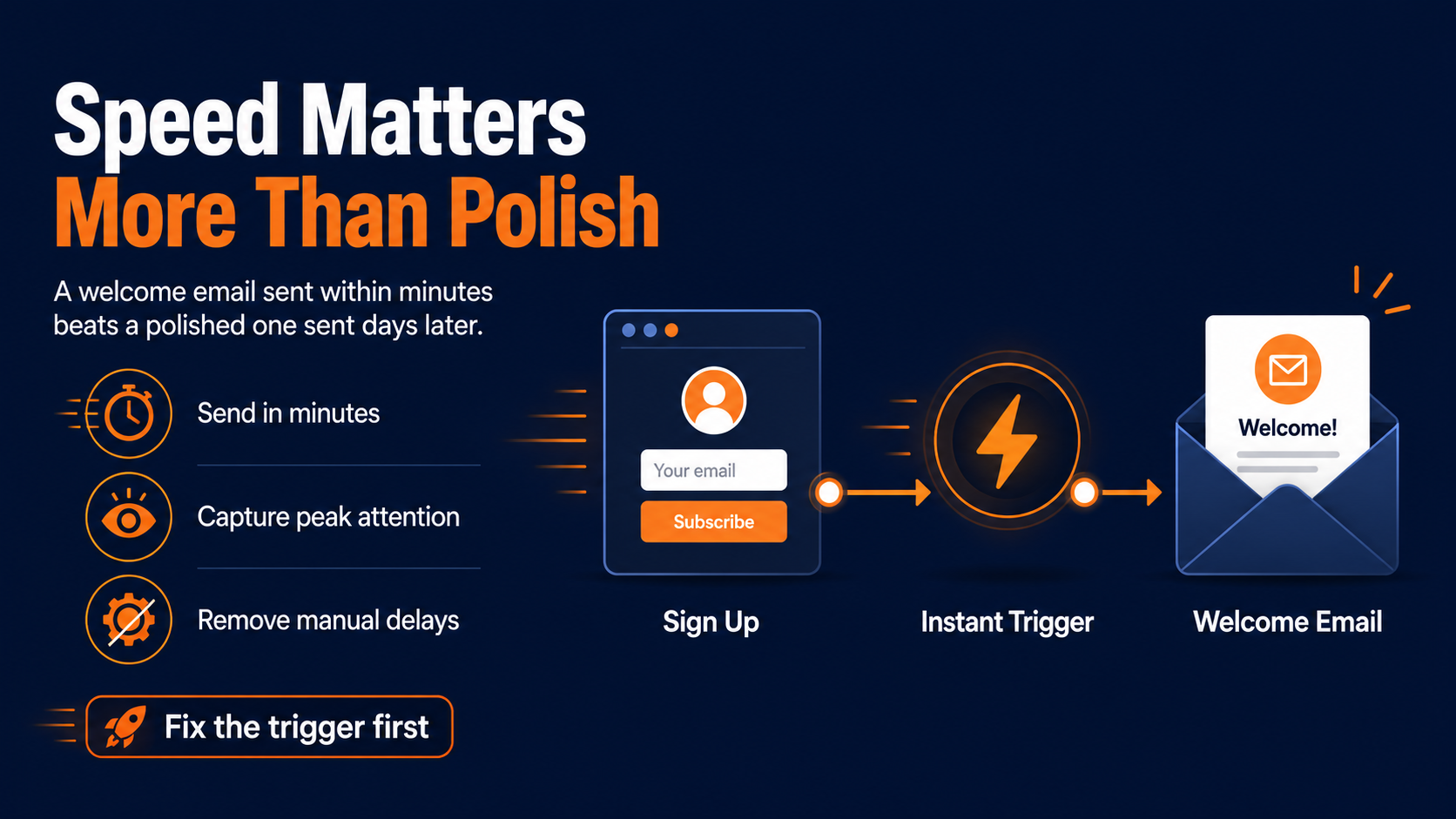
Speed matters more than polish here. This is the single clearest case for email marketing automation in your entire program: nobody should be manually triggering a welcome message by hand. If you're batching welcome emails to go out on a schedule instead of the moment someone signs up, you're leaving most of the value on the table.
Think about your own behavior. You sign up for something, and your attention is at its peak for the next few minutes.
An hour later, you've moved on to six other tabs. A day later, you barely remember signing up.
Why delay kills the moment
The whole point of a welcome email is that it rides the intent the subscriber already has. Wait too long, and you're not riding that intent anymore, you're trying to manufacture it from scratch with a cold subject line.
This is exactly the kind of gap dynamic segmentation and behavioral triggers are built to close. The trigger fires the moment the behavior happens, not whenever someone remembers to check the list.
What immediate actually means
"Immediate" doesn't mean flawless. It means the email goes out within minutes, not days. A good-enough welcome email sent in real time will consistently outperform a polished one sent a week later, because the subscriber has already moved on by then.
If your current process depends on someone manually pulling a list and hitting send, that's the first thing to fix. Everything else in this article assumes automation is already doing that part for you.
Why automated triggers are your email foundation
A trigger tied to the signup action itself removes the human bottleneck entirely. Nobody has to remember to check a spreadsheet at the end of the day. The moment the form submits, the sequence starts, and the subscriber never experiences the gap in the first place.
That's a small technical change with an outsized effect on the reader's experience. They don't know or care that your team runs lean. They only notice whether the thing they were promised showed up when they expected it.
Once that trigger exists, everything else in this article, the segmentation, the sequencing, the testing, sits on top of it. Fix the trigger first.
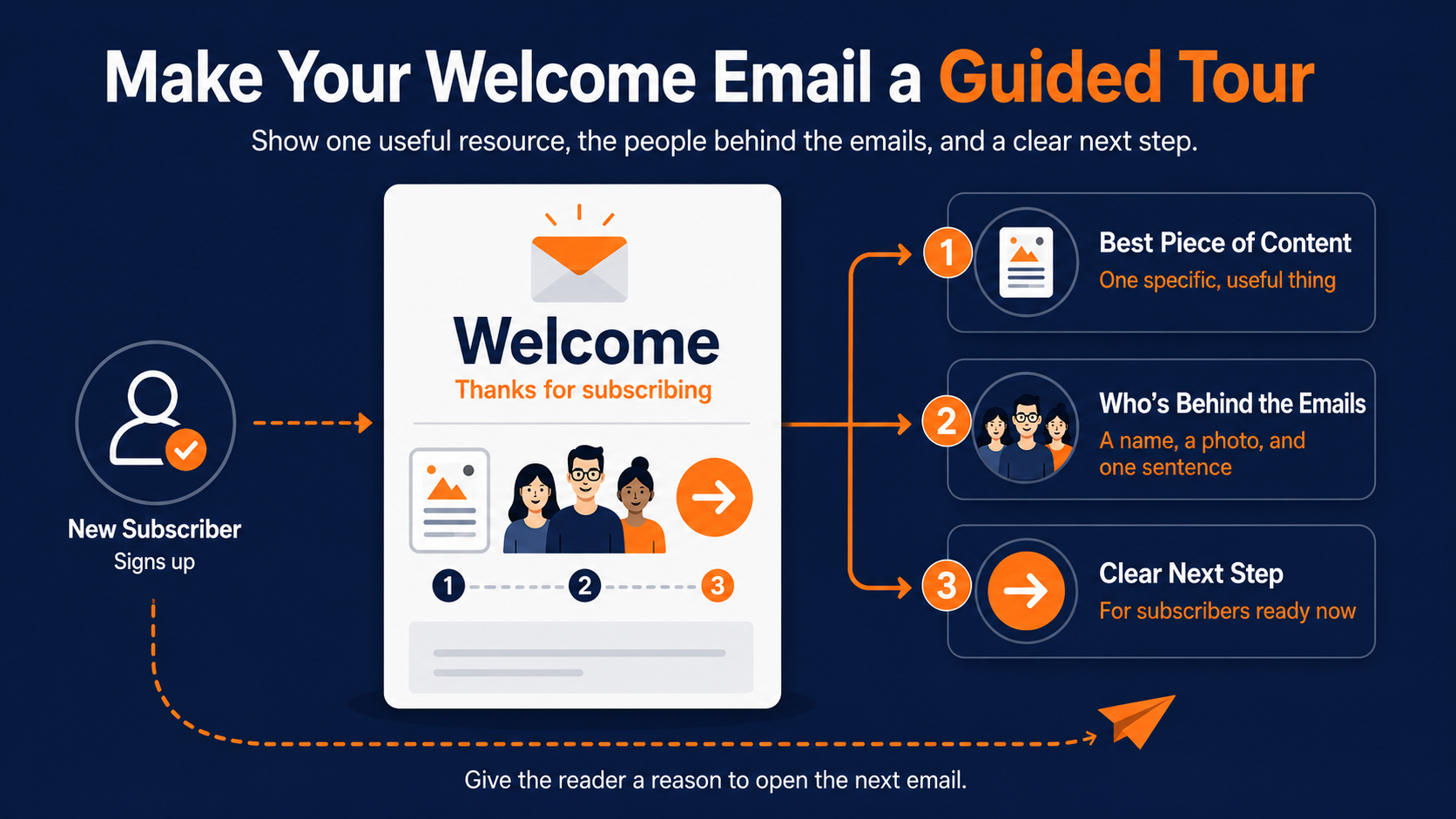
Give New Subscribers Somewhere to Go, Not Just a Thank You
A "thanks for subscribing" line by itself wastes the highest-attention moment you'll ever get with this contact. Use it instead as a guided tour.
Point new subscribers toward your single best piece of content, the one that actually explains what you do and who it's for.
Not your homepage. Not a generic "welcome to our newsletter" graphic. One specific, useful thing.
Let people see who's behind the emails
Buyers connect with people, not logos. A short section introducing the humans who write your content, run your product, or handle support does more for trust than another paragraph of company description ever will.
This doesn't need to be elaborate. A name, a photo, and one sentence about what that person actually does is enough to turn "a company emailed me" into "someone at this company emailed me."
Give the ready-to-act subscriber a place to land
Some subscribers already know they want to talk to you. They just signed up to confirm what they suspected. Bury that option three emails deep in your sequence, and you'll lose them to a competitor who made it obvious on day one.
Include a clear, specific next step for the subscriber who's ready now, alongside the slower path for everyone else. Both paths matter. Forcing everyone through the same drawn-out sequence loses the people who never needed convincing in the first place.
The goal across all of this is the same: give the reader a reason to open the next email, not just an acknowledgment that the last one arrived.
One Welcome Email Is a Missed Opportunity
A single B2B welcome email tries to do too much at once. Introduce the company, prove credibility, deliver value, and ask for a next step, all in one message. Something gets rushed.
Splitting that job across a short welcome email series lets each message do one thing well.
What a welcome series should actually do
A reasonable three-part structure looks like this:
- Email one: deliver whatever was promised at signup, immediately.
- Email two: show the people and the substance behind the brand. A short intro, a piece of your best content, something that builds trust.
- Email three: make a specific, low-friction ask. Book a call, answer a two-question survey, follow you somewhere.
Each email earns the right to send the next one, instead of front-loading everything into a message the subscriber skims once and forgets.
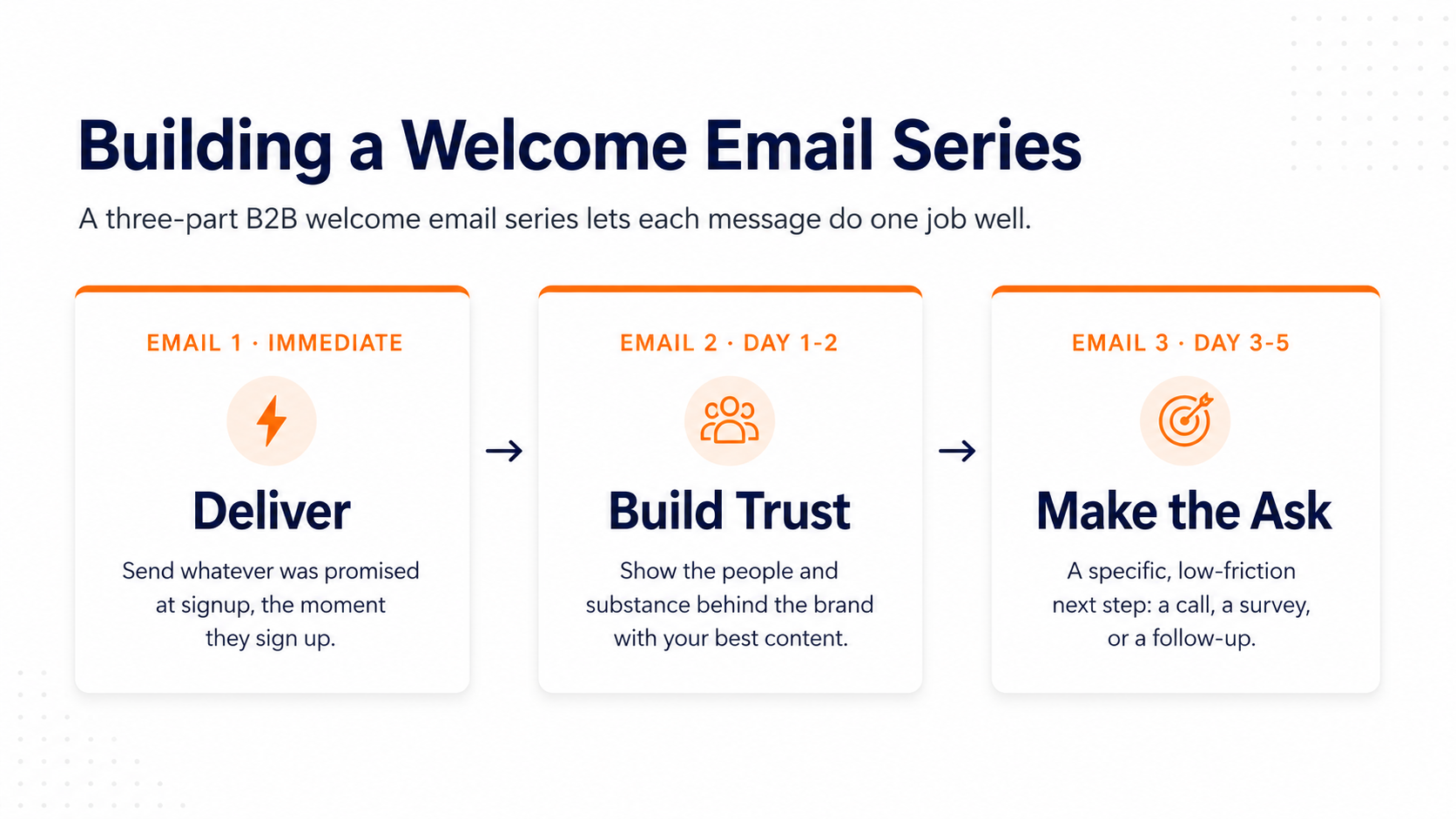
A three-part welcome email series framework. Source: Pinpointe email marketing automation framework.
A one-email welcome message and a three-part welcome email series are not the same asset wearing different clothes.
They're two different strategies with two different outcomes, and the difference tends to show up fastest in click-through rate, since each message in a series only has to carry one job instead of four.
Sequencing beats stuffing
Order matters as much as content. Testing which message goes first, second, and third is worth doing before you assume the obvious order is the right one.
Some audiences want proof before they want a pitch. Others want the value first and the story later. You won't know which until you test it on your own list.
How to compete with busy inboxes
Don't treat sequencing as a one-time decision either. What worked for your list a year ago may not hold once your audience mix shifts, so revisit the order every couple of quarters rather than assuming it's settled forever.
Keep the individual emails short while you're at it. A welcome message competing with someone's actual inbox workload doesn't win by saying more, it wins by being the fastest thing in that inbox to read and act on.
Get Smarter With Every Message You Send
This is where most B2B welcome emails fall flat. They treat every new subscriber identically, when the whole point of email marketing automation is that you don't have to.
Segmented sends consistently beat generic ones. Emails sent to a defined segment produce roughly 30% more opens and 50% more clicks than unsegmented sends to the same size list. Fifty percent more clicks is the gap between a welcome email that gets read and one that gets archived.
Combine subscriber data and send logic under one roof
You don't need a mountain of data to start. You need one or two signals collected at the moment of signup, and a system that actually acts on them.
That's the part that trips most B2B teams up. It's not that they lack data. It's that the data sits in one system while the emails go out from another, so nothing in the welcome sequence actually reflects what's already known about the subscriber.
A single marketing automation platform that holds both the data and the send logic closes that gap without a separate integration project.
Progressive profiling in practice
Asking for a job title, a company size, and a top priority all on the same signup form kills conversions before the relationship even starts. Spread the questions out instead.
Grab a first name and an email address up front. Ask what they care about in the welcome email itself. Ask something more specific a week later, once they've already opened two or three of your messages and trust has started to build.
By the time you're asking for detail number four, you're not interrupting a stranger. You're following up with someone who already knows who you are.
Turning clicks into segments
The most useful signal you have isn't what someone tells you on a form. It's what they actually click. Someone who clicks through to a pricing page cares about something different than someone who clicks through to a case study, even if both of them filled out the identical signup form.
Segmenting contacts based on what they've clicked or opened, not just what they typed into a form, is what turns a generic welcome series into something that actually adapts to the person receiving it.
|
Approach |
Single generic welcome email |
Segmented welcome series |
|
Content |
Same message to every signup |
Tailored by declared interest or click behavior |
|
Timing |
One send, static schedule |
Triggered by signup, refined by engagement |
|
Follow-up |
None, or a generic newsletter |
Next message adapts to prior opens and clicks |
|
Typical outcome |
Read once, forgotten |
Builds toward a specific next action |
None of this requires a dramatic overhaul of your tech stack. It requires connecting the signals you're probably already collecting to the sequence that's probably already running, so the two stop operating like strangers.
Test Before You Assume Your Welcome Email Works
Every part of this sequence is testable, and most B2B teams never test any of it. That's less about effort and more about where welcome emails tend to sit: set up once, then left alone for years.
Treating this like a living asset, not a one-time setup task, is one of the welcome email best practices that separates programs that improve from ones that quietly stagnate.
What's actually worth testing
A short list worth actually running:
- Send timing, immediate versus a short delay
- Email personalization depth, name only versus name plus one behavioral detail
- Single email versus a three-part series
- The specific ask in the final message
- Subject line framing, direct versus curiosity-driven
You don't need to test all five at once. Pick the one most likely to move the needle for your list, usually sequencing or timing, and start there.
Give each test enough volume and enough time to mean something before you call a winner. A welcome email test decided after 40 sends isn't a result, it's a coin flip that happened to land somewhere.
Where B2B teams skip this
Most B2B marketers treat their welcome email as a "set it and forget it" asset because nobody's actively complaining about it. But nobody complaining isn't the same as nobody losing interest. A welcome email that quietly underperforms for two years is still costing you exactly as much as one that obviously fails, it's just easier to ignore.
Revisit it the same way you'd revisit any other high-traffic page or high-volume campaign. Not because something broke, but because it's touching every single new contact you generate.
Put welcome sequence reviews on a recurring calendar schedule
Put a recurring reminder on the calendar, once a quarter is reasonable, to pull open and click data for the welcome sequence specifically, separate from your broader campaign reporting.
A welcome series buried inside your overall email averages will always look fine, because it's propping the averages up, not the other way around.
Assign it to someone by name, too. A metric with no owner tends to sit untouched for years, no matter how good the intentions were when it was first set up.
What Your First Email Says About Every One After It
The subscriber who reads your welcome email decides, right then, how much attention the rest of your emails deserve. Everything downstream, your nurture sequence, your product updates, your case studies, inherits whatever impression that first message left.
Skip the welcome email, or send a generic one on a delay, and you're asking every email after it to work harder than it should have to. Get it right, and every message after it starts from a position of trust instead of having to rebuild one from zero.
Stop treating a marketing automation platform as an optional upgrade
None of this requires a bigger team or a bigger budget. It requires treating email marketing automation as the thing that protects that first impression, not an optional upgrade for later, and deciding that the first message a new contact gets from you is worth as much attention as the campaign you'll send to your entire list next month.
Pinpointe's omni-channel journey builder and behavioral triggers exist to handle exactly this kind of first-moment timing and follow-up sequencing without you having to build it by hand.
If your welcome email is still a manual, one-size-fits-all send, schedule a marketing automation audit and see exactly where the gaps are, and let our team help you optimize your welcome email series for conversions!