
A brand we watched over the past year sent the same win-back email twice. Same subject line, same offer, same list, once at 9 AM on a Tuesday and once at 8 PM on a Friday. The Friday send pulled in more than twice the revenue, and nothing else changed but the clock.
The honest truth about email and SMS timing
That's the part most guides about the best time to send marketing emails skip. They hand you a single golden hour like it's a locked vault combination, and it just doesn't hold up once you start looking at what real subscribers actually do across a full week, across B2B and B2C, across email and SMS, across a normal Tuesday and the chaos of Black Friday. The honest answer is more useful than a single number, but it takes a little unpacking.
Open Rates Lie: What the Data Actually Measures
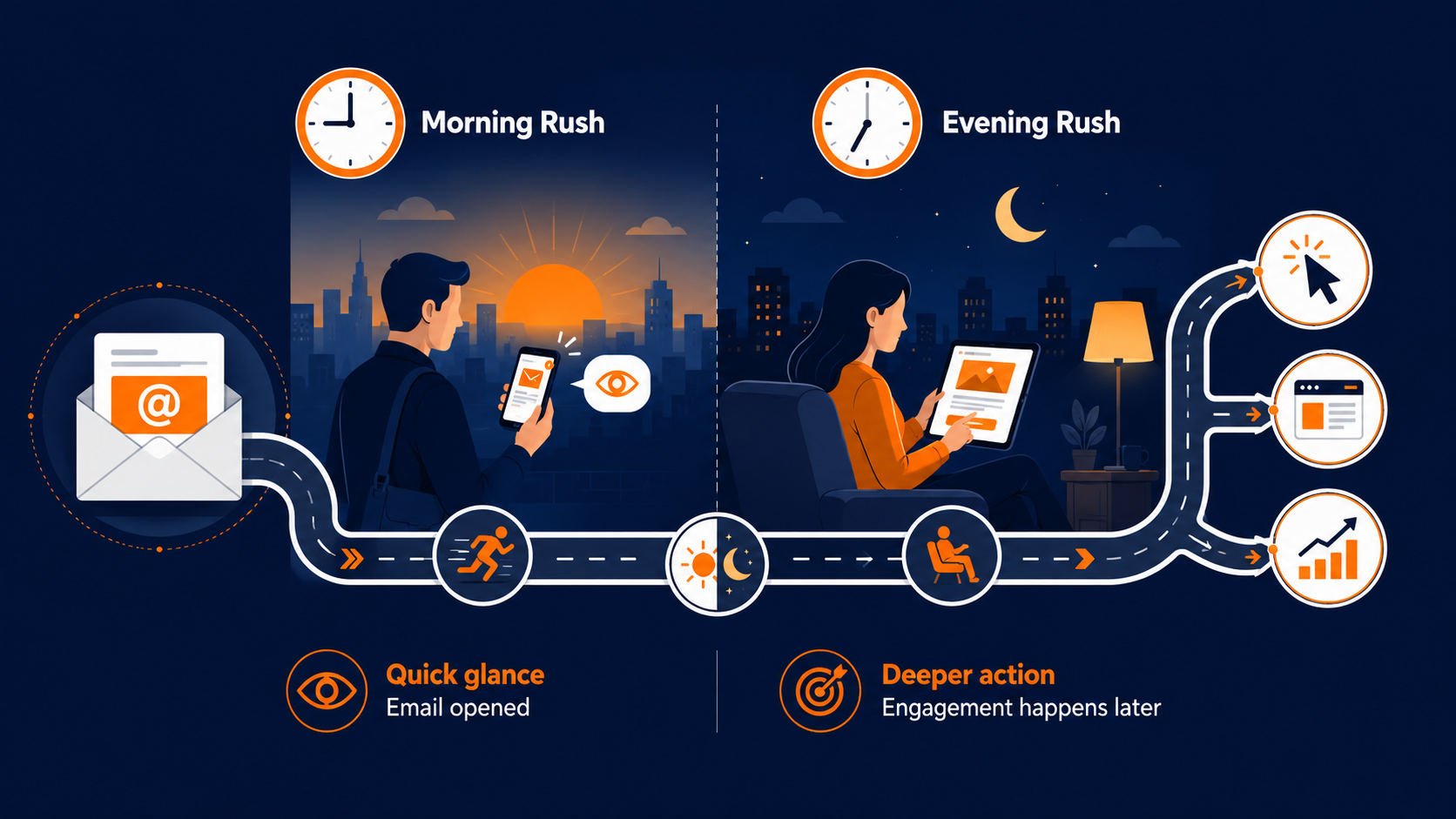
Here's the part that trips up even experienced marketers: the moment your email gets opened and the moment your subscriber actually does something about it are frequently two different hours of the day, sometimes two different days entirely.
Think of your send calendar like a road system. There's a morning rush when everyone glances at their phone before they've even sat down for coffee, and a completely different evening rush when people finally have time and headspace to click through.
Sending at the wrong hour doesn't mean your email gets lost. It means it arrives during the wrong kind of traffic for what you're asking someone to do.
The Real Question Nobody Asks
Most timing advice answers "when will this get opened," which is the easier, lazier question. The harder one, the one that actually pays your team's salary, is "when will this get acted on."
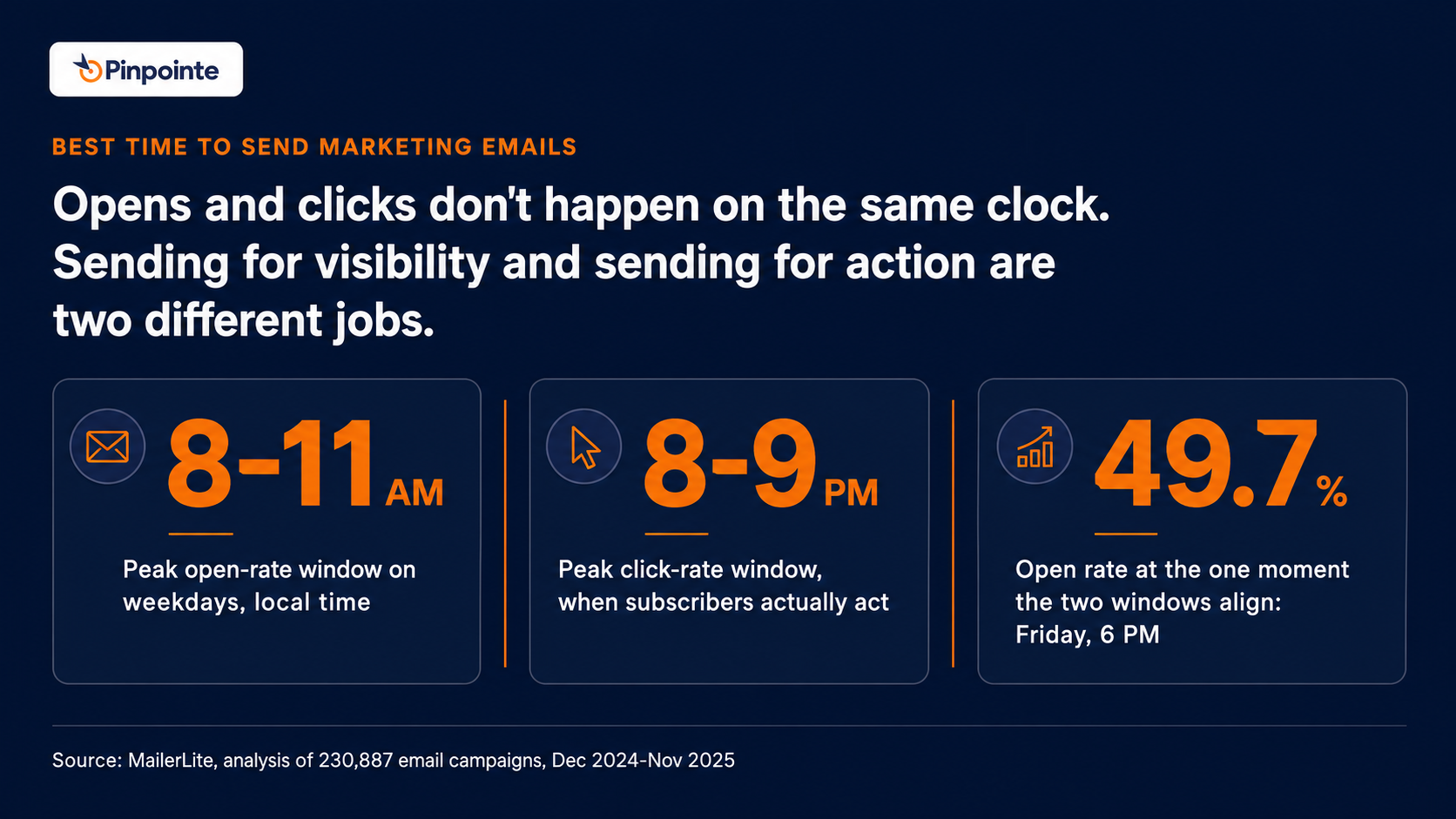
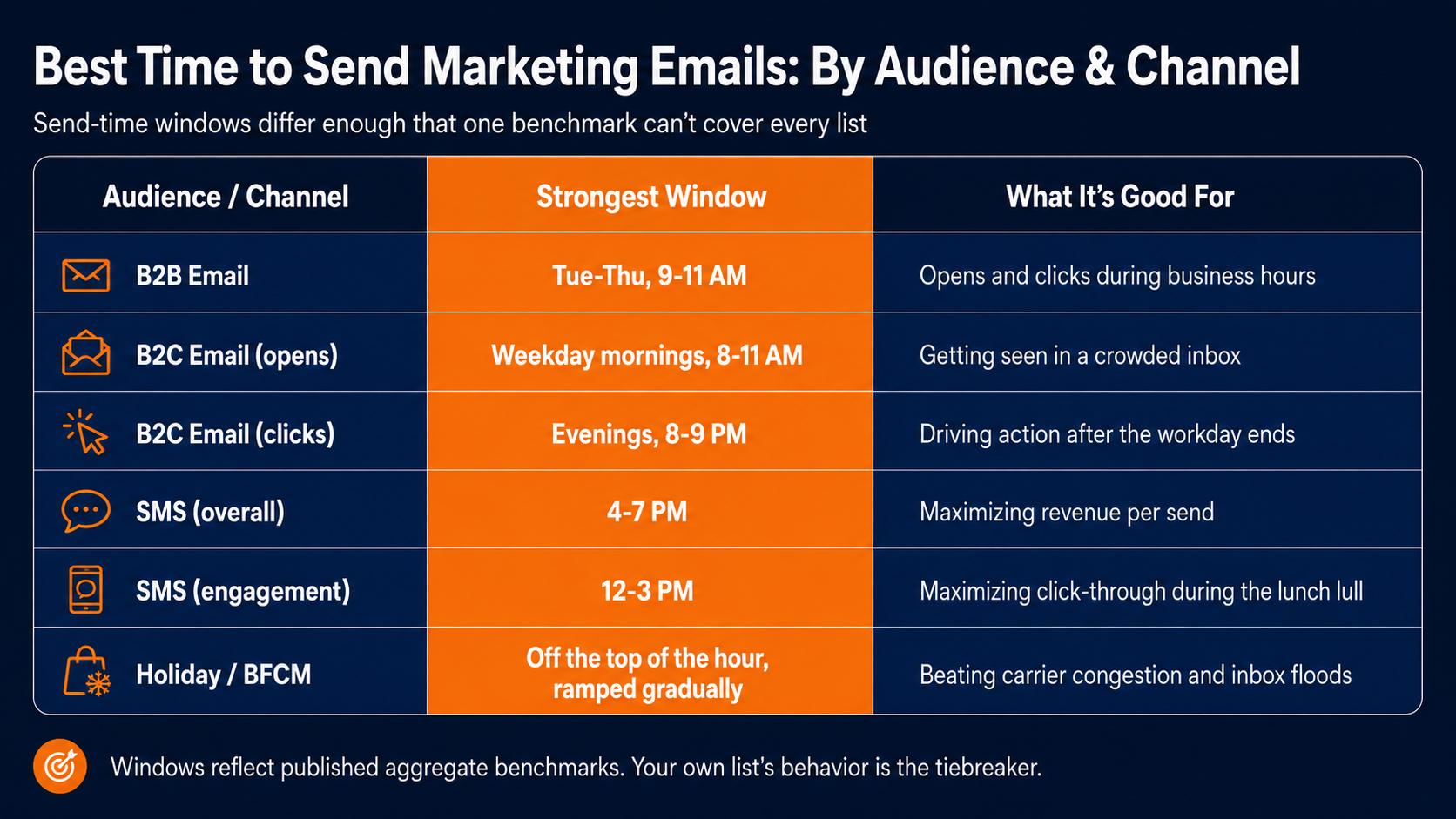
MailerLite's analysis of over 2.1 million email campaigns sent between December 2024 and November 2025 found that open rates peak on weekday mornings between 8 AM and 11 AM local time, while click rates peak much later, between 8 PM and 9 PM. That's not a small gap. That's an entire workday between when someone sees your subject line and when they're actually ready to act on it.
We've watched this exact pattern show up in our own customers' data for years, long before Apple's privacy changes made open rate a shakier metric. People skim in the morning. They shop at night.
"But Everyone Says Tuesday at 10 Is Best"
You've heard this one. It's not wrong, exactly. It's just answering a narrower question than most people realize.
Tuesday at 10 AM is a reasonably safe bet for getting an email opened. It is a considerably worse bet if your entire campaign hinges on someone clicking "buy now" or booking a demo right that second.
That same MailerLite dataset found the only day where the highest open rate and highest click rate land at the same hour is Friday at 6 PM, a 49.7% open rate paired with an 8.09% click rate at that single moment.
That's rare enough that it's worth remembering. Most of the week, you're choosing one goal or the other.
The Two-Clock Rule
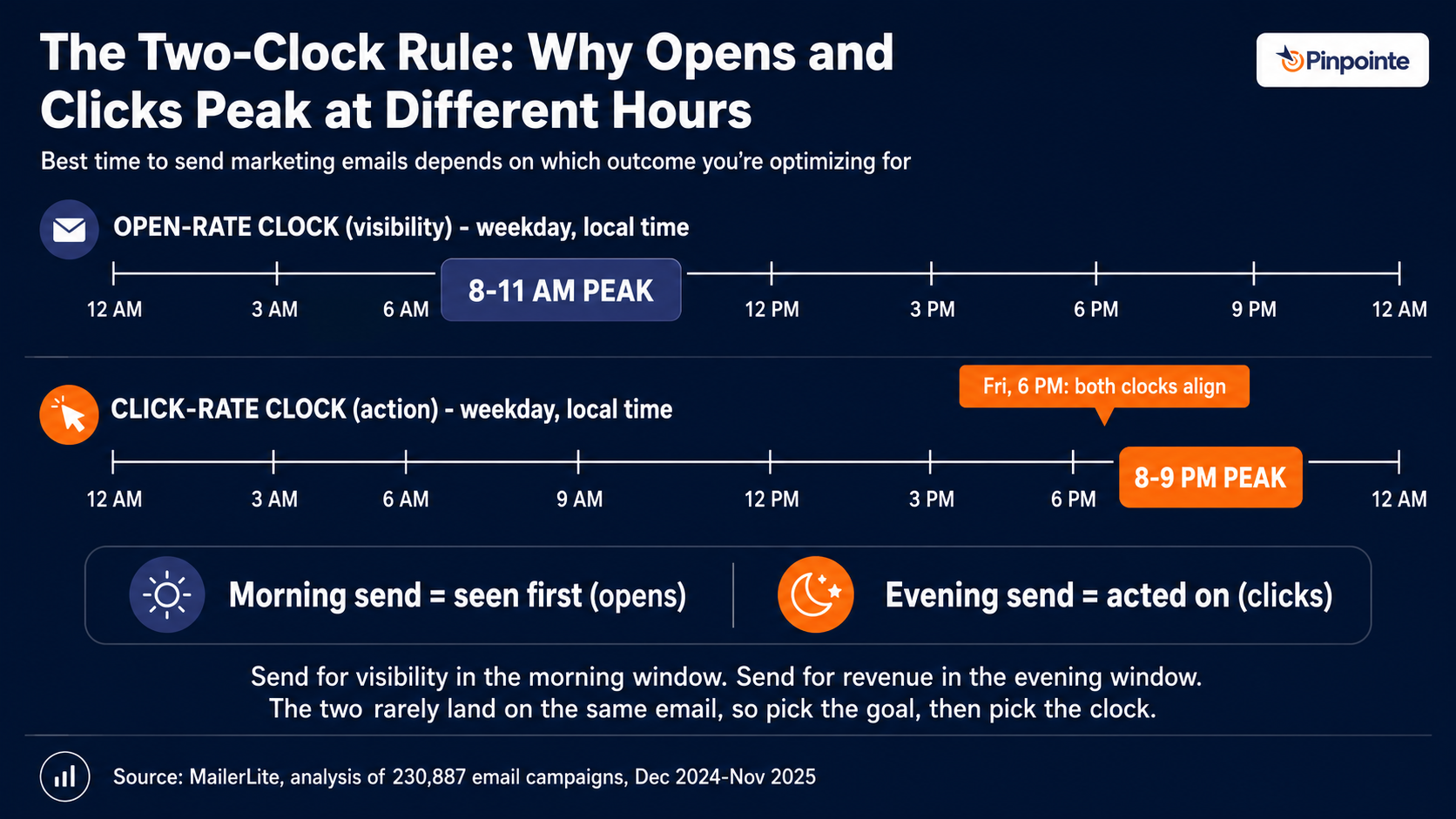
We've started calling this the Two-Clock Rule internally, and it's changed how we think about scheduling for our own campaigns. One clock governs visibility, the other governs revenue, and they are not the same clock.
Pretending they are is how a technically successful send still underperforms on the metric that actually matters to your business.
If your goal is a newsletter someone reads over coffee, aim for the morning clock. If your goal is a cart recovery email or a flash sale, aim for the evening clock instead, even if the projected open rate looks a little lower on paper.
B2B Send Times: Business Hours Still Win
B2B buyers don't stop being people once they clock in, but their inbox behavior does shift hard toward the calendar they're already looking at all day. If you're trying to pin down the best day to send email to a business audience, the data points in one clear direction.
Salesforce's own guidance for marketers puts it plainly: B2B professionals are more likely to engage with emails during weekdays, particularly Tuesday through Thursday, and sending between 9 AM and 11 AM tends to yield higher open and click-through rates in that sector.
That lines up with what we've seen across our own base of B2B senders for two decades now. The inbox is a work tool during the week, and people treat it that way.
Why Mondays and Fridays Fall Flat
Monday morning is catch-up mode. Your prospect isn't reading anything new yet, they're triaging the 40 emails that piled up since Friday.
That same Salesforce research notes Mondays are often busy with catching up on work, while Fridays are associated with wrapping up the week, making both less optimal for B2B sends.
We're not saying never send on a Monday. We're saying if you've got one shot at a decision-maker's attention this week, don't spend it competing with their entire weekend backlog.
The Lunch Hour Nobody Talks About
There's a quieter opportunity most B2B senders skip past. Sending during the lunch hour, roughly 12 PM to 1 PM, can be effective because professionals often check email during a break from meetings.
It's not flashy. It won't show up in a highlight reel of "best practices." But a calendar with fewer competing sends is still a calendar, and lunch is one of the few pockets of the workday where that's true.
Test it against your standard 10 AM slot for one quarter. You might be surprised.
PRO TIP Schedule for 9:17 or 9:42, not 9:00 or 9:30. Landing off the hour skips the pileup everyone else creates by sending exactly on the dot.
When B2B Sending Behaves Like B2C
Not every B2B send lives inside the 9-to-5 box. If you're selling to solo founders, freelancers, or anyone whose workday bleeds into their evening, your b2b email send time should shift with them rather than the enterprise buyer persona. The job title on the contact record tells you less than the actual click data does.
B2C Send Times: Evenings, Weekends, and Impulse Windows
Consumers operate on an entirely different rhythm, and it's the mirror image of the B2B pattern in almost every way. The best day to send email to a consumer list often isn't the same day that works for a business inbox at all.
That same Salesforce research shows B2C customers often have more leisure time in the evenings and on weekends, which makes those windows ideal for email sends, and that Friday afternoon sends in particular can capture attention as people plan their weekend.
Where B2B is about catching someone between meetings, B2C is about catching someone once the meetings are finally over.
Friday Night Is Not an Accident
We keep coming back to that Friday 6 PM data point because it's the cleanest signal in the entire dataset. People have mentally clocked out, and they're not multitasking through your email between Slack messages anymore.
They have room to actually engage.
If you've got a weekend sale, a new product drop, or anything that benefits from someone browsing without a deadline hanging over them, this is your window.
PRO TIP If Friday 6 PM works for your list, don't overlook Sunday morning either. Some of the best B2C opens happen when nobody else is sending anything at all.
The Weekend Nobody Wants to Send On
A lot of marketing calendars quietly skip Saturday and Sunday out of habit rather than evidence. That's leaving something on the table.
That same MailerLite research found weekend opens peak around 9 AM for both Saturday and Sunday, with engagement levels comparable to weekday performance, even though far fewer total campaigns get sent on those two days.
Lower competition in the inbox is still a real advantage, even if it feels counterintuitive to schedule a Sunday morning send.
Retail Versus Leisure Versus Everything Else
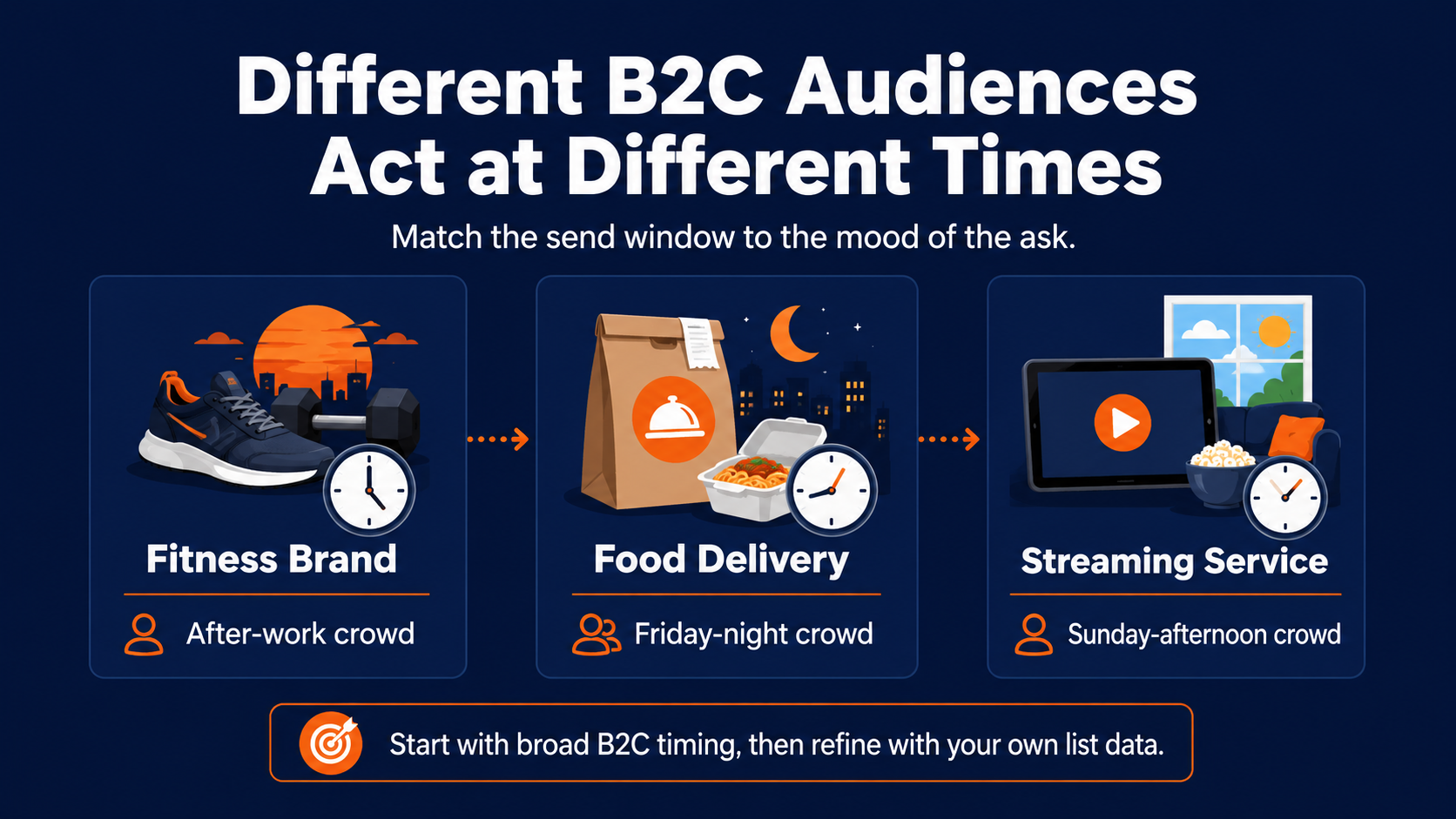
Not all B2C is the same B2C. A fitness brand's after-work crowd behaves differently than a food delivery app's Friday-night crowd, which behaves differently again than a streaming service's Sunday-afternoon crowd.
The broad B2C pattern is a starting line, not a finish line, and your own list will tell you which flavor of evening or weekend actually applies to your specific audience.
A fashion retailer promoting a limited drop and a healthcare brand promoting a wellness checkup shouldn't be scheduling off the same playbook, even though both technically sell to consumers. Match the send window to the mood of the ask, not just the industry label on your account.
Time Zones Turn One Send Into Four
If your list spans more than one region, "9 AM" is really three or four different actual hours depending on who's reading. A single blast timed for Eastern mornings lands as a pre-dawn ambush for anyone on the West Coast.
Segmenting by time zone and sending each group its own local version of your target hour is a small operational lift with an outsized payoff, especially for a national or global list where "morning" and "evening" mean something different depending on where the subscriber actually lives.
Mobile Changed the Entire Commute
Here's something that would have sounded strange a decade ago: the device someone's using to read your email now matters almost as much as the hour you sent it.
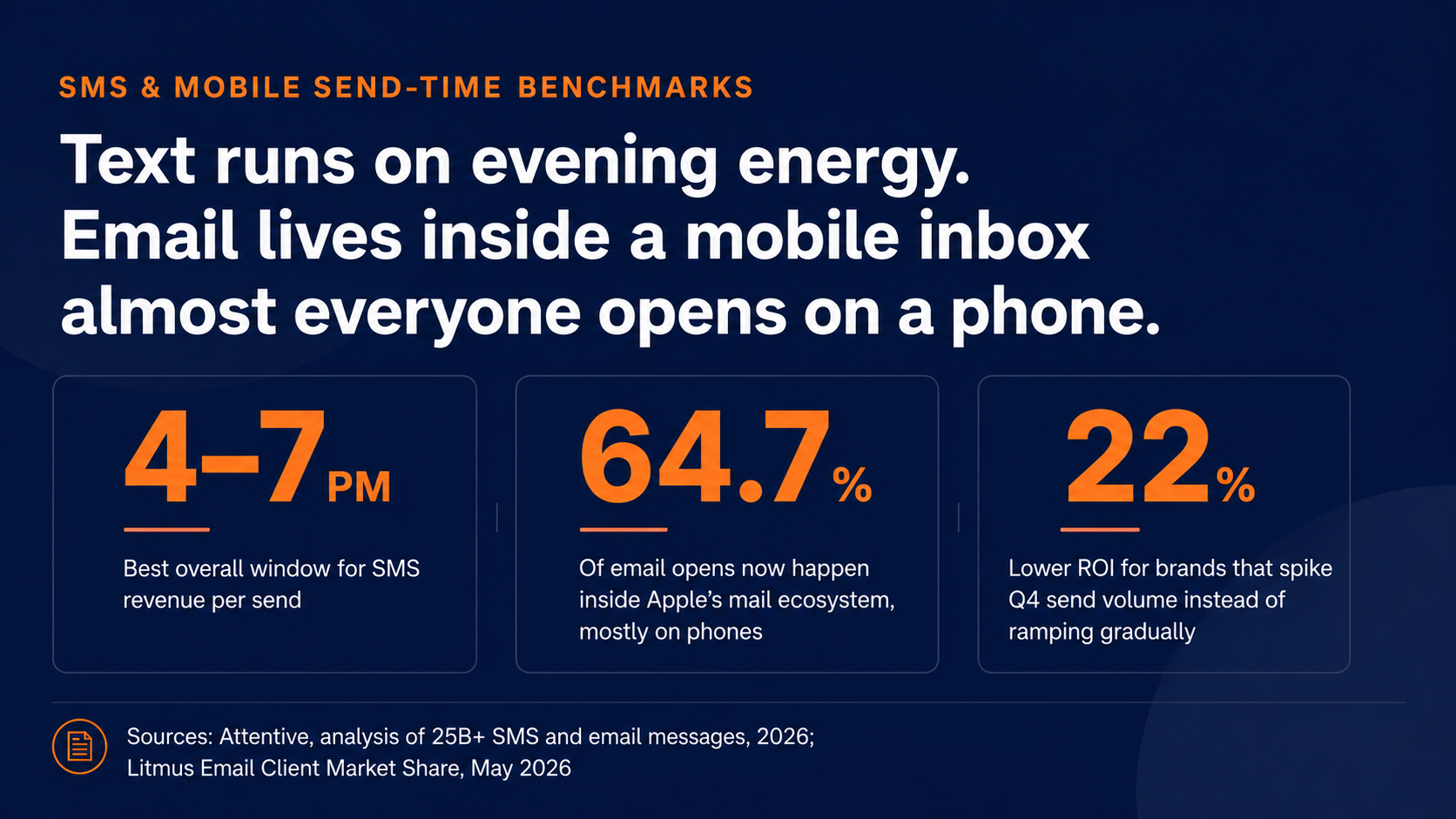
Litmus's May 2026 email client market share report, calculated from over one billion opens, found that Apple's ecosystem, which includes Apple Mail, iPhone, and iPad, now accounts for 64.66% of email opens, with Gmail close behind at 24.11%. Add those together and you've got roughly nine out of ten emails opened somewhere in one of two ecosystems, and the vast majority of that traffic is happening on a phone screen, not a desktop monitor.
Apple Owns the Inbox Now
This isn't a minor shift. Your subject line, preview text, and first two lines of body copy are being read on a screen the size of a deck of cards, most of the time, by most of your subscribers.
If your email was designed and tested on a wide desktop monitor and never checked on an actual phone, you're optimizing for a minority of your traffic.
PRO TIP Read your own subject line on your phone before you schedule it. If it truncates awkwardly there, it truncates awkwardly for most of your list.
What Mail Privacy Protection Actually Broke
That same Litmus report notes Apple's Mail Privacy Protection now affects roughly 55 to 60 percent of all email opens, which quietly undermines open rate as a trustworthy signal for a huge chunk of most lists. The pixel fires automatically through Apple's proxy servers whether or not a human actually looked at the email.
This is the practical reason click-through data and revenue per send have become the metrics worth trusting more. Open rate isn't dead, but treating it as gospel on timing decisions is a habit that's overdue for retirement.
One line worth sitting with: if more than half your reported opens might not represent an actual human glancing at your email, your entire send-time strategy needs a second signal to lean on.
Designing for the Thumb, Not the Mouse
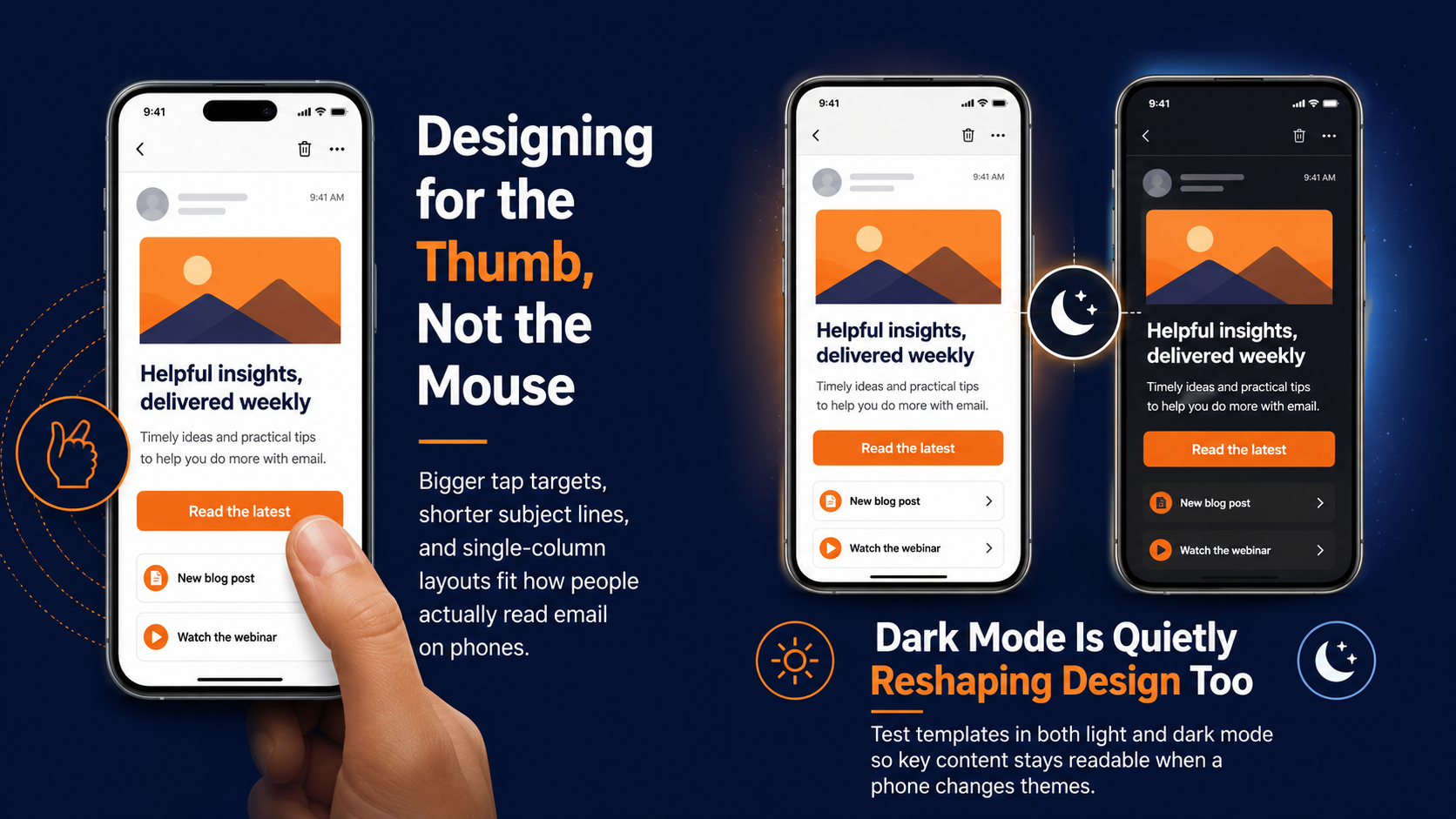
Bigger tap targets, shorter subject lines, single-column layouts, none of that is new advice. There's just a lot less room to skip it now that most of your audience is reading on a screen that small.
Dark Mode Is Quietly Reshaping Design Too
More than a quarter of subscribers now read email in dark mode, and a card that looks sharp on a white background can turn muddy or unreadable the moment a phone flips its default theme.
Test your templates both ways before you lock in a send, the same way you'd test on more than one device.
SMS Runs on Its Own Clock Entirely
If email timing is a morning-versus-evening story, the best time to send SMS marketing is almost entirely an evening story, and the data backs that up more decisively than anything we've covered so far.
Attentive's analysis of more than 25 billion messages found the best overall time to send SMS marketing is between 4 PM and 7 PM, when revenue per send peaks.
That's a tighter window than email gets, and it makes sense once you think about how differently people treat a text message compared to an inbox they check on their own schedule.
Why 25 Billion Messages Point to the Same Few Hours
Text is immediate in a way email simply isn't. The real differentiator isn't whether a text gets seen, nearly all of them do within minutes, it's when people actually act on it, and that clusters heavily in the late-afternoon-into-evening window as people wind down from their workday.
A text that lands while someone's still buried in meetings gets glanced at and forgotten. A text that lands as they're driving home, or already home, gets read in the moment it arrives.
The Lunch Break Click
There's a second, smaller window worth knowing about. That same Attentive analysis recommends the 12 PM to 3 PM window when click-through rate matters more than pure revenue per send, since subscribers are more likely to be on a lunch break and actively engaged with their phone.
This is your move for a message that needs a click more than it needs an immediate purchase. Think webinar reminders, appointment confirmations, or anything where the action itself takes more than thirty seconds.
Quiet Hours Are Not Optional
SMS comes with a genuine legal and reputational guardrail that email doesn't carry in the same way. Respect it, since sending outside reasonable hours isn't just bad practice, it can be a compliance problem depending on where your subscribers live.
Check with your own counsel on the specifics for your markets before you lock in a schedule, and whatever schedule you land on, the best time to send SMS marketing to your list should always leave room for that guardrail first.
PRO TIP A great click-through rate isn't worth a compliance complaint. When in doubt, don't send outside your quiet hours.
Holiday Sending: Same Roads, Way More Traffic
Everything we've covered so far assumes a normal week. The holidays are not a normal week, and treating them like one is one of the most common mistakes we see. Holiday email marketing timing has its own rules, separate from anything that applies the other eleven months of the year.
Picture the same commute metaphor from earlier, except now it's the day before a three-day weekend and everyone's on the road at once.
The good send times don't necessarily change all that much. What changes is how much competition you're up against, and how much your own sending behavior can either help or hurt you.
The Ramp Beats the Spike
Attentive found that brands which spiked their email send volume all at once during Q4, rather than ramping up gradually from earlier in the year, saw 22 percent lower ROI than brands that built up their volume steadily. That's a brutal number for a mistake that's entirely avoidable with a little planning.
Mailbox providers watch for sudden changes in sending behavior. A dormant sender who suddenly floods inboxes in November looks a lot like a spam operation from the outside, even if the intent is completely legitimate.
PRO TIP Increase Q4 send volume in small daily steps, not one Black Friday spike. Mailbox providers reward the ramp, not the surge.
Beating Carrier Congestion on Black Friday
SMS has its own version of holiday traffic jams. That same Attentive research shows phone carrier congestion peaks between 10 AM and 3 PM ET on Black Friday and Cyber Monday specifically, with the fastest message delivery happening just before or after that window.
Small scheduling tweaks matter here. Sending a few minutes off the top of the hour, rather than exactly at 9:00 or 12:00, helps you avoid getting stuck behind every other brand's scheduled blast. Even the best day to send email during Cyber Week shifts once carrier congestion enters the picture.
When to Start Talking About the Holidays at All
The instinct to wait until the week of Black Friday to start messaging is understandably tempting and also a little late. Building anticipation in the weeks before, through product education and loyalty content rather than straight promotion, sets up your actual sale messages to land with an audience that's already paying attention instead of one you're introducing yourself to cold.
Reading the Room During Religious and Cultural Holidays
Not every holiday on the calendar is a promotional opportunity. Some are moments of remembrance or observance for a real chunk of your subscriber list, and a cheerful sale blast lands badly against that backdrop.
A quick pause on promotional sends during those specific dates costs you very little and shows subscribers you're paying attention to more than their wallet.
Building Your Own Send-Time Playbook
Every benchmark in this piece, ours included, is an average pulled from millions of other people's subscribers.
There's no single best time to send marketing emails that works for every list out there, and yours might behave differently, which is the whole point of testing rather than something to apologize for.
Start With the Baseline, Not the Benchmark
Pick a reasonable starting point from the data above that fits your audience type, whether that's B2B mornings, B2C evenings, or the SMS late-afternoon window.
There's rarely one best day to send email that holds steady all year, so send consistently at that time for a few weeks before you touch anything else. You need a baseline before a single variable test means anything.
Testing One Variable at a Time
Change the send time and nothing else. Same message, same segment, same offer. If you change the subject line and the send time in the same test, you'll never know which one actually moved the number that changed.
Run it across at least two or three cycles before drawing a conclusion. One good Tuesday doesn't prove a Tuesday, it might just prove that particular email was good.
PRO TIP Change one thing per test. If the subject line and the send time both moved, you learned nothing.
What Your Own Data Will Tell You That Ours Can't
Your subscribers have their own commute, their own version of a lunch break, their own device habits. A nurse's list behaves differently than an accountant's list, which behaves differently again than a college student's list. The benchmarks in this piece get you moving in the right direction.
Your own send history is what actually gets you to the right hour for your specific list.
How Pinpointe Takes the Guesswork Out of the Clock
Here's what actually got us building Pinpointe: a marketing team running email out of one dashboard and SMS out of another, each on its own schedule, just hoping the two happen to line up. They usually don't.
One Send-Time Decision, Two Channels
Run email and SMS from the same platform and you stop stitching calendars together by hand. Our omni-channel journey builder lets you plan a morning email and an evening text as one coordinated sequence, not two campaigns that just happen to land on the same day.
Behavioral Triggers Don't Care What Time It Is
Everything we've covered so far is built for broadcast sends, the newsletter or flash sale that goes out to your whole list at once. Some of your best messages shouldn't wait on a clock at all.
An estimate request nudge, a post-purchase follow-up, a win-back email, these land better when they fire off something a customer just did, which is exactly what Pinpointe's behavioral triggers and dynamic segmentation are built for.
That's the piece a lot of "best time to send" advice misses. The best time to send isn't always a time on a clock. Sometimes it's a moment in what a customer just did, and building for that moment beats chasing a benchmark hour every time.
The Best Time to Send Marketing Emails Isn't a Benchmark, It's a Habit
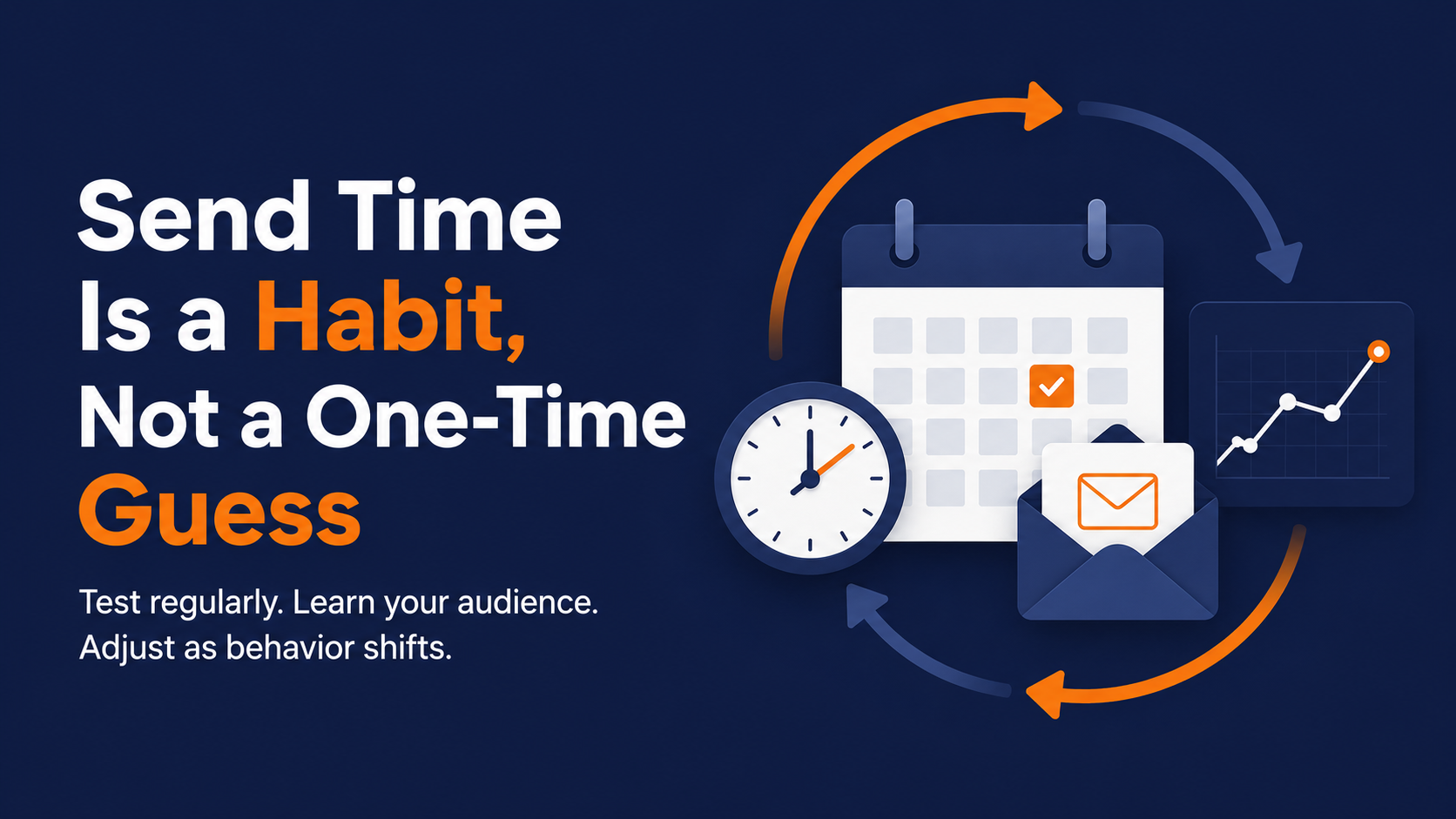
Every stat in this piece points to the same underlying truth: timing is a lever, not a magic trick, and it only works if you keep pulling it consistently enough to learn what your own audience actually does.
The brands that win this aren't the ones who found the one perfect hour and never touched their calendar again. They're the ones who treat send time as something worth testing every quarter, because audiences shift, inboxes evolve, and what worked last year quietly stops working without anyone noticing until the numbers slide.
So here's the honest challenge: when's the last time you actually tested your send time, instead of just trusting the slot you picked two years ago?
Ready to Stop Guessing When to Hit Send?
If you're still scheduling email and SMS separately, hoping the timing lines up, schedule a marketing automation audit with Pinpointe and we'll walk through exactly where your current send times are leaving engagement on the table.