
An email nurture campaign is a planned series of emails that keeps a lead engaged until they're ready to talk to sales. Each message is chosen based on what that lead has done and what they're trying to figure out, and the program can run on a schedule, on behavior, or both.
Somebody downloaded your guide three weeks ago. They got a thank-you email, one follow-up, and then nothing, because nobody decided what should happen next.
That lead is still out there researching. You just aren't part of it anymore. This guide is for B2B marketers who want to fix that, and it walks through picking the goal, setting triggers and exits, branching on signals you can trust, handing off to sales, and measuring the program.
Key Takeaways
- Plan for a self-directed buyer: B2B buyers spend only 17% of their purchase time meeting with potential suppliers, and any one sales rep may get just 5% to 6% of that time when buyers compare several vendors, according to Gartner's 2017 buyer survey. An email nurture campaign is how you stay part of that research.
- Design for looping, not a straight line: 90% of buyers revisit at least one buying job during their purchase, so a nurture program needs branches that can bring someone back rather than a fixed sequence.
- Route by buying group, not just by lead: Forrester's 2021 survey found that 60% to 90% of B2B purchases involve buying groups of three or more people, so a lead nurture campaign should connect engaged contacts from the same account to one opportunity.
- Build compliance into the plan: Gmail and Yahoo require spam complaint rates below 0.3%, and Google recommends staying below 0.10%. Senders of 5,000 or more daily messages to personal Gmail accounts must support one-click unsubscribe, and Yahoo expects unsubscribes honored within 2 days.
- Know the legal floor: The FTC's CAN-SPAM Act applies to every commercial nurture email with no business-to-business exception, requires opt-out requests to be honored within 10 business days, and sets penalties of up to $53,088 per violating email.
In this guide
- What an Email Nurture Campaign Is and How It Differs From a Drip
- Why Email Nurturing Matters in a B2B Buying Journey
- Lead Nurture Campaign Types Worth Building
- How to Build an Email Nurture Campaign Step by Step
- Measuring Email Nurturing Without Relying on Opens
- Nurture Campaign Best Practices and Common Mistakes
- Email Nurture Campaign FAQ
What an Email Nurture Campaign Is and How It Differs From a Drip
A nurture campaign exists for leads who have raised a hand but aren't ready to buy. Its job is to stay useful while they work through the decision, and to notice when they're ready for a sales conversation.
Most nurture programs mix two mechanics. Some emails go out on a schedule after a lead enters. Others fire because the lead did something, like clicking a pricing link or registering for a webinar.
Drip campaign vs nurture campaign
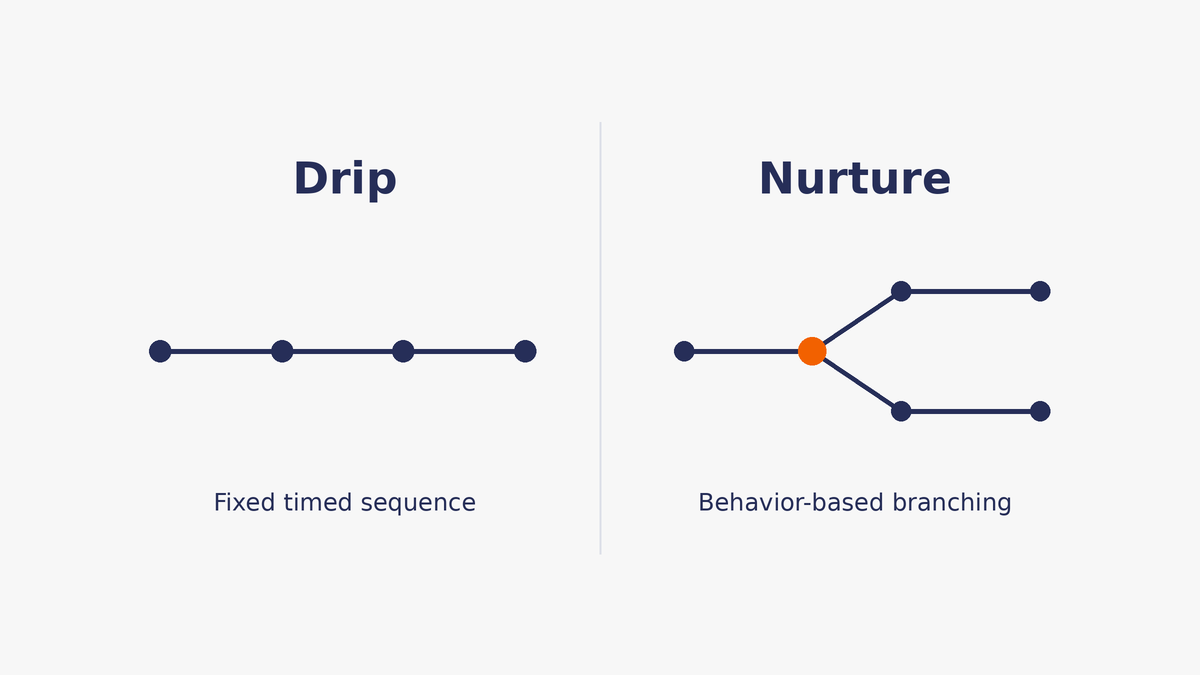
People use the two terms loosely, and often interchangeably. The useful distinction is what sends the next email. A classic drip sends on a timer, so everyone who enters sees the same messages in the same order.
A nurture program uses behavior and buying stage to decide what a lead sees next. That means planning branches and conditions, not just a list of emails in a row.
You don't have to choose one on day one. Madison Logic recommends using drip campaigns as a starting point while you build toward nurture that responds to buyer characteristics, intent, and engagement history.
A timed sequence gives you a baseline. Behavioral branches get added where the data shows leads heading in different directions. If you're starting from scratch, our guide to building a drip email campaign walks through the timed version step-by-step.
Why Email Nurturing Matters in a B2B Buying Journey
B2B buyers do most of their deciding when you aren't around. Email nurturing is how you stay part of that research without forcing a meeting your potential customer didn't actually want.
Buyers spend little of their time with suppliers
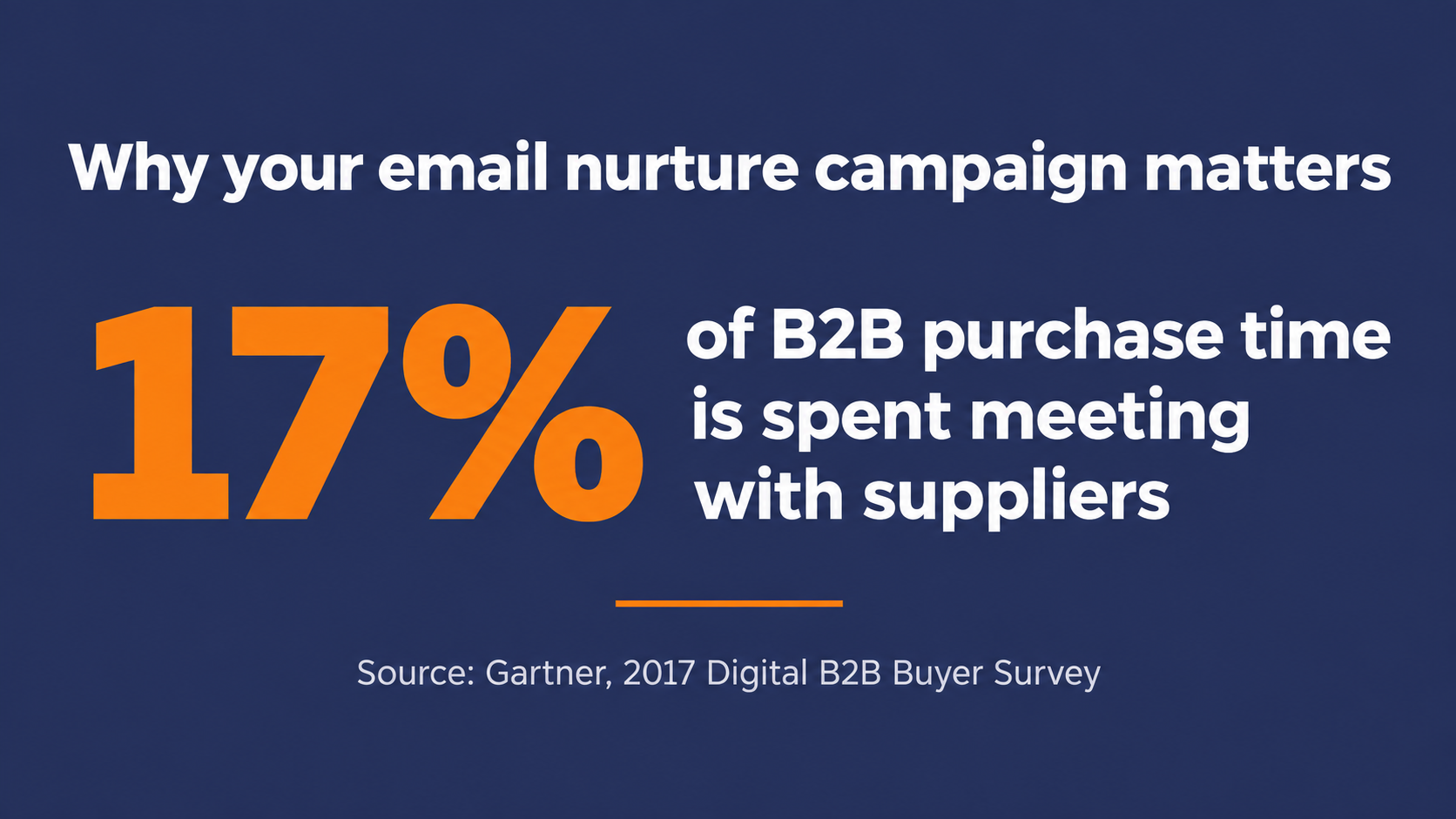
Gartner found that B2B buyers considering a purchase spend only 17% of that time meeting with potential suppliers. When they're comparing several vendors, any one sales rep may get just 5% to 6%.
That data comes from Gartner's 2017 buyer survey, so treat the exact numbers as dated, but the direction is what matters and still holds true.
Buyers spend the bulk of the journey reading, comparing, and debating among themselves. If your emails stop when the first call doesn't happen, you're absent for most of the decision, which is why nurturing matters.
Buying journeys loop back on themselves
The same Gartner research reports that 90% of buyers revisited at least one buying job during their purchase.
In practice, that looks like a lead who was reading pricing content last week and is suddenly back on articles about defining the problem. A fixed sequence assumes buyers move in a straight line, but often your buyers will jump around to different stages of their journey. That's why your program needs a way to meet someone who has doubled back.
Generic nurture content gets ignored
Gartner reports that buyers often describe supplier digital content as neither memorable nor meaningfully valuable. The same research found buyers were nearly three times more likely to show high brand commitment when they saw a personal benefit from a supplier, rather than a purely functional one.
That's a warning about the "just checking in" email. It also points to what works instead, which is content that makes the reader's own job easier or makes them look good in front of their team.
Lead Nurture Campaign Types Worth Building
A lead nurture campaign works best as a few focused tracks, each built around a specific entry point, because the lead who downloaded an ebook and the lead who abandoned a demo request want different things next.
New lead welcome and content follow-up
When someone downloads a guide or subscribes, the first emails should deliver what they asked for and point to the next most useful thing. Keep the early asks small because the lead just met you.
An effective way to do this is to make the next stage of your sales process feel like the obvious next step to get the best results. That way, a plug to take that next step feels natural rather than forced.
If you manage several brands, run this track per property. Networld Media Group runs trigger welcome flows on Pinpointe while managing 10 separate publications. For the emails themselves, our welcome email sequence playbook covers what each message in that first run should do.
Unfinished action follow-up
Some of the best nurture triggers are things a lead started and didn't finish. An example of this is how 21st Mortgage runs automated drip campaigns on Pinpointe aimed at homebuyers who start a loan application but don't complete it, and the company credits them with closing more loans.
The B2B version is a lead who hit your pricing page, started a demo request, or opened your ROI calculator and left. That lead told you something specific. Your next email should answer it and guide them back to the next step of their buyer's journey.
Post-event follow-up
A strategy we've seen enterprise SaaS companies use in our Pinpointe software is to nurture their trade show leads with webinars and newsletters, and only highly engaged leads pass into their HubSpot CRM. That way, they don't end up wasting sends on unengaged contacts and can protect their sending reputation.
Unfortunately, many programs like this have had a tough time with this strategy using other marketing automation platforms. They end up emailing old trade show lists, hitting spam traps, and getting their company's domain blocklisted.
A way to solve this is to scrub and hold to strict list hygiene before sending contacts through your nurture workflows. The same logic applies to webinar lead generation, where the list is just as easy to let go stale.
Stalled lead re-engagement
Leads that become disengaged deserve a short, explicit re-engagement track, not an endless drip. Google advises senders to periodically confirm that recipients still want their messages and to consider unsubscribing people who don't open or read them.
Yahoo similarly recommends sending a reconfirmation email to inactive subscribers and removing invalid recipients promptly. Where you can, define "inactive" by clicks and site activity rather than opens, for reasons covered in the measurement section below. Our guide to re-engagement campaigns goes deeper on structuring that specific track.
How to Build an Email Nurture Campaign Step-by-Step
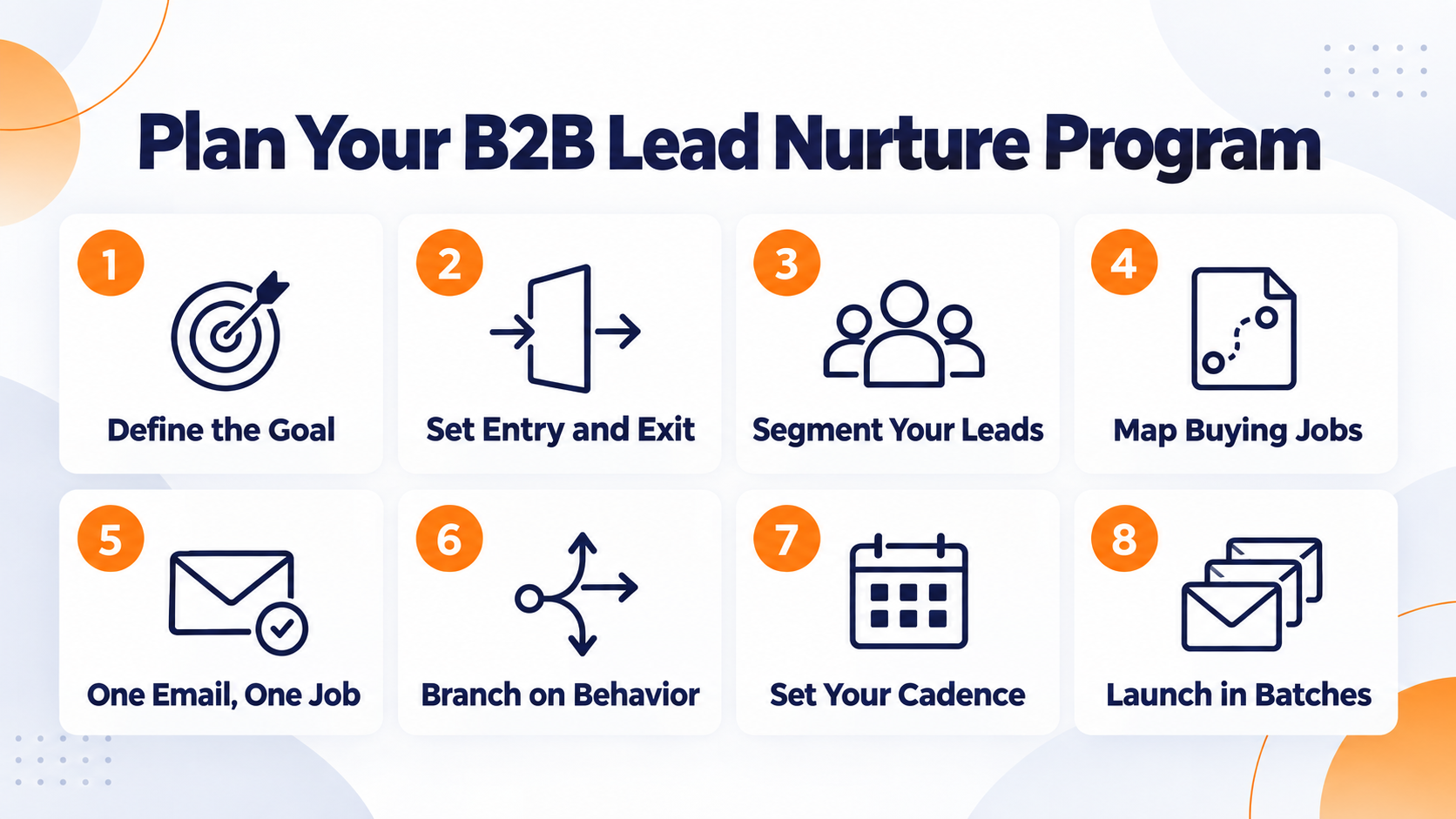
Every step below answers a question your program will face whether you plan for it or not. Answer them before the first email goes out, and the build of your nurture sequence gets much easier.
1. Pick one goal and define sales-ready
Each nurture track should move a lead toward one next step, such as booking a demo or starting a conversation with sales. Then write down what sales-ready means for that track, with sales in the room.
Salesforce recommends that a sales and marketing agreement include a concrete, data-backed definition of a qualified lead, set timeframes for sales follow-up, and a required way for sales to explain why a lead was rejected.
Without that feedback loop, marketing keeps sending over the same kinds of leads sales already passed on. If you continue to see that roadblock, sales and marketing alignment is usually the deeper issue.
2. Define the entry trigger and the exit
The entry trigger of your nurture sequence decides who gets in. A content download, an event badge scan, a missed demo, and an unfinished form each deserve their own track, because each one tells you something different about the lead.
The exit decides who gets out. A lead should leave the track when they book the meeting, when sales accepts them, or after a set number of emails with no meaningful engagement.
3. Segment by source, role, and interest
If you only have one track for every lead, that's how a finance director ends up getting the same email as a coordinator who grabbed a checklist. Segment first by how the lead arrived, then by role or interest where you have the data.
An example of this is Innovation Arts & Entertainment, a live-events producer, which segments a database of more than 500,000 contacts by geography and event preference and uses trigger and drip campaigns on Pinpointe to retarget buyers for seat upgrades. It's a consumer business, but the mechanic carries over to B2B.
Aligning personalization with B2B buying committees
The more precisely you know what someone cares about, the more specific the next email can be and B2B adds one more layer. Forrester's 2021 survey research found that between 60% and 90% of purchases are made by groups of three or more people.
Often several people from the same account may enter your program from different directions, so decide up front whether they get coordinated messages or independent ones.
4. Map each email to the job the buyer is working on
Gartner describes six buying jobs, which are problem identification, solution exploration, requirements building, supplier selection, validation, and consensus creation. Buyers often work on several at once, which makes the jobs a better planning tool for nurture content than a linear funnel.
An early email helps the lead identify the problem. A later one gives them something to validate a choice or bring a skeptical colleague along.
Gartner also says information helps buyers most when it's shareable, consistent across channels, and targeted to the job at hand. Run every email through that test. Ask yourself if the lead would forward it to a colleague, does it match what your site and sales team say, and does it help with the job they're on right now?
5. Write one email for one job
Each email gets one purpose and one primary call to action. Lead with the reader's problem, give them something they can use even if they never click, and keep the ask in proportion to where they are.
Keep the sender consistent and recognizable too. Google recommends that messages of the same type use the same From address. If the track switches to a sales rep's name partway through, make it a deliberate move and give the reader a reason.
6. Branch on clicks, replies, and visits
Branching is where a nurture program becomes most effective. It's also where it's tempting to build on the weakest signal available, the open.
Weight your branches toward the clearest signals of intent, which are replies, completed forms, and event registrations. Clicks and site visits help too, but recorded clicks can include automated activity as well as people. Filter suspected bot activity where your tools allow it, and don't treat a single click as proof of buying intent.
Watch the account as well as the person. Forrester recommends connecting the members of a buying group to the opportunity they belong to, rather than tracking each person as a separate lead.
When three people from one account start engaging in the same week, that pattern usually tells you more than any single lead score can.
7. Set a cadence you can stick to
Choose a starting cadence that fits your audience and sales cycle, then test it against real engagement.
Mailbox provider guidance frames cadence around expectations. Yahoo recommends telling subscribers at signup what mail to expect and how often, then honoring that frequency, so a weekly program doesn't suddenly go daily.
For the first version, tie the track's length to your sales cycle, space emails far enough apart that each one has time to be read and acted on, and let behavior pull the next email forward when a lead does something worthy of a response.
When you send your emails matters as well. Hallmark Building Supply reports a dramatic increase in opens and click-throughs using Predictive Send, Pinpointe's per-contact send-time optimization.
8. Stagger the launch if you're loading a large list
If you're about to drop thousands of old leads into email one, don't do it all on the same day. Google advises large senders to increase volume gradually, start with engaged recipients, and avoid sudden spikes.
Enroll the backlog in batches, starting with the most recent and most engaged leads. The older the list, the more carefully it should be cleaned first.

Measuring Email Nurturing Without Relying on Opens
Judge a nurture program by the results it creates. Relying only on opens can skew that data, because the number isn't as reliable as it used to be to accurately predict how engaged people really are.
Why open rates mislead
Google states that it doesn't track open rates and can't verify the open rates third parties report. Litmus notes that Apple Mail Privacy Protection has made open data unreliable and recommends leaning on clicks and conversions instead.
There are two key areas this can impact within your nurture sequences. A branch built on opens can send the wrong people down the wrong path, and a report built on opens can make a weak track look healthy. If you want the fuller picture on Mail Privacy Protection and what it's done to open tracking, we've covered it in more depth.
Measure the whole track for results
A single email with a modest click rate may be doing its job if the track as a whole moves leads toward meetings. Look at how many leads who enter each track reach its goal, how long that takes, and where they drop out.
Compare tracks against each other, not just emails within a track. The post-event track and the pricing-page track will never look alike, and they shouldn't.
Metrics that show nurture is working
Other aspects to pay attention to are clicks on the links that matter, replies, meetings booked, the share of nurtured leads sales accepts, and pipeline sourced or influenced by the program. Watch unsubscribes and spam complaints per email as well, as a spike on one email usually means that email is off, or aimed at the wrong segment.
Nurture Campaign Best Practices and Common Mistakes
Most of what makes nurture work is covered above. What's left are the rules that keep the program deliverable and legal, and the mistakes we see show up again and again.
Meet Gmail and Yahoo sender rules before launch
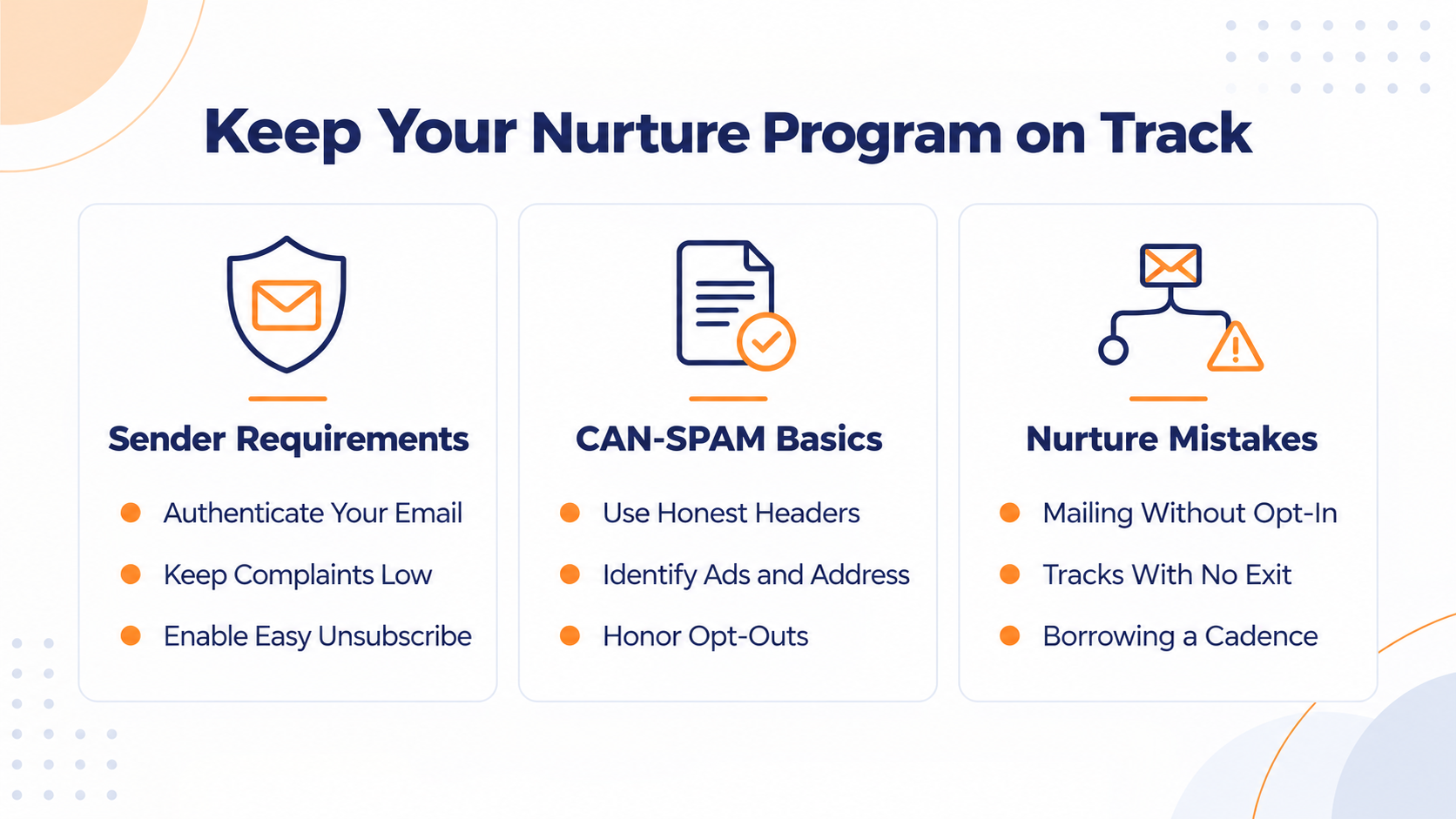
Google requires everyone sending to personal Gmail accounts to authenticate with SPF or DKIM and keep spam rates below 0.3%. Senders of more than 5,000 messages a day to Gmail accounts must also set up SPF, DKIM, and DMARC, and their marketing and subscribed messages must support one-click unsubscribe along with a clearly visible unsubscribe link in the body. Google recommends keeping spam rates below 0.10% and never reaching 0.30%.
Yahoo's requirements are similar. All senders need SPF or DKIM and spam rates below 0.3%, and bulk senders need SPF, DKIM, and DMARC, one-click unsubscribe for marketing and subscribed messages, a visible unsubscribe link, and unsubscribes honored within 2 days.
Google's sender guidelines FAQ says Gmail has been increasing enforcement since November 2025, including temporary and permanent rejections for mail that fails the requirements. Google classifies senders that send close to 5,000 or more messages to personal Gmail accounts within 24 hours as bulk senders. Messages from the same primary domain, subdomains included, count together, and bulk status is permanent once assigned.
That means your nurture emails, newsletters, and promotions add up together.
Cover the CAN-SPAM basics
The FTC's CAN-SPAM Act covers all commercial email and makes no exception for business-to-business messages. Commercial nurture emails need accurate header information, a subject line that reflects the content, a clear disclosure that the message is an ad, your valid physical postal address, and a working way to opt out.
The FTC says opt-out requests must be honored within 10 business days. That's the legal floor, and Yahoo's 2-day expectation for bulk senders is stricter. The FTC's guide lists penalties of up to $53,088 per violating email.
Mistakes that stall nurture programs
Mailing people who never opted in is the fastest way to sink a program. Google tells senders not to buy email addresses, not to email people who didn't sign up, and to avoid opt-in boxes that are checked by default.
Running a track with no exit is a big mistake we see many companies make that destroys deliverability and engagement. Leads who will never engage keep receiving mail, complaints creep up, and the people who might have converted get buried in the same send.
Copying someone else's cadence is the last one. A sequence tuned for a quick ecommerce purchase won't fit a B2B decision that takes months, and borrowed numbers hide that until the results come in.
Make Your Email Nurture Campaign Follow the Buyer
Modern buyers conduct most of their research independently and rarely follow a linear path toward a purchase. To convert these prospects, email nurture sequences must be flexible enough to accommodate an unpredictable decision process.
A modern marketing automation system provides the underlying infrastructure required to orchestrate these adaptive, high-performing nurture programs.
To drive sequence success, your automation platform should support tracks built around singular goals, precise triggers, and automated exit criteria.
The system must branch dynamically based on real intent signals, such as form submissions, link clicks, and content downloads, so performance is judged by sales pipeline and booked meetings rather than surface-level open rates.
Essential platform capabilities for high-converting nurture workflows
A robust marketing automation system elevates nurture programs in several key ways:
- Combined Timed and Behavioral Triggers: Sequential drip autoresponders manage scheduled touchpoints, while real-time behavioral triggers immediately dispatch context-aware follow-ups when contacts demonstrate high intent or abandon key interactions.
- Dynamic Lead Routing: Smart dynamic segmentation combines demographic data, custom contact attributes, and behavioral history to continuously move leads into the exact nurture track matching their latest actions.
- Pre-CRM Nurturing Layer: An effective system acts as a cost-effective staging layer in front of your primary CRM. It warms cold contacts in the automation platform first and syncs only qualified, sales-ready leads to your CRM, protecting seat costs and sales team bandwidth.
- Centralized Multi-Brand Management: When running nurture programs across multiple brands, clients, or business units, the platform should support multi-brand account structures. This allows each entity to run isolated workflows and data models while enabling administrators to manage templates and global settings centrally.
Find the leaks in your nurture program with an automation audit
Our Marketing Automation Audit is a free, one-on-one session built around your current follow-up and marketing automation system. We'll look at where leads drop out of your funnel and which manual steps are eating your team's time. You leave with a custom automation roadmap for your nurture program. Schedule your audit today!
Email Nurture Campaign FAQ
Short answers to the questions that come up most when teams plan a nurture program.
How many emails should be in a nurture sequence?
There's no single right number. Tie the length to your sales cycle and the single goal of the track, then add or cut emails based on where leads drop out and where they convert. Setting frequency expectations at signup and keeping them, as Yahoo recommends, is a better anchor than a borrowed template.
How often should you send nurture emails?
Send often enough to stay useful, and never more often than you told subscribers to expect. Let behavior speed things up when a lead does something worth answering, such as visiting pricing or replying.
Is email nurturing the same as lead nurturing?
Email nurturing is lead nurturing done through email. Lead nurturing can also include sales outreach, events, and other channels. Gartner's research suggests buyers care less about the channel than about getting consistent, useful information for the decision in front of them.
When should a nurtured lead go to sales?
A lead should go to sales when it meets the sales-ready definition you and sales wrote down together, with a set timeframe for follow-up. Watch buying-group activity as well. Forrester recommends connecting buying-group members to the opportunity they belong to, and several engaged people from one account can signal that opportunity before any single contact looks ready.