Most of your best-fit buyers will never say yes to a demo the day they download your lead magnet. They just handed over an email address to grab a checklist. Asking them to book a sales call in the same breath is the fastest way to watch a promising contact go quiet.
That is the trap sitting in the middle of almost every funnel. You have plenty of contacts at the top and a sales team hungry for pipeline at the bottom, and nothing in between doing the patient work of turning one into the other. The middle of the funnel is where deals are actually won or lost, and it is the part most teams leave to chance.
The data-backed case for webinar marketing
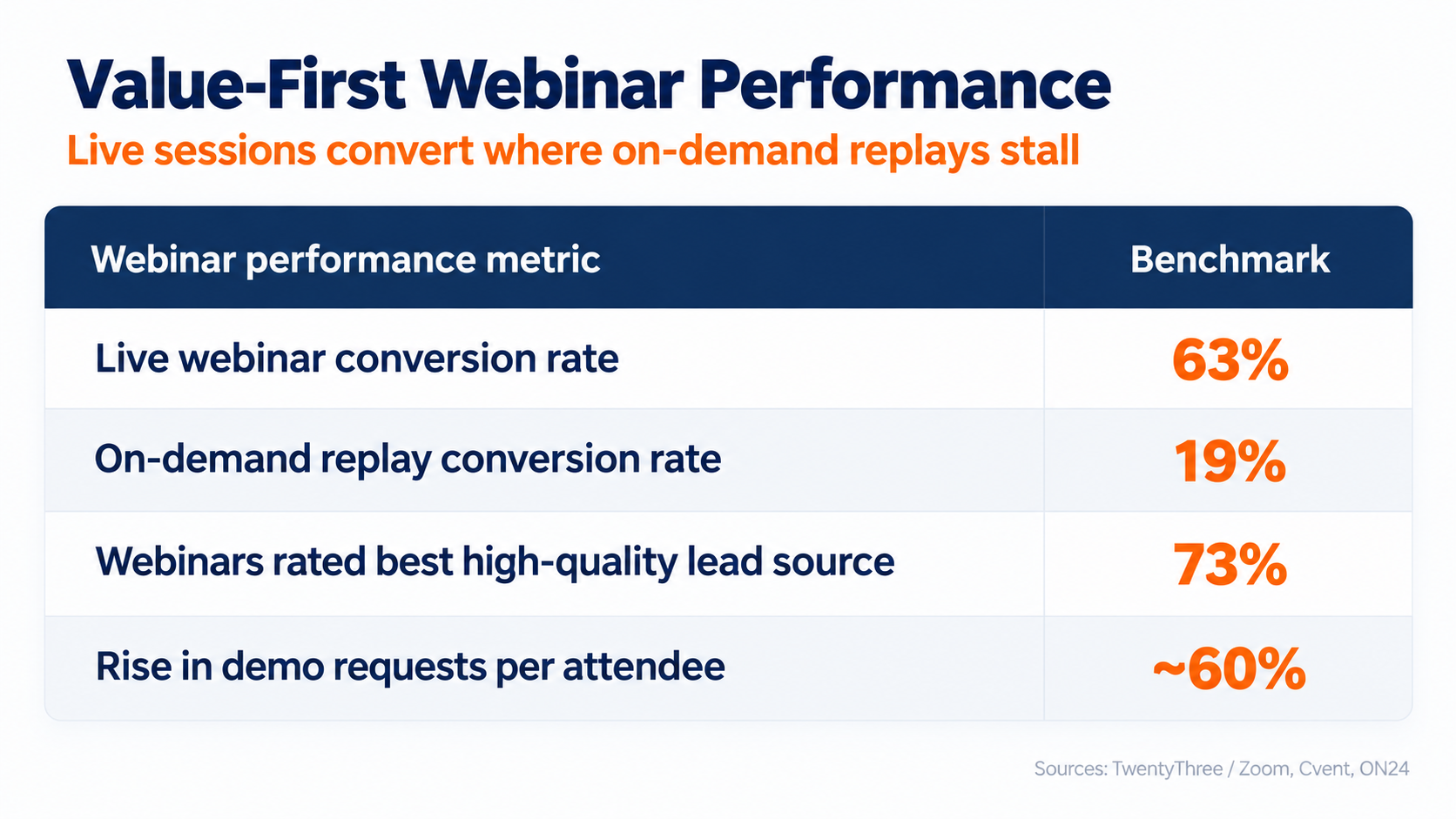
There is a better bridge, and the data on it is hard to argue with. 73% of B2B marketers and sales leaders say webinars are the best way to generate high-quality leads. That is not a small edge over other channels. It is a decisive one, and it points straight at the tactic this whole post is built around.
Why The Middle Of The Funnel Breaks Down
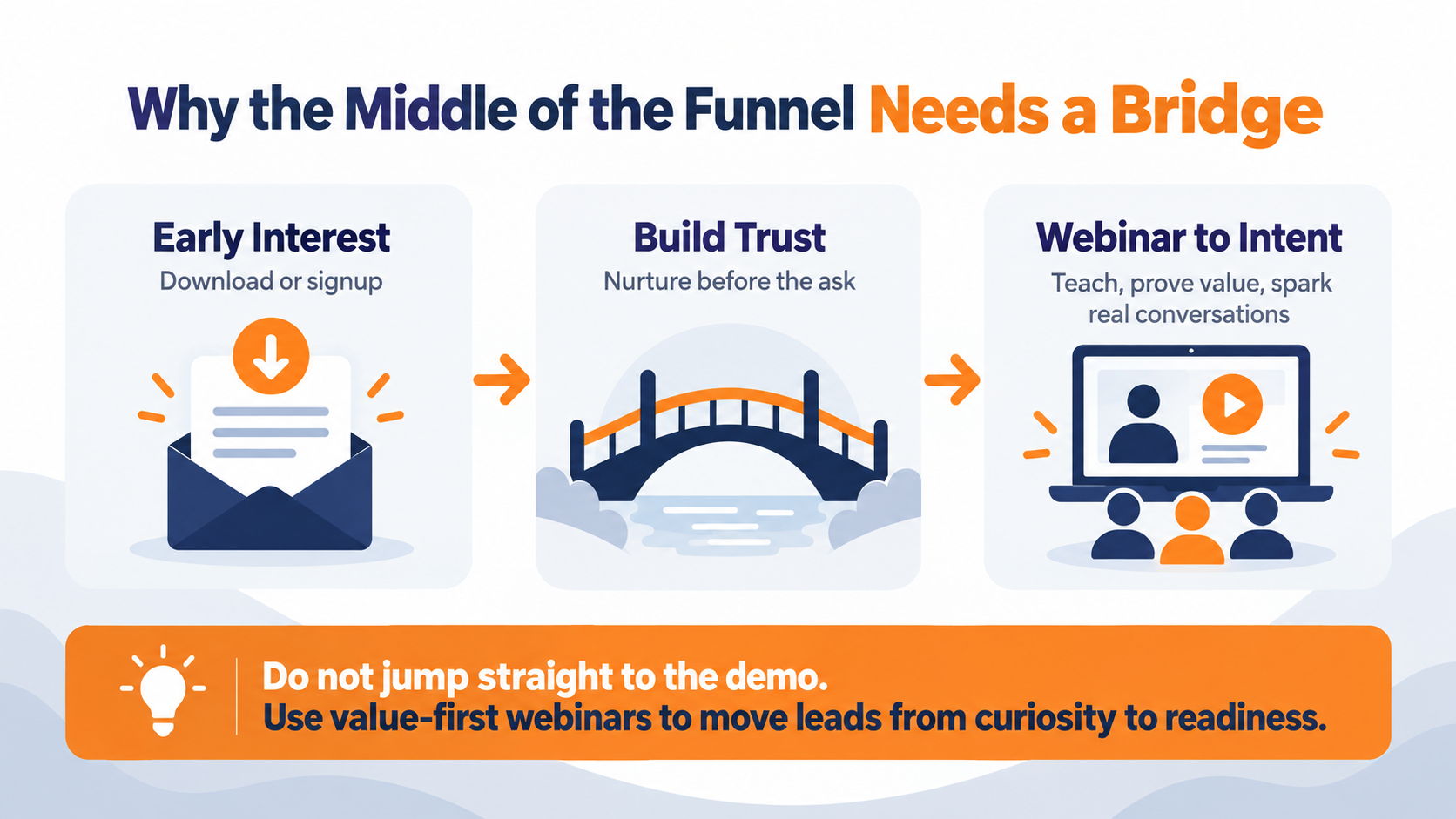
The middle of the funnel is where good intentions go to die. A contact downloads something, lands in a generic newsletter list, gets three unrelated promotional emails over the next month, and then stops opening them. Nobody decided to lose that lead. It just happened, because there was no system carrying them from casual interest to real intent.
The problem with skipping straight to the ask
Trying to close a complex sale the moment someone gives you their email can drastically reduce conversions. A lead magnet download signals curiosity, not readiness. The person on the other end is still figuring out whether they even have the problem you solve, let alone whether you are the one to solve it.
When you jump straight to a demo request, you are asking for a level of commitment the relationship has not earned yet. Most people say no by simply not responding. And once a contact ghosts your first ask, re-engaging them gets much harder.
What a real bridge does instead
A middle-of-funnel bridge exists to build trust at scale, establish that you actually know what you are talking about, and handle objections before a sales rep ever gets involved. It does the relationship-building that a single email blast cannot.
Think of lead nurturing as the job the middle of the funnel is supposed to be doing. You are not trying to close anyone in the first touch. You are earning the right to the next one, and then the one after that, until a contact has moved far enough on their own to welcome a real conversation. Skip that work, and you are left doing what most teams do, which is generating leads at the top and hoping they somehow ripen into buyers on their own. They rarely do.
Turning interest into intent at scale
The value-first webinar is the strongest bridge available for exactly this job. It gives you room to teach, to demonstrate credibility, and to move someone from “this looks interesting” to “I need to talk to these people,” all without a one-to-one call. Done well, it functions like an automated sales engine that runs whether you are in the room or not.
|
Pro Tip: Treat the webinar as the middle of your funnel, not the top. Promote it hardest to contacts who already raised a hand, not to cold strangers who have never heard of you. |
The Eduselling Framework
A great webinar is not a dry lecture, and it is definitely not a sixty-minute infomercial. It sits in a very specific spot between those two failures. The whole point is to teach something truly useful while dismantling the reasons someone would hesitate to buy.
This is where webinars earn their reputation. When you actually deliver value in the session, the conversion numbers get striking. Live webinars convert at around 63% for live sessions versus 19% for on-demand replays. The lesson buried in that difference is that presence and interaction do the heavy lifting. People who show up live and engage are the ones who move.
Break the old way of thinking first
If your audience shows up believing their current approach is working fine, they will never buy anything from you. So the first job of the session is to challenge that belief, gently but clearly.
Spend the opening stretch teaching a bigger framework rather than a pile of random tips. Expose the hidden costs and structural limits of the status quo they are living with. Once someone has the small epiphany that their current way of operating is costing them, they stop looking for minor tweaks and start looking for a real solution. That shift in posture is what makes the rest of the webinar land.
Teach the what, not the how
Amateur presenters make the same mistake every time. They cram a tedious, step-by-step technical manual into the session, and the audience drowns in detail. Instead of feeling capable, viewers feel overwhelmed, and an overwhelmed prospect does not buy.
The move is to teach the what and the why, not the exhaustive how. Explain which milestones matter and why hitting them leads to real results. Keep the tactical grunt work reserved for your paid solution. When you do this right, the audience leaves thinking, “I completely agree with this, and I know what I need to do. I just do not want to build all of it myself.” That thought is the whole game.
Make the pivot feel like a gift, not a pitch
The transition from teaching to offering should never feel abrupt. Frame your solution as the shortcut to the exact strategy you just taught. The audience already bought into the destination, so you are simply handing them the fastest route.
A clean version sounds like this. You can take everything I just walked you through and spend the next six months building and troubleshooting it yourself, or you can use what we have already built and have it running in weeks. No awkward hard sell required, because the education did the persuading for you.
Get People To Actually Show Up
A registration page is only as valuable as the event promotion and show-up rate behind it. You can fill every seat and still lose if half your registrants forget the event is happening. This is where your automation and your list segmentation start doing real work, long before anyone joins the live room.
The good news is that webinar audiences are unusually reachable by email. Invitation emails for webinars pull dramatically stronger engagement than your average campaign, which means the channel you already own is the one best suited to driving attendance. When a webinar registrant is on your list, a reminder sequence should fire without anyone lifting a finger for each new signup.
Build a pre-webinar sequence that primes, not just reminds
Do not just send dates and links. A three-part reminder sequence in the days before the event should carry real value, whether that is a short case study, a quick worksheet, or a single provocative question that previews the belief you are about to challenge. You are warming people up for the paradigm shift before they even arrive.
This kind of automated lead nurturing built around a webinar registration trigger is the difference between a room full of primed attendees and a room full of people who half-remember signing up. Each message should build anticipation rather than just restating the calendar invite.
Use SMS for the moments that matter most
Email handles the conceptual buildup over several days. SMS handles urgency in the final minutes. Combining email marketing and SMS marketing together will maximize results. Fifteen minutes before you go live, a short, direct text with the join link cuts through everything else competing for attention in that moment.
The message can be as simple as letting them know you are going live shortly and here is the link to jump in. Email and text are not competing channels here. They are covering different jobs, and the handoff between them is where your show-up rate climbs.
|
Pro Tip: Send your fifteen-minute SMS reminder with the direct join link, not a link to the registration page they already filled out. Remove every extra click between the buzz in their pocket and their seat in the room. |
Capture What Attendees Actually Do
The live session is not just a broadcast. It is a data-collection event, and the behavior you capture during those forty-five minutes tells you exactly who is ready for sales and who needs more time. Modern webinar tooling logs these signals straight into a contact’s profile, so intent becomes something you can act on rather than guess at.
Active engagement during a webinar is a clear sign that a prospect is ready to buy. Live sessions naturally bring genuine interest to the surface as attendees interact with your content and ask for next steps. The people paying close attention are giving you a clear signal that they are close to making a decision.
Track how long they stayed
Retention time is one of the clearest signals you have. Someone who stayed past the forty-five-minute mark to hear your core pitch is a very different lead from someone who dropped off during the introduction. Log the timestamp, because it changes how you follow up with each group.
That single customer data point lets you sort a registration list into people who saw your offer and people who never got that far. Those two groups deserve entirely different next steps, and the timestamp is what tells them apart.
Capture poll answers and chat activity
Every poll response and chat comment is a small confession of what someone really cares about. Map those answers into custom fields on the contact record. Now your follow-up is not generic, because you know which specific pain point that person raised their hand about.
When a rep eventually reaches out, they are not guessing. They are referencing the exact thing that person flagged during the session, which makes the outreach feel like a continuation of a conversation rather than a cold interruption.
Tag the offer clicks
The moment someone clicks the offer button during the webinar, tag it. That click is the hottest signal in the entire event, and it should trigger a different path immediately. A contact who clicked through to your booking page has told you plainly that they are ready to talk.
Turn those signals into a simple score
None of these signals mean much in isolation, but together, they add up to a picture of intent that is far more reliable than any form field. Retention time, poll answers, and offer clicks each say something, and when you stack them, the hot leads separate themselves from the merely curious without anyone reading transcripts by hand.
You do not need a complicated model to start. Give a few points for staying past the pitch, a few more for engaging in the poll, and the biggest bump for an offer click. Contacts who cross a threshold get routed to sales, and everyone else stays in nurture a little longer.
The point is that lead nurturing and lead scoring stop being separate manual chores and become two outputs of the same behavioral data your webinar already collected.
Follow Up Based On Behavior, Not A Blast
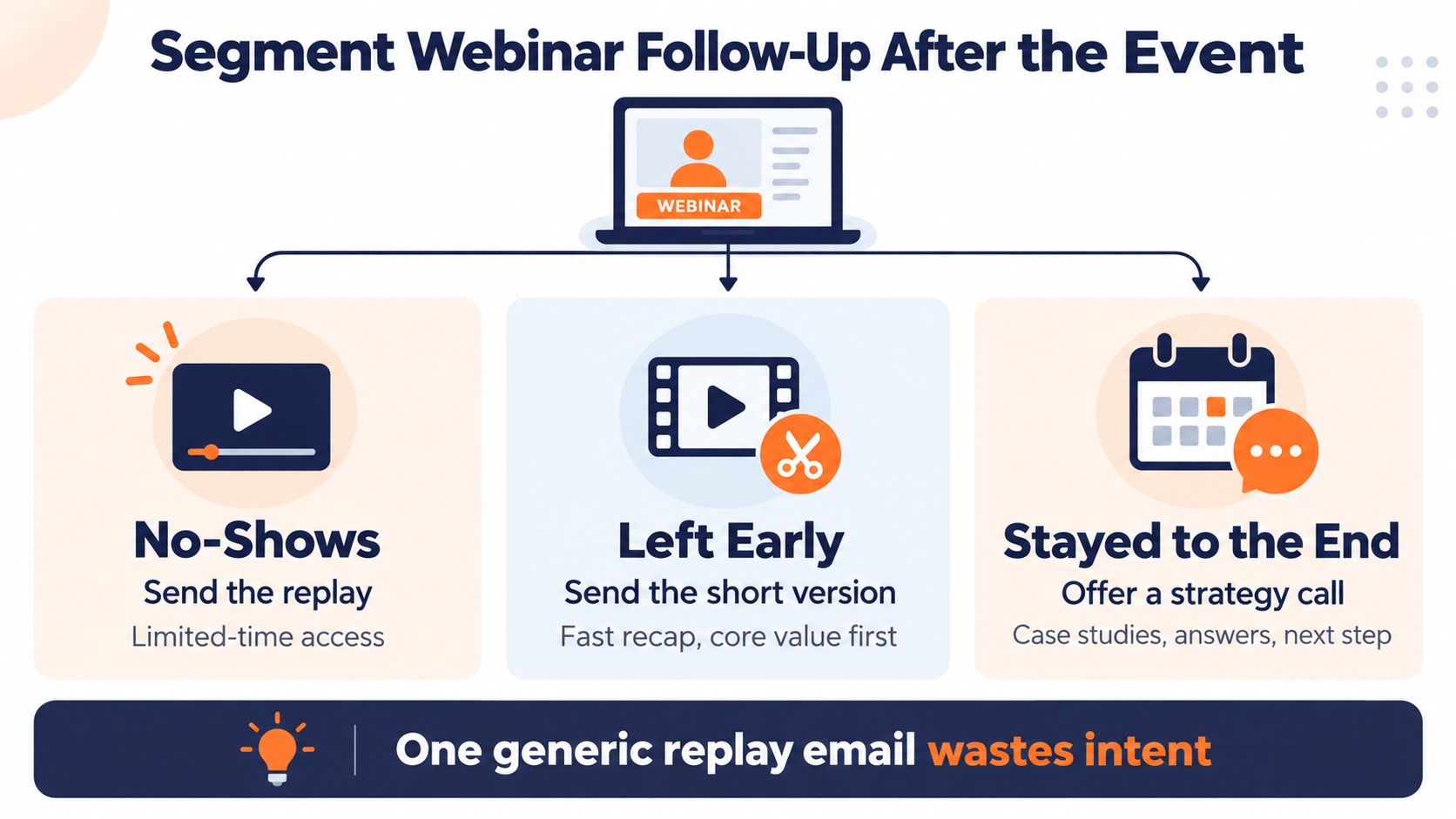
Here is where most webinar programs fall apart. The event goes well, everyone celebrates the attendance numbers, and then the same generic “here is the replay” email goes out to the entire list. That single lazy step wastes most of the intent you just worked so hard to capture.
Improving post-event follow-up is not a minor optimization. It is where the pipeline actually gets built, and treating every registrant identically throws away the behavioral data your webinar just handed you. The correct way to structure this is to branch your audience into distinct paths the moment the session ends.
The mistake is understandable. Sending one email to everyone is easy, and email segmenting feels like extra work in a week that is already full. But the whole reason webinars produce hot leads is that they reveal who is close and who is not, and a single blast erases that distinction the instant it goes out. You spent the session learning who your best prospects are. The follow-up is where you either act on that knowledge or throw it away.
Route the no-shows toward the replay
Registered but did not attend is not a dead lead. Life most likely just got in the way. These contacts still raised their hand for the topic, so send them into a short sequence built around the replay, with a genuine reason to watch it soon rather than never.
A light touch of scarcity works here. The replay is available, but not forever, and giving it a real expiration nudges the people who meant to attend to finally make time for it.
Give early drop-offs the short version
Attendees who left before the pitch loved the education but missed the offer. Do not send them the full sixty-minute recording. Send a tighter cut that skips the intro and gets to the core value fast, because their behavior already told you they are busy and skeptical of long content.
Meeting them where they are respects the signal they sent by leaving. A fifteen-minute summary is far more likely to get watched than a full replay they already partially skipped once.
Give the highest-intent leads a real conversation
The contacts who stayed to the end and saw the full pitch are your hottest group. They understood the offer, saw the pricing, and did not book. That usually means one lingering objection, not a lack of interest. Trigger a targeted sequence with case studies, answers to common questions, and a direct note from a rep offering a short strategy call.
This is the segment where a human touch pays off most, because these people are one good answer away from a yes. Everything you tracked during the session tells the rep exactly which answer to lead with.
Turning warm attendees into booked calls
Even here, the rep is not starting from scratch. The lead nurturing you did before and during the webinar means this contact already trusts your point of view, already sat through your best argument, and already saw the offer.
The follow-up sequence is not trying to build a relationship from zero. It is closing the small remaining distance between a warm attendee and a booked call, and that is a very different, much shorter conversation.
|
Pro Tip: For your stay-to-the-end group, have a rep reference the exact poll answer or chat comment that person left. Nothing warms a follow-up faster than proving you were actually paying attention to them. |
Make The Sequence Run Without You
Everything above only works if it runs automatically. The problem is not that teams do not know follow-up matters. The problem is that follow-up depends on someone remembering to send it.
It's impossible to manually send the right message to the right segment at the right moment, when at the same time you are busy running the next webinar. The instinct is right, but the execution dies in a to-do list.
Put middle of the funnel nurturing on autopilot
Stop treating post-webinar follow-up as manual work and start treating it as a system that fires on its own. When a registration, a poll answer, or an offer click can each trigger its own path, the entire middle of your funnel starts moving without a person babysitting it.
Timing is everything when you follow up after a webinar. If you wait too long, interested leads quickly go cold. By sending both emails and text messages from the same tool, you can easily track what each person did during the session. Someone who clicked an offer gets a completely different follow-up than someone who left early or didn't show up, ensuring everyone gets the right message at the right time.
Turning A Single Webinar Into A Repeatable Pipeline Engine
Here is what actually moves the needle. Stop asking your best contacts to buy before they trust you, and start giving them a value-first webinar that earns that trust in forty-five minutes.
Teach the framework, challenge the status quo, and let the education do the selling so the pivot to your offer feels like a shortcut rather than a pitch. Then capture what attendees do, and follow up based on behavior instead of blasting one replay link at everyone.
The middle-of-funnel engine your webinars are missing
Webinars are the highest-quality lead source B2B teams have, and the reason so many programs still underperform is not the content of the session.
It is the middle-of-funnel machinery around it, the reminders that drive attendance, the tracking that captures intent, and the segmented follow-up that turns a warm room into booked calls. Get that marketing automation system running once, and it keeps working on every webinar after.
Turn warm audiences into real pipeline
If your webinars are pulling good audiences but your pipeline is not reflecting it, that shortfall is fixable, and it starts with the system underneath.
Request a demo, and we will show you how to wire your next webinar into an automated engine that captures intent and follows up on it while you focus on the next session.