You planned every detail of the event, confirmed the caterer, printed the badges, and then watched half the chairs sit empty. That difference between the registration list and the room is the most expensive number in event marketing, and almost nobody plans for it.
Most event promotion advice stops at the sign-up. Get the registrations, celebrate the count, move on. The problem is that a registration is a promise, and promises made in a hurry get broken the second something more urgent lands on someone's calendar.
So this is a walkthrough of event promotion that assumes the sign-up is the halfway point, not the finish line. In this post, we'll dive into five creative ways to promote your next event, plus the reminder and follow-through work that turns a name on a list into a person in a seat.
Why the event registration number lies to you
Free events lose a huge share of the people who sign up. Industry data puts no-show rates for free events somewhere between 40 and 60 percent, compared with 8 to 15 percent for paid events.
That spread tells you something useful. The no-show problem is rarely a promotion problem. Your event marketing worked. People wanted to come at the moment they clicked register. The commitment just evaporated between sign-up and show day, and that evaporation is the part you can actually design around.
Effective Event Promotion Starts With The Staples Before You Get Creative
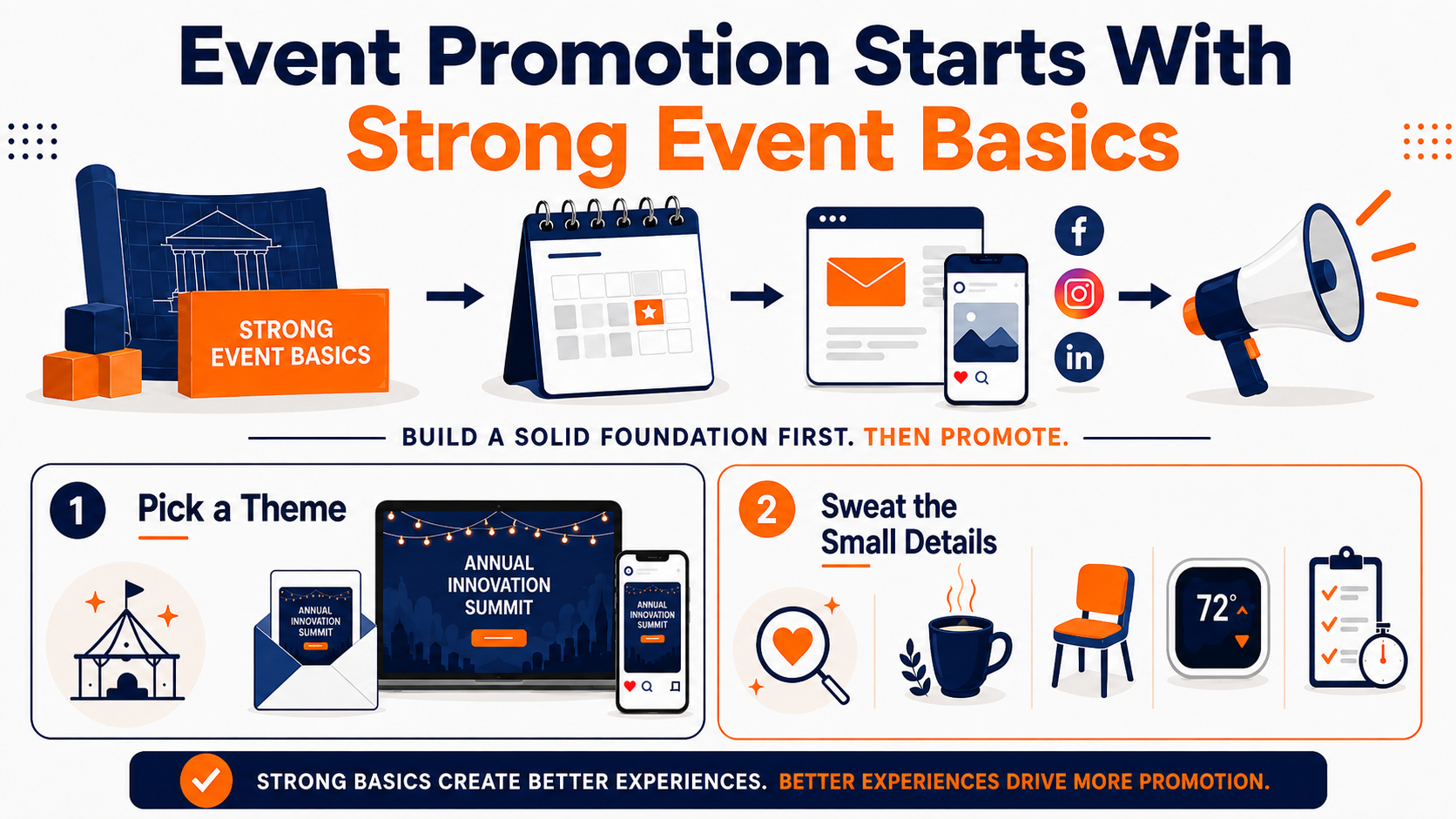
Creative promotion only works when the fundamentals are already handled. A clever digital marketing campaign that drives sign-ups to a confusing, forgettable event just fills the room with people who leave early and never come back. Nail the basics first.
Pick a theme and let it organize everything
A theme is not decoration. It is the organizing principle that keeps your event promotion consistent from the first teaser to the post-event recap. When every email, landing page, and social post traces back to one clear idea, attendees remember the message long after the event ends.
A theme also makes your own job easier. It gives you a filter for every decision. If a design choice, a session title, or a giveaway does not fit the theme, you cut it. That single filter saves hours of second-guessing.
Sweat the small details attendees actually remember
Whether this is your first event or your fiftieth, the little things decide whether people come back. Room temperature, enough coffee, breathing room between sessions so nobody feels rushed. Attendees remember how the day felt more than they remember any single slide.
Those small comfort details are often the deciding factor on whether someone attends your next event. Get them right, and you build a reputation that does your promotion for you before you send a single invite.
|
Pro Tip: Space your sessions with real breaks built in, not five-minute gaps, so networking happens instead of getting crushed between talks. |
Remind Like It Is Your Only Job
People are busy. Their inboxes are full, their calendars are packed, and your event is competing with every other thing fighting for their attention. One reminder the day before does not cut it anymore, and it never really did.
Build a reminder sequence, not a single nudge
A good reminder sequence spreads across the weeks leading up to the event, and each message does a different job. A logistics email four weeks out. An agenda or speaker highlight two weeks out. A short, direct confirmation the day before. Each one keeps the event alive in someone's mind and removes a small reason not to show.
The email sequence matters more than any single send. One email is a reminder. Five well-timed emails are a relationship with the event, and relationships are what get people to rearrange their morning to be there.
Get attendees to reconfirm, and use two channels to do it
Here is where the channel choice determines everything. Event reminder emails typically see open rates of 30 to 45 percent, while SMS runs above 95 percent. More than half your registrants may never see an email nudge, which is exactly why the reminders that matter most should not live in email alone.
Ask people to reconfirm their spot a couple of weeks out, and frame it as helping you finalize planning. Offer a small incentive for that second confirmation, a resource download or a giveaway entry. That extra action holds people accountable and reminds them why they signed up in the first place.
For SMS to work, you need the number and the opt-in, so collect both on the registration form itself rather than chasing them down afterward. Make the ask plain, something like get a text reminder the day before, and most people say yes. Then your day-before nudge actually reaches the ones email misses.
Space the reminders so they build instead of nag
There is a rhythm to reminders that works, and a rhythm that annoys. The messages that land carry something useful each time. Logistics far out. A speaker reveal in the middle. A short, warm confirmation right before. Every send gives the reader a reason to keep the date rather than just repeating the date at them.
Good event marketing treats the run-up as a story with a beginning, a middle, and a payoff, not a countdown clock that pings the same message louder each week.
When each reminder advances the story, people stay engaged instead of tuning out, and the ones who were on the fence get pulled back in by content they actually want.
4 Creative Event Marketing Tactics That Still Work
The staples get people to take your event seriously. These four event marketing tactics get people to notice it in the first place. None of them require a huge budget, and all of them reward creativity over spend.
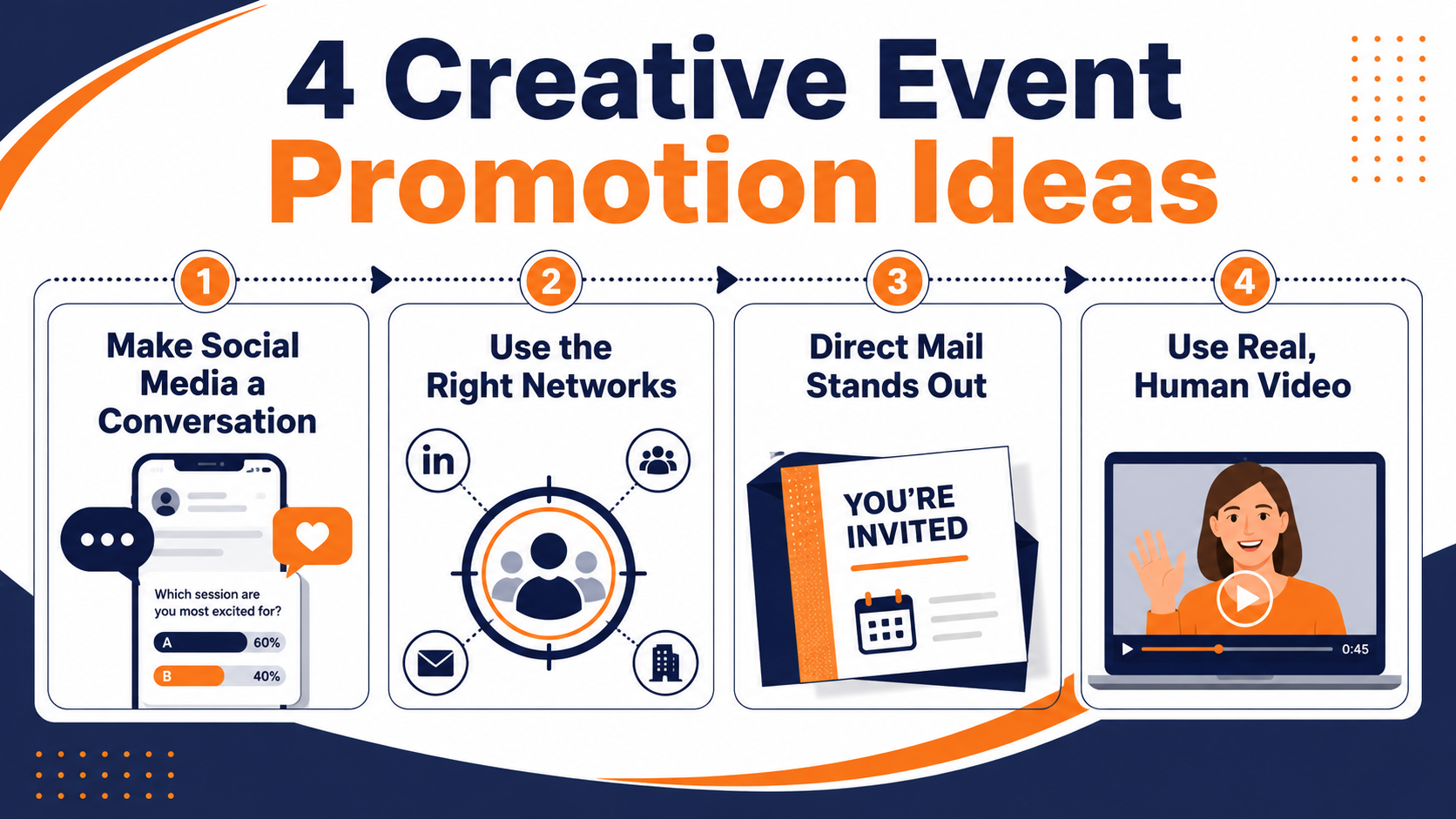
1. Make social media a conversation, not a broadcast
Social platforms reward genuine engagement now, not the old like-and-share contest mechanics that used to game the feed. Those tactics get suppressed today, so the move is to give people something worth reacting to. A behind-the-scenes look at the planning. A poll on which session topic they want most. A short clip of a speaker previewing their talk.
Let your audience help shape the event, and they show up feeling like they already have a stake in it. Ask what they want covered, then actually cover it, and tell them you did. That loop turns passive followers into people who feel personally invited.
2. Give the other networks room to work
The biggest platform is not always where your audience lives. For a B2B event, LinkedIn often does more work than anywhere else, especially from personal profiles rather than the company page. People engage with faces, not logos, so let your team share the event in their own words.
For larger or annual events, a dedicated hashtag lets attendees, speakers, and sponsors promote on your behalf. A small, tightly targeted paid campaign to the exact job titles you want in the room can also stretch a modest budget further than a broad boosted post ever will.
3. Direct mail cuts through a crowded inbox
A physical piece of mail lands differently now that the inbox is where everything else screams for attention. A well-designed invite, a small branded object, or a handwritten note stands out precisely because so little arrives in the mailbox anymore.
Yes, it costs more per touch. That is also the point. The cost signals that this event is worth the effort, and for a high-value audience, that signal is doing quiet work your tenth promotional email cannot.
4. Video that shows you are actually human
A shareable event video works when it feels real, not staged. Stock footage of people nodding around a laptop does nothing. Your team showing genuine excitement does. A countdown on someone's desk, a planning huddle, a quick unscripted reason each person is looking forward to it.
Remember your brand identity and let that show. The video that spreads is the one that feels like a person made it for other people, not the one that looks like it came off an assembly line.
We saved a 5th tactic for its own section, because it is the one that routinely outperforms the other four combined when you do it right.
Get Personal With Email And SMS Event Promotion
This is the event marketing tactic worth building your promotion around. Email is still the channel where you own the relationship end to end, and paired with SMS for the time-sensitive nudges, it drives more registrations and more actual attendance than any social media marketing will.
Personalization starts with knowing who you are sending to
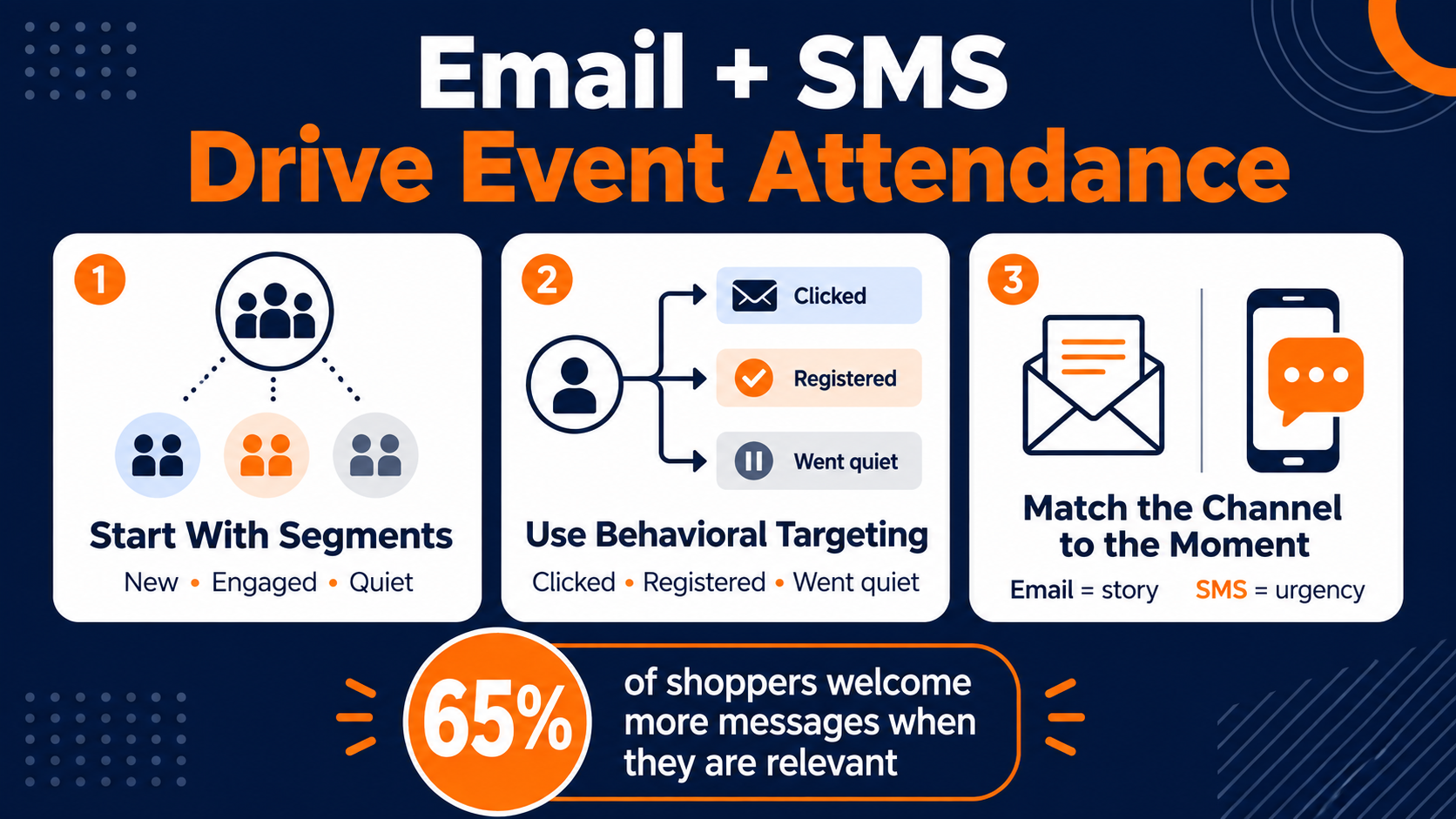
Generic blasts get ignored. The way to make an email feel like it was written for one person is to actually know something about that person, and email segmentation is how you get there. Group people by how they have engaged, then speak to each group differently.
Start small. Three groups based on where someone sits with you, new, engaged, and gone quiet, will teach you more than an elaborate structure you cannot maintain. Prove the basic split moves your numbers, then get more granular once it does.
Let behavior decide the message, not a calendar
Tag and target based on what people actually do. Who opened the last three event emails. Who clicked the agenda but never registered. Who registered but has not opened anything since. Each of those groups needs a different message, and behavioral targeting is what lets you send it automatically instead of by hand.
Keep your theme consistent through this whole phase. A person who gets a text that clashes with the email they opened an hour ago notices the seam, and seams make an event feel disorganized before anyone even arrives.
Match the channel to the moment
Email carries the story. SMS carries the urgency. A cart-style reminder that a session is filling up, a text that a demo starts in fifteen minutes, a day-before confirmation. People are not opposed to hearing from you more often, as long as it is relevant. 65 percent of shoppers are open to more frequent messages when brands make those messages worth opening.
How often you send the messages isn't necessarily a problem, it's when the messages don't feel relevant that causes issues. A text sent because the timing actually matters gets welcomed. A text that just repeats your email gets you muted, so give each channel a distinct job and let it do that job well.
Map Your Event Promotion Across The Full Timeline
Creative tactics and personalized reminders only work when they run in the right order. A promotion plan is really a timeline, with each channel doing its job at the moment it fits best. Here is how the pieces line up from launch to day-of.
A channel-by-channel promotion timeline
The table below maps which channel earns which job across the run-up to your event. Use it as a starting sequence, then adjust the spacing to fit how far out your audience tends to commit.
|
Channel |
Best for |
When to lead with it |
|---|---|---|
|
|
Storytelling, agenda reveals, speaker previews, logistics |
4 to 1 week out |
|
SMS |
Time-sensitive nudges, reconfirmation, day-of check-in |
48 hours to day-of |
|
Social |
Awareness, audience input, shareable moments |
Launch through event week |
|
Direct mail |
High-value invites that signal the event matters |
3 to 5 weeks out |
|
Video |
Human, shareable excitement that spreads reach |
Launch and mid-campaign |
Sequence the channels instead of firing them all at once
The instinct when you promote an event is to blast every channel on day one and hope something sticks. That burns your audience out before the event is even close. A timeline works because each channel gets its turn at the moment it does its best work, and the stretches between pushes let anticipation build.
Direct mail and video open the campaign and create awareness. Social keeps a steady hum going through the middle. Email carries the substance across the weeks before, and SMS closes the last mile. When you promote an event this way, no single channel has to carry the whole load, and none of them wears out its welcome.
Give the plan room to run before you judge it
Commit to the sequence for the length of the campaign. Switching lanes because the first week looked slow is how good event marketing plans die before they get a chance to work. Most sequences need more than a few days to show real numbers.
Set your review points before launch. Two weeks in, pull the data. One week out, decide whether to adjust the final push or hold steady. Building those checkpoints in up front keeps you from making panicked changes off a single quiet day, which is the most common way a solid plan gets abandoned early.
Design The Registration Itself To Reduce No-Shows
Promotion gets people to the sign-up. The sign-up itself decides how many of them actually show. A registration that takes a few thoughtful seconds creates a stronger commitment than a one-click form that people forget the moment they close the tab.
Make registrants take an active step
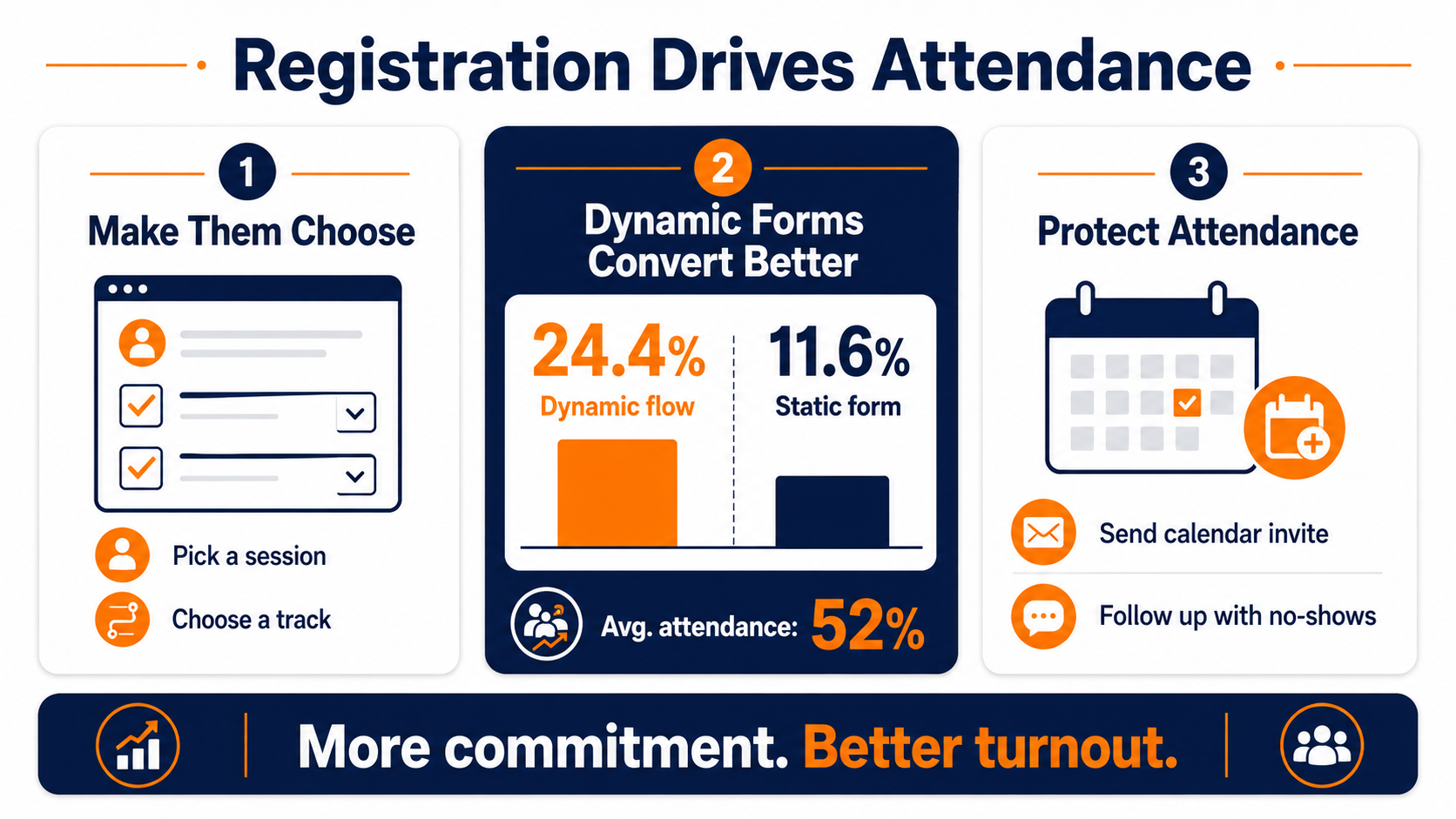
Forms that ask people to pick a session, choose a track, or note a preference do two things. They give you useful planning data, and they make the registrant picture themselves at the event. That forward projection is what turns a casual sign-up into a real intention to attend.
Someone who chose a specific 2 pm workshop has a stronger mental commitment than someone who just clicked register. The small act of choosing plants the event in their plans in a way a bare form never does.
The registration flow shapes your attendance rate
This is not a small lever. Platform benchmarks show dynamic registration flows convert visitors at 24.4 percent versus 11.6 percent for static forms, and the average event attendance rate sits at just 52 percent. The way you build the sign-up is doing as much work as the campaign that drove people to it.
Add an automatic calendar invite to every confirmation. Most people will not add the event themselves, and the difference in attendance between registrants who have a calendar block and those who do not is real. That one file goes a long way to protect a chunk of your room.
Follow up with the ones who slip away
Some no-shows are recoverable. A morning-of reminder with a check-in link and a map pin catches the person who woke up tired and needed one small push. Make it easy to show up, not easy to opt out, and you win back a slice of the room you would otherwise lose.
The people who never made it are still worth something. A post-event note to no-shows, framed as we missed you rather than where were you, keeps them warm for next time.
Send them a session recording or a highlights recap, and your event marketing keeps paying off long after the doors close, because those warm contacts become next year's early registrations.
Where To Focus Your Next Event Promotion Push
Here is what the day-empty-chairs problem actually comes down to. Treat the sign-up as the halfway point. Nail the staples so the event is worth attending, build a real reminder sequence across email and SMS instead of one day-before nudge, get creative on the channels where your audience already pays attention, and design the registration itself to build commitment.
These event marketing tactics are not complicated. The hard part is keeping the reminder sequence, the segments, and the two channels in sync while a real event bears down on you. That coordination is exactly the work that falls apart when it lives in someone's head and a spreadsheet.
Scale event attendance with behavioral triggering
This is where email and SMS marketing automation earns its place. Pinpointe's omni-channel journey builder and behavioral triggers exist to handle exactly this kind of timing, firing the right reminder across email and SMS based on what each registrant actually did, so nobody gets a text about a session they already confirmed.
The events that fill the room are rarely the ones with the cleverest single invite. They are the ones whose reminder sequence keeps working while the organizer sleeps, moving people between segments as their behavior changes, without anyone rebuilding the flow by hand.
Build your automated reminder sequence
Schedule a demo with our team, and we will show you how to build the email and SMS reminder sequence that turns more of your registrations into people who actually walk through the door.