B2B email marketing is the practice of sending permission-based email campaigns to other businesses to build relationships, nurture leads through long buying cycles, and drive revenue, instead of pushing a single purchase to an individual consumer. That difference may sound small, but it changes almost everything about how you build, send, and measure a program.
Most B2B email advice hands you a benchmark number and a few subject-line tricks. This guide does something more useful. It covers what actually moves a program, how to build and segment a list, how to nurture buyers who take months to decide, how to keep your email out of spam, and how to measure results now that open rates are harder to trust.
It is written for the person doing the work. The marketer or operator who owns the sends and answers for the numbers so let's dive in.
Key Takeaways
- No universal open rate exists: There is no reliable benchmark for B2B email open rates, because Apple Mail Privacy Protection accounted for 55% of measured opens in March 2024, so judge B2B email marketing programs on clicks and pipeline instead.
- ROI is real but slower in B2B: Across all email marketing, the average return is about $36 for every $1 spent, though B2B-specific figures are older and lower.
- Nurture pays off: An older Marketo guide reported that strong lead nurturing generates 50% more sales-ready leads at 33% lower cost, the logic behind effective B2B nurture campaign examples built for a full buying committee.
- Deliverability is now enforced: Google treats any domain sending 5,000 or more messages a day to personal Gmail as a bulk sender and wants spam complaints under 0.1%.
- Real proof beats borrowed benchmarks: On Pinpointe, Networld Media Group reports link click-throughs up 167%, and Coastal Insurance Underwriters reports a 96 to 99% inbox rate.
In this guide
- What B2B Email Marketing Is and How It Differs From B2C
- Why B2B Marketers Keep Betting on Email
- B2B Email Open Rates and the Metrics That Actually Matter
- How to Build and Segment a B2B Email List
- B2B Nurture Campaigns With Examples
- The Types of B2B Marketing Emails That Work
- B2B Email Deliverability and Sender Requirements
- Common B2B Email Marketing Mistakes to Avoid
- Running B2B Email Across Multiple Brands Clients or Accounts
- Frequently Asked Questions
What B2B Email Marketing Is and How It Differs From B2C
B2B email marketing sells to a company, not a person. The account behind your subscriber has a budget cycle, an approval chain, and several people who all have to agree before anything gets bought. That is the whole reason generic email tactics fall flat here.
How B2B email differs from B2C
In B2C, one person can read an email and buy in the same minute. In B2B, that is rare. In a Databox survey on B2B sales cycles, the largest share of respondents, over 30%, reported deals closing in one to three months, and plenty run far longer.
So a B2B email is rarely trying to close. It is trying to stay useful and stay in the inbox long enough for a committee to reach a decision. Your email segmentation, your cadence, and your metrics all follow from that one fact.
Why B2B Marketers Keep Betting on Email
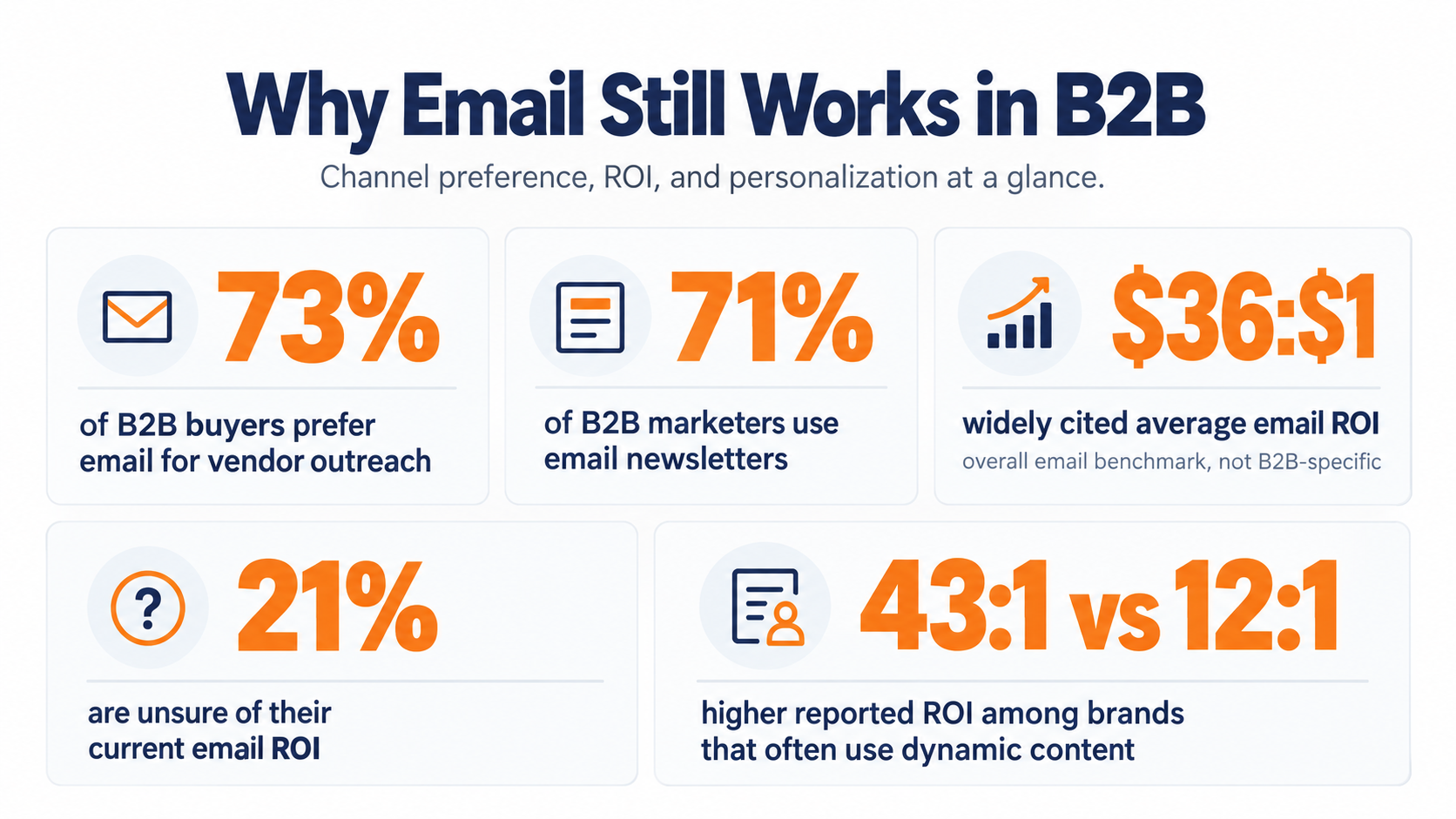
Email holds its place in B2B for a simple reason. It is where buyers say they want to hear from you. In Sopro's State of Prospecting research, about 73% of B2B buyers named email their preferred channel for vendor outreach, ahead of every other option.
Marketers back that up with how they use it. In CMI's B2B research, about 71% of B2B marketers run email newsletters as part of their content strategy, one of the most-used content distribution channels.
The ROI case, stated honestly
You have seen the famous number. Across all email marketing, Litmus puts the average return at about $36 for every $1 spent. Here is the part worth being precise about. That is an all-email figure, not a B2B one.
B2B-specific numbers are older and regional. In DMA UK's 2019 Marketer Email Tracker, B2B organizations reported roughly £36 per £1 against nearly £48 for B2C. Treat that as a dated snapshot, not a current rate.
Measuring that return remains a challenge. In Litmus's 2025 State of Email, 21% of respondents said they were unsure of their current email ROI.
Personalization is associated with stronger returns
In older Litmus survey research, brands that said they often use dynamic content reported email ROI near 43 to 1, against about 12 to 1 for those that rarely do. That is an association across surveyed brands, not proof that personalization alone drives the gap, and it is not B2B-specific. Read it as a reason to test personalization, not a guaranteed multiplier.
B2B Email Open Rates and the Metrics That Actually Matter
Here is the question every B2B team asks, and the honest answer almost no guide gives. There is no defensible universal number for good B2B email open rates.
Published open-rate figures for B2B email vary widely, because the label lumps together cold outreach, opted-in newsletters, transactional mail, and blended all-industry averages, which are not the same population and cannot share one benchmark.
The datasets you can find easily also come mostly from platforms that compete with the tool you would be benchmarking, and the ones cited here do not provide a directly comparable permission-based B2B benchmark. A borrowed number tells you little.
Why Apple Mail Privacy Protection muddied the open rate
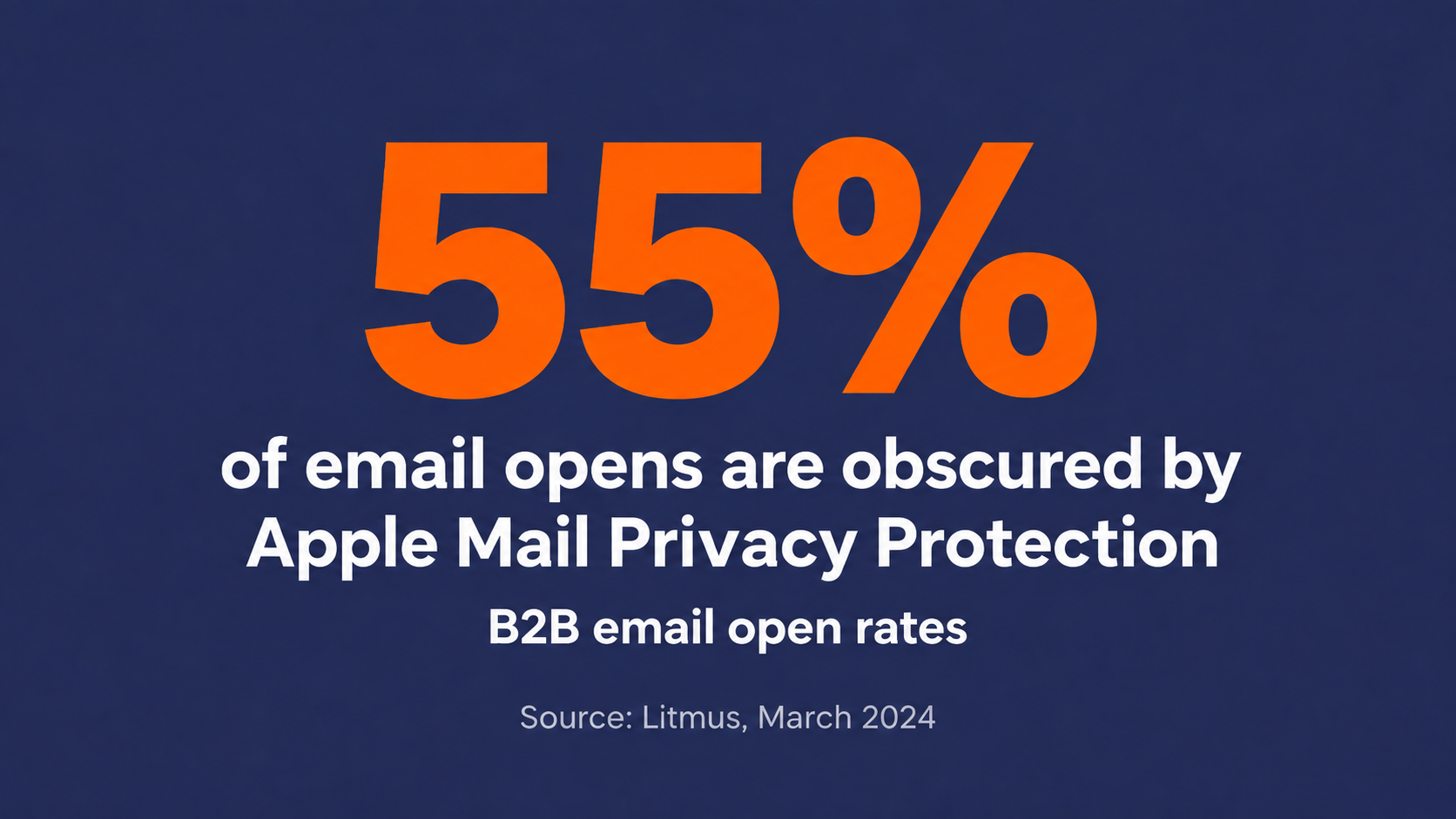
There is a technical problem on top of that. Apple Mail Privacy Protection can load tracking pixels without a person reading the message.
In Litmus data from March 2024, it accounted for 55% of measured opens, so raw opens cannot reliably distinguish real reads from automated activity.
Click-to-open rate does not fully rescue you, since it divides clicks by that same inflated open count. Opens still have some diagnostic use, a sudden drop can flag a deliverability problem, but they are no longer a clean measure of interest.
The metrics to track instead
Lean on the numbers that survive the privacy changes. Clicks, replies, conversions, and pipeline. Conversion rates in particular vary so much by program, and by how each dataset defines a conversion, that a borrowed figure means little.
The real benchmark is your own last quarter. Beat that, and the industry average is noise.
How to Build and Segment a B2B Email List
Every reliable B2B program starts with a list people chose to join. Permission-based and opt-in, not scraped. That is not a compliance footnote. It is what keeps your deliverability alive later, which is its own section below.
Segment by how buyers actually differ
Once your list is clean, segment it by the things that change what a buyer needs to hear. Role, industry, company size, and where they sit in the buying cycle.
Segmentation and personalization are consistently linked to stronger engagement, though the splashiest multipliers you will see quoted come from e-commerce studies and should not be promised to a B2B audience.
The B2B case for segmentation is simpler than any statistic. A CFO and a practitioner at the same company do not want the same email, and sending them one generic message trains both to ignore you.
Segmentation compounds over time
Done consistently, segmentation helps keep your messages relevant as a list grows. As an example, the Gerson Companies grew its opt-in list eightfold over a decade on Pinpointe while segmenting across roughly 25 behavior and event-based lists instead of blasting one file.
Another example was that Oaktree Funding took a list from 25,000 to more than 400,000 over six years while running a daily cadence off saved template blocks. Relevance is what keeps people subscribed long enough to buy.
B2B Nurture Campaigns With Examples
Most of your list is not ready to buy today, and a nurture campaign keeps those buyers warm until they are. In B2B, that job is bigger than it sounds. You are not just nurturing one person toward a decision. You are keeping an entire buying committee engaged across months, feeding different stakeholders the proof each one needs before they will agree in a room you are not in. That is what the best B2B nurture campaign examples are really built to do.
Why nurtured leads are worth more
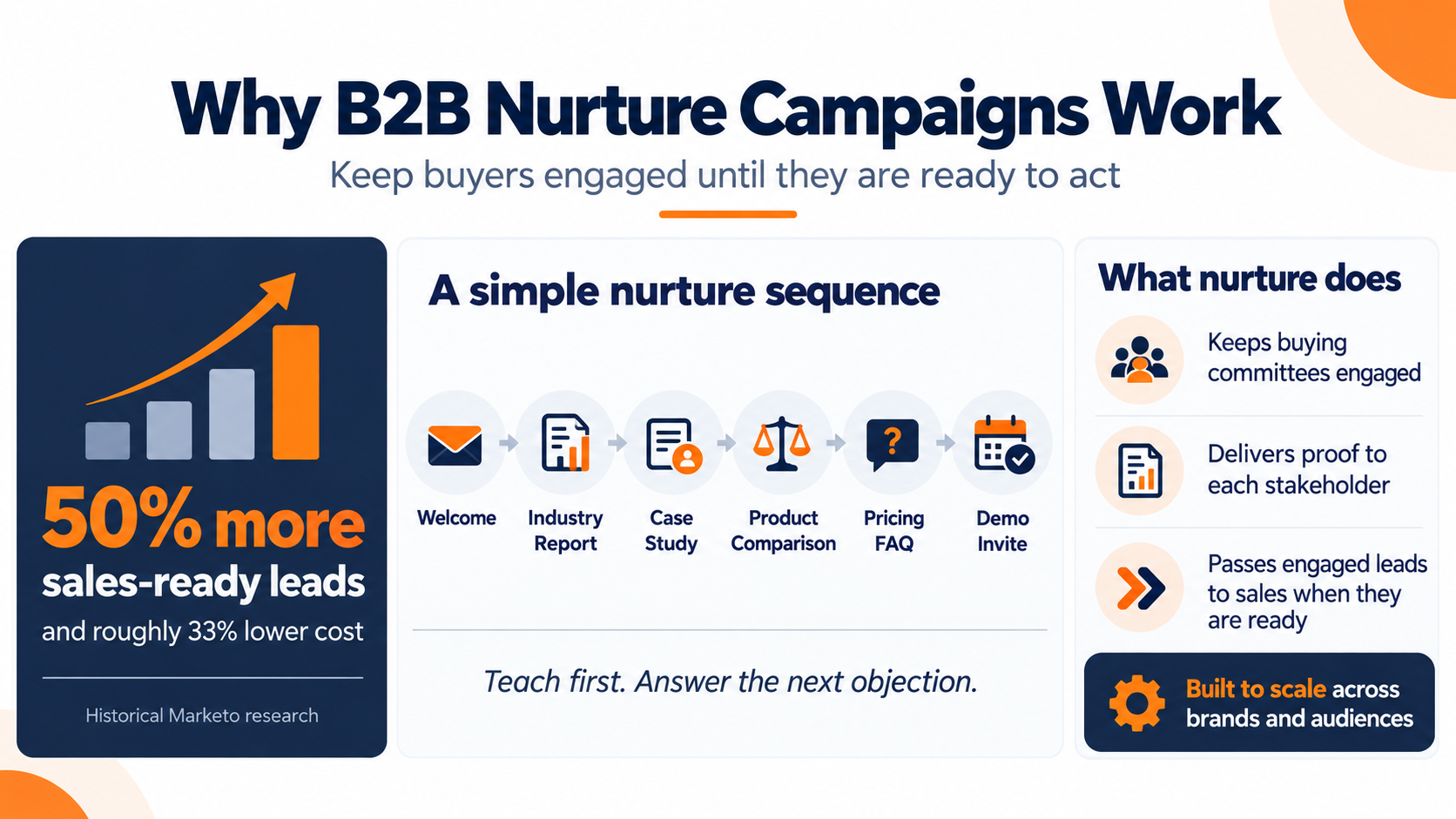
The case for nurture leans on well-worn research. Companies excelling at lead nurturing generate 50% more sales-ready leads at roughly 33% lower cost. It is a historical figure, so treat it as directional evidence that nurture pays, not a current benchmark. Either way, it's the mechanism that matters, and nurtured buyers arrive better informed and closer to a decision.
What a B2B nurture sequence looks like
A workable B2B SaaS sequence has a clear shape. Welcome, then an industry report, a customer case study, a product comparison, a pricing FAQ, and a demo invite, each mapped to a stage of the buyer's journey.
Treat that as an illustrative skeleton to adapt, not a captured campaign with reported results. The point is the logic behind the nurture workflow. You should teach before you pitch, and answer the next objection before it is asked.
Nurture campaigns in the wild
Real programs run this way at scale. An example we've seen work for enterprise SaaS companies that use Pinpointe is that they use it as their top-of-funnel nurture engine to drip-feed trade-show leads and pass only the ones that engage into its CRM, so it is not paying CRM licensing to store contacts that never respond.
21st Mortgage runs automated drip campaigns across several sister companies, about 2.5 million emails a year, without letting those audiences bleed into each other. Both are nurture programs, not blasts, and both are built around who is ready and who is not.
The Types of B2B Marketing Emails That Work
You do not need a hundred email types. You need a handful that each do one job well. Here are the B2B marketing email examples worth studying, and what each one is doing.
Welcome and onboarding emails
The first email you send tends to do the heaviest lifting. Across email broadly, not B2B specifically, welcome emails tend to outperform standard campaigns on opens and clicks, so a wasted one is a missed opening.
Greenhouse's onboarding email, archived as "Welcome to MyGreenhouse. Start your search.", shows the discipline: it points the reader to one clear action rather than a feature tour.
That single-action focus is the lesson that every B2B company should add to their marketing strategy. Networld Media Group leaned on trigger welcome flows and reports link click-throughs rising 167% across ten publications on Pinpointe. One job, one call to action.
Educational and thought-leadership emails
The strongest B2B senders teach instead of sell. Circle, described in a US Chamber of Commerce roundup, runs email that educates its community with tutorials, case studies, and curated tips, and segments so new members get an onboarding series while inactive ones get re-engagement messages.
Figma's archived email, "An inside look at how we build at Figma", walks through how the team builds rather than listing what shipped. The move to copy is simple. Give the reader something worth reading this time.
Product updates and announcements
Feature announcements keep the customers you already have. Slack's archived email about its AI teammate frames a product update as an invitation to come try something new. For B2B, getting existing users to adopt what they already pay for is a large part of retention.
Research reports and case studies
Some of the strongest B2B emails give a reason to click that is not a discount. Wistia's archived email promotes its State of Video report, leading with original research rather than an offer.
Whatever the type, simpler tends to win. OES Global used Pinpointe heat maps to see where readers actually clicked, cut an email from eight links down to two focused calls to action, and reports its click-through roughly doubled. Every extra link is another chance for the reader to do nothing.
Subject lines that earn the open
The subject line decides whether any of this gets read. Personalized, specific subject lines tend to earn more opens than generic ones, but do not optimize them against opens alone. This is because that metric is now less reliable than it used to be thanks to mail privacy settings that tend to skew email open rates. So test subject lines against clicks and replies in your own campaigns, where the result actually reflects interest.
B2B Email Deliverability and Sender Requirements
None of this matters if your email lands in spam. Since 2024, the major mailbox providers have turned old best practices into hard requirements, and they do not all play by the same rules.
Authenticate every send
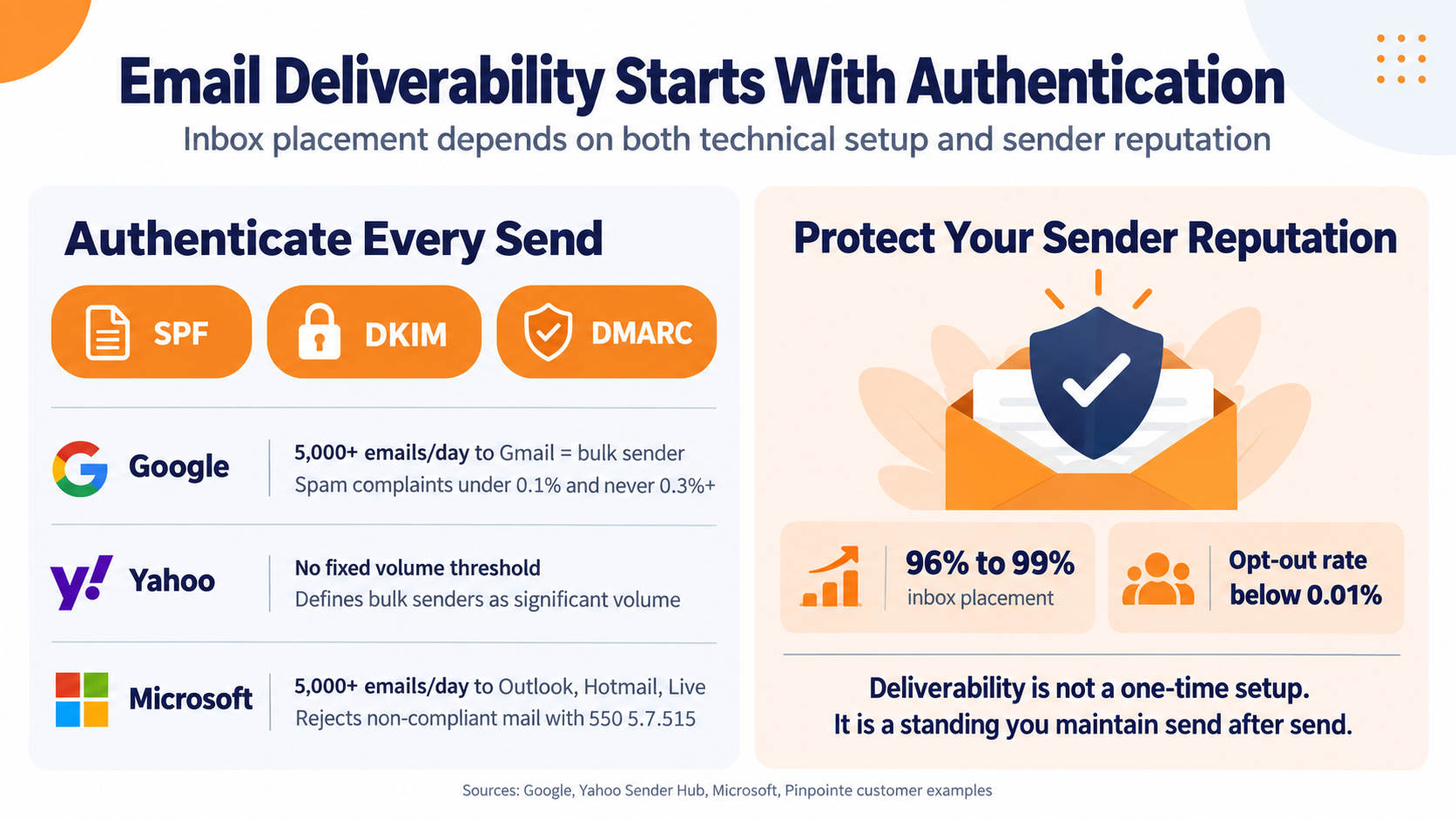
Every sender should have SPF or DKIM in place, and bulk senders now need SPF, DKIM, and DMARC together. Missing what a provider requires puts your delivery at risk, from throttling to outright rejection, though the exact rule and enforcement differ by provider.
Read each provider on its own terms. Google treats any domain sending 5,000 or more messages a day to personal Gmail accounts, counted across the same primary domain, as a bulk sender, and wants your spam-complaint rate under 0.1% and never at or above 0.3%.
Yahoo takes a different line. Its Sender Hub FAQ states plainly that it will not specify a volume threshold, defining a bulk sender simply as one sending significant volume.
Microsoft joined in on May 5, 2025, applying its own 5,000-a-day rule to mail sent to its consumer inboxes at Outlook, Hotmail, and Live, and it rejects non-compliant mail outright with a 550 5.7.515 error.
Protect your sender reputation
Authentication gets you in the door. Reputation keeps you there, and it is earned per sender. Coastal Insurance Underwriters reports holding a 96 to 99% inbox rate for more than five years on Pinpointe using ReturnPath-certified dedicated IPs, which is huge, because ordinary insurance wording typically trips generic spam filters.
Hallmark Building Supply reports eliminating ISP blocking and cutting its opt-out rate below 0.01% after moving to Pinpointe, which shows that deliverability is not a one-time setup. It is a standard that you have to maintain send after send.
Common B2B Email Marketing Mistakes to Avoid
Most B2B email problems are self-inflicted, and there are four mistakes that most companies continue to make.
The first is chasing the open rate and optimizing hard for a number that Apple has turned into something unreliable. The second is blasting one list, sending everyone the same message and wondering why engagement decays, when segmentation is the difference between a list that grows and one that burns out.
The third is importing cold-outreach tactics, and cold-outreach benchmarks, into a permission-based marketing program. They are different disciplines with different rules, and mixing them wrecks both.
The fourth is treating authentication as optional until deliverability craters. By then you are rebuilding reputation, not running campaigns.
Running B2B Email Across Multiple Brands, Clients, or Accounts
Everything above is doable for one brand and one list. The trouble starts when managing ten.
That is precisely the challenge modern multi-brand marketing automation tools are designed to solve. A multi-brand platform enables organizations to run many independent brands, clients, or locations from a single central console. Each audience receives isolated data management, a distinct sender identity, and dedicated reporting. This will deliver independent engagement alongside centralized control.
Flexible support for complex enterprise structures
This architecture supports a variety of complex organizational setups. Media groups can manage multiple publications sending millions of messages monthly, each on isolated IPs with tailored reporting. Multi-brand enterprises and sister companies can keep audience data strictly separated within one primary account while sharing template assets where relevant.
Additionally, enterprise SaaS companies frequently deploy a dedicated automation platform as a cost-effective nurture layer in front of their primary CRM, keeping cold leads out of expensive CRM license tiers until they demonstrate engagement.
Built-in deliverability engineered for scale
Crucially, robust deliverability management should be built directly into these platforms. Advanced marketing automation tools feature integrated pre-flight spam checking to score messages prior to launch, dedicated and deliverability-certified IPs to safeguard each sender's reputation, and automated traffic shaping to properly pace delivery to major inbox providers like Gmail, Yahoo, and Outlook.
This infrastructure provides a stable foundation that allows growing organizations to expand their contact lists smoothly without ever needing to swap platforms as they scale.
Make B2B Email Marketing Your Most Reliable Channel
B2B email rewards the teams that treat it as a program, not a series of one-off blasts. Segment for how buyers actually differ. Nurture across the full committee and the full cycle, because the decision takes months and involves people you never email directly. Protect deliverability per sender, since it is the price of entry every provider now enforces. And measure clicks and pipeline, not an open rate that privacy changes have muddied.
Do those four things and email stops being the channel you hope works and becomes the one you can count on.
If your B2B email has drifted into batch-and-blast against a benchmark you borrowed from someone else, the fix is a better program, not another subject-line hack. Schedule a marketing automation audit with our team, and we will show you where your pipeline is leaking and what to fix first.
Frequently Asked Questions
What is a good open rate for B2B emails?
There is no agreed-upon universal number. Published B2B open rates vary widely because the label mixes cold outreach, newsletters, and transactional mail, and Apple Mail Privacy Protection can inflate opens, with the effect varying by audience. Benchmark against your own last quarter and judge the program on clicks and pipeline instead.
Is email marketing effective for B2B?
Marketers rate it highly, and it is one of the channels B2B teams rely on most. Buyers say they prefer it, most B2B marketers use email newsletters as a core content channel, and email ROI is strong overall, though the headline $36-per-$1 figure is an all-email number, and the B2B-specific comparison cited here is an older UK snapshot where surveyed B2B organizations reported a lower return than B2C organizations.
What is the difference between B2B and B2C email marketing?
B2B email markets to a company with several decision-makers and a longer buying cycle, so it works over weeks and months to keep a committee engaged. B2C markets to one person who can often decide in a single sitting, which is why a survey found the largest share of B2B deals taking one to three months to close.
How often should you send B2B marketing emails?
There is no fixed number. Send as often as you have something genuinely useful to say, and test frequency against clicks, replies, and unsubscribes rather than a set cadence. Watching your spam-complaint rate matters for sender health, but relevance, not a target frequency, is what keeps a list converting.