Somewhere in your platform right now sits a welcome series nobody has touched since the week it launched. Maybe it still mentions a product you retired. Maybe the discount code expired eighteen months ago.
Nobody remembers, because it runs itself, and running itself is exactly the problem. You built it once and walked away, and it's been quietly doing the same stale thing to every new contact ever since.
This isn't really about automation failing. Most people set it up once and never look again, and that's the actual problem.
Why “set it and forget it” is where automation goes to die
The tools got good years ago. Triggered sends, dynamic segments, real-time behavioral data, all of it has been sitting inside most marketing automation tools for a while now.
Access stopped being the constraint a while ago. What's rare is someone actually going back in to tend the thing.
Marketing Automation Tools Are No Longer the Hard Part
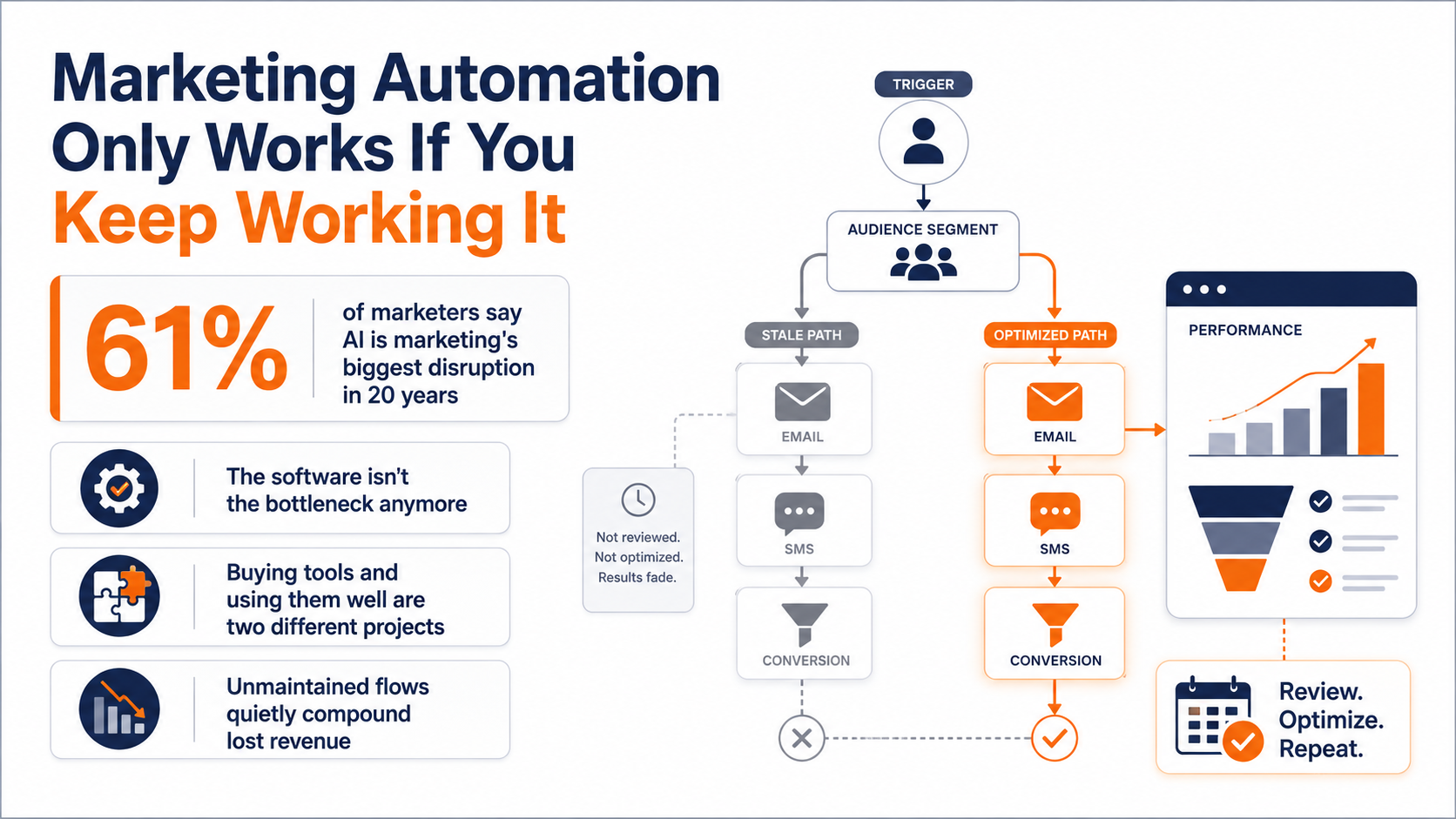
If you're still evaluating whether to adopt marketing automation, you're behind a conversation the rest of the industry already had. Sixty-one percent of marketers say AI represents marketing's biggest disruption in twenty years, and most of that disruption is happening inside the automation layer: the sequences, the triggers, the segments deciding who gets what and when.
That's a fast-moving number, and it tells you adoption stopped being the interesting question a while ago. The interesting question is what you're actually automating, and whether it still reflects how your business runs today.
Here's the uncomfortable part. Buying marketing automation tools and using them well are two completely different projects. One is a purchase order. The other is an ongoing habit of checking your own work.
The software isn't the bottleneck anymore
Every major email and SMS platform, Pinpointe included, ships with triggered workflows, segmentation logic, and send-time controls out of the box. You don't need a developer to stand up a welcome series or a cart-abandonment flow anymore. What you need is someone willing to revisit it after launch.
Most teams don't. They build the flow, watch it perform fine for a quarter, and stop looking. Fine is not the same as good, and by month six, fine usually means stale.
Why unmaintained email flows cost more than software
This is where a lot of marketing automation strategy conversations go wrong from the start. Teams frame the decision as “should we get automation software,” when the software question got settled years ago.
The real decision, the one that actually determines whether automation pays off, is who owns reviewing it after launch, on what schedule, and against what standard.
Skip that part, and you end up with the exact scenario from the top of this post: a flow that technically runs perfectly and says something nobody would approve if they read it today.
How a weak conversion rate quietly compounds lost revenue
Budget conversations tend to focus on the platform line item, but the higher cost is usually the opportunity cost of automation nobody's maintaining.
A flow that converts at half its potential rate for a year is quietly more expensive than the software itself, because that gap compounds every single month it goes unaddressed.
Generic Automation Is Just Faster Spam
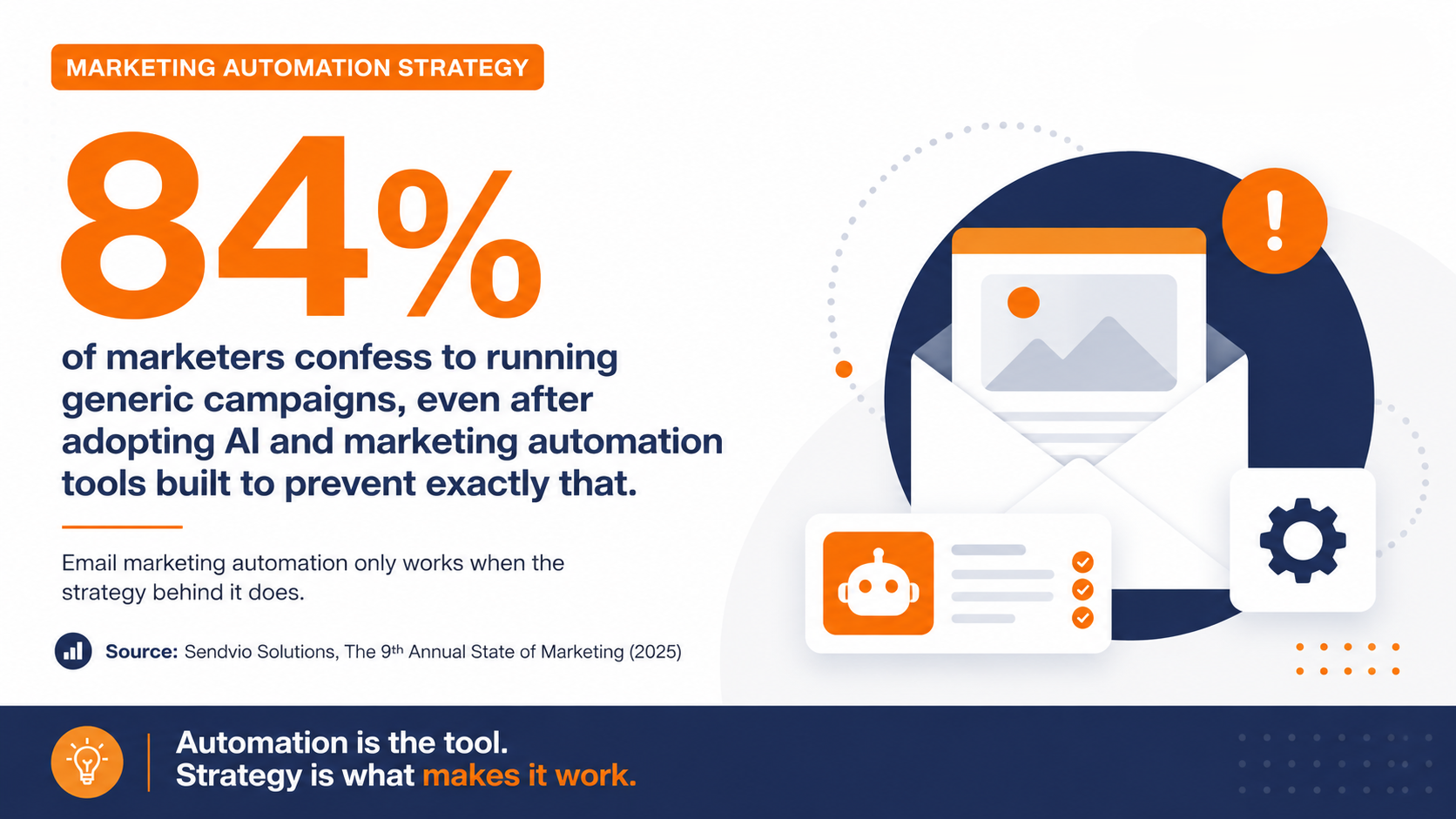
Here's the part that should worry you more than any adoption stat. Eighty-four percent of marketers confess to running generic campaigns even after adopting AI and automation tools built specifically to prevent that. The tools didn't fail. The strategy behind them did.
Automating a bad message just gets a bad message to more people, faster. If your welcome flow greets every new subscriber the exact same way regardless of how they found you, what they clicked, or what they actually bought, you haven't automated relevance. You've automated volume.
The gap between “automated” and “relevant”
Relevance requires a decision. Automation without a decision behind it just repeats whatever you set up on day one, forever, to everyone. That's the trap: the system feels sophisticated because it's technically automated, while the actual content stays as generic as a single static email ever was.
Ask yourself when you last changed the logic in your top three automated flows. If the honest answer is “I don't remember,” that's your answer for why they're underperforming.
Separate your email automation from your content
It helps to separate two things that get treated as one. There's automation as infrastructure, the actual triggers, timing, and delivery mechanics, and there's automation as message, what the contact actually reads once it arrives.
Most teams pour their attention into the infrastructure and assume the message will keep working because the infrastructure does. It won't. Infrastructure doesn't age.
Messages do, especially once the offer, the product lineup, or the audience buying it has quietly shifted underneath a flow that hasn't been touched since it launched.
What Marketing Automation Tools Actually Cover Today
A lot of marketers still picture marketing automation as scheduling social posts or setting up an autoresponder. That's a decade out of date. Real email marketing automation today spans a handful of connected pieces, not a single feature:
- Behavioral triggers that fire off real actions, not just a calendar date
- Dynamic segmentation that updates as contacts behave differently, not static lists built once and left alone
- Cross-channel sequencing across email and SMS so a contact doesn't get the same message twice on two different channels
- Deliverability infrastructure making sure the automated send actually lands in an inbox instead of a spam folder
- Real-time engagement data feeding back into the next decision the system makes
Each piece depends on the others. Segmentation without behavioral triggers just sorts people into buckets that never update. Triggers without solid deliverability just automate messages straight into the spam folder faster.
Treat any one of these as the whole strategy on its own, and the rest of the program quietly underperforms, even if the piece you did invest in is working exactly as designed.
Behavioral triggers replace static send schedules
A static schedule sends on Tuesday because Tuesday was chosen once, a while back, for reasons nobody remembers.
A behavioral trigger sends because a contact just did something, viewed a product, abandoned a cart, went quiet for sixty days, that actually matters right now.
The message arrives at the moment it's relevant instead of the moment it happened to be scheduled.
Dynamic segmentation beats static lists
Static lists are a snapshot. Someone qualified for a segment in March, and they're still sitting in it in October, even if everything about their behavior has changed since then.
Dynamic segmentation checks itself continuously, moving contacts in and out as their actual behavior shifts. That single difference is often the gap between a list that performs and one that quietly stops working.
If your list hasn't been re-evaluated in a while, it's worth checking what's actually still accurate about it. We wrote about exactly that problem in our piece on cleaning up a stale email list, and the short version is that segments rot the same way lists do.
Cross-Channel Sequencing Is Where Most Programs Still Fall Short
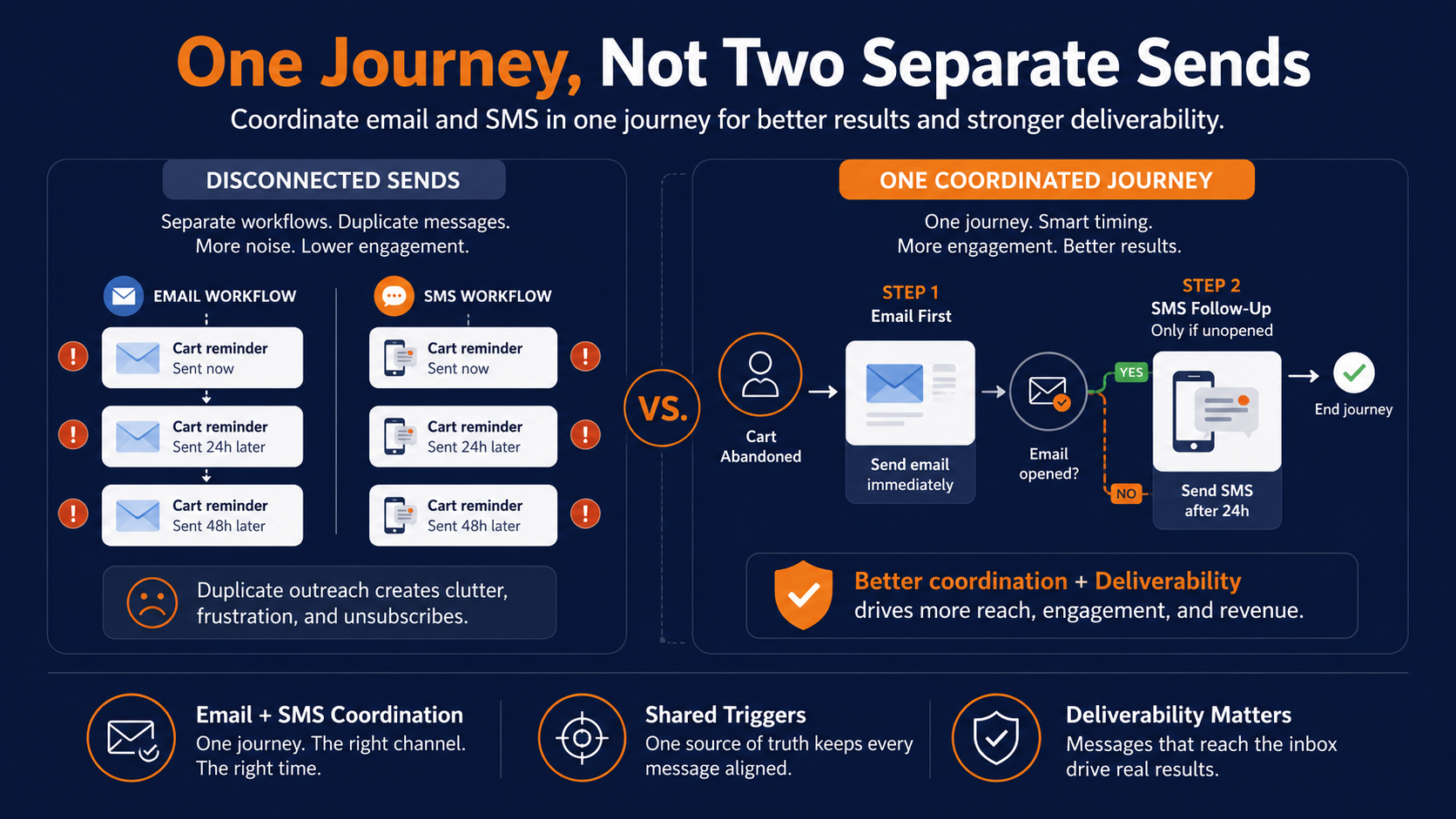
Email and SMS get built as two separate programs at most companies, run by different owners, on different calendars, with no visibility into what the other channel just sent.
A contact abandons a cart, gets an automated email about it four hours later, then gets an SMS about the exact same cart the next morning from a completely unrelated workflow that has no idea the email already went out.
Two systems accidentally repeating themselves at the same person isn't coordination, and the person on the receiving end notices immediately, even if nobody on your team does.
Coordinating sequences instead of running parallel channels
True cross-channel sequencing means one workflow deciding what a contact sees next, regardless of channel, instead of email and SMS quietly duplicating effort.
That could mean the SMS only fires if the email goes unopened after a set window, or the channel choice depends on which one that specific contact actually responds to.
Either way, the decision happens once, in one place, instead of getting made twice by two systems that don't talk to each other.
How bad deliverability quietly burns your sender reputation
This is also where deliverability quietly determines whether any of the rest of this works.
An automated sequence that's technically well-built but consistently lands in spam is worse than no automation at all, because it's actively burning sender reputation on every send instead of just sitting idle.
Behavioral email triggers and dynamic segmentation only pay off if the message actually reaches an inbox in the first place.
Automated Flows Outperform One-Off Campaigns, and the Data Backs It
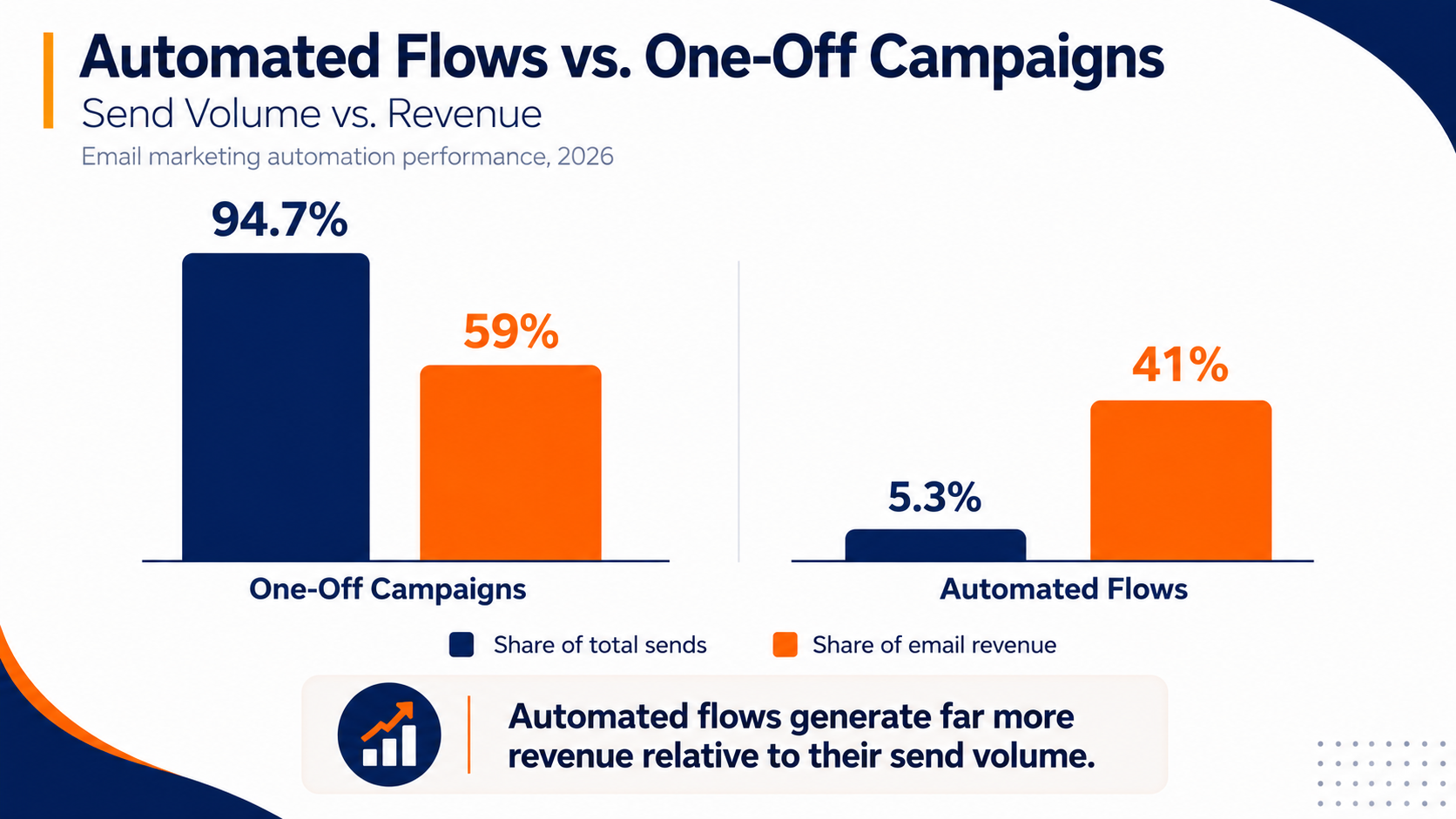
The numbers back it up plainly, and they're the clearest evidence yet that email marketing automation earns its keep. Automated flows generate nearly 41% of total email revenue from just 5.3% of sends, with revenue per recipient running close to 18 times higher than one-off campaigns.
Read that again. A sliver of your total send volume is responsible for a huge share of what email actually earns you. Flows aren't earning that because the copy is better written.
They show up at the exact moment a specific action makes the message relevant, instead of getting broadcast to everyone at once regardless of where they are in the relationship.
|
Metric |
One-off campaigns |
Automated flows |
|
Share of total email sends |
About 94.7% |
About 5.3% |
|
Share of email revenue generated |
Roughly 59% |
Nearly 41% |
|
Revenue per recipient |
Baseline |
Up to ~18x higher |
|
Click-through rate |
Lower |
More than 3x higher |
What this means for your program
If flows are earning that disproportionately well off a fraction of your volume, sending more campaigns isn't the fix. Building out more of the moments that trigger a flow in the first place is.
Welcome sequences, browse abandonment, post-purchase follow-up, win-back sequences for contacts who've gone quiet. Every one of those is a decision point, not a calendar date.
The best teams win by automating specific moments
Most programs stop at three or four flows and call the automation build finished. That's usually a fraction of the decision points actually available.
A contact who downloads a resource, watches most of a product video, or browses the same category three separate times without buying is all handing you a signal a flow could act on immediately.
The teams pulling ahead aren't sending more email overall. They're just building automation around more of the moments that already exist in their own data.
The Personalization Gap Nobody's Automation Is Closing
Here's where most email marketing automation strategies quietly fall apart. Seventy-eight percent of marketers say they need more personalized content than they're actually able to produce. The demand for relevance has outpaced the supply of it, even at companies running plenty of automation.
Usually that gap traces back to content and segmentation, not the tooling. You can have the most sophisticated trigger logic available and still send the same three email templates to every segment, because nobody built enough variation to actually feed the system.
Why more automation isn't the same as better automation
Adding another automated touchpoint on top of a shallow segmentation strategy just multiplies the same generic message across more moments.
Buying a bigger platform won't close it. Going back into your existing behavioral triggers and asking what's actually different about the person receiving this message right now will.
We dug into some of the actual techniques for closing that gap in our post on email personalization that moves the needle, and most of it comes down to using the data you already have instead of collecting more of it.
Don't ignore the entry signal your subscriber arrived with
Think about your own welcome series again. If it's a single sequence sent identically to a first-time browser, a returning customer, and someone who arrived through a referral, you've built one flow doing the work of three.
Each of those contacts arrived with a different signal already attached to them, and a single generic sequence throws that signal away the moment it gets treated the same as everyone else.
Use data you already track to create simple flow branches
The fix rarely means writing more content from scratch. It usually means taking a flow you already have and asking where it should branch based on something you're already tracking, like acquisition source, product category viewed, or whether this is a first purchase or a fifth one.
Small branches, applied to your highest-volume flows first, close more of the personalization gap than an entirely new automated sequence built from nothing.
PRO TIP: Before building a new automated sequence, check whether an existing one could just be split into two or three variants based on a signal you're already tracking. That's often faster than starting from scratch.
Stop Treating a Marketing Automation Platform as a Set-and-Forget Purchase
Most teams don't need a new platform to fix this. They need to admit nobody currently owns going back into these flows once they're live, and assign that job to someone. That's the actual work of email marketing automation, not the initial setup.
Pinpointe's behavioral triggers and dynamic segmentation exist to handle exactly this kind of ongoing adjustment, updating who gets what as behavior changes instead of locking contacts into a segment they qualified for months ago.
If your top automated flows haven't been touched since launch, that's usually the clearest sign something needs a second look. Not a rebuild from scratch, just an honest look at whether the logic still fits how your customers behave right now.
Why Your Marketing Automation Strategy Still Needs a Human Checking In
Automation earns its keep when someone keeps deciding what it should be doing. That welcome series from the opening of this post, the one nobody's touched since launch, is a strategy failure, not a tooling one, the kind that happens when a team assumes automated means finished.
You don't need new software to fix outdated logic
The platforms have caught up. Behavioral triggers, dynamic segmentation, cross-channel sequencing, all of it is available and working right now inside tools most teams already have. Most companies already have the capability.
What they're missing is the habit of going back in and asking whether the logic still matches how customers actually behave today.
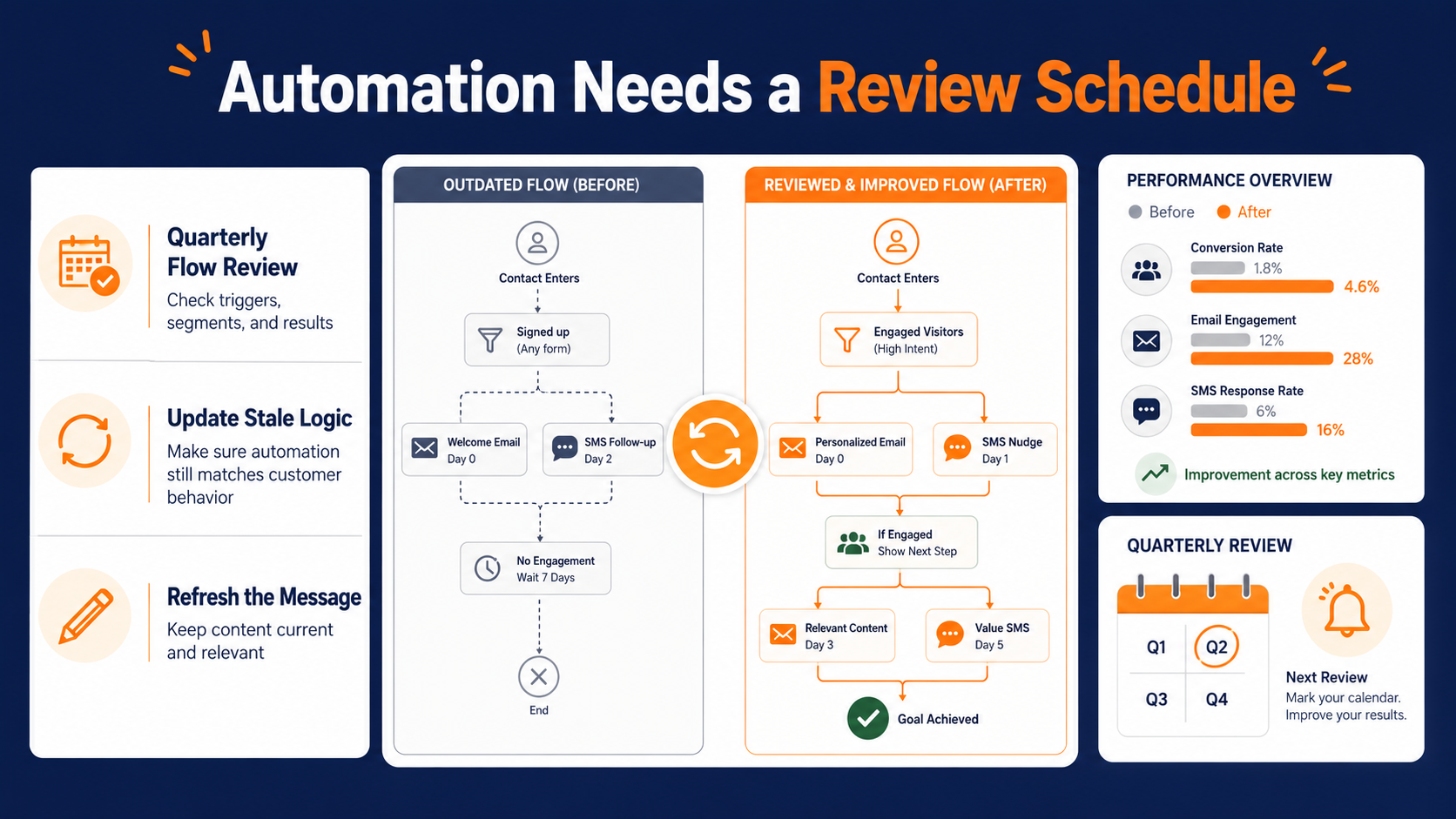
Put a standing quarterly review of your marketing automation tools on your calendar
This doesn't require an overhaul. It requires a schedule. Pick a cadence, quarterly works for most teams, and hold a standing review of your highest-volume automated flows against actual current performance, not the performance you remember from launch.
Bring whoever owns segmentation and whoever owns content into that same conversation, because the gap usually shows up at the seam between the two, not inside either one alone.
Take direct ownership of stale triggers and messaging
So take one flow, just one, and actually look at it this week. Check whether the trigger still makes sense, whether the segmentation still reflects reality, and whether the message still sounds like something you'd send today instead of eighteen months ago. The automation isn't going to flag its own staleness. That part's still on you.
Ready to Find Out What Your Marketing Automation Platform Is Actually Doing?
If you can't remember the last time someone reviewed your top automated flows, that's worth fixing before you build anything new.
Schedule a demo with the Pinpointe team, and get a straight answer on what's working, what's gone stale, and what to fix first.