You're probably running email and social media like two separate jobs. You build your list over here, you post content over there, and you hope the two somehow reinforce each other. They don't, usually. That gap isn't just an inefficiency. It's the biggest untapped lever in your marketing right now.
Building an audience engine that compounds
Here's the thing about brands that actually pull ahead: they build audiences that compound. Every new social follower becomes a potential subscriber for you. Every email subscriber becomes a potential amplifier for your social reach. That flywheel is real, but it only spins if you connect the two channels on purpose.
This post walks through five ways to actually do that, plus the reasoning behind why each one works. If your email marketing strategy still lives in a completely different world than your social calendar, this is where you start closing that gap with some real social media email marketing tactics you can put to work this week.
Why Email and Social Media Work Better Together
Social is exceptional at awareness. Email is exceptional at conversion. Those aren't competing roles, they're sequential ones. Social brings people into your orbit. Email is where you actually earn the relationship.
Email owns the bottom of the funnel
This matters because each channel has a completely different relationship with your audience. On social, an algorithm decides who sees your content and how often. You don't own that reach, full stop. On email, you have a direct line. Your message shows up in a personal inbox that someone invited you into.
That opt-in is the whole ballgame. It's why email consistently returns around $36 for every $1 you spend, beating paid search and social advertising on ROI by a wide margin.
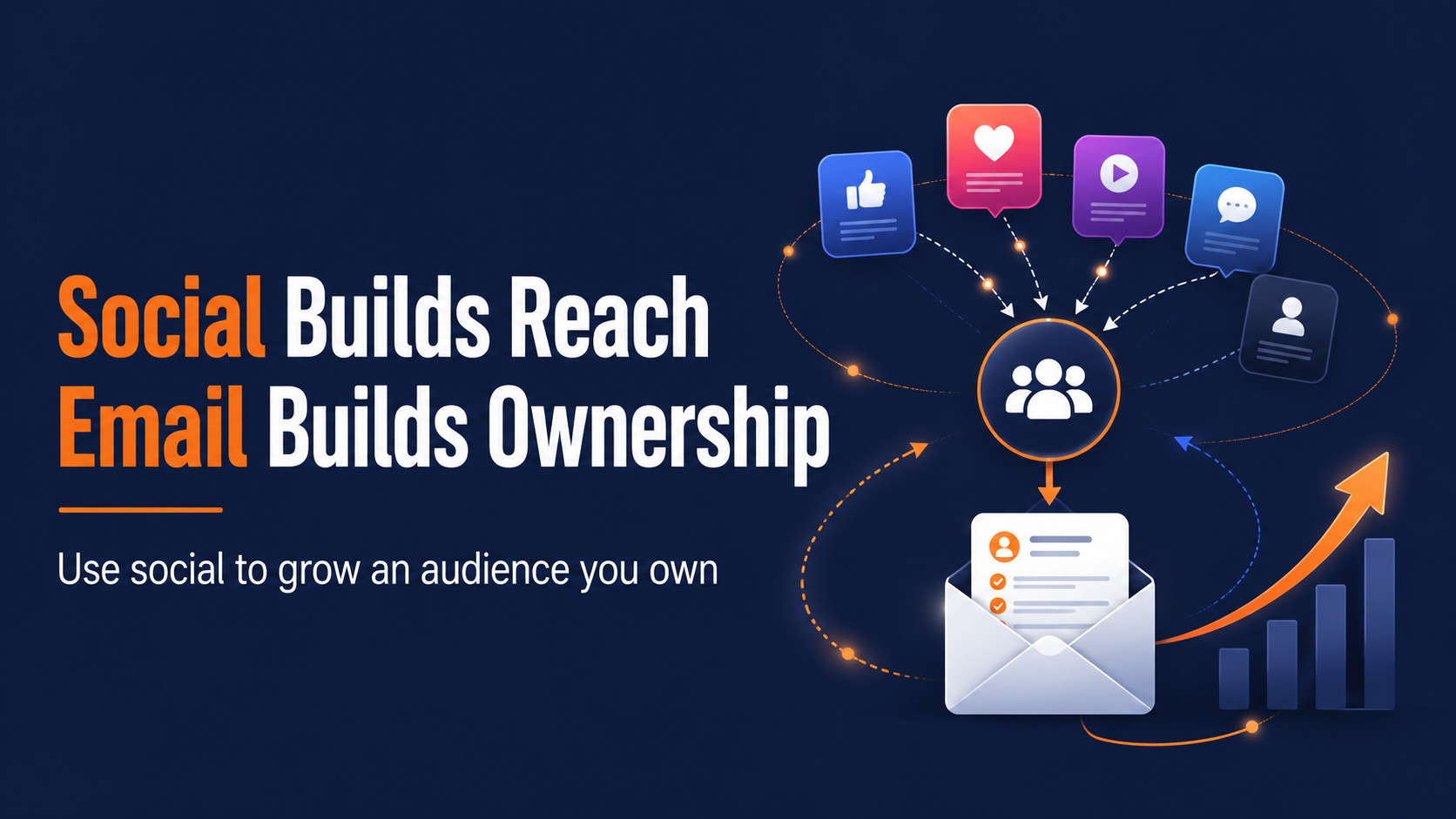
Social Platforms Do Not Belong to You
Here's a reality check most social-first strategies would rather ignore: every major platform can suspend your account, change its algorithm, or gut your reach without warning. It's happened before. It'll happen again.
Your email list, on the other hand, is yours. It doesn't vanish because a platform pivots its monetization model or decides your content category is out of favor. Treating social media as a list-building engine, not just a broadcast tool, is one of the more resilient calls you can make as a marketer.
How email and social fuel each other’s engagement
When you run social and email in parallel without connecting them, you're leaving the compounding effect on the table. Subscribers who also follow you on social tend to engage more with your emails. Followers who receive your emails are more likely to interact with your posts. Put the two together and both channels lift, not just one.
Both email and social media consistently rank among the top three most effective channels for marketers. Integrating them well is what separates programs that plateau from the ones that keep growing.
If you're building out a broader plan here, check out our digital marketing campaign strategy blog post that walks through how to sequence these channels instead of running them in isolation. Getting this right is really just cross-channel marketing done well, not some separate discipline you need a new team for.
1. Align Your Branding Across Both Channels
Consistency is not the same as being identical
Before you run any cross-channel marketing play, get your branding aligned first. This is the part of your email marketing strategy that's easy to skip and expensive to get wrong. That doesn't mean every email has to look like a screenshot of your Instagram feed. It means your voice, your tone, your visual language, and the promise your brand makes should all feel like they're coming from the same place.
When they don't, people notice fast. Someone who follows you on social and then signs up for your list, only to get something that feels like a totally different company, is going to unsubscribe. Worse, they're going to feel like you misled them.
Brand voice is the real throughline
Think of your brand voice as the connective tissue between channels. A subscriber might see your Instagram post at 7 a.m. and open your promo email at noon. If both feel unmistakably like you (same wit, same formality, same visual cues), you're building equity. If they feel like two different creative teams with zero coordination, you're burning trust.
Go audit your last ten emails next to your last ten social posts. Do they read like the same company? Do your CTAs point in the same direction? If the answer isn't an obvious yes, that's where you start.
Color, typography, and tone as brand anchors
Visual consistency matters more in inboxes than most marketers assume. Email clients strip a lot of your styling by default, so your brand elements (logo placement, accent colors, font choices) need to do a lot of work fast. Someone should glance at the preview pane and know it's you before they even read the subject line.
Same goes for your social profiles. Header images, color palettes, and caption tone all send the same signal your email list is already getting. Get this right, and every other integration tactic below has something solid to stand on.
2. Use Social Media to Grow Your Email List
Your social audience is a list waiting to happen
Here's one of the simplest, most overlooked plays in social media email marketing: actively turn your social followers into email subscribers. If someone follows you on Instagram or LinkedIn, they've already raised their hand. The only question is whether you're making it easy, and worthwhile, for them to take the next step.
Most brands don't. They post consistently, build a real audience, and then leave that relationship sitting entirely on a platform they don't control. Pulling that audience over into email is one of the highest-leverage moves you can make this quarter.
Gated content, contests, and lead-gen ads
The best social-to-email tactics tend to fall into three buckets:
- Gated content: a downloadable guide, checklist, or template in exchange for an email address. The value exchange needs to be real. A gated piece that could've just been a blog post won't convert.
- Contests and giveaways that require an email to enter. These build lists fast, though quality matters as much as volume. A prize tied to your product pulls better-fit subscribers than a generic giveaway.
- Paid lead-gen ad formats. Most major platforms let you run ads that auto-populate someone's contact info. Friction is basically zero, so conversion rates beat sending people to a landing page.
Make the newsletter itself worth following
The part people skip: positioning. Don't just ask people to sign up for your newsletter, tell them what's in it for them. Exclusive content? Early access? Deals nobody else gets? Discounts and exclusive offers are the number one reason people subscribe to a brand newsletter. Not curiosity, not FOMO. Tangible value.
Use your social channels to tease what subscribers get that followers don't. A post that says "this week's newsletter had three things we can't post publicly, link in bio" beats a generic "subscribe now" every time.
3. Use Your Email List to Grow Your Social Audience
The relationship goes both ways
The same logic that makes social a list-building tool works in reverse. An engaged subscriber already trusts your brand, which makes them one of the best potential social followers you could ask for. They're more likely to engage, share, and do the kind of thing that extends your organic reach.
Yet most brands bury their social links in an email footer and call it a strategy. It isn't. Passive icon placement gets you passive results.
Social icons are not enough
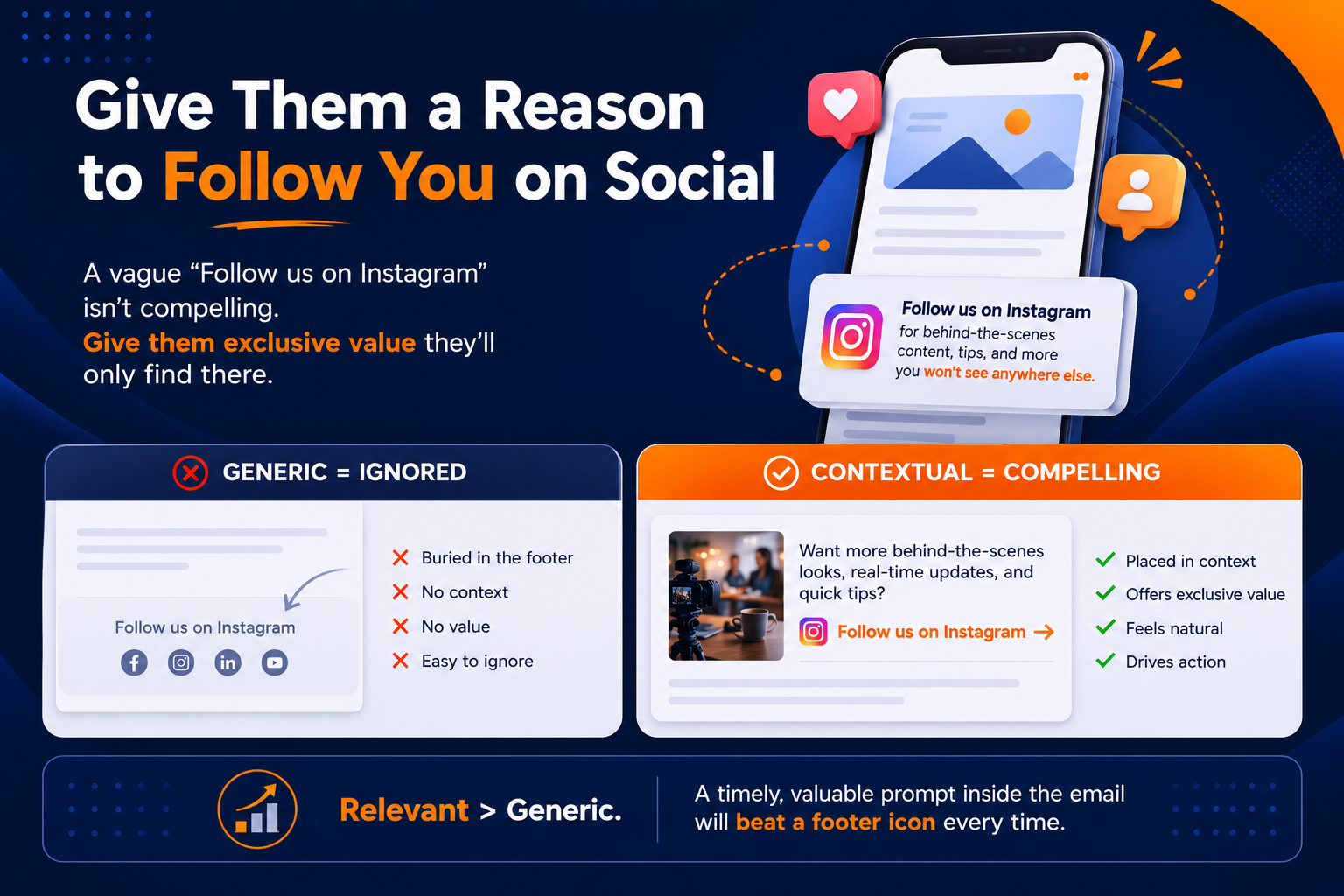
If you want subscribers to actually follow you on social, give them a reason. "Follow us on Instagram" in a footer isn't a reason. "Follow us on Instagram, where we post behind-the-scenes stuff you won't see anywhere else" is a reason.
The best version of this tactic is contextual, not generic. Drop a social prompt into a section of the email where that channel is obviously relevant. A contextual ask will beat a footer icon every time.
Welcome emails and reengagement sequences
Two moments worth prioritizing: your welcome series and your reengagement sequences. A new subscriber is curious and engaged, they just opted in. That's the perfect moment to introduce your social channels as an extension of the relationship they just started.
On the flip side, someone who hasn't opened an email in months might not be ready to reengage with email, but they might still want to connect on social. Offering that as an alternative touchpoint keeps the relationship alive even after email stops working for that person.
Share-to-social links inside your emails
One more underused tactic: build social sharing directly into your email content. If you're sending research, an announcement, or a strong opinion piece, drop in a pre-populated share link so subscribers can post it to LinkedIn or X in one click.
Their share reaches an audience you don't have yet. Every share is free reach, and they get to be the one who shared something worth reading.
4. Upload Your Email List to Build Smarter Social Ad Audiences
Your email list is also a targeting asset
Here's a tactic most marketers understand in theory and skip in practice: your subscriber list can power much better social ad targeting than any interest-based or demographic audience you'd build from scratch.
Facebook, Instagram, and LinkedIn all let you upload a customer email list and match it against their user base to build a Custom Audience. That gets you your existing subscribers, targetable with ads. But the smarter move comes next.
Lookalike audiences: your best customers, multiplied
Once you've built a Custom Audience from your list, use it to generate a Lookalike Audience, a group of people who share behavioral and demographic traits with your subscribers. You're not starting cold. You're finding people who already resemble the audience you've proven can convert.
The quality of your source list matters a lot here. An audience built from your most engaged subscribers (people who open consistently, click through, and buy) will generate better lookalikes than a list built from everyone who's ever handed you an email address. Segment before you upload.
Using a high-quality segmented list to build a 1% lookalike audience can cut cost per acquisition by 40% compared to broad interest-based targeting.
Suppression lists are just as valuable
The flip side is worth building too: a suppression list. Upload your existing subscribers to exclude them from acquisition campaigns.
You're not wasting budget reaching people who already subscribe, you're putting every acquisition dollar toward people you haven't reached yet. That's how you keep cost per new subscriber low and your email list growth efficient.
5. Run Integrated Cross-Channel Marketing Campaigns
Single-channel campaigns leave signal on the table
The most advanced version of cross-channel marketing isn't two separate programs sharing an audience. It's one coordinated campaign that uses each channel for what it's best at, timed to work together.
Picture a launch campaign. Social builds anticipation and drives sign-ups. Email delivers the full story, the offer, the CTA. Social amplifies the proof from people who responded to the email (testimonials, user-generated content, reactions).
Email follows up with behavioral triggers based on what people clicked. Each channel feeds the next one.
Paid social and organic email, working in sequence
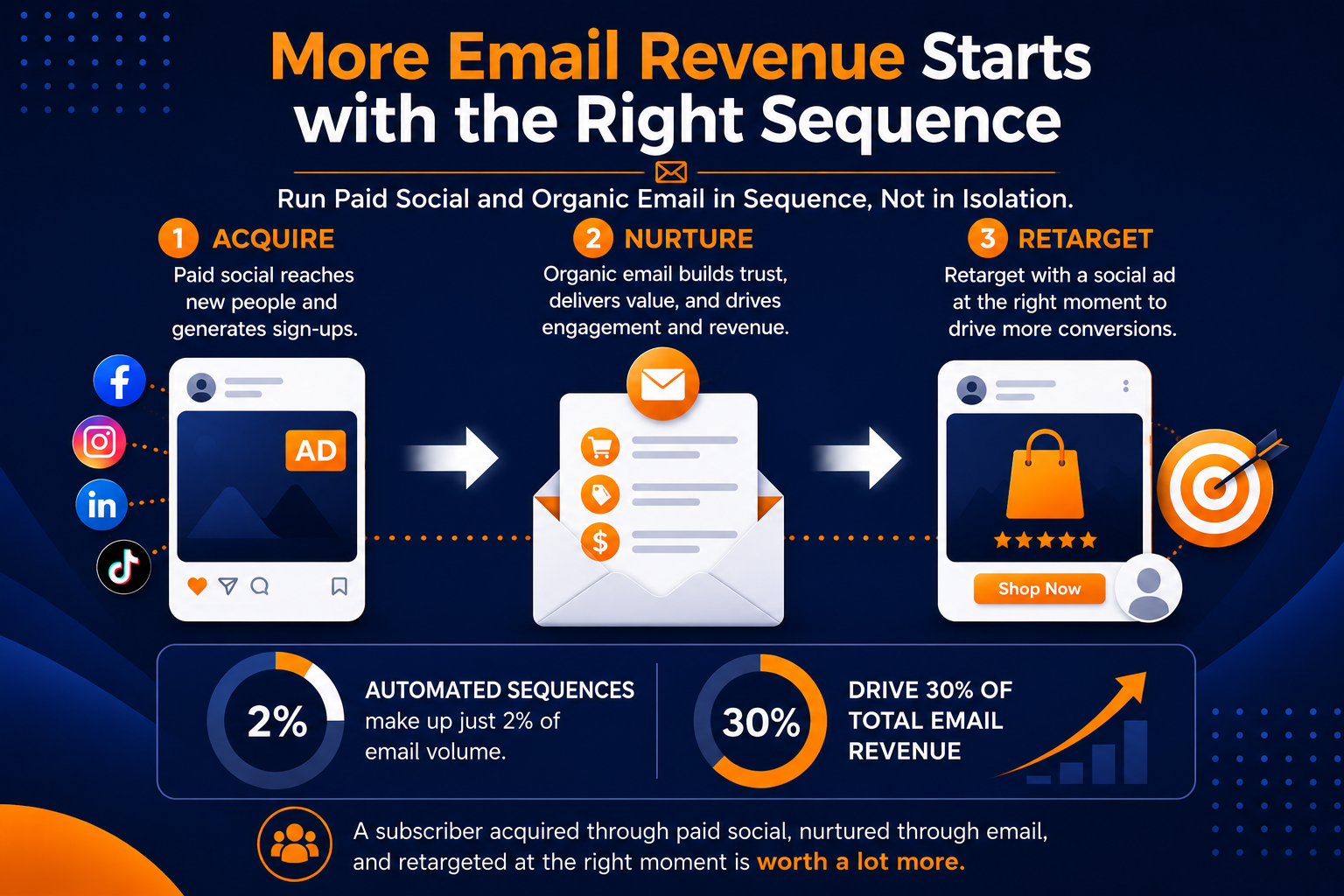
The paid-versus-organic debate gets framed as a choice. It shouldn't be. Paid social is great at acquisition, reaching new people and generating first sign-ups. Organic email is great at retention, revenue, and loyalty. Run them in sequence, not in isolation.
A subscriber acquired through paid social, nurtured through a behavioral email sequence, then retargeted with a social ad at the right moment, is worth a lot more than someone who only ever got broadcast emails or only ever saw an ad. Automated sequences make up just 2% of email volume but drive 30% of total email revenue.
Consistent hashtags, shared content, and cross-promotion
Smaller tactics compound too. A campaign hashtag that shows up in both your emails and social posts gives subscribers a thread to follow across channels. Content shared from email to social, or teased on social before it lands in the inbox, rewards people who engage with both and gives them a reason to keep doing it.
None of this needs to be complicated. It needs to be intentional. Most cross-channel failures aren't tech failures, they're coordination failures. The email team doesn't know what social is running this week. Social wasn't briefed on the email campaign's core message.
Real social media email marketing means both teams plan together instead of just existing at the same time, which is a lot of what separates the brands that actually pull this off from the ones still posting and emailing in parallel.
How We Help You Actually Pull This Off
One Platform, Both Sides of the Conversation
Everything above is doable. Where most teams get stuck isn't strategy, it's execution. Pulling off email and social media integration well takes behavioral data, automation, and the ability to move fast the moment a subscriber signals intent. If your email platform lives in one tool and your customer data lives in another, you lose that signal before you can act on it.
We built Pinpointe around that exact problem, because a modern email marketing strategy shouldn't stall out the second it touches another channel. Our platform combines email and SMS in a single omni-channel journey builder, which means the behavioral triggers that fire off a subscriber's actions (an open, a click, a stretch of silence) can inform every touchpoint downstream, not just the next email in line.
Behavioral triggers that connect the channels
When someone clicks through a campaign about a specific topic, our behavioral automation can route them straight into a follow-up sequence that matches what they just showed interest in, no manual segmentation required.
That same signal can shape how you target them on social too: suppress them from acquisition campaigns, seed them into a lookalike list, or trigger a retargeting sequence tied to exactly what they clicked.
You end up with an audience strategy where your email data makes social smarter, and your social reach makes your list stronger. That's the kind of email and social media integration most teams say they want but rarely pull off, because it needs both channels pulling from the same behavioral foundation.
Dynamic segmentation across every touchpoint
Our dynamic segmentation updates in real time as subscriber behavior shifts. Someone who went quiet last month but clicked three emails this week doesn't need a reengagement sequence, they need content that matches their renewed interest, sent right away. That's the difference between an email program that feels personal and one that feels like it's running on a timer.
Pair that with Pinpointe's deliverability infrastructure, built to protect your sender reputation and get your messages into inboxes, and you've got what you need to run coordinated, high-performing marketing automation across email and SMS without duct-taping two separate systems together.
Stop Treating Email and Social Like Separate Jobs
Stop optimizing each channel in isolation
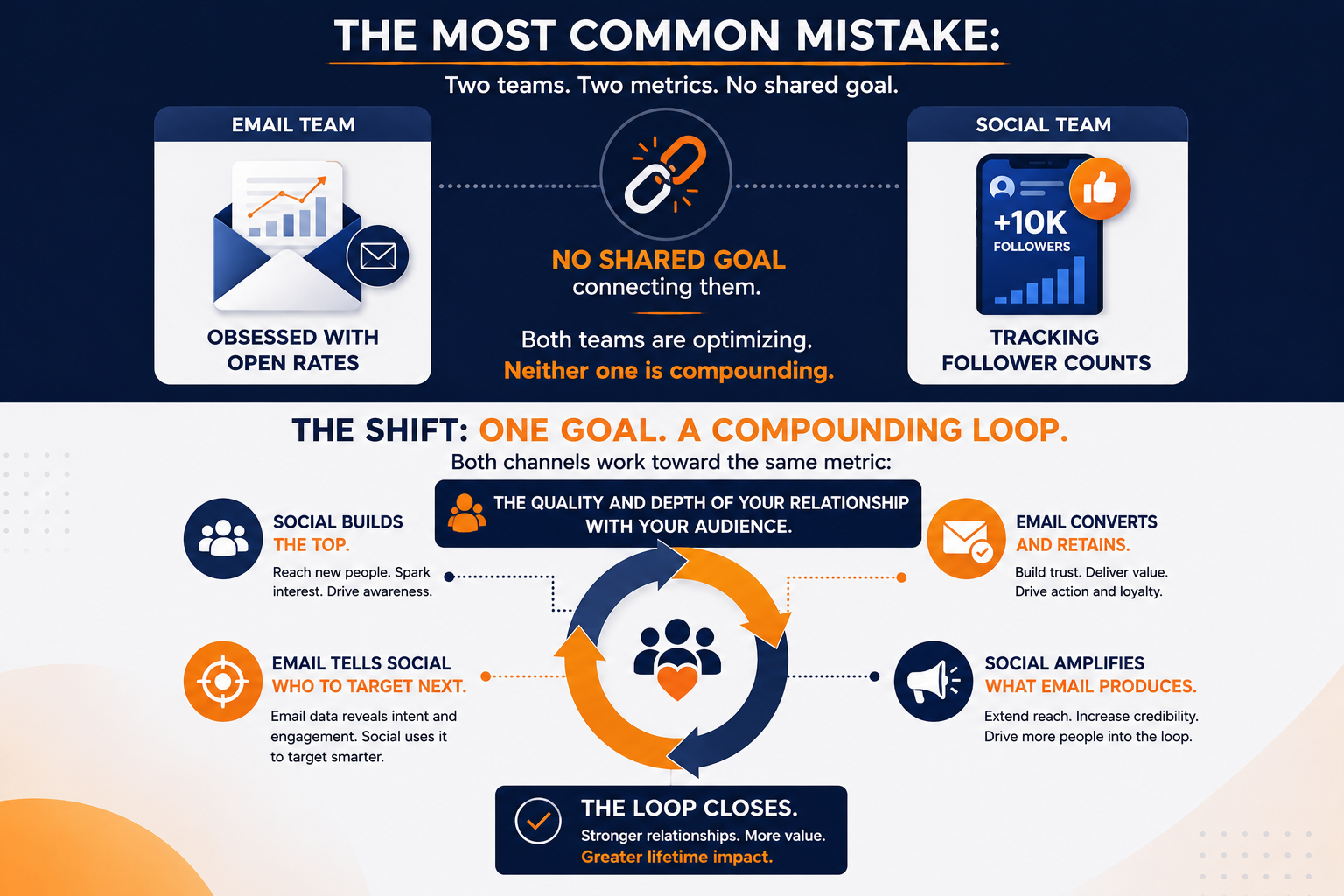
Here's the most common version of the mistake: an email team obsessed with open rates, a social team tracking follower counts, and no shared goal connecting them. Both teams are optimizing. Neither one is compounding.
The shift happens when both channels start working toward the same metric, the quality and depth of your relationship with your audience. Social builds the top. Email converts and retains.
Social amplifies what email produces. Email tells social who to target next. The loop closes.
Integration is a decision, not a tactic
You can't bolt this onto two programs built to run independently. It has to be designed in from day one: shared data, shared audience definitions, shared campaign calendars.
None of the tactics above are complicated. The commitment to running them consistently is what most teams never quite get to.
But the teams that do, the ones where the email list grows because of what's happening on social, and the social following grows because of what's happening in email, build audiences that are a lot harder to compete with.
It's not just more subscribers. It's subscribers who show up across more than one channel, which makes every message you send more likely to land.
Where to Start
If you're starting from zero, pick one tactic from this post and commit to it for sixty days. Add a social follow prompt to your welcome sequence. Build a lead-gen Facebook ad around a gated piece of content.
Upload your top-engaged subscribers as a Custom Audience seed. Any one of these, done consistently, moves the needle. The rest builds from there.
The question isn't whether social media email marketing is worth the effort, the data settles that. The real question is whether your cross-channel marketing actually behaves like one strategy, or just two teams sharing a calendar invite.
Are you ready to stop running these two channels like they've never met?
See how Pinpointe closes the gap between email and social
Stop leaving your audience flywheel to chance. Book a quick demo of Pinpointe to see how automated behavioral triggers, real-time dynamic segmentation, and omni-channel messaging can turn your separate strategies into one compounding growth engine.