
A warm follow-up email is a message to someone you already have a connection with, such as a person you met, a lead who downloaded your guide, or a contact who asked for pricing, that picks up the earlier conversation and asks for one clear next step. Because they already know who you are, the email's job is to remind them why you talked and make replying easy.
You had a good call on Tuesday. They asked good questions, asked you to send something over, and then went silent.
That silence doesn't have to mean no. Your email may have landed on a busy afternoon and got lost in the shuffle.
This guide covers how to write a warm follow-up, how to title it, how many to send, and examples for the most common situations. One clarification first. "Warm email" also gets used for email warm-up, the deliverability practice of ramping up a new sending domain. That's a different topic. This one is about people and following up effectively.
Key Takeaways
- Define it by shared history: A warm follow-up email is a message to someone who already knows you, from a meeting, a referral, a download, or an earlier reply, that picks up that context and asks for one next step.
- Plan for more than one email: In Belkins' 2026 report on 7.5 million cold B2B emails, follow-up messages accounted for 58.6% of all replies, while the first email captured 41.4%.
- Make one clear request: A good follow-up request email names the exact next step, adds one new thing, and stays at no more than 125 words, which is Bouncer's recommendation.
- Title a follow-up email around the action: Name what the person did or asked for. Belkins found a 46% open rate for personalized subject lines against 35% without, but GetResponse found personalized subject lines opening at 18.79% versus 22.14% for generic ones.
- Start with two follow-ups: For warm contacts, a sensible starting point is two follow-ups after your original message, three emails in all, then stop when they reply, book, or decline.
In this guide
What Makes a Follow-Up Email Warm
Warmth comes from shared history with your reader. If the person has met you, replied to you, downloaded something from you, or been introduced to you, your next email carries context that a stranger's email can't.
That context does the heavy lifting for you. A warm email references a real interaction the two of you share, which gives the reader a reason to open it instead of deleting it.
Warm vs cold follow-ups
A cold email has to earn a reader's attention from zero. A warm email continues something that already exists. That changes everything downstream, because the subject line can be plainer, the opening can skip the introduction, and the ask can be more direct and still be effective.
You'll see plenty of published reply rates claiming warm outreach beats cold by a wide margin. The numbers vary so much from source to source that none of them is worth planning around.
The mechanism is the useful part. The reader already knows who you are. If your list isn't responding as you had hoped, this guide to warming up your cold email marketing strategy is a good place to start.
Two kinds of warm follow-up
Not every warm follow-up email should be the same email. There are two situations, and they call for different timing.
The first is responding to fresh interest. Someone just booked a demo, downloaded a guide, or asked for pricing, and speed matters. Hunter's warm-lead guidance recommends responding within the same business day, and if your team can't manage that, sending a short automated acknowledgment that sets expectations rather than leaving the person hanging.
Timing, triggers, and re-engagement
The same logic shows up in marketing email. An NP Digital analysis of 162 million emails found trigger-based emails averaged a 56.1% open rate, compared with 28.5% for scheduled sends.
Since these are automated marketing messages, not one-to-one notes, treat the comparison as directional for follow-up emails. It suggests behavioral email, meaning a message tied to something the reader just did, tends to land better than one sent on the sender's schedule.
The second is the reminder after silence. You sent the recap, the proposal, or the answer they asked for, and nothing came back. This email needs a new reason to reply, because repeating the last one just asks them to ignore it twice.
How to Write a Warm Follow-Up Email
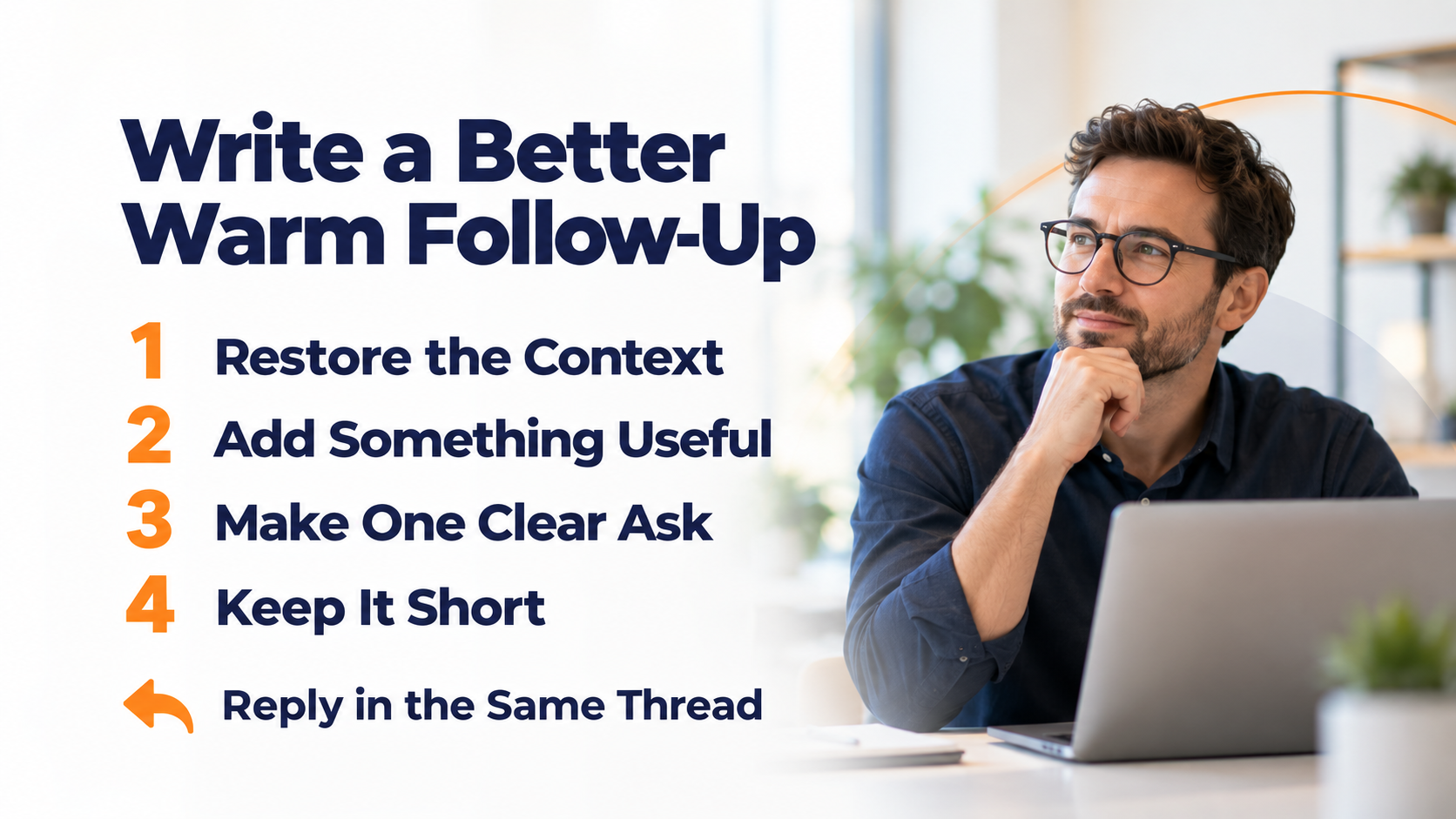
Every good warm follow-up does four things. It restores the context, adds something useful, asks for one specific thing, and stays short.
Open with the shared context
Skip "I hope this email finds you well." Your first line should name the thing you share, and specifics win. "The integration question your ops lead raised" places you instantly. "Our recent conversation" makes the reader work.
If they can't place you in one sentence, the rest of the email doesn't get read and the likelihood you end up in the spam folder skyrockets.
Add one new thing
A follow-up that only says "just checking in" gives the reader nothing to respond to. Give them a reason to reply, like an answer to a question they asked, a relevant example, a short resource, or a date that changed.
Belkins makes the same point about outreach sequences, advising that the third email, which is the second follow-up, should arrive with a different angle or proof point instead of a recycled nudge. The research is about cold outreach, but the principle carries over. Every message should earn its place in the inbox.
Make one clear request
A vague ask is an easy way to lose the reply. "Let me know your thoughts" is an ask with no edges. Your ask is an email call to action, so give it one clear step.
A good follow-up request email names the exact next step. LeadHaste's guidance for warm opportunities is to anchor the email on whatever was left unresolved last time and ask for the specific step you already discussed, rather than asking whether they had a chance to look.
Keep it to one ask per email. Two asks force a choice, and a busy reader's easiest choice is to answer neither. Make it easy to say yes with a specific time, a yes-or-no question, or a single document to review.
Keep it short
Bouncer's warm follow-up guide recommends keeping these emails to no more than 125 words. Treat that as a guideline rather than a rule.
It forces the right discipline. If you can't say it in a short paragraph or two, you're probably writing two emails.
Reply in the same thread
When you're following up on an earlier email, send it as a reply. Replying in the existing thread can help keep the earlier message and your original subject line in front of the reader, so they don't have to search for context.
Exactly how a thread displays depends on the email client, but when you position your email as a continuation of an existing conversation, the likelihood the email gets a response goes dramatically up.
How to Title a Follow-Up Email
The subject line decides whether your context ever gets seen. For a warm follow-up, your best asset is the history you share, so put it where the reader sees it first. For the wider data on what gets opened, these email subject line best practices are worth a read.
Name the thing they did or asked for
Hunter's warm-lead templates recommend subject lines that reference the specific action the lead took, like the guide they downloaded or the product they asked about. Hunter also advises against a bare "Following up," which tells the reader nothing about what's inside.
That's more advice from results seen in practice than a detailed controlled study, but the advice is sound. A subject line that names their request reads like a reply to them. "Following up" reads like a reminder from a stranger.
A few subject lines that follow this pattern:
- Notes from Tuesday's call, plus the timeline you asked for
- The pricing breakdown for [Company]
- Your question about the [integration] setup
- [Referrer's name] suggested I reach out
Keep the original subject when you reply
If you're replying in the thread, leave the subject alone. The "Re" prefix tells the reader this continues a conversation they were part of, which is the signal you want.
Personalize with something real
The evidence on subject-line personalization is mixed. In Belkins' 2025 study of cold B2B email, personalized subject lines averaged a 46% open rate, against 35% without. GetResponse's 2022 benchmark, based on emails sent the previous year, found the reverse, with personalized subject lines opening at 18.79% versus 22.14% for generic ones.
One plausible reading is that a first name dropped into a template is easy to spot as automation, while a detail only the two of you know reads as a person wrote it. Neither study tested that directly, so treat it as a hypothesis.
If the hypothesis holds, it favors warm follow-ups. You already have the real detail in hand. For more on getting personalization right, see these email personalization techniques.
Try a question
Belkins also found question-style subject lines among the top performers in its cold email study, at a 46% open rate. In a warm follow-up, a question works best when it's the actual decision you need answered, so send something like, "Still aiming for a March launch?"

Warm Follow-Up Email Examples You Can Adapt
Below are some Pinpointe-original examples written to show the techniques above. However, they aren't real campaigns, so we don't have performance data to go with them.
When you use these, you'll want to swap in your own details, especially the specific ones, because those are what make the emails work.
After a meeting or discovery call
The goal here is to lock in the next step while the conversation is still fresh. Subject line first, then the body.
> Tuesday's call and the rollout timeline
>
> Hi [First name],
>
> Thanks for walking me through how your team handles [process] today. You mentioned the bottleneck is [specific problem], so I put together a rough timeline for fixing that first. It's attached.
>
> Does Thursday at 2 p.m. work to go through it with [stakeholder]?
>
> [Your name]
It names a detail from the call, delivers what was promised, and asks for one meeting at one time.
After a download or inbound request
This is a fresh-interest follow-up, so send it promptly.
> The [guide name] you downloaded
>
> Hi [First name],
>
> Glad the [guide name] was worth grabbing. If you're working on [goal the guide addresses], the checklist on page [number] is where most teams start.
>
> Want me to send two examples of how other teams have set this up?
>
> [Your name]
It points to one useful part of what they already have and ends with a yes-or-no offer.
After a referral or introduction
The referrer is your context, so lead with them.
> [Referrer's name] suggested I reach out
>
> Hi [First name],
>
> [Referrer] mentioned you're working on [project] and thought we should talk, since [one-line reason]. Rather than guess at what you need, I'll ask one question.
>
> Is [problem] something you're trying to solve this quarter? If yes, I'll send a short outline. If not, no problem at all.
>
> [Your name]
It borrows trust from the introduction, asks instead of pitching, and gives the reader an easy way out.
After silence on a proposal
This one needs a new reason to reply.
> Still targeting [date] for the decision?
>
> Hi [First name],
>
> When we last spoke, you planned to review the proposal with [stakeholder] before [date]. Since then, [new information, such as an answer to the open question about X or an updated timeline].
>
> Is the review still on track, or has the timeline moved? Either answer helps me plan on my end.
>
> [Your name]
It anchors on the commitment left open, adds something new, and asks a question that's easy to answer in one line.
How Many Follow-Ups to Send and When to Stop
Most of the data quoted on this question comes from cold sales outreach. So read it with that in mind and understand that your numbers could perform better if you are sending it to a warm audience.
What the cold outreach data shows
In Belkins' 2026 report analyzing 7.5 million cold B2B emails sent during 2025, follow-up messages accounted for 58.6% of all replies, while the first email captured 41.4%. The first email still had the best reply rate of any single step. The follow-ups simply added up to more.
Woodpecker's data points in the same direction. Campaigns that included at least one follow-up averaged about 13% replies, compared with roughly 9% for campaigns without one. That's an observed difference between campaigns, not proof that one extra email causes a four-point lift.
These are emails to strangers, and large-scale, well-documented data for warm contacts is hard to find. And while the numbers don't predict how your follow-ups will perform, they do show how often the first email isn't the one that gets the answer.
A reasonable cadence for warm contacts
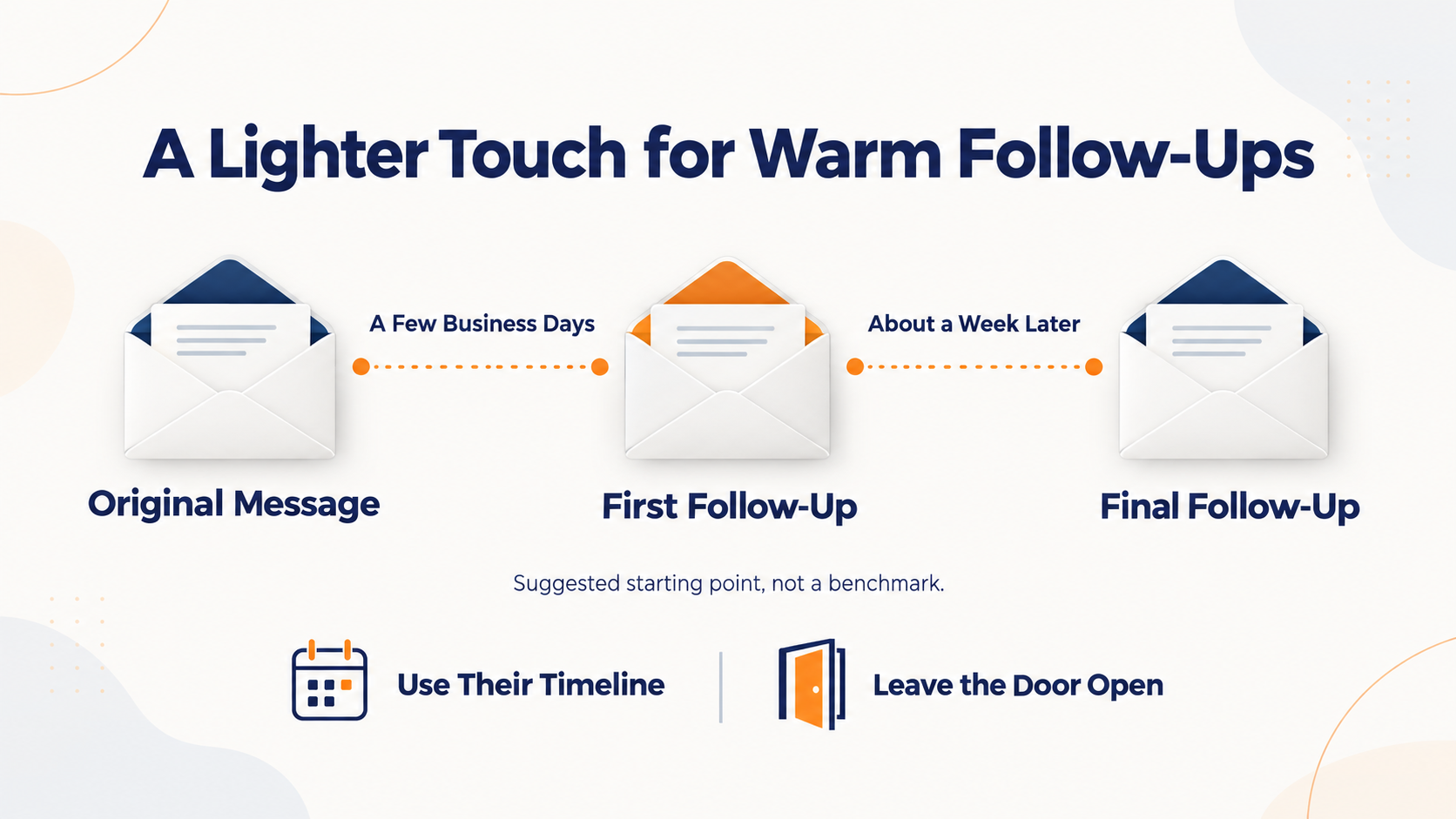
Belkins puts the practical sweet spot for cold B2B sequences at three to five emails in total. For warm contacts, a lighter touch usually fits better.
As a starting point, plan on two follow-ups after your original message, and three emails in total. You should space the first a few business days out and the second about a week after that. This is editorial guidance, not a measured benchmark, so adjust this according to how the person engages in your typical audience.
If they gave you a date, use it. "Let's talk after the board meeting" is a follow-up schedule they handed you, and it beats any rule of thumb. To automate the spacing and reduce tasks you have to remember, build the sequence as a drip email campaign.
Know when to stop
Every extra nudge that you send spends a little goodwill, and with a warm contact you have more to lose. Keep going past the point of interest, and you risk an unsubscribe, a spam complaint, or a relationship that was going fine turning sour. That's a judgment call you'll need to make, and it relies on instinct with someone you know compared to a hard metric you'll measure.
Close the loop instead of fading out. Belkins suggests ending a sequence with a low-commitment, long-horizon ask, something like asking whether it's worth reconnecting next quarter. That kind of last email leaves the door open, and it takes the reader five seconds to answer.
Mistakes That Make a Warm Follow-Up Go Cold
A warm follow-up can go cold for a handful of predictable reasons, and each one has a simple way to fix it.
Writing it like a cold email
If you open with a company introduction and a pitch, you've thrown away the one advantage you had. Start with what you share.
Saying just checking in
It asks the reader to do the work of remembering why you're writing. Replace it with the specific context and one new thing.
Stacking asks
Asking for a call, feedback on the deck, and an intro to their CFO in one email hands the reader three decisions. Pick the one that moves things forward and save the rest.
Writing a wall of text
A long recap reads like homework. If the email takes longer to read than it took them to agree to the meeting, cut it.
Following up with no off switch
A sequence that keeps firing after someone has replied, booked a meeting, or said no is the fastest way to make a warm contact feel like a list entry. Whatever sends your follow-ups, make sure a reply stops the sequence.
Automating Warm Follow-Up Emails Without Losing the Personal Touch
A warm follow-up works because it continues a conversation. Name what you share, add one new thing, ask for one clear next step, keep it short, and stop before persistence turns into pressure. The subject line should point straight back to what they did or asked for.
Writing one good follow-up is the easy part. Sending the right one at the right moment, for every lead who raises a hand, is where follow-up falls apart.
That timing is the part worth automating. In Pinpointe, behavioral trigger campaigns can fire on the actions that make a contact warm in the first place, like joining a list, clicking a specific link, or opening a specific email, so the first follow-up goes out while the interest is fresh. Drip autoresponders then handle the timed steps after that, so the second and third touches go out on schedule without anyone remembering to send them.
Automate the timing, personalize the message
The personal touch still comes from you. Write the follow-ups using everything above, and let the system handle when they go out.
An example of this is 21st Mortgage, a Berkshire Hathaway company, which used drip campaigns on Pinpointe that follow up automatically with homebuyers who start a loan application and don't finish it. That's a warm follow-up in its purest form. Someone showed interest, stopped partway, and got a nudge tied to exactly what they left unfinished.
Find the follow-up gaps in your own program
If you want to see where follow-ups are getting dropped in your own funnel, book a free marketing automation audit with our team. We'll analyze your current setup, identify the bottlenecks, and give you a clear, actionable automation roadmap.

Frequently Asked Questions
These cover the questions people most often ask about warm follow-up emails.
What is a warm follow-up email?
A warm follow-up email is a message to someone who already knows you, from a meeting, a referral, a download, or an earlier reply, that picks up that context and asks for one next step. A cold email, by contrast, goes to someone with no prior contact.
How long should you wait to send a warm follow-up email?
If the person just showed interest, respond quickly. Hunter recommends the same business day at the latest. If you're following up after silence, wait a few business days before the first nudge and longer before the next. If they gave you a date, follow up on that date.
What should a follow-up email subject line say?
It should name the specific thing the person did or asked for, such as the call you had or the guide they downloaded. If you're replying to an earlier email, keep the original subject so the conversation stays in one thread.
How do you politely ask for something in a follow-up email?
Make one specific request tied to what was left unresolved last time, like a meeting time or a yes-or-no answer. Giving the person an easy way to decline makes replying feel lower stakes.
How many times should you follow up?
For warm contacts, two follow-ups after your original email is a sensible starting point. In Belkins' cold outreach data, follow-up steps produced 58.6% of replies, versus 41.4% from the first email, but the right number for someone you know depends on how they've engaged. Stop as soon as they reply, book, or decline.