Most landing pages fail not because of poor design, but because of delayed follow-up and a breakdown between marketing and sales allignment.
Automated landing page workflows bridge the critical gap between opt-in and sales engagement by immediately delivering requested value, establishing domain deliverability, and dynamically routing leads based on real-time behavior.
Key Takeaways
Speed drives revenue & deliverability:
- The Immediate Welcome Send: This capitalizes on peak buyer interest while signaling positive engagement to mailbox providers (Gmail, Outlook).
- Compliance Is Non-Negotiable: Multi-region databases must adhere to the strictest applicable laws (GDPR, CAN-SPAM, CASL). Always capture explicit consent with documented metadata (timestamps, opt-in source) to protect against severe fines and reputation-damaging spam complaints.
Proven workflow architecture:
- Asset Delivery: Instant gratification that secures open/click signals.
- Value Amplification: Follow-up content focused on problem-solving rather than immediate hard pitches.
- Progressive Profiling: Collect demographic details gradually across multiple interactions instead of using long, friction-heavy initial forms.
- Behavioral Branching: Route contacts into customized paths (e.g., alert sales for enterprise signals, or send lower-frequency nurture for smaller prospects).
Essential technical baselines
High-performing workflows require complete email authentication (SPF, DKIM, DMARC) to avoid SMTP-level rejections, along with real-time, bidirectional CRM sync to ensure sales and marketing share identical lead data.
Capitalize on peak prospect interest the moment they raise their hand
The gap between the opt-in and the first meaningful touch is where most of your conversion potential leaks out. But having automated landing page workflows can fix that issue.
Instead of a form that dumps names into a spreadsheet, you get a system that responds the moment someone raises their hand, delivers what they asked for, and starts learning who they are with every click.
This is the difference between collecting leads and actually converting them. In this post, we'll dive into how you can maximize conversions with automated landing page workflows!
The Power of Automation in Landing Page Follow-Up
The difference between a high-performing landing page and an underperforming one often lies not in the page design itself, but in what happens immediately after a prospect opts in.
Automated follow-up workflows transform your landing page from a static data collection point into a dynamic conversion engine that nurtures prospects through their buyer journey without manual intervention.
Use marketing automation to capitalize on buying intent immediately
When a visitor converts on your landing page, they're signaling intent at a critical moment. Automated workflows capitalize on this momentum by delivering immediate value while simultaneously collecting behavioral data that refines your segmentation strategy.
This dual-purpose approach ensures that your first touchpoint serves both as a deliverability signal-boost and as an intelligence-gathering mechanism that informs all subsequent communications.
How marketing automation improves sales follow-up
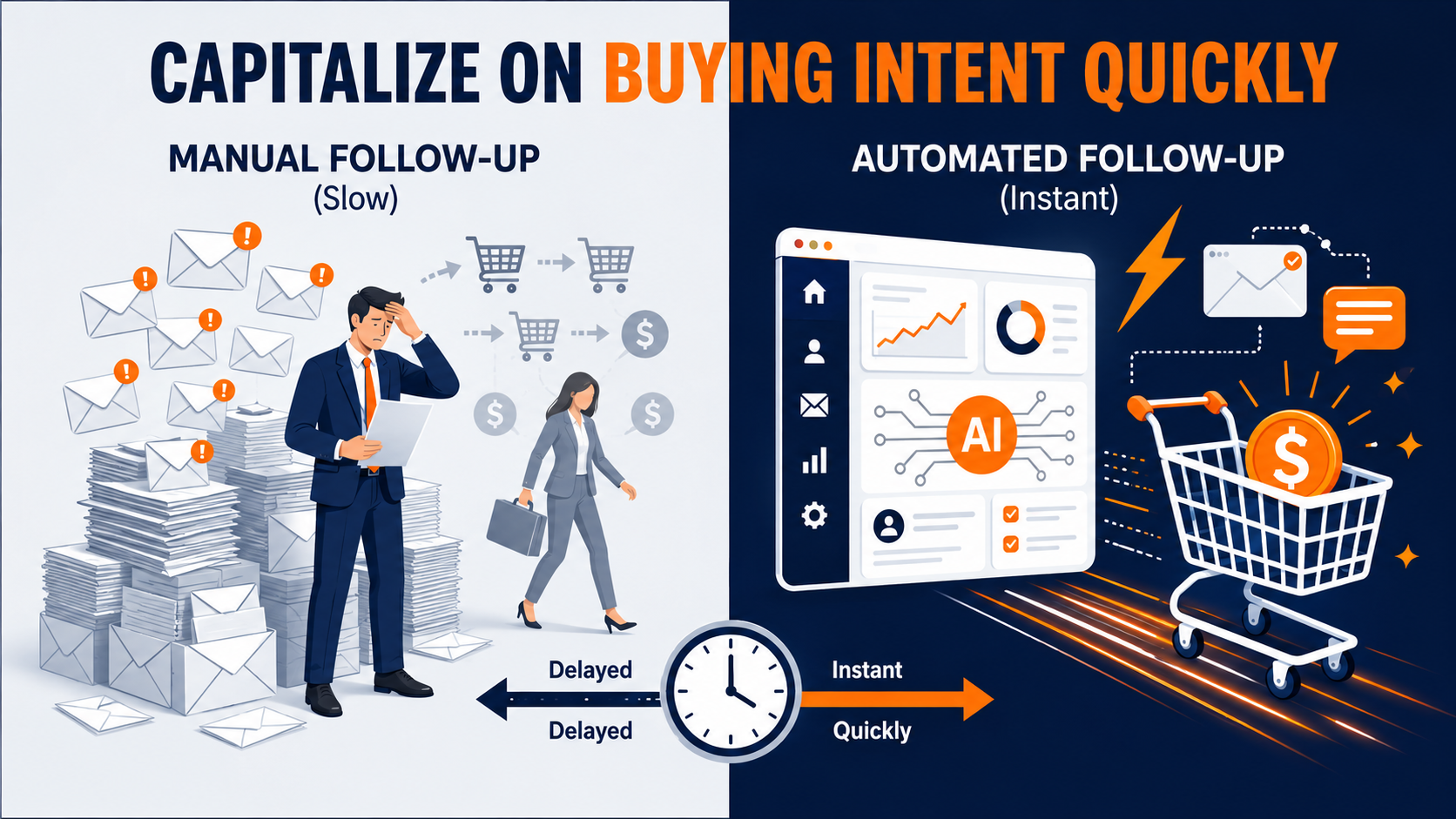
The moment someone converts on your landing page is the peak of their interest in you. Not next week. Not whenever your team clears its queue. Right then.
Marketing automation exists to capitalize on that window before it closes. The data on this is hard to argue with. Automated emails drive 37% of all email-generated sales while making up just 2% of total email volume.
It means the tiny sliver of your email program that fires automatically, triggered by something a person actually did, does the heavy lifting for revenue.
The reason is timing. A broadcast email hopes someone is in a buying mood when it lands. A triggered email arrives because someone just told you they're interested. This automation can take the follow-up burden off your sales team and drive conversions faster and even on autopilot.
Stay Compliant Before You Scale: Consent, Privacy, and the Law
Before you build a single trigger, understand this. Every data point you collect, every behavioral tag you apply, and every nurture email you send is governed by law. Skipping this part doesn't make it optional and a single mistake can be costly.
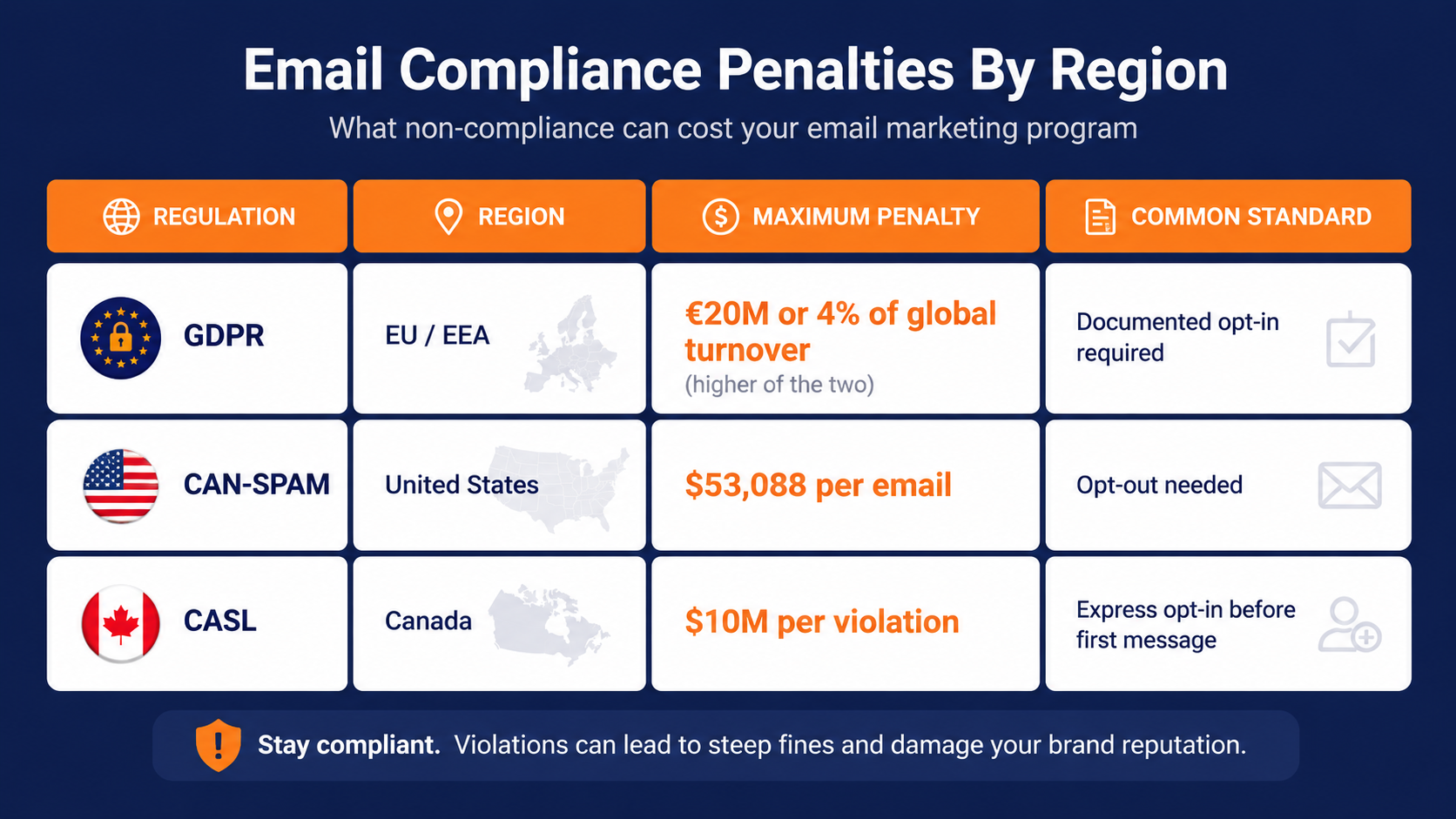
If you email anyone in the EU, GDPR requires a documented lawful basis before you process their data, and an email address counts as personal data. The penalties aren't just theoretical. Violations can reach €20 million or 4% of global annual turnover, and CAN-SPAM now carries fines of up to $53,088 per non-compliant email in the US. Canada's CASL is stricter still, demanding express opt-in before the first commercial message.
Multiply that per-email figure across a single sloppy send to a purchased list and the math gets frightening fast.
When laws conflict, follow the strictest one you touch
The practical rule for any multi-region list is simple. If your database includes US, Canadian, and EU contacts, treat the entire list like an opt-in list. Document where every consent came from. Process opt-outs immediately instead of queuing them for a weekly batch.
This matters beyond legal cover, though. Consent and deliverability have become the same conversation. Mailbox providers don't separate legal risk from sender quality. They look at complaints, engagement, bounce rates, and authentication together, and a list built on weak consent produces exactly the complaint signals that wreck your reputation.
Build your data on a foundation that holds
Build your forms with unchecked opt-in boxes and store the consent metadata that proves what happened. This means including things like a timestamp, source form, and what the subscriber actually agreed to.
And remember the scope of that agreement. Someone who signed up for shipping updates did not agree to your weekly promo blast. One guide download doesn't open the door to every campaign on your calendar. Respecting that boundary is how you keep the complaint rate down and the sender reputation intact.
Pro Tip: Store the exact opt-in source and timestamp on every contact record, so when a complaint or audit happens you can show precisely what each subscriber agreed to.
Building High-Converting Workflow Sequences
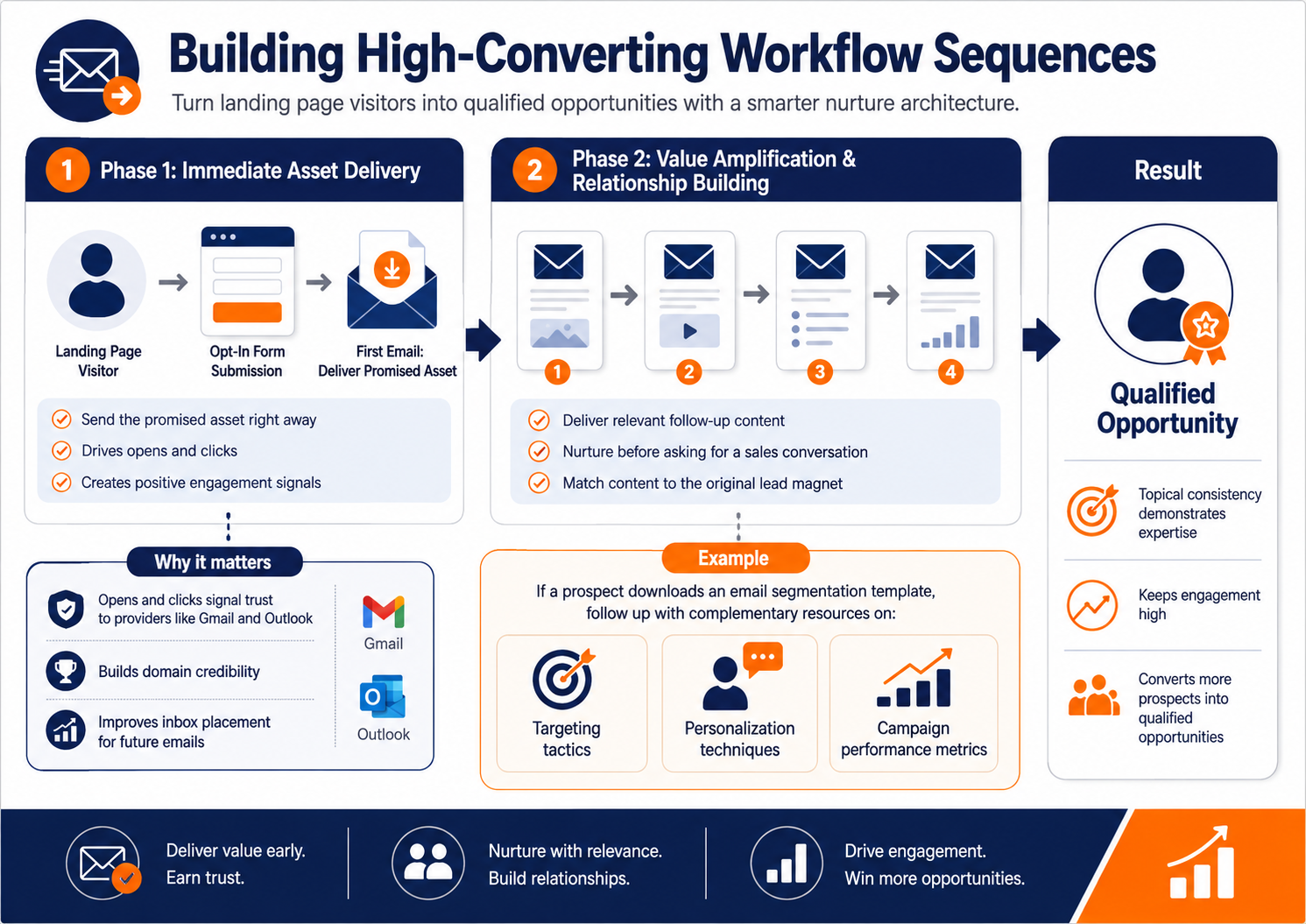
The architecture of your automated workflow sequence determines how effectively you convert landing page visitors into qualified opportunities. A high-converting sequence begins with immediate asset delivery in the first email, which serves as your primary deliverability mechanism.
When recipients open and click to access their promised resource, they send positive engagement signals to Internet Service Providers like Gmail and Outlook, establishing your domain's credibility and improving inbox placement for all future messages.
Phase 2 of building your optimized nurture workflow
The second phase of your workflow should focus on value amplification and relationship building. Rather than immediately pushing for a sales conversation, deploy a nurture sequence that delivers additional relevant content based on the specific lead magnet that triggered the opt-in.
If a prospect downloaded a template on email segmentation strategies, your automated sequence should deliver complementary resources.
For example, you could focus on information related to subjects like targeting tactics, personalization techniques, and campaign performance metrics. This topical consistency demonstrates expertise while keeping engagement rates high.
Use Progressive Profiling To Further Enhance Your Segmentation
Progressive profiling represents the most sophisticated element of workflow architecture. Instead of requesting extensive information upfront, which damages conversion rates, your automated sequence gradually collects additional data points through each interaction.
A returning visitor who previously provided only their email address might encounter a form requesting company size on their second visit, then job title on their third.
This approach maximizes initial conversion rates while systematically enriching your contact database data with the precise targeting data your segmentation strategy requires.
Implement branching logic to improve conversions
The final component of a high-converting workflow is the conditional branching logic that routes prospects based on their behavioral signals. When a contact clicks a specific topic within a resource vault or achieves a particular engagement threshold, the automation system applies appropriate tags and redirects them into hyper-targeted journey paths.
For example, a contact demonstrating enterprise-level needs through their interactions might trigger a webhook notification to your sales team, while smaller prospects continue receiving self-service educational content. This intelligent routing ensures that every prospect receives communications aligned with their readiness to engage.
A Workflow in Action: What This Actually Looks Like
Enough theory. Let’s walk one prospect through an example sequence so you can see the architecture move.
Say a contact downloads your “Email Segmentation Template.” Here’s the cadence:
- Day 0, within minutes: The asset-delivery email. Get them the resource they asked for. The open and click here are your first positive engagement signals to the inbox providers.
- Day 2: Value amplification. A complementary resource on targeting tactics, directly related to what they downloaded.
- Day 5: A short case study or a diagnostic angle that introduces the problem your product solves.
- Day 8: A behavioral fork. If they’ve clicked into enterprise-focused content along the way, the system tags them and fires a webhook to your sales team. If they haven’t, they roll into a lower-frequency educational track.
- Day 12+: Engagement scoring kicks in. Cross 100 points, and they get a consultation offer; sit below 50, and they stay in nurture until they warm up, or get routed to a re-engagement sequence if they go cold entirely.
The point isn’t that these exact days are magic. The point is that “precisely timed sequence” has to mean actual numbers you can test and tune, not a vibe. Start with a cadence like this, watch where people drop, and adjust one variable at a time.
Implement multi-channel outreach
Pure email automation is half a strategy. The same behavioral triggers driving your email branching should be firing across other channels, too.
When a high-intent contact hits an engagement threshold, that’s not just an email event, it can trigger an SMS reminder (with its own separate consent, which is non-negotiable), drop them into a retargeting audience, or, for genuine enterprise prospects, justify a piece of direct mail that no inbox filter can touch.
Expand your coverage without rebuilding your workflow from scratch
The branching logic you’ve already built is the engine. Multi-channel just means wiring more outputs to it. A prospect who ignored three emails might respond to a single well-timed text.
An enterprise lead who went quiet might re-engage when your logo shows up in their ad feed for a week. Same intelligence, more surface area.
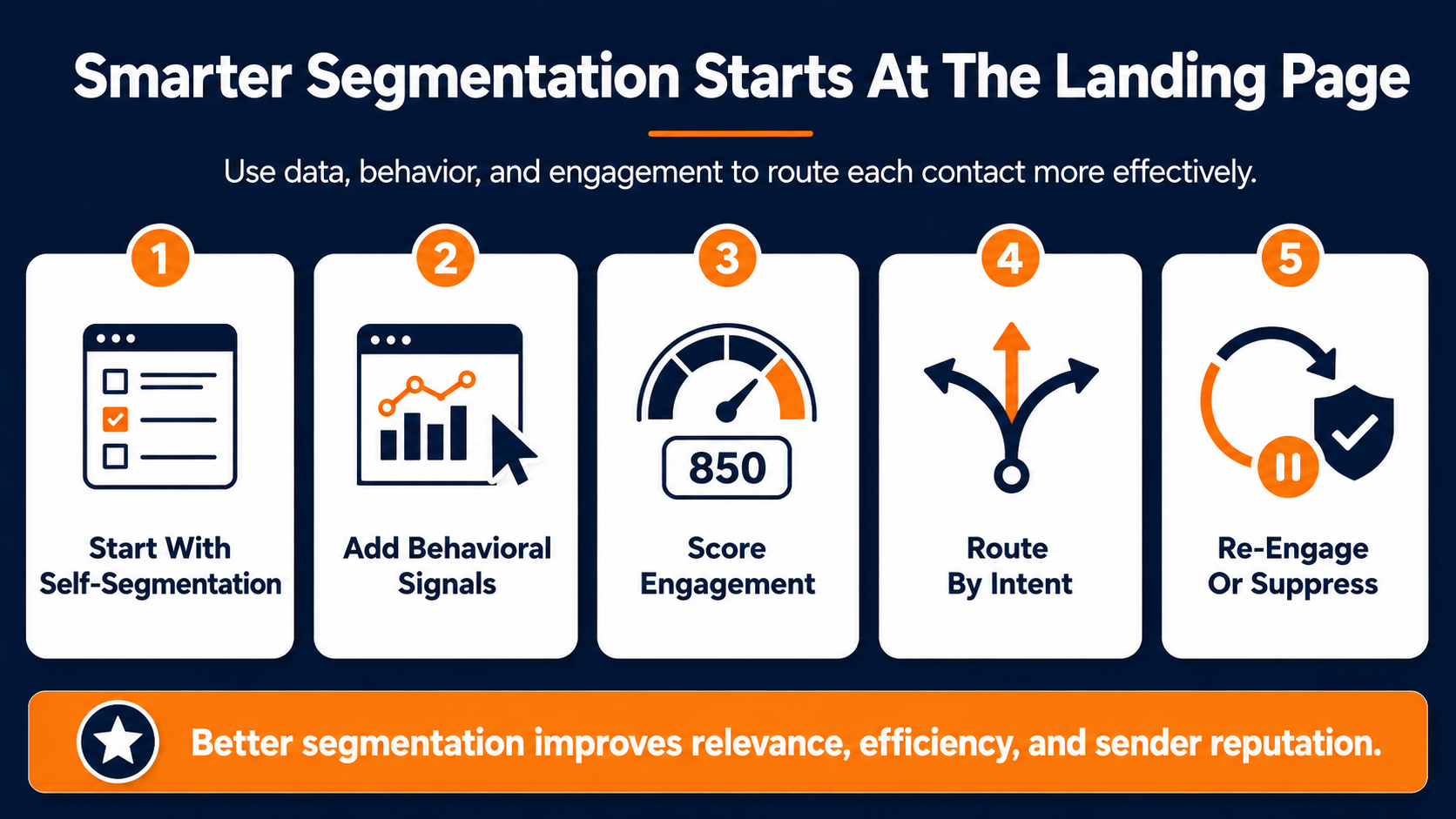
Segmentation Strategies That Drive Results
Effective segmentation transforms generic landing page traffic into precisely targeted audience groups that receive highly relevant messaging. The foundation of results-driven segmentation begins at your landing page form and the lead magnet selection process.
By offering multiple lead magnets tailored to different audience segments, you enable prospects to self-identify their primary interests and needs before entering your database.
How to add behavioral segmentation to your automation workflows
An interactive quiz asking diagnostic questions provides particularly rich zero-party data that maps directly to custom fields in your marketing automation platform.
Behavioral segmentation layers additional intelligence onto your initial contact data by tracking how prospects interact with your automated sequences.
Digital footprint tracking reveals which email topics generate clicks, which resources get downloaded, and which pages receive the most attention.
Using engagement-based activity effectively in your workflows
When a contact repeatedly engages with content about high-volume email delivery and enterprise scalability, your automation system should apply corresponding tags and route them toward messaging that addresses enterprise-specific challenges. This behavioral intelligence often proves more predictive of purchase intent than demographic data alone.
Engagement-based segmentation identifies prospects at different stages of the buyer journey based on their interaction patterns. High-intent contacts who visit your pricing page, watch product demonstration videos, or download comparison guides should receive different messaging than early-stage prospects still educating themselves on fundamental concepts.
Adding engagement scoring to your automation workflows
Your automated workflows should incorporate engagement scoring that assigns point values to specific actions, then triggers different sequence paths when contacts cross predefined thresholds.
A contact reaching 100 engagement points might automatically receive a personalized consultation offer, while contacts below 50 points continue receiving educational nurture content.
Also consider using negative segmentation, or identifying and suppressing contacts unlikely to convert. This can be equally important for maintaining campaign efficiency and sender reputation.
What to do with contacts who don't engage
Contacts showing zero engagement after multiple touchpoints should be routed into re-engagement campaigns designed to either reactivate interest or facilitate clean list removal.
Prospects who interact heavily with entry-level content but show no progression toward purchase-ready behavior might be better suited for lower-frequency educational campaigns rather than sales-focused sequences.
This strategic suppression protects your sender reputation by concentrating your sending power on contacts most likely to generate positive engagement signals.
Where Automation Is Actually Heading: AI-Driven Personalization
The workflows described throughout this post are rules-based, if this, then that. The next layer is predictive. Modern automation platforms increasingly offer AI-driven send-time optimization. This means that the system learns when each contact opens and schedules accordingly.
Allowing for dynamic content blocks that assemble different email bodies per recipient based on their behavioral profile and AI-assisted subject lines, tested in real time.
Keep compliance in mind when using AI for automated outreach
A word of caution that ties straight back to compliance. AI-generated outreach is exactly the behavior regulators are tightening around, and AI tools have a habit of producing misleading subject lines to juice open rates, which is now creating real legal exposure.
Use these tools to personalize for people who genuinely opted in, not to scale cold outreach. The technology is a force multiplier on a clean, consented list. On a sloppy one, it just multiplies your risk.
Pro Tip: Use AI to optimize send times and personalize content for subscribers who actually opted in, not to generate clickbait subject lines for cold outreach.
Understanding Email Deliverability
Email deliverability metrics tell you whether your workflow is healthy or slowly failing. Watch inbox placement rates, not just delivery rates, so you know whether messages actually reach the primary inbox or get shunted to promotions and spam.
Track engagement by mailbox provider too. If Gmail or Outlook shows declining performance while others hold steady, that's a reputation problem localized to one provider, and it needs attention before it spreads.
Know the thresholds that signal trouble
Some numbers are early warnings. Hard bounce rates above 2% or spam complaint rates above 0.1% point to fundamental problems with your data quality or your messaging, and they compound over time if you leave them alone.
The behavioral engagement that makes automation so effective is the same thing that protects these numbers. Emails triggered by behavior earn far more than ordinary sends precisely because they go to people primed to engage, and engaged recipients don't file complaints. Deliverability and relevance are the same problem viewed from two angles.
The Authentication Foundation Under All Of It
You can build the most elegant branching logic in the world, but if your emails never reach the inbox, none of it matters. The deliverability numbers above are symptoms. Authentication is the foundation, and it is no longer optional.
Google, Yahoo, and Microsoft now require SPF, DKIM, and a published DMARC record for domains sending more than 5,000 messages a day, with non-compliant mail rejected outright at the SMTP level. A failed check no longer means a trip to the spam folder. The message gets rejected as a hard bounce and never arrives at all.
What each record actually does
In plain terms, SPF lists which servers are allowed to send on your behalf. DKIM adds a cryptographic signature proving the message wasn't altered in transit. DMARC ties the two together and tells receiving servers what to do when a message fails a check.
Get these three right and you clear the baseline every major provider now enforces. Get them wrong and every clever thing downstream, your segmentation, your branching, your beautifully timed sequence, fires into the void.
Measuring and Optimizing Workflow Performance
Comprehensive measurement begins with establishing clear conversion goals at each stage of your automated workflow.
Beyond the obvious landing page conversion rate, track secondary metrics including first-email open rates, asset download completion rates, sequence-to-opportunity conversion percentages, and ultimate revenue generated per workflow.
These stage-specific metrics reveal exactly where prospects disengage, allowing you to identify and resolve specific friction points rather than making broad, unfocused optimizations.
| KPI Name | Meaning | Ideal Range | What Low Performance Indicates |
| Landing Page Conversion Rate | The percentage of page visitors who complete the primary action (e.g., filling out a form to enter the workflow). |
5% – 15% (Standard Lead Gen) 10%+ (Top Performers) |
Mismatch: The ad or link that brought them there didn't match the page content. Friction: The form has too many fields, or the page loads too slowly. Weak Hook: The value proposition isn't clear or compelling. |
| First-Email Open Rate | The percentage of recipients who open the very first email (usually the welcome or asset delivery email) in your sequence. | 40% – 60% (Welcome emails naturally track higher than standard newsletters) |
Bad First Impression: The subject line or preview text is uninspiring. Deliverability Issues: The email is landing straight in the spam or promotions tab. Low Intent: Users used a fake/secondary email just to pass the landing page. |
| Asset Download Completion Rate | The percentage of users who actually download or view the lead magnet (e.g., eBook, checklist) after signing up. | 60% – 80% |
Technical Friction: Broken download links or a confusing post-signup process. Timing Lag: The delivery email took too long to arrive, and the prospect moved on. Low Perceived Value: The thank-you page or email failed to re-excite them about the asset. |
| Sequence-to-Opportunity Conversion % | The percentage of leads in the automated email sequence who successfully transition into qualified sales opportunities (e.g., booking a demo or call). | 5% – 15% (Varies significantly by sales cycle length) |
Weak Nurturing: The email sequence is too aggressive, too boring, or irrelevant to their needs. Unclear CTAs: It isn't obvious or easy for the reader to take the next step. Bad Timing: You are asking for a meeting before establishing enough trust. |
| Revenue Generated per Workflow | The total financial value directly driven by prospects who engaged with and completed that specific automated workflow. | Positive ROI (Targeting a 3x to 5x return on the ad/tool spend for that workflow) |
Poor Lead Quality: The workflow is attracting "freebie seekers" rather than buyers. Handoff Breakdown: The automation worked, but the sales team failed to follow up on the opportunities. Pricing Mismatch: The offer presented at the end of the workflow doesn't align with the audience's budget. |
Tip for Optimization: When troubleshooting a broken workflow, consider working backwards from the bottom of the funnel (Revenue) to the top (Landing Page). Fixing a landing page and email sequence when your offer doesn't convert just means you waste money driving traffic into a leaky bucket.
Why determining proper attribution tracking matters
Attribution analysis connects your landing page workflows to actual business outcomes by tracking the complete journey from initial opt-in through closed revenue. Implement UTM parameters on your landing page traffic sources to log exactly which campaigns, channels, and creative variations generate the highest-quality contacts.
Use your marketing automation platform's revenue reporting capabilities to calculate cost-per-acquisition and return on investment for each workflow, enabling data-driven budget allocation decisions.
Contacts entering through different lead magnets often show dramatically different conversion rates and lifetime values. These insights should inform both your content strategy and your paid acquisition investments.
Strive for continual optimization of your marketing automation strategy
Continuous optimization requires systematic testing of workflow components using statistically valid methodologies. Deploy A/B tests on email subject lines, call-to-action copy, send timing, and content sequencing to identify incremental improvements that compound over time.
A 10% improvement in first-email open rates combined with a 15% increase in click-through rates and a 20% boost in landing page conversion rates doesn't add up to 45% better performance, it multiplies to nearly 52% improvement through the compounding effect of each optimization.
Establish a testing calendar that systematically evaluates one variable at a time while maintaining consistent traffic volumes to ensure reliable results.
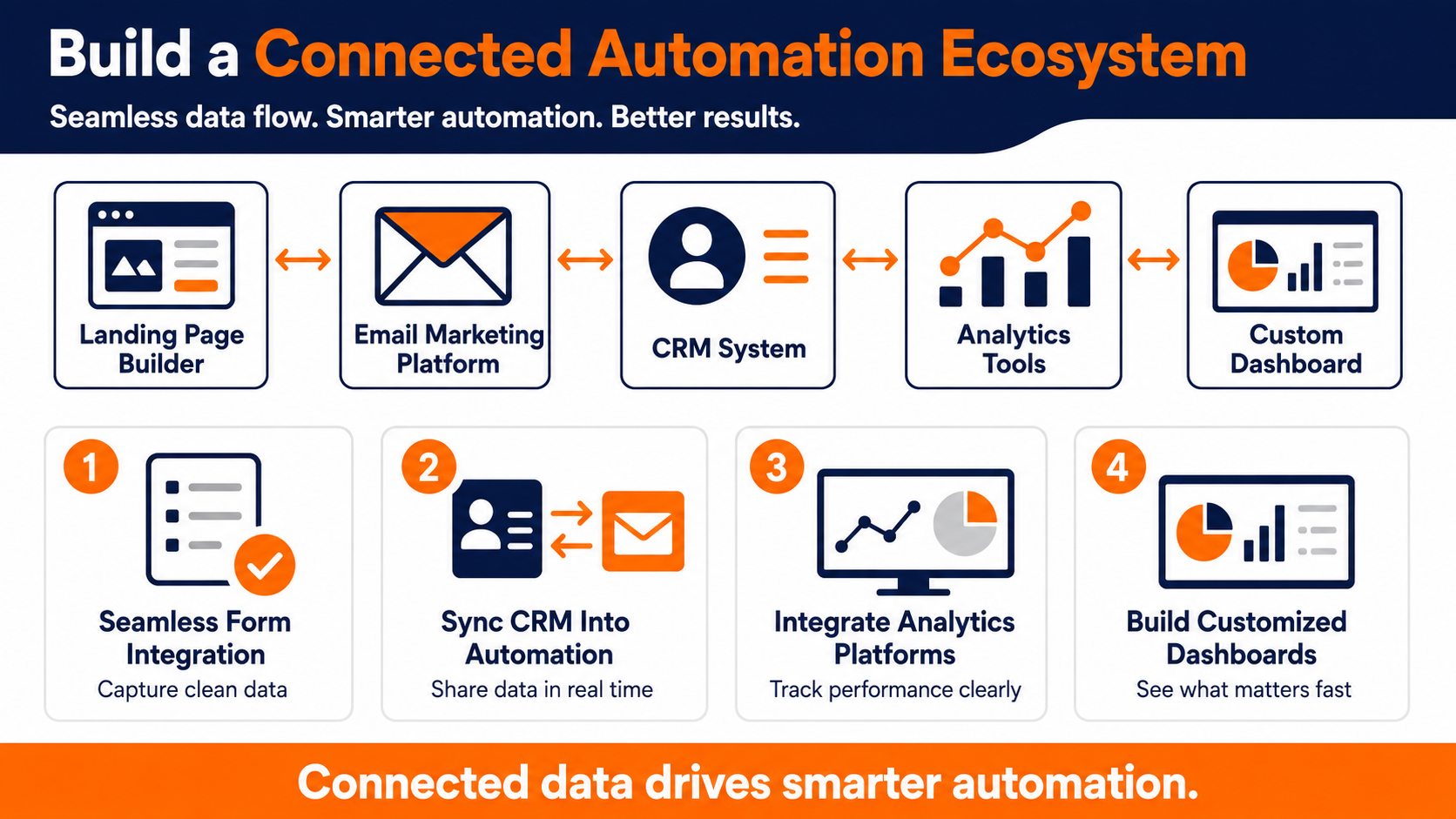
Integration Best Practices for Seamless Campaign Execution
Successful workflow automation depends on seamless data flow between your landing page builder, email marketing platform, customer relationship management system, and analytics tools. The technical architecture connecting these systems determines whether your automation operates as a unified intelligence engine or a collection of disconnected tools generating inconsistent data.
Implement a robust API integration strategy that ensures real-time data synchronization across platforms, eliminating the lag time and data discrepancies that plague webhook-only implementations.
Establish seamless form integration into your automated workflows
Form integration represents the critical first link in your automation chain. Your landing page forms must pass not only basic contact information but also hidden fields containing UTM parameters, traffic source data, lead magnet identifiers, and timestamp information directly into your marketing automation platform.
This metadata enables sophisticated segmentation and attribution analysis that would be impossible with contact data alone. Configure your forms to validate email addresses in real-time using verification services that catch typos and disposable email domains before they enter your database, protecting your sender reputation and improving downstream conversion rates.
Sync your CRM into your marketing automation system
CRM synchronization ensures that your sales team operates with complete visibility into each contact's automated workflow journey. Bidirectional integration allows engagement data from your email sequences to populate contact records in your CRM, while simultaneously pulling opportunity data back into your marketing platform for closed-loop reporting.
Configure your integration to trigger specific sales notifications when contacts exhibit high-intent behaviors, such as visiting your pricing page three times in one week or downloading enterprise-focused resources—enabling your team to provide perfectly timed outreach that feels helpful rather than intrusive.
Properly integrate 3rd party analytics platforms into your automated workflows
Analytics integration connects your workflow performance to broader business intelligence by pushing email engagement data into platforms like Google Analytics.
Implement event tracking that logs specific workflow milestones as conversion events, enabling multi-channel attribution analysis that reveals how email automation interacts with other marketing touchpoints throughout the buyer journey.
Build A Customized Dashboard For Quick Analysis
Custom dashboard development consolidates metrics from all integrated platforms into unified reporting views that eliminate the need to toggle between multiple systems.
This centralized visibility enables faster decision-making and ensures that optimization efforts focus on metrics that actually impact business outcomes rather than vanity statistics that look impressive but don't drive revenue.
Bringing Your Marketing Automation System Together: From Architecture to Execution
Let’s be honest, building a finely tuned marketing automation engine sounds incredible on paper, but executing it without a hitch can feel like trying to assemble a jet engine while mid-flight.
As we’ve covered, maximizing your conversions isn't just about setting up a basic welcome email and hoping for the best. A truly high-performing system requires a delicate balance of seamless CRM integrations, intelligent branching logic, progressive profiling, and hawk-like monitoring of your email deliverability.
When all of these moving parts click, the compounding returns on your revenue are massive. But when just one gear slips, whether it's a misconfigured form webhook, a broken data sync, or an unoptimized nurture path, your entire lead pipeline can leak valuable opportunities.
Stop guessing. Let’s tune your engine.
You shouldn't have to guess whether your automated workflows are actually driving revenue or just creating digital noise. If you want to ensure your tech stack is working for you rather than against you, it’s time to get an expert pair of eyes on your setup.
Our team is ready to lift the hood on your current systems. We will dig deep into your architecture to help you:
- Identify Friction Points: Pinpoint exactly where prospects are dropping off in your current nurture sequences.
- Optimize Deliverability: Verify that your domain reputation is protected and your emails are actually hitting the primary inbox.
- Streamline Data & Integrations: Ensure your landing pages, CRM, and analytics platforms are communicating flawlessly without data lag.
- Uncover Growth Opportunities: Map out the exact branching logic and segmentation strategies needed to trigger conversion boosts.
Don't let hidden technical glitches or outdated sequences slow down your marketing engine.
Click here to request your Marketing Automation Audit today, and let's transform your workflow into a high-yielding revenue driver.