You've got a send date on the calendar and nothing in the doc. That gap between "we email on Thursdays" and "what do we actually say on Thursday" is where most email programs struggle.
Poorly structured choices overshadow good substance every time. You're circling the same three promotional angles because nobody wrote down the other options, so here are seven distinct email marketing ideas to pull from the next time the calendar sneaks up on you.
Why the well runs dry in the first place
Most lists don't run out of things worth saying. They run out of formats. If every email is "buy this" or "buy this, but 20% off," your list starts tuning you out before they even open the subject line, and eventually they stop opening at all.
What actually breaks the rut
More categories fix this faster than more creativity ever will. Once you've got seven or eight distinct email types you can rotate through, "what do we send this week" stops being a blank-page problem and starts being a pick-from-a-list problem.
Send A Digest Instead Of A Full Newsletter
If your newsletter has turned into a three-page scroll with four articles and a coupon jammed at the bottom, your subscribers have noticed, even if your open rate hasn't cratered yet.
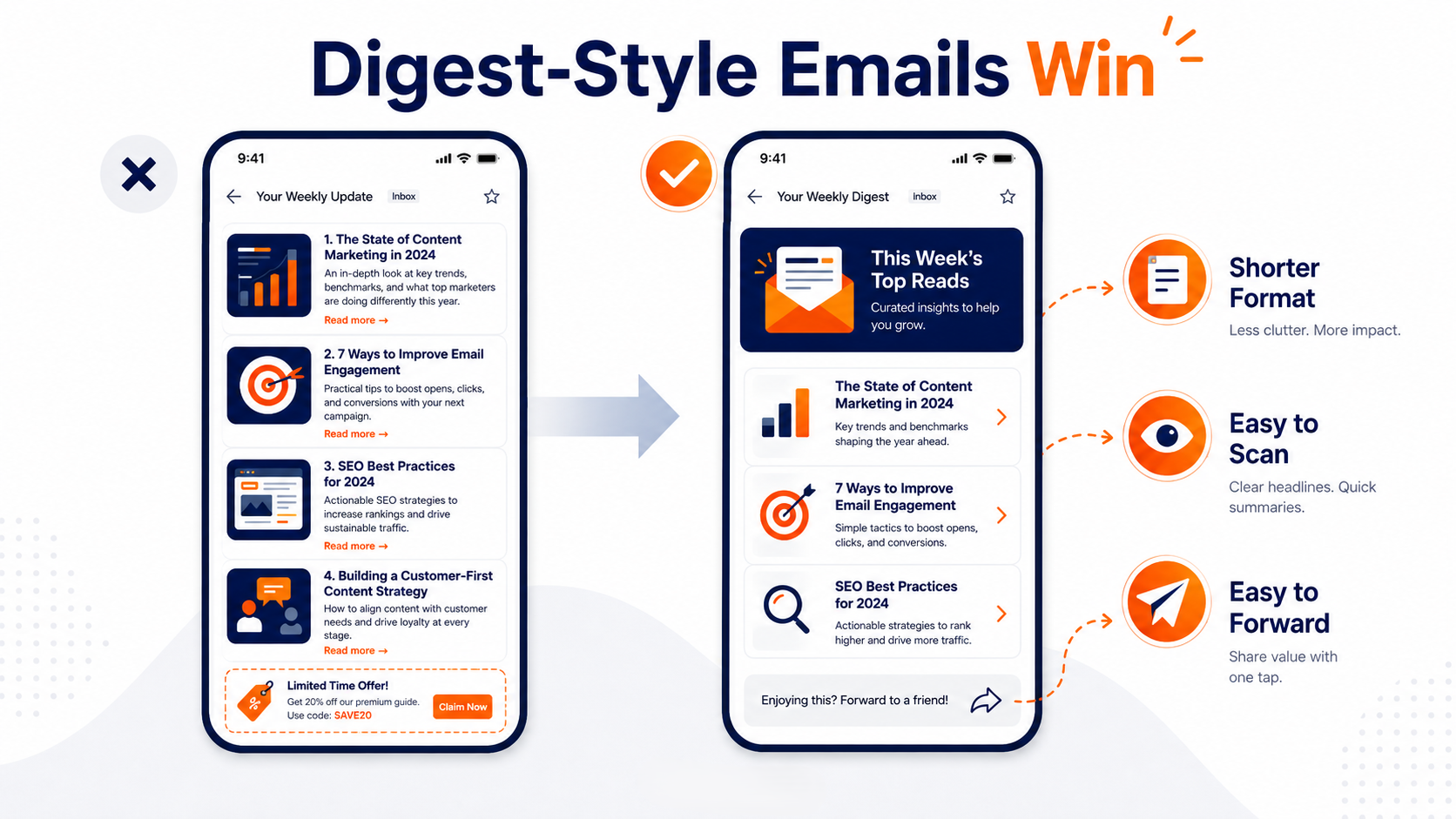
The fix is a digest. Write two or three short blurbs, each pointing back to the full piece on your blog, and let the email do less work per send. Shorter format, same value, way less friction for the person reading it on their phone between meetings.
Why the short version keeps winning
Digest-style sends work because they respect the reader's time instead of testing it. A subscriber can scan three headlines and two-line summaries in the time it takes them to decide whether to keep scrolling.
The distribution channel you're underusing
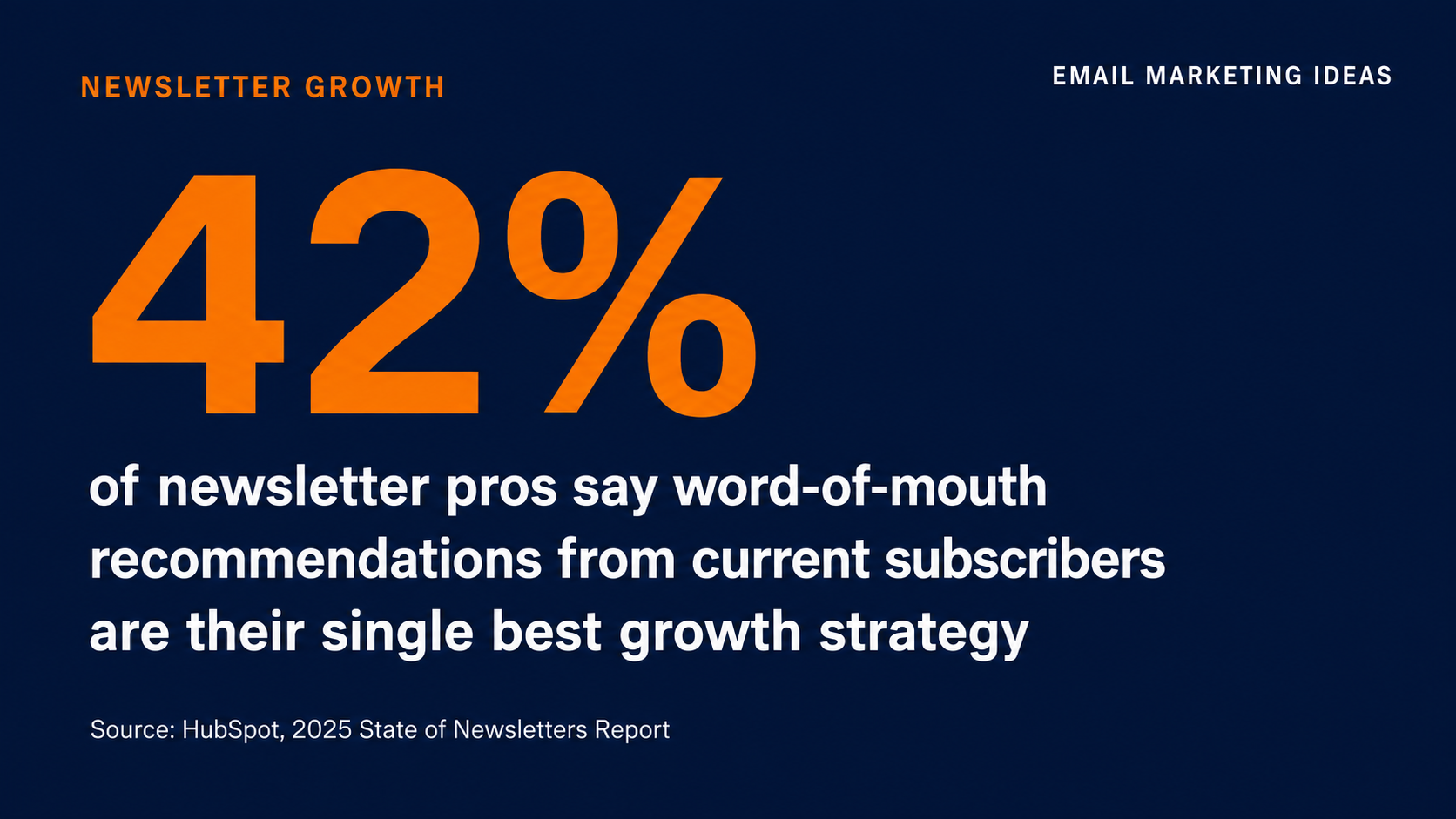
Word of mouth still moves more subscribers than almost anything else you'll try. Newsletter professionals surveyed by HubSpot rank direct recommendations from current subscribers as their single most effective growth strategy, ahead of paid acquisition and ahead of social promotion.
That only happens when what you're sending is actually easy to forward, and a tight digest is a lot easier to forward than a dense newsletter someone half-read.
Pro Tip: End your digest with one line inviting a forward, something as plain as "know someone who'd want this?" It costs you nothing, and it's the exact behavior that stat is describing.
When a full email newsletter still makes sense
None of this means digests win every time. A long-form email newsletter still earns its length when you've got one substantial idea worth sitting with, a deep dive, an annual roundup, something that actually benefits from more than three sentences.
Judge it on whether that extra length is doing real work, not on whether it hits a word count you've always aimed for out of habit.
Keys to making a digest actually land
Keep each blurb to two or three sentences and let the headline do the selling. Link every blurb straight to the full article, not your homepage. And use a template that stays consistent send over send, so your list recognizes the shape before they even read a word.
Announce Something New Without Turning It Into A Sales Pitch
A new product or service is one of the easiest emails to justify sending, because you've got a genuine reason to show up in someone's inbox. Don't waste that reason on a generic blast.
"New" doesn't have to mean flashy. A new class on your course schedule, a new service tier, a new flavor, a new integration, any of it qualifies. What matters is that it's new to the person reading, not new to the world.
Match the announcement to who's actually interested
This is where a lot of new-product emails fall flat. They go to the entire list instead of the segment most likely to care, so the open rate looks fine, but the follow-through doesn't.
Pull the subscribers who've already shown interest in that category and lead with them before you ever consider a full-list send. The same email personalization techniques that make a regular campaign convert better apply just as hard here, maybe harder, since a launch email only gets one real shot at a first impression.
Let the product do the talking
Show the thing. One clear image, one clear sentence about what it does differently, and a CTA that goes straight to a dedicated landing page, not your homepage. Every extra click between "interested" and "converted" is a chance for someone to close the tab.
Pro Tip: If you're only announcing one thing, resist the urge to also plug two other products in the same email. A launch email that tries to sell three things ends up selling none of them well.
Give early subscribers a reason to feel early
A short early-access window for your most engaged segment does two things at once. It rewards the people who actually open your emails, and it gives you a small pool of real feedback before the announcement goes wide.
That feedback is worth more than it looks. A launch that gets quietly adjusted after twenty early replies performs better than one that goes to the full list untested and gets picked apart in public instead.
Feature One Product Instead Of Blasting Your Whole Catalog
You don't need something new to justify an email. Pick something you already sell and give it its own moment. This is the easiest email on this list to write when the well feels completely dry, because the product already exists, the photos already exist, and the only real work is picking the angle.
Why one product beats a full catalog dump
Featuring a single item works because it lets you actually say something about it, instead of listing ten things with one line each. Tie it to the season, a use case, or a problem it solves, and give the reader a reason that item matters to them specifically today.
The segment decides the send, not the calendar
This is also where email segmentation earns its keep. Focus your list to get better results. Smaller, targeted email campaigns consistently make more money than big mass blasts. Sending to the right 2,000 people beats blasting 20,000 every time.
Below is roughly what that email segmentation gap tends to look like across a typical list.
|
Metric |
Narrow Segment (Under 25% of List) |
Full-List Blast (Over 75% of List) |
|---|---|---|
|
Open rate |
Higher |
Lower |
|
Click-through rate |
Higher |
Lower |
|
Revenue per recipient |
Higher |
Lower |
|
Unsubscribe risk |
Lower |
Higher |
Email blasts can still work in the right moment. But tighter email segmentation should be your default every time you feature a single product, not the exception you reach for occasionally.
Give the reader a reason beyond "it's on sale"
Explain what makes the item worth a second look this week specifically. A seasonal tie-in, a customer favorite you haven't spotlighted in a while, a restock, anything with a real reason attached beats a generic "check this out."
Ask Your List What They Actually Think
When you truly don't know what to send, ask. A short, focused survey does double duty. It fills the calendar slot, and it hands you real material for the next six emails you'll write.
Keep the survey narrow
Pick one topic. Customer service, a specific product line, your checkout experience, whatever you actually need an answer on right now.
A five-question survey about one thing gets finished. A fifteen-question survey about everything gets abandoned at question four.
Tell people what they're signing up for before they click
Say how long it'll take before they open the survey, not after. "Two minutes, three questions" gets more completions than a vague "we'd love your feedback" that could mean anything from ninety seconds to twenty minutes.
Pro Tip: If you're offering an incentive for completing the survey, name it in the subject line or the first sentence. Vague incentives read as filler. Specific ones read as a fair trade, not a maybe.
What you do with the answers matters more than the questions
The data you get back only pays off if you act on it and, ideally, tell people you did. An email later that says "you told us X, so we changed Y" closes the loop and makes the next survey request land better than this one did. This ties back to the idea that customer data only earns its keep when it actually changes what you send next, not when it just sits in a spreadsheet nobody revisits.
Turn one survey into a month of content
A single round of feedback usually surfaces three or four recurring themes. Each one of those is a legitimate future email. A "here's what we heard" recap, a deeper answer to the most common complaint, a product tweak announcement tied directly back to what people said.
That's the real payoff of asking. You're not just filling one send, you're stocking the shelf for several more without starting from a blank page each time.
Turn A Giveaway Into A List-Growth Tool, Not Just A Gimmick
A giveaway or contest solves two problems in one shot for your email list growth. Your current list gets something worth opening for, and you've got a built-in reason to promote sign-up on social media too, since entry usually requires an email address.
Keep the prize connected to your business
The instinct to give away a trendy gadget because it'll get more entries is the wrong instinct. A clothing brand giving away a tablet attracts people who want a tablet, not people who want clothes.
Keep the prize something your actual customer would pay for anyway, a sizable gift card, early access to a sale, a bundle of your own products.
Know what you're actually trading for a lower cost per signup
Giveaways are not the strongest incentive you have, and it's worth knowing that going in. Giveaway-based sign-up units convert around 11%, well behind plain discount offers at roughly 43%. A giveaway pulls in volume and social reach, a discount pulls in people already closer to buying.
Here's roughly how the major incentive types stack up on conversion rate.
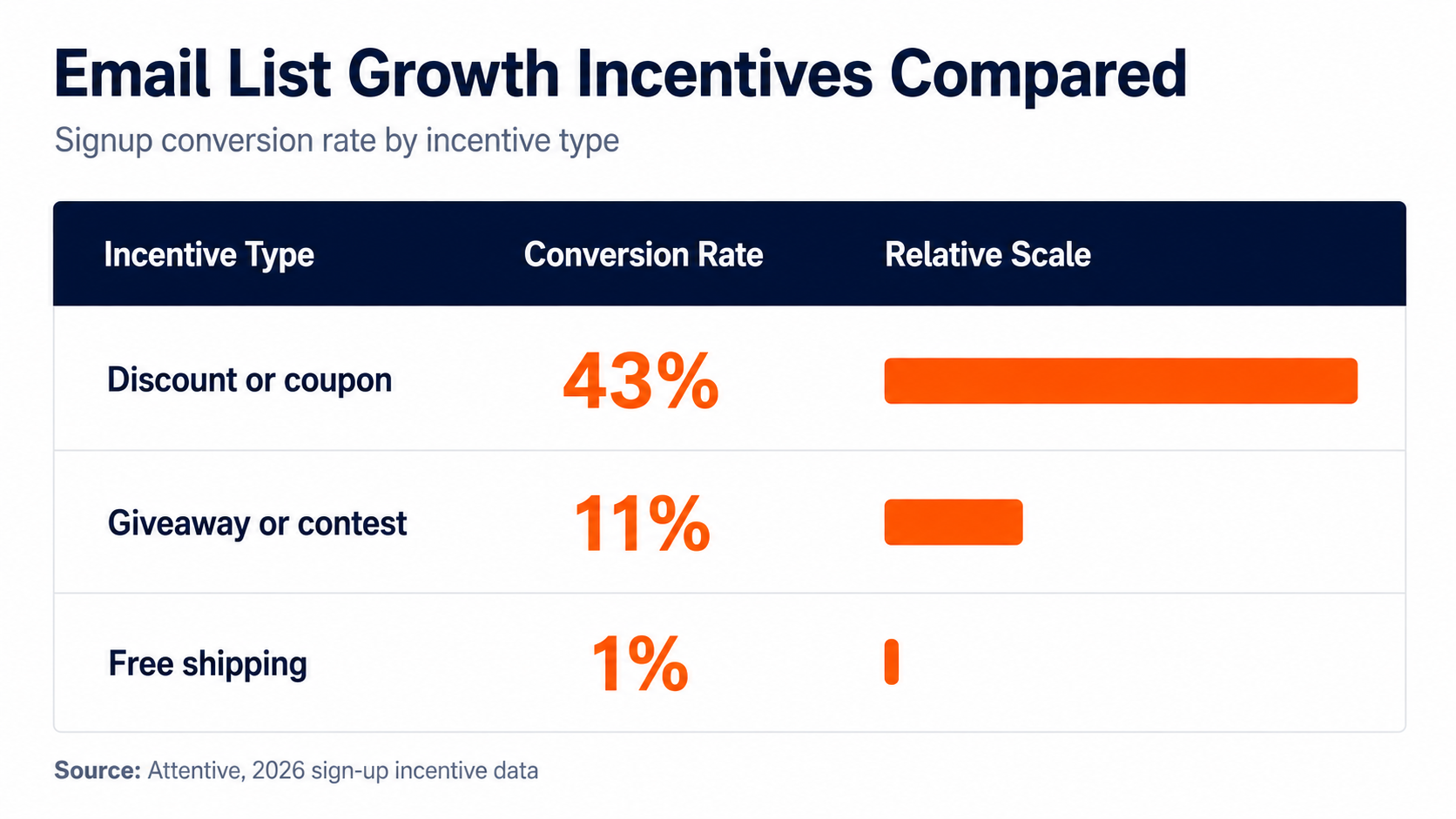
Use a giveaway when you want reach and buzz around a specific moment, not as your everyday email list growth engine. Save the discount offer for the subscriber who's already on the fence.
Set clear rules and a real deadline
Spell out how to enter and how winners get picked, keep the fine print on your site rather than crammed into the email, and send at least one reminder before the entry window closes. A deadline with teeth moves people from "I'll enter later" to "I'll enter now."
Win Back The Customers Who've Gone Quiet
Every list has a segment that used to buy from you and quietly stopped. Most brands never build a real win-back email sequence for them, which means an entire chunk of past revenue just sits there, unaddressed, month after month.
Define "quiet" before you build anything
A win-back segment usually means someone who hasn't purchased or opened anything in roughly six months, though the exact window depends on your buying cycle.
Pull that segment out on its own rather than folding it into your general list, because a re-engagement sequence needs a different tone than your regular promotional cadence.
Be honest about what this flow will and won't do
Win-back email doesn't perform like your best acquisition flows, and pretending otherwise sets you up to kill a working program too early. Revenue per email tends to run well below what a welcome series or an abandoned cart flow brings in, since you're reaching people who've already checked out mentally, not someone mid-purchase.
That gap looks discouraging until you remember what this flow actually costs to run. Nothing you weren't already paying for, aimed at people who already know your brand and don't need to be won over from scratch.
- Lead with a real reason for the message, not just "we miss you." Mention what's changed since they last engaged.
- Offer something concrete. A coupon, early access, or an actual new reason to look again.
- Make the next step a single click, straight to a product or category, not your homepage.
Give the win-back email more than one shot
One email rarely wins someone back. A short sequence, a check-in, then an offer, then a final "last chance before we stop emailing you" tends to outperform a single blast by a wide margin, mostly because it gives a dormant subscriber more than one moment to notice you.
What to do with the ones who still don't respond
Not everyone comes back, and that's fine. After a final message with a real deadline, move the truly unresponsive contacts out of your regular sends rather than continuing to email them indefinitely.
A shrinking list that opens and clicks beats a bloated one that mostly gets ignored. Every unengaged address you keep mailing drags down your sender reputation for the subscribers who are still paying attention.
Invite Your List To Something Real
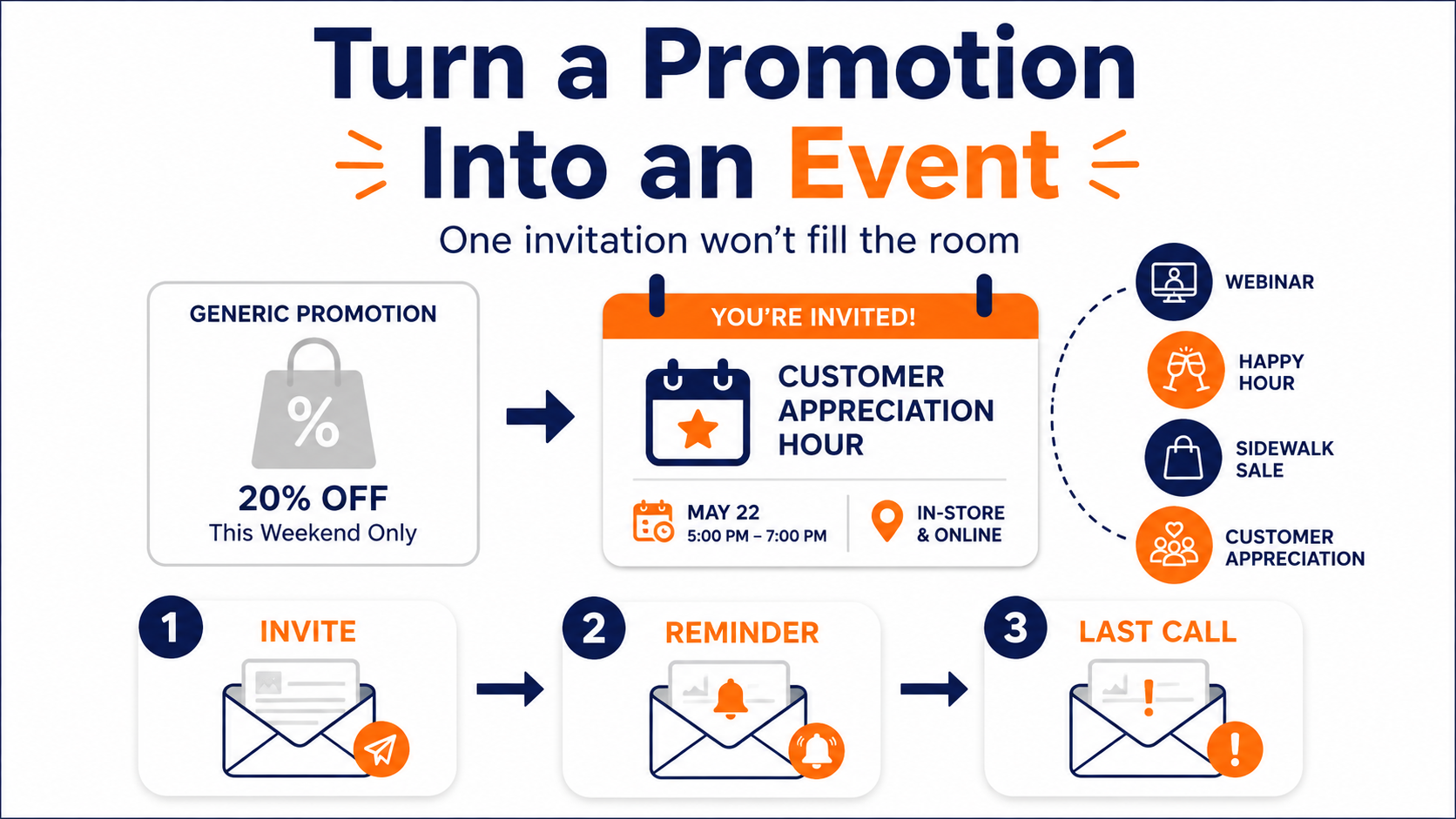
An event doesn't need a budget or a venue with a name people recognize. A webinar, a customer appreciation hour, a sidewalk sale, even a themed happy hour tied to something happening at your company, all of it counts.
Turn a regular promotion into an occasion
If you're already planning a seasonal sale or a product drop, frame it as an event instead of just another discount code. "Join us Thursday at 2 pm" creates a moment on the calendar in a way "20% off through Sunday" never quite does.
One invitation won't fill the room
Plan for at least three touches around any event: the initial invite, a reminder as the date approaches, and a last-call email the morning of. This is the same logic that applies to webinar and pipeline-focused email sequences, where a single send almost never carries the whole load on its own.
Pro Tip: Cap your RSVP form at name and email. Every extra field between "interested" and "registered" costs you completions you don't get back.
Keep the follow-through going after the invite
Once someone's registered, don't go quiet until the event itself. A short reminder with the schedule, a "bring a friend" option, or even just confirming the time zone keeps the event top of mind without feeling like nagging.
The event email doesn't end when the event does
The send right after the event is one of the most skipped emails on this whole list, and it's an easy one to write. A short recap, a replay link if there was one, and a next step for the people who showed up because they cared about the topic.
That follow-up email also works for the people who registered and didn't show. A recap gives them a second chance to engage with the content without the pressure of having missed a live moment.
Build A Rotation Instead Of Chasing The Next Idea
Most teams have every one of these seven ideas somewhere in their head. What they don't have is a place those ideas live where the person writing Thursday's email actually looks before hitting send.
With our omni-channel journey builder and behavioral triggers you can handle exactly this kind of rotation automatically, matching a digest, a win-back nudge, or a feedback request to the right segment at the right moment without someone manually deciding it fresh every week.
If your last five sends could be summarized as "buy this" in five different fonts, it might be worth finding out what a real content rotation would do for your open rates. Schedule a demo, and we'll walk through what your list is actually ready for next.