Most brands still think list building means one popup with a discount code slapped on it. That still works, but it's only one lever, and most brands never pull the others.
If you want to grow your email list faster, the businesses pulling ahead right now are stacking multiple entry points instead of betting everything on one box that shows up ten seconds into a page visit.
Improve your email strategy without abandoning current wins
Some of these tactics take an afternoon to set up. Others take a quarter. None of them require you to abandon what's already working.
That matters because the list itself is still worth more than almost anything else you're building. Here's why, and here's what to actually do about it.
Why Your Email List Still Beats Your Follower Count
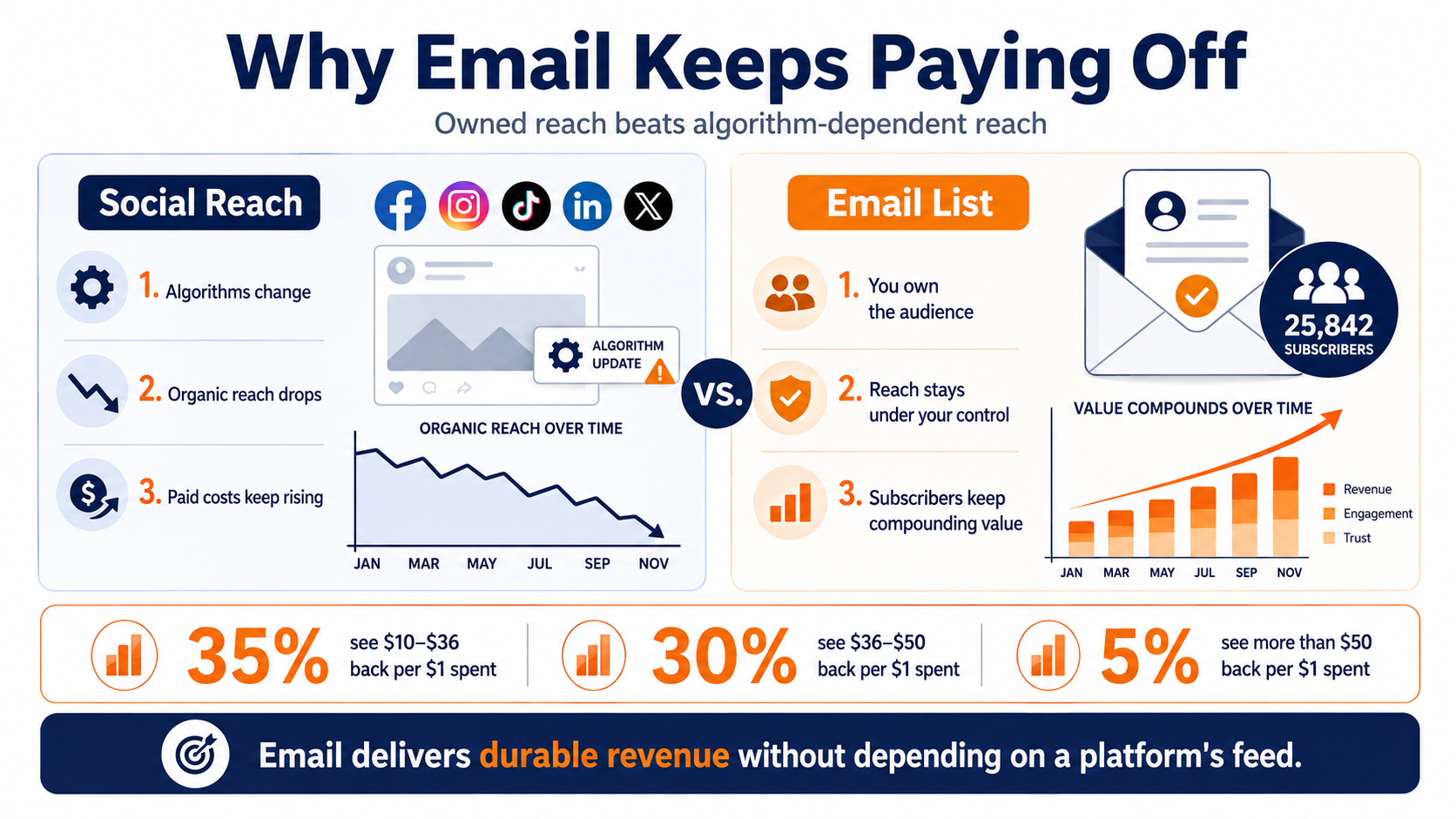
Every quarter someone tells you social media is where the growth is. Then the algorithm changes, organic reach drops again, and the post your team spent all week planning reaches a fraction of your following.
Email doesn't have that problem. You own the list. Nobody resets your reach with a platform update overnight, and nobody can suddenly decide your content doesn't qualify for the feed anymore.
The return that keeps paying off
The return backs this up too. Companies now report real, durable revenue from email compared to almost any other channel. 35% see $10 to $36 back for every dollar spent, and another 30% clear $36 to $50, with a further 5% clearing even more than that. No other line in your marketing budget reports numbers like that consistently, year over year.
Why that consistency matters
That consistency is the part worth sitting with. Paid social costs go up every year as more advertisers bid on the same eyeballs. Organic reach keeps sliding as platforms protect their own ad revenue. Your email list doesn't have either problem baked into it. A subscriber you earned three years ago still opens your emails today, at no additional cost to reach them.
That's the case for growing your email list on purpose instead of treating it as a background task that happens whenever there's time left over. It also explains why so many brands quietly keep investing in email even during years when every conference keynote is about the next platform.
Expand your opt-in strategy beyond standard lead capture
The channel keeps earning its budget, year after year, in a way that's easy to take for granted precisely because it doesn't generate the same headlines a viral post does.
The tactics below aren't the popup you've already tried a dozen times. They're the ones most teams skip, usually because they take a little more setup than a form field and a submit button. Think of this as adding entry points, not replacing the one you've already got running.
Turn Free Wi-Fi And On-Site Perks Into Signups
If you run a physical location, a checkout counter, or an event booth, you already have an underused list-building tool sitting in plain sight. It's free Wi-Fi.
Guests love free Wi-Fi. Most won't think twice about trading an email address for it, especially when the login screen is quick and doesn't ask for a password too. Compare that to a cold sign-up form on your website, where a visitor has zero immediate incentive to hand over contact information beyond a vague promise of "updates."
You're not just collecting an address either. You're capturing a moment when someone chose to engage with your brand in person, which tends to make for a warmer lead than a cold web form ever will. Someone standing in your store or sitting in your restaurant already made a decision to be there. That context carries into how they respond to your emails later.
PRO TIP: Keep the Wi-Fi signup to one field. Every extra field you add cuts completion, and an email address is really all you need at this stage.
Beyond the checkout counter
The same logic holds beyond retail. Conferences, webinars, in-store kiosks, even a QR code printed on a receipt, they all work the same way. Trade something people already want for permission to stay in touch.
A coffee shop might offer free Wi-Fi in exchange for an email. A conference booth might offer a charging station. A restaurant might offer a discount on the next visit.
The mechanism barely changes, but the setting does, and that variety is exactly why this tactic tends to get overlooked. It doesn't live in your marketing stack the way a popup does. It lives on a router configuration page nobody on the marketing team ever opens.
Worth a quick audit this week. Does your physical location, if you have one, actually capture email at all right now? For a lot of brands, the honest answer is no, and that's a gap that costs nothing but a little setup time to close.
Build A Lead Magnet Worth Trading An Inbox For
A lead magnet is the classic exchange, something valuable for free, an email address in return. Where most brands go wrong is treating the lead magnet as an afterthought instead of the actual hook that determines whether someone signs up at all.
A generic PDF nobody asked for just becomes digital clutter with a form bolted onto it. Nobody is holding their breath for your "Ultimate Guide to Getting Started," especially if five competitors already published a version of the exact same title.
Show visitors how your lead magnet offer fits their exact situation
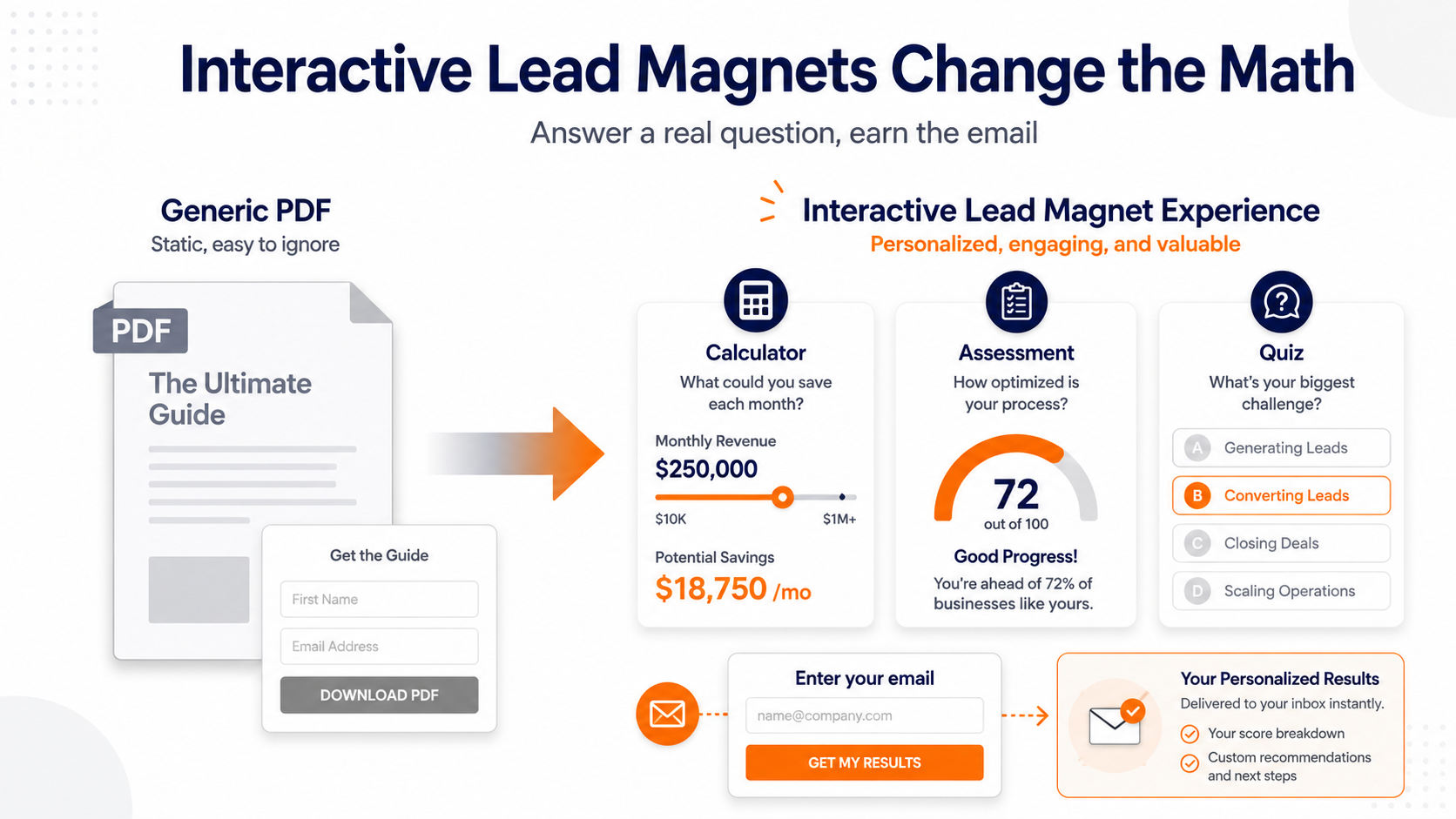
Interactive lead magnets change the math. A quiz or an assessment does something a static PDF can't. It shows the visitor how your business actually relates to their specific situation, instead of asking them to draw that connection themselves.
A calculator that estimates potential savings, an assessment that scores current practices against a benchmark, a short quiz that recommends a specific product tier, all of these work because they answer a question the visitor already has, rather than handing over generic information they'd have to translate into their own context.
Segmenting from the first click
Here's the part that compounds. A quiz doesn't just capture an email, it captures context. Someone who answers "yes, I run a distributed team" is telling you exactly how to talk to them from message one, long before a human ever reviews the lead.
That kind of upfront signal is worth more than it looks. 93.2% of marketers say personalized or segmented experiences lead directly to more leads and purchases, and a quiz is one of the easiest ways to start segmenting before someone even confirms their subscription.
Compare that to a plain email signup form, where every new contact lands in the exact same bucket regardless of what actually brought them there.
Why interactive lead magnets earn better follow-up engagement
Most modern quiz and survey builders hand you a template and a way to route answers straight into your list, tagged and ready to use, so this doesn't take a developer to pull off anymore.
A marketer can build a functioning assessment in an afternoon, connect it to existing tags in the email platform, and have a segmented lead magnet live before lunch the next day.
The lesson generalizes past quizzes too. Any lead magnet that asks the visitor one or two questions before delivering value, instead of zero, walks away with something a plain PDF download never provides. It earns a reason to send the second email that isn't just "here's more content like the first thing."
A calculator instead of a brochure
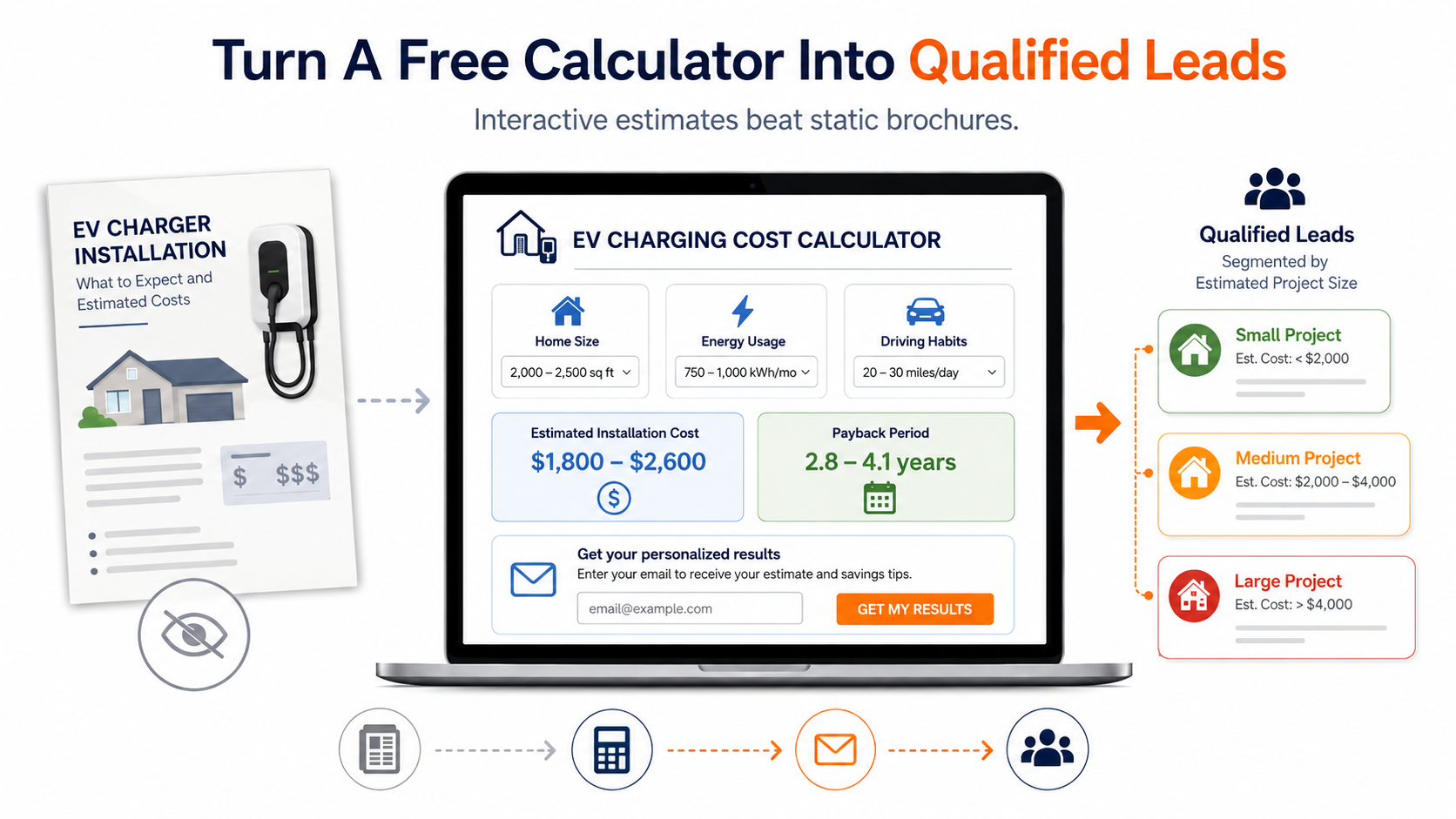
Picture a utility company trying to get homeowners interested in electric vehicle charging equipment. A static brochure on installation costs gets ignored, because most visitors don't know their own numbers well enough to care yet.
A short calculator that asks about home size, current energy usage, and driving habits, then estimates installation cost and payback period, gives that same visitor something they couldn't get from a brochure, an answer specific to their own house.
The email address becomes a fair trade for a number the visitor actually wants, and the utility walks away with a lead they can segment by estimated project size before a single follow-up call happens.
Make Your Giveaway Do More Than Attract Freebie Hunters
Free stuff works. The harder part is running a giveaway that brings in subscribers who actually care about what you sell, instead of people chasing a prize they'd never otherwise buy and who unsubscribe the moment the contest ends.
Three things separate a giveaway that builds a real list from one that just inflates a number for a week:
- The prize has to be specific to your audience, not universally appealing. A niche prize filters for people who actually want what you offer, and a car or the latest phone filters for nobody, since everybody wants a car regardless of whether they'll ever buy from you.
- A partner brand doubles your reach and splits the cost, and their audience tends to be warmer to your offer than a cold ad ever would be, since they're already primed to trust a recommendation from a brand they follow.
- Promotion matters as much as the prize itself. A great prize with no promotion behind it still fails, and a mediocre prize promoted well through your existing community usually outperforms it.
Don't leave the runners-up empty-handed
Don't leave every non-winner empty-handed either. A small consolation offer, a discount code, a bonus resource, keeps the goodwill even for people who don't win the big prize. And it's often what turns a one-time entrant into an actual subscriber who opens your next email instead of forgetting they ever signed up.
One more thing worth building in from the start. Ask entrants to share the giveaway with a friend for an extra entry. This turns your existing audience into a distribution channel without spending anything extra on ads, and the friends who sign up through a personal share tend to convert better than the ones who found you through the paid promotion in the first place.
Collaborate with complementary brands to double your reach
Think about how this plays out for a mid-sized retailer partnering with a complementary, non-competing brand for a joint giveaway. Both companies promote the same contest to their own list and their own social following, both split the cost of a single prize that appeals to the shared audience, and both walk away with new subscribers who were already primed to trust one of the two brands involved.
That's a materially different outcome than either company running a solo giveaway with a universally appealing prize and hoping the right people show up.
Popups And Exit-Intent Offers That Convert, Not Just Interrupt
Popups get a bad reputation because most of them are badly timed. Shown too early, before a visitor has any context on your brand, they read as intrusive. Timed to the moment someone's about to leave, an exit-intent popup is catching someone who's already decided to go, which changes the entire psychology of the ask. You're not interrupting their reading anymore. You're offering one last reason to stay.
A well-built exit-intent popup earns that interruption instead of just causing it, and the difference between the two usually comes down to what you're actually offering.
The offer inside the popup matters more than the timing alone. A plain newsletter signup with no incentive attached converts modestly. Add something the visitor actually wants, and the gap becomes real.
|
Popup Offer |
Average Conversion Rate |
|
Newsletter signup, no incentive |
5.10% |
|
Ebook or guide offered |
7.49% |
|
Discount code offered |
7.65% |
An ebook or discount offer converts roughly 45 to 50% better than a plain newsletter ask. That's not a marginal difference. It's the gap between a popup that mostly annoys people and one that actually earns its interruption by giving them something concrete in return.
Timing the offer to the visit
Exit-intent isn't the only trigger worth using. A popup that shows after someone's read two or three pages is talking to a very different visitor than one that fires on page one, and your offer should reflect that difference in intent.
Someone who's browsed several pages already trusts you more than someone who just landed, so a slightly bigger ask, a product guide instead of a generic newsletter, tends to convert better at that stage of the visit.
A/B test popup copy, offers, and formats
Don't stop at a single popup design either. Test the copy, test the offer, test whether a smaller slide-in outperforms a full-screen takeover for your specific audience.
The format that wins for one brand's visitors won't necessarily win for yours, and the only way to know is to actually run the comparison instead of copying whatever a competitor happens to be using.
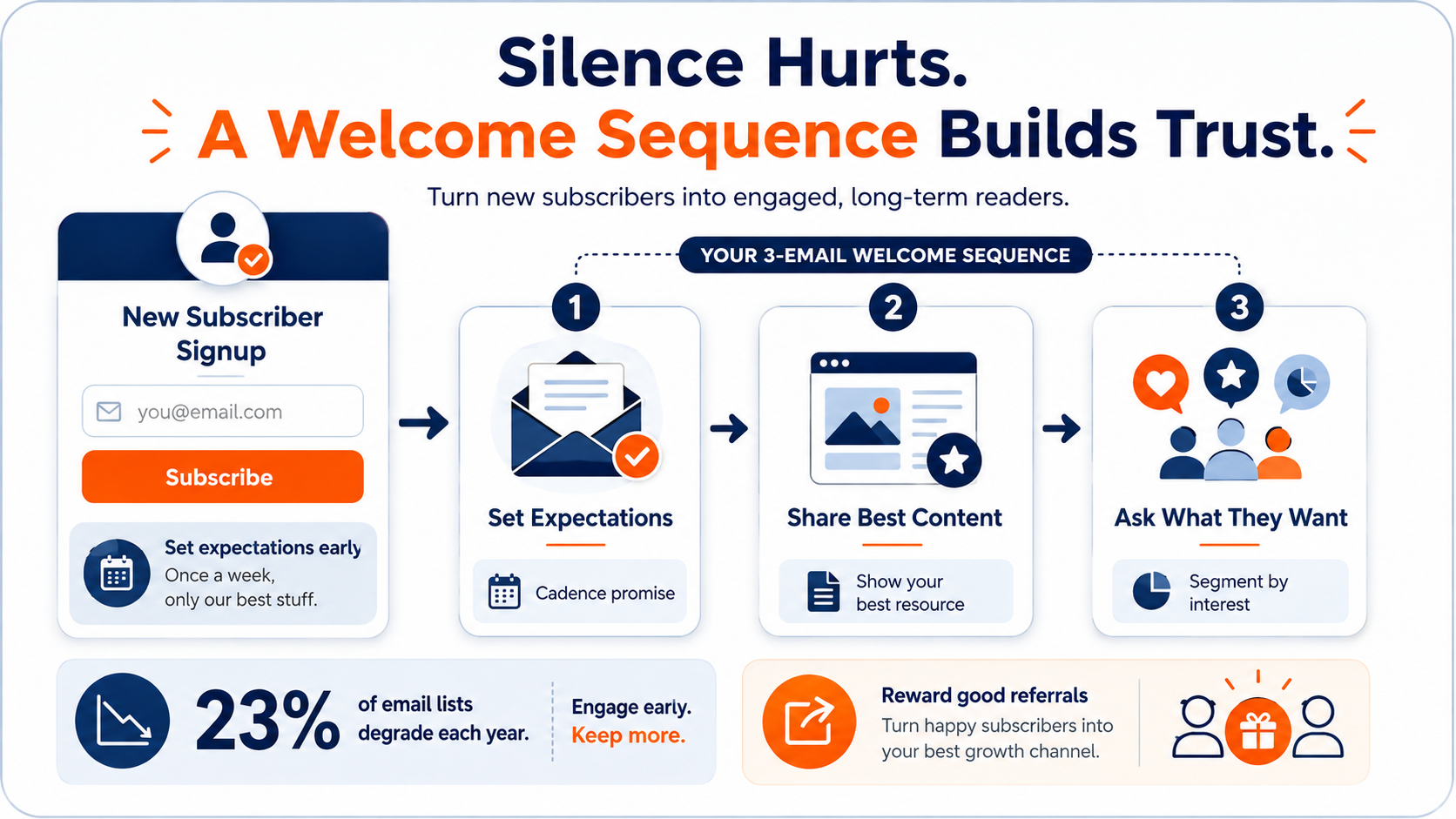
Set Expectations Before The First Send
Silence is usually what kills a new subscriber relationship, not a bad email. Someone signs up, hears nothing for two weeks, then gets a random send they don't remember agreeing to.
Tell people what they're getting into before they confirm. A one-line promise, something like "once a week, only our best stuff," sets an expectation your future sends then have to live up to.
It also filters at the point of signup. Someone who doesn't want weekly emails can decide that before they subscribe instead of unsubscribing in frustration three weeks later.
Stop losing subscribers before the relationship begins
This matters more than most teams realize, because lists don't just grow, they also shrink in the background whether you're paying attention or not.
At least 23% of an email list degrades within a single year, and unclear expectations from the very start are one of the biggest reasons subscribers check out early instead of sticking around long enough to become a real relationship.
PRO TIP: If your welcome email skips the expectation-setting, you're not just risking one early unsubscribe. You're setting up the slow decay that shows up in your numbers eight months from now, once nobody remembers why they signed up.
Offer quick perks to encourage repeat referrals
Reward good referrals while you're at it. Someone who forwards your newsletter to a friend is doing your list-building work for you at no cost, and a small thank-you, early access to a new resource, a bonus guide, keeps that habit going instead of letting it happen once and never again.
The best time to ask for that referral is usually right after someone's had a strong experience with a specific piece of your content, not buried in a generic footer line that nobody scrolls far enough to read.
Let the welcome sequence do this automatically
A welcome email sequence does a lot of this work automatically, if you build it that way. The first email can set the cadence promise. The second can highlight your single best piece of content, the one thing you'd want a brand-new subscriber to see before anything else.
The third can simply ask what they're hoping to get out of being on the list, which doubles as a light segmentation question and a signal that you're paying attention to who actually opens your mail. None of this needs to be complicated. It just needs to exist instead of dropping a new subscriber straight into your regular weekly send with zero introduction.
Track Which Tactic Actually Earns A Subscriber
Most teams running four or five list-building tactics at once still can't tell you which one is pulling its weight. You can grow your email list from all of them at once, sure, but they all dump into the same list with no record of where anyone actually came from or what that source predicts about how they'll behave later. The Wi-Fi signup, the quiz, the giveaway, the popup, they all land in one undifferentiated pile.
If you can't say right now which of your email list building tactics is actually working to grow your email list, schedule a marketing automation audit with our team and we'll help you find out.