
In April 2025, open rates on Yahoo and AOL addresses fell from a normal 20 to 25 % down to under 5 % almost overnight. Nothing about the emails changed. Yahoo's own deliverability shift explained what was happening: domain reputation had quietly replaced IP reputation as the thing that decides whether you land in the inbox at all.
That's the first half of 2026 in one stat. The shifts that actually mattered this year weren't the ones on anyone's trend deck. They were infrastructure problems wearing a marketing costume.
The 2026 Mid-Year Scorecard For Marketing Trends
We spend a lot of time in this industry predicting what's next. Six months in, it's worth figuring out what actually happened as opposed to what we all said would happen back in January.
Some of it lines up. A lot of it doesn't. The gap between the two is where the real lessons live. Here's the honest scorecard.
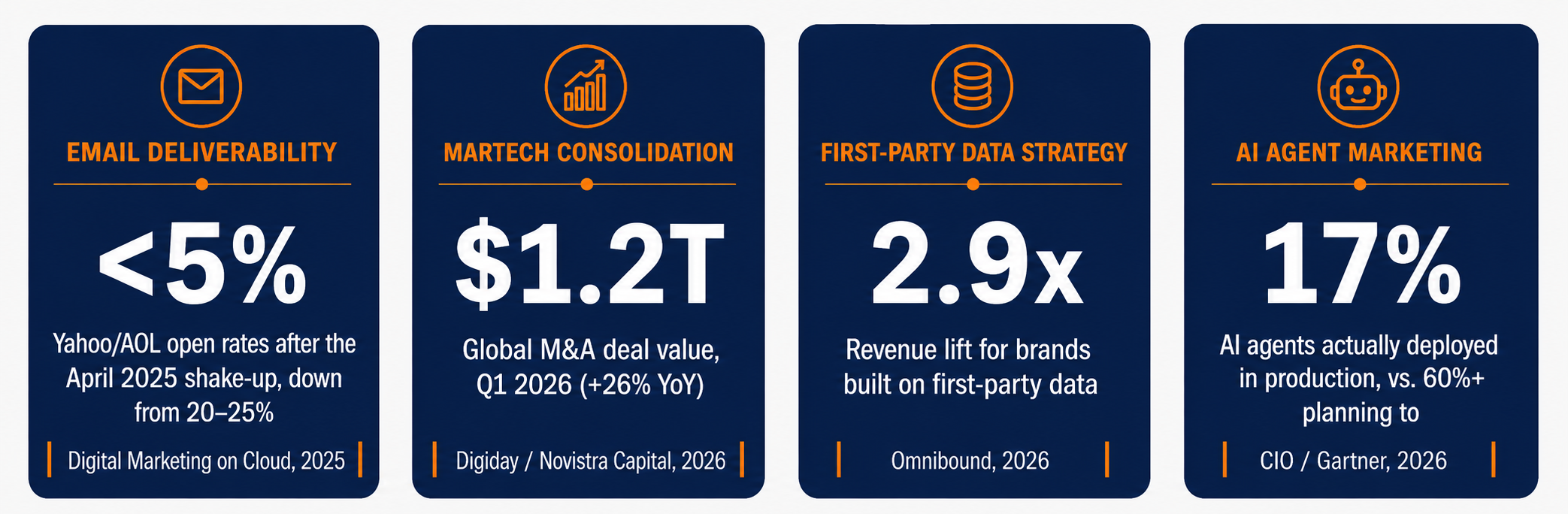
Figure 1: Four numbers that defined the first half of 2026.
Deliverability Stopped Being a Checkbox
The enforcement finally landed
For most of the last decade, deliverability was something you configured once and mostly forgot about. That era is over.
Gmail began ramping up enforcement on non-compliant bulk senders in November 2025, moving from temporary deferrals to permanent rejections.
Yahoo and Microsoft ran their own versions of the same crackdown earlier in the year, which tells you this wasn't one company's policy tweak. It was the industry deciding all at once that self-reported trust wasn't enough anymore.
What the rule actually assumes about senders
The interesting part isn't the rule itself. Rather, it's what the rule assumes. Mailbox providers stopped trusting senders to police their own list hygiene and started scoring domains the way a lender scores a borrower: continuously based on behavior, not on a one-time application.
That's a fundamentally different relationship between sender and inbox. Most marketing teams still haven't updated their mental model to match it.
Why the gap between good and bad senders got so wide
Think back to that Yahoo stat from the opening of this piece. Senders who hadn't touched their authentication setup in years watched a decade of built-up trust evaporate in days, not because they'd done anything new and wrong, but because the scoring model changed and nobody re-checked the homework.
The senders who treated authentication as a living system, not a settings page configured once and forgotten, came through the year fine. Everyone else is still catching up.
What this actually changes about who owns email deliverability
The quieter shift here is organizational, not technical. Email deliverability used to be an IT ticket that got filed and forgotten once the DNS records were in place.
Now, it behaves more like a credit score that the whole marketing team is responsible for maintaining since list quality, send cadence, and content all feed into the same domain reputation.
Teams that still treat it as someone else's job are the ones most likely to get surprised by it.
Where this probably goes in the second half of 2026
Expect the enforcement to tighten further before it loosens. Mailbox providers rarely walk back a policy that's working, and this one clearly is. It works for inbox quality, and it works for the providers’ own spam metrics.
The safest assumption for planning purposes is that the bar keeps rising, not that this was a one-time correction everyone can now dismiss.
The Martech Land Grab Nobody Asked For
The deal volume is staggering
If your vendor landscape got reshuffled this year, you weren't imagining it. Global M&A deal value hit $1.2 trillion in Q1 of 2026 alone, up 26% year over year.
The Omnicom-IPG merger at $25 billion was the loudest example of just how much consolidation pressure is running through the industry right now.
What's actually driving the buying spree
Buying sprees of late are happening for two reasons.
Companies that can't build competitive AI capability fast enough are simply buying it instead, which is a faster and pricier way to close the same gap.
At the same time, RevOps teams took over stack decisions at a lot of companies this year, and their instinct isn't to add tools, it's to justify the ones already on the books.
The valuation split says everything
AI-native martech firms are commanding roughly double the revenue multiple of traditional martech SaaS companies in this year's M&A deals, and even more in venture rounds.
That's the market pricing in a structural shift in what a marketing platform is supposed to do out of the box. It's also why the tools you depend on today are more likely than ever to get acquired, sunset, or re-platformed out from under you in the next twelve months.
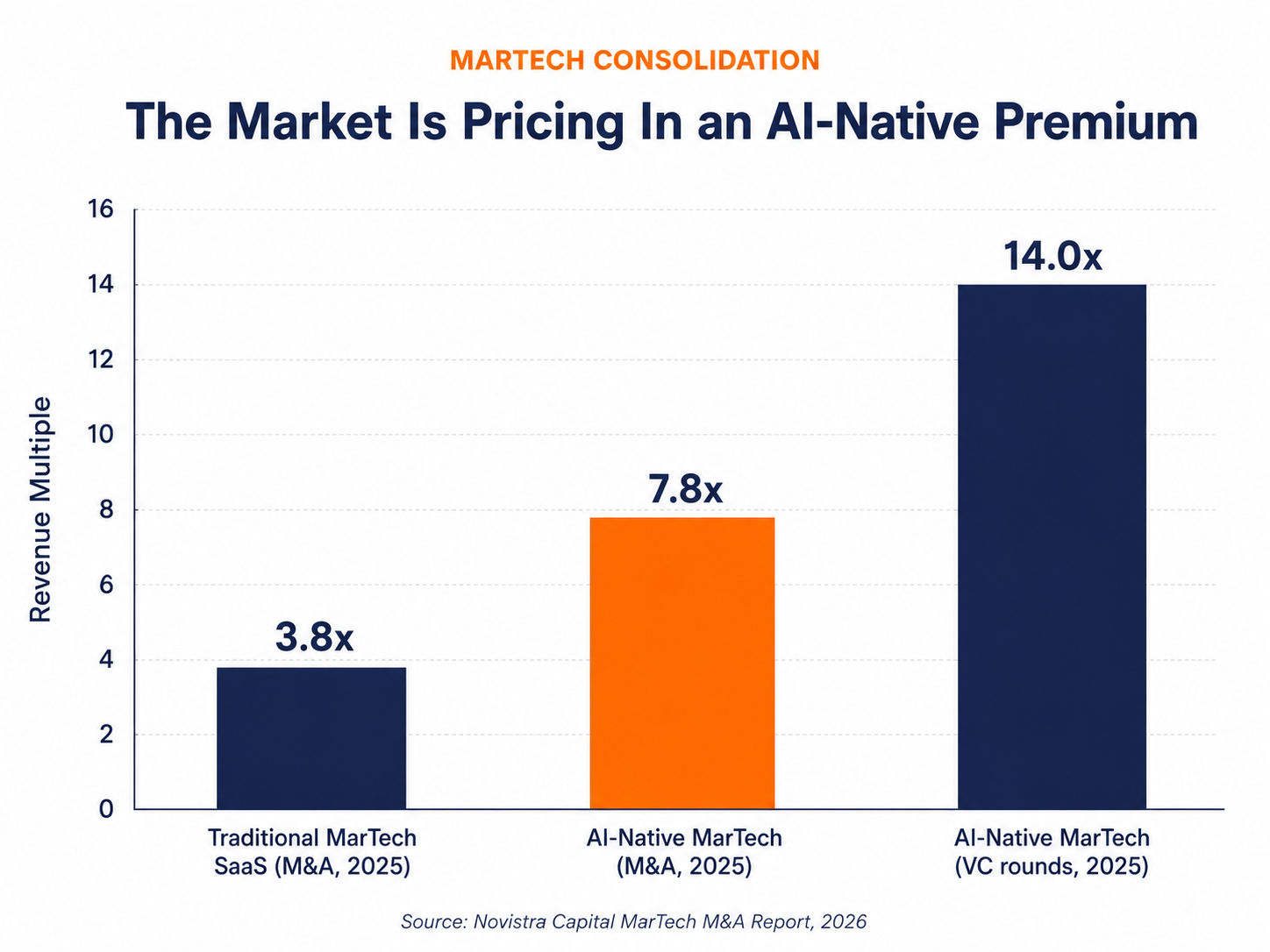
Figure 2: Traditional vs. AI-native MarTech valuation multiples, 2025.
What this means if you're evaluating vendors right now
Ask two questions before you sign anything in the latter half of this year.
Who else has looked at acquiring this vendor? What happens to your data model and integrations if they say yes?
A surprising number of teams can't answer either question about tools they've relied on for years, and that gap is exactly what's been biting brands mid-contract more often than not.
The independent platforms left standing have a real advantage
There's an upside for the vendors that didn't get swept into the acquisition wave. A platform that isn't currently being shopped around, integrated into a bigger suite, or having its roadmap rewritten by a new parent company can make longer-term commitments to customers than one that might not exist under the same name in a year.
That stability is worth more this year than it's been in a long time, and it's underrated precisely because it doesn't show up in a funding announcement.
Why bigger isn't automatically safer
It's tempting to assume the giant suite that just absorbed three smaller vendors is the safe choice, but integration takes years to actually finish, not months.
In our conversations with teams that switched to a newly combined platform this year, the day-to-day experience often stayed just as fragmented as before, only now under one logo instead of three.
Size solves a vendor's balance sheet problem. It doesn't automatically solve your workflow problem.
First-Party Data Went From Slide Deck to Compliance Mandate
The cookie deadline that never quite arrived
The cookie deprecation story took a strange turn this year. Google paused its plan to fully phase out third-party cookies in Chrome, while Safari and Firefox kept blocking them outright.
The result is fragmentation rather than a clean cutoff, which in some ways is a worse planning environment than a hard deadline would have been.
Why compliance turned into a growth argument
What actually moved the needle this year wasn't the browser mechanics, it was the math. Brands built on first-party data are seeing a 2.9x lift in revenue compared to brands still leaning on third-party sources, and that number is doing more to move budget conversations than any compliance mandate could on its own.
Marketing leaders who used to frame first-party data as a legal obligation are now framing it as the highest-return infrastructure investment they can make.
The brands pulling ahead already made the call
The brands that treated first-party data as a 2023 buzzword are behind. The ones that treated it as 2026 infrastructure, worth the same budget fight as a new acquisition channel, are pulling ahead.
That's a strategic choice, not a technical one. It also usually gets made above the marketing team's pay grade.
The customer experience angle nobody talks about
Most of this conversation happens in compliance and finance terms, but there's a customer experience story hiding underneath it. Data collected directly through a real relationship, a purchase, a preference center, a support conversation, tends to be more accurate than data inferred from a third-party pixel guessing at intent.
That accuracy shows up as fewer irrelevant sends, better timing, and messages that actually reflect what someone did, not what an algorithm assumed they might want. Customers can notice that difference even when they can't put their finger on it.
Why this is a harder habit to build than it sounds
The tricky part is that first-party data only compounds if you actually use it consistently, and most teams collect far more of it than they ever act on. A preference center that nobody checks before sending a campaign isn't a data asset, it's a filing cabinet!
The brands pulling ahead in 2026 weren't necessarily collecting more data than everyone else. They were the ones who'd actually built the habit of checking it first.
What Got the Headlines and Delivered Nothing
The agentic AI reality check
Every year has a trend that dominates the keynote stages and underdelivers in the actual results. This year, that trend was autonomous AI agents running entire marketing programs end to end. Only 17 % of organizations have actually deployed AI agents in production, even though more than 60 % say they plan to within two years, and a large share of these projects are expected to get canceled before 2027 is over.
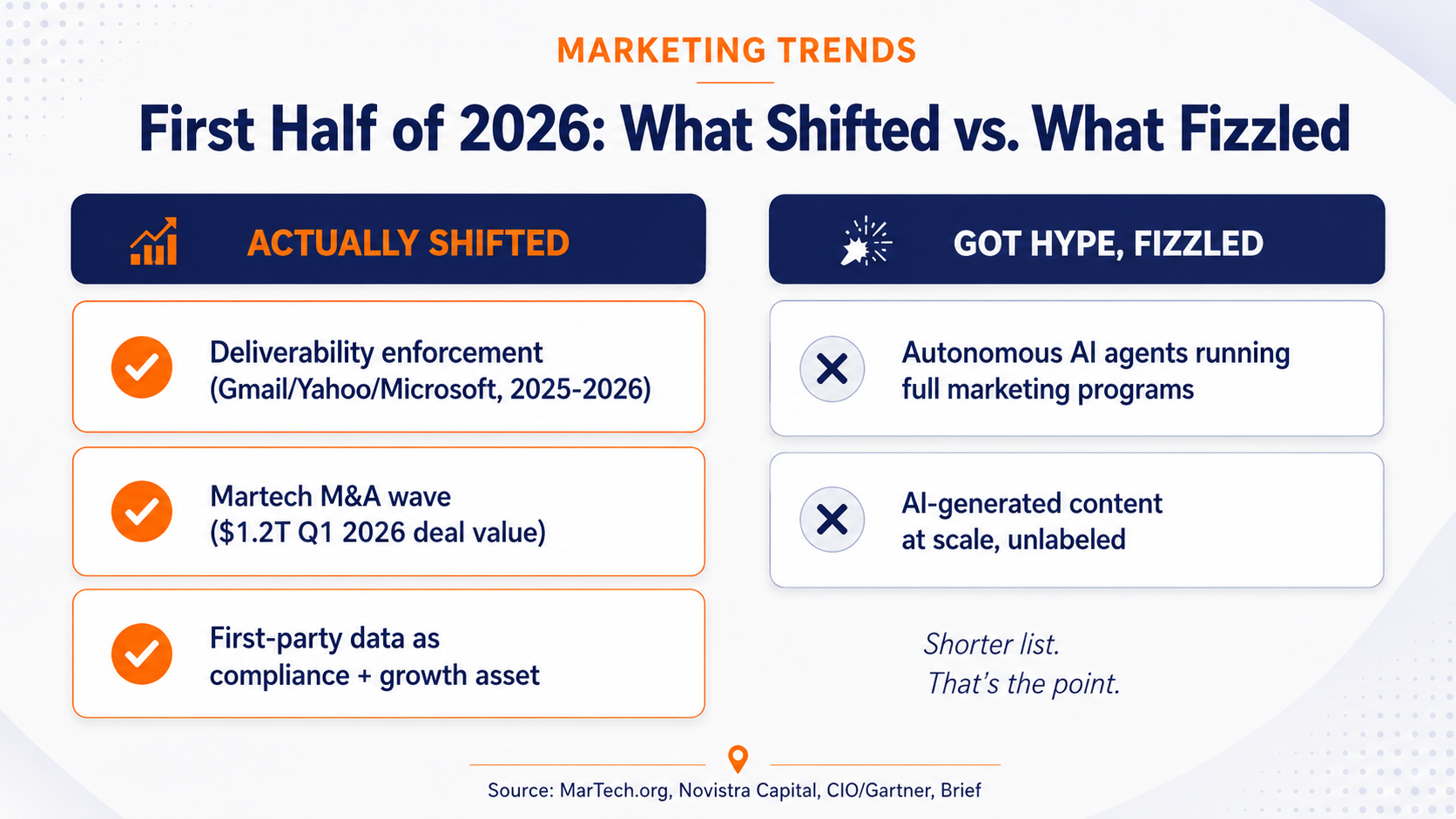
Figure 3: What actually shifted in the first half of 2026 versus what got hype and fizzled.
Why the hype outran the deployment
The honest read on this isn't that agentic AI doesn't work, it's that most organizations don't have the governance or data maturity to run it safely yet. Marketers who spent the year chasing a fully autonomous campaign engine were mostly solving a problem they didn't have.
Meanwhile, the marketing automation software they already owned, taking care of triggers, segmentation, sequencing, kept doing the actual work.
The content backlash nobody saw coming
The second trend that fizzled is closely related: content produced entirely by AI at scale, with no human hand anywhere in the process. Consumer excitement about AI collapsed this year, and brands including Aerie, Equinox, and Almond Breeze all ran explicit anti-AI campaigns, turning "we made this ourselves" into an actual selling point.
The quiet lesson underneath both trends
Notice the pattern. The technology hyped as a replacement for judgment underperformed, and the technology that quietly supports judgment, better data, cleaner automation, faster infrastructure, kept earning its keep.
That's probably the most useful takeaway from the entire AI conversation this year, and it's the one getting the least airtime.
What "boring automation" actually looks like in practice
It's worth being specific about what did work, because "boring" undersells it.
A well-built trigger that fires the moment someone abandons a cart, a segmentation model that updates itself as behavior changes, a send-time optimization layer that quietly adjusts for each recipient, none of that made a keynote this year, and all of it kept generating revenue while the agentic AI conversation played out in the background.
The teams that kept investing in that layer, instead of waiting for a flashier autonomous system to arrive, had a strong first half to show for it.
Why the backlash might be the healthiest thing that happened all year
There's a case that the AI content backlash was overdue, and actually good for the industry in the long run. For a couple of years, plenty of brands treated volume as a strategy: more content, more variations, more automation, regardless of whether any of it was actually good.
The pushback this year forced a harder question back onto the table, which is whether the content is worth reading at all.
That's a better question than "How much can we produce?" Frankly, it's one marketing teams should have been asking this whole time.
Where This Leaves Pinpointe for the Second Half
Email deliverability gets first claim on our roadmap
We built our priorities for the back half of 2026 around the shifts above, not the ones that got more attention on stage. Deliverability infrastructure gets first dibs on engineering time.
A platform that can't guarantee inbox placement under the current enforcement rules isn't really a platform, it's a liability with a nice interface.
That means continued investment in authentication tooling, spam complaint monitoring, and domain reputation visibility built directly into the send flow.
One platform, not a stitched-together stack
The martech consolidation wave is exactly why we've stayed committed to email and SMS living in one platform under one data model.
Dynamic segmentation and behavioral triggers only work if the underlying customer record is unified, and every acquisition headline this year has been a reminder of what happens when it isn't.
Data ownership, not just a new dashboard
On first-party data, our answer isn't a new dashboard, it's ownership. Behavioral triggers and real-time engagement data collected directly inside the platform are first-party by construction.
None of it is layered on top of a third-party pixel that might not survive the next browser update.
The infrastructure work you won't see, until you need it
The pressure described above is also why platform infrastructure and UI are getting the single biggest investment on our roadmap this half.
We're rebuilding core processing speed, stabilizing the platform under real production load, and reworking the interface so building and monitoring a journey feels as fast as the decisions marketers are already making.
That work won't make headlines, but it's the difference between a platform that can absorb what's coming and one that can't.
Why this bet pays off later, not just now
None of this is glamorous, and we know it. Every deliverability enforcement rule, every consolidation headline, and every privacy shift points at the same underlying truth.
Platforms get judged on whether they hold up under real pressure, not on how good the roadmap slide looks.
Getting the foundation right in the second half of 2026 is what lets us build an exciting features roadmap heading into 2027 and beyond instead of layering new capability onto infrastructure that's already straining to keep up.
What we're deliberately not chasing
What we're not chasing this half is an autonomous-agent arms race that the data says most organizations can't operationalize yet.
Real-time engagement data and behavioral triggers already give marketers meaningful automation without the governance risk that's sinking so many agentic AI projects elsewhere.
We'd rather ship infrastructure and a marketing automation platform that holds up under enforcement scrutiny than a headline feature that gets canceled in 2027.
What This Year's Marketing Trends Mean for Your Second-Half Roadmap
Six months in, the pattern is clear. The trends that mattered in the first half of 2026 were the ones that were less than glamorous: deliverability enforcement, vendor consolidation, and data ownership.
The trends that got the most airtime, autonomous agents and AI-generated content at scale, are the ones the data says to treat with caution for now.
Notice what these trends have in common
Every genuine shift we’ve covered rewards teams that did unglamorous work early: authentication nobody celebrates, data governance nobody demos well, and platform consolidation nobody puts on a conference slide.
On the other hand, every trend that fizzled was the one promising a shortcut around that work. That's not a coincidence, and it's probably not going to reverse for the rest of the year either.
The real question isn't whether you noticed these shifts. It's whether your roadmap for the latter half of 2026 reflects them, or whether it's still chasing the keynote version of 2026 instead of the real one. Teams acting on this now will be the ones still landing in the inbox come Q1 of 2027.
Talk to our team at Pinpointe about a marketing automation audit, and we'll show you exactly where your current stack stands against the shifts that actually matter (deliverability, data ownership, and platform readiness) before your planning for the rest of 2026 locks in.