Do you ever notice how marketers are usually a certain breed? They are more personable, persuasive, and great communicators.
They have a natural tendency to greet you at the office and usually bring an fun energy to wherever they are. When it comes to writing a persuasive email, this is where they excel.
Why effective marketing requires more than just technical or creative skill
Here's the thing, marketers have to comprehend human psyche on a different level than most people. Technical types have a knack for how things are set up, how to troubleshoot issues, and the math and science behind it all. While, creative types think outside the box and help bring ideas to life.
Use Psychology and Structure to Guide Prospects to Buy
Marketers constantly need to channel both types and put themselves in other peoples' shoes in order to communicate messages clearly and concisely, while also creating interest. They bring empathy to the workplace that resounds with prospects, customers, and their co-workers.
The answer of how to write a persuasive email is along those lines of understanding human psyche and what we’re all naturally drawn to and away from.
If you can master the AIDA copywriting formula described in detail below, then you can master persuading your prospects to buy from you and work with you.
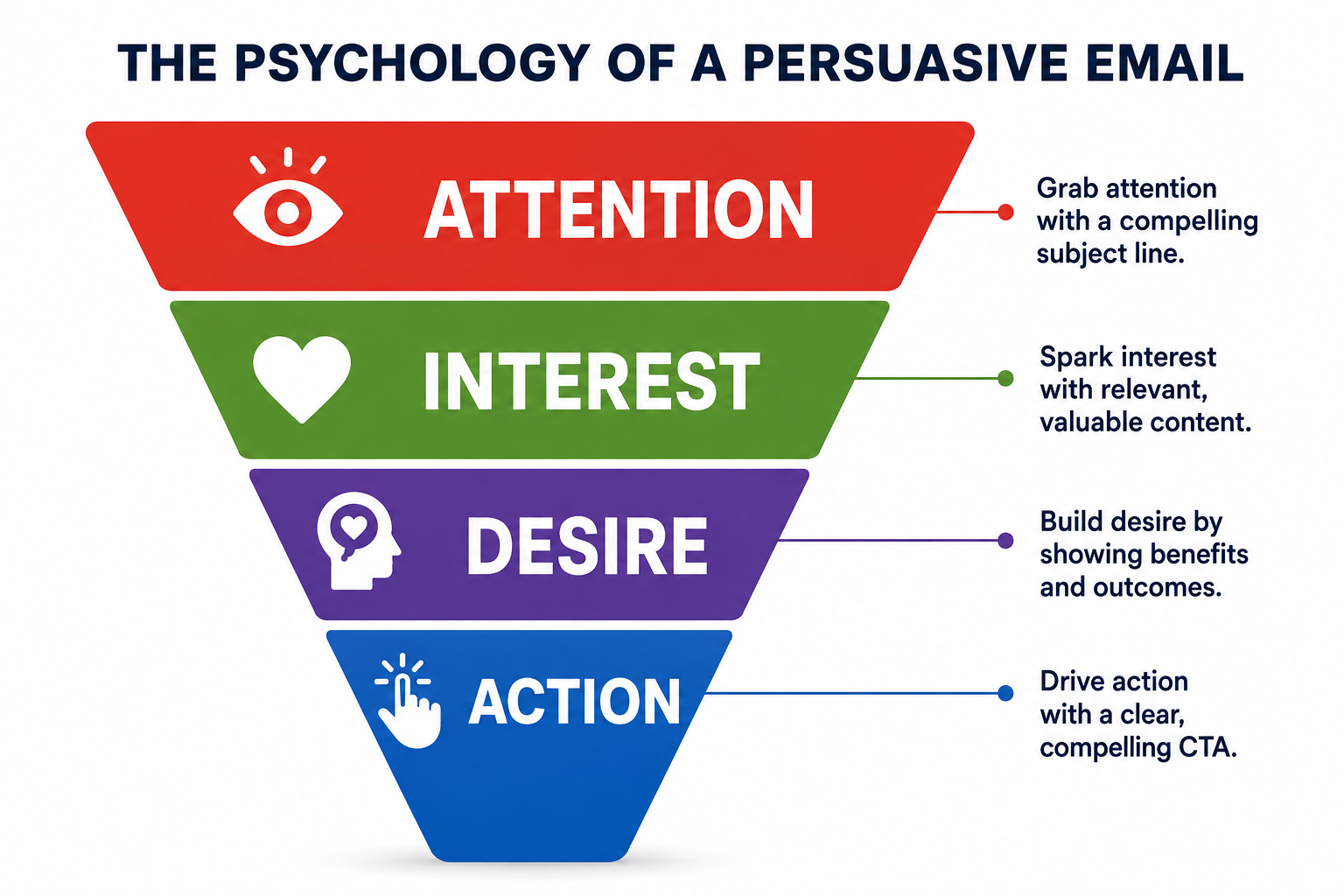
AIDA has been taught in universities for years, as in a hundred years. It goes back to the early 1900’s and has stuck around because…well, it works! Don’t mess with a good thing, right? Right! Here’s a closer look at each level of this formula.
May I Have Your Attention?
Attention is placed at the top, filling the most space because absolutely nothing else can happen unless you get your reader’s…attention! That is your first and primary goal when creating a persuasive email.
One simple, yet effective way to grab attention is to use the name of the person you’re sending an email to. If you use a generic greeting or no greeting at all, you run a higher risk of your email getting deleted immediately or even worse, being marked as spam.

Speak directly to subscriber pain points to boost open rates
Another way is to optimize your subject line to really speak to your reader’s pain points and situation. If you don’t have those exact details, no worries. You can still improve the effectiveness through best practices.
Check out these tips for writing the best email subject lines and maybe even consider using emojis in your subject line. This may not be for every brand, but it sure is proven to grab attention.
In addition to grabbing the reader’s attention, the subject line and greeting also needs to draw the reader in…
Say What? Hmm Interesting…
Once you’ve grabbed their attention, you now need to be interesting and relevant enough to make readers listen to you. The subject line along with the first few sentences in your email will be your interest drivers and make sure to implement images that align with your message.
In order to generate interest in your email, it helps to be a good story teller. People react from hearing other people’s stories and are often emotionally invested from the beginning. When possible, put the art of story telling at work, but don’t write a novel. Short and sweet while driving readers to the full story will be a more effective option.
Drive interest by calling out familiar, real-world problems
It also doesn’t hurt to talk about a problem or address pain points that your readers are especially familiar with. If you can spark interest on a subject that worries them daily or makes them lose sleep, they are sure to pay attention to what you have to say and even act on it.
Shock also creates a desired effect on readers, making them ask the question, “Really? How is that possible?”. If you can make a bold statement or promise that elicits this type of response while following through, then you have readers right where you need them to be for the next phase of the formula.
Yep. I’m In!
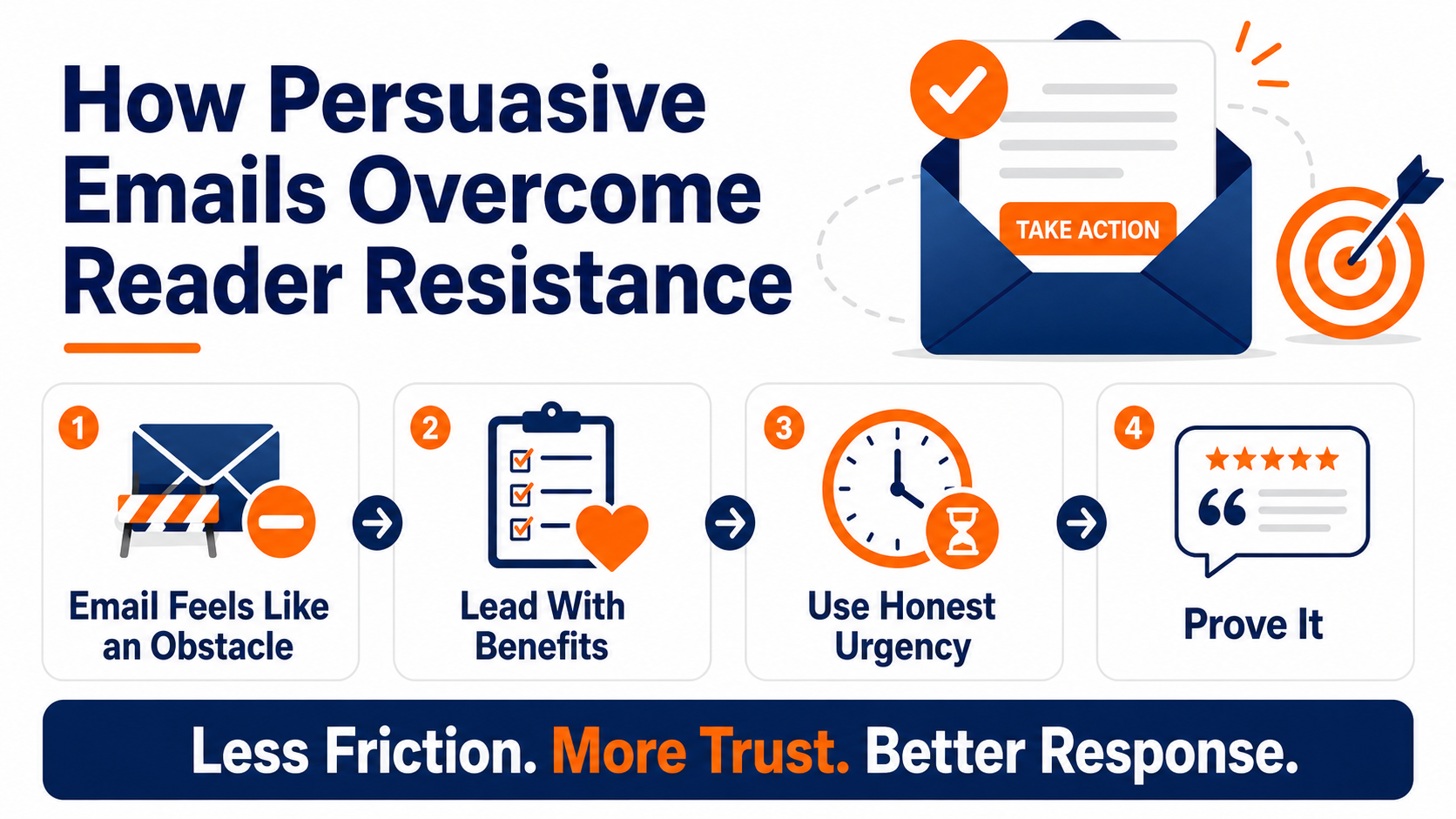
Receiving an email is perceived as an obstacle for many. The email interrupts their day, they read it (or quickly lose interest), decide whether or not to click on the call to action, and then finally ignore, delete, or respond to it.
When creating a persuasive email, you have to think about how you’re helping readers overcome those obstacles. Make it incredibly easy for them to decide if they’re interested and if they should actually do what you’re telling them to. Before they click or download, there should be no doubt on why they need what you’re offering.
There are a number of ways to accomplish this, but make sure you test the different ways to see what works for your industry.
This benefits me why?
Always answer the question why should your reader care by listing out the benefits of your offer. Numbers are great, but make sure to also tap into the emotional benefits, such as less stress worrying about inaccurate data or more confidence in leadership abilities after reading your eBook.
Sense of urgency:
Creating a sense of urgency or instilling the fear that they may miss out makes people respond and respond much faster. In order to do this, make offers for a limited time or a limited number of giveaways.
Looking at the psychology of this, when things are all around us, people naturally take it for granted. With this, you don’t want to lie about the scarcity. This threatens the trust you’re creating with your readers and you never want to lose that.
Prove it!
Proving your bold statements that elicited shock with before and after photos or sharing nice social media testimonials about your products and services only help build the case of why readers should work with you.
Walk Me Through This, The Basics of a Persuasive Email
Finally, action is what makes marketing emails worthwhile. When readers click the sign up button, marketers rejoice! It’s still possible for readers, however, to get to this point and delete the email. There are best practices to help avoid inaction with your call to action (CTA).
Here are just a few of our favorites:
- Keep it Short!
Clear and concise is what your CTA needs to be. You’ve developed the why, now make the how extremely easy to figure out for your readers. Hold their hand and literally spell it out! - Location. Location. Location.
Statistics vary on this one. Should it be above the fold or below the fold? I’ve found the best place is to have it toward the bottom of the email and if you want one above the fold, place it in a left sidebar. When in doubt, test it out with A/B split testing. - Visual Appeal.
This is a great place to bring in more design elements. Instead of just using a button, use an arrow or image of your eBook to entice a click.
An Annotated AIDA Email, Start to Finish
Theory is easy. Watching the four stages actually hand off to each other inside one real email is where it clicks.
Below is a short prospecting email built the way AIDA is supposed to work, with a note after each block showing exactly where one stage ends and the next picks up.
Read the email straight through first, then read it again with the callouts. You'll start seeing the seams in your own sends after that.
The email
Subject line: You're paying for 400 contacts you never email
[ATTENTION. This is the whole job of the subject line. It names a specific, uncomfortable thing the reader recognizes about their own list. No brand name, no "quick question," no windup. The click is earned right here or not at all.]
Hey Sarah,
Most lists carry a chunk of contacts nobody has touched in months. They still count toward your plan, they still drag your sender reputation, and they pull your averages down every send.
[INTEREST. The first line inside the email has to confirm the subject line wasn't a bait. It names the problem in plain terms and adds one detail the reader hadn't connected, that dead weight hurts deliverability, not just budget. This is where read time lives or dies.]
Here's the part that most marketers miss. Cleaning that dead segment out usually lifts open and click numbers immediately, because you stop diluting every campaign with people who were never going to engage. The median click-to-open rate sits at 6.81%, and a bloated list is one of the fastest ways to stay stuck below it.
[DESIRE. Now the reader can picture the payoff. The stat isn't dropped and abandoned, it's followed by what it means for her specifically, that her own averages are being held down by contacts she could remove today. Desire is the reader wanting the after-state, not just understanding the problem.]
Want us to run a free five-minute audit on your list and show you exactly which segments are pulling you down? Just reply "audit" and we'll set it up.
[ACTION. One ask. One verb. No competing buttons, no "or you could also." The path from wanting the outcome to taking the step is as short as it gets.]
Why the handoffs matter more than the parts
Notice that no single stage is doing anything fancy. The subject line is one sentence. The CTA is one line. What makes the email work is that each stage sets up the next one cleanly, attention buys the open, interest buys the read, desire buys the intent, action collects on all three.
Break any handoff and the rest collapses. A great subject line attached to a rambling body wins the open and loses the read. A tight, persuasive body buried under five buttons builds desire and then strangles the action. The stages are a chain, and the chain is only as strong as the weakest link between two of them.
Map Every AIDA Stage to the Metric That Proves It
When a campaign underperforms, most people guess. They rewrite the whole email, change everything at once, and learn nothing about what was actually broken.
There's a better way. Each AIDA stage has one metric that tells you whether that specific stage did its job. When a campaign disappoints, you don't rewrite blindly, you find the stage where the number falls off a cliff and fix that.
Troubleshooting Failing Email Campaigns
|
AIDA Stage |
Core Psychological Objective |
Primary Metric to Track |
|---|---|---|
|
Attention |
Break inbox noise and earn the click |
Open rate |
|
Interest |
Hook the reader and introduce the problem |
Read time / scroll depth |
|
Desire |
Build emotional connection and prove value |
Click-to-open rate (CTOR) |
|
Action |
Drive a friction-free conversion |
Conversion rate / ROI |
How to read the drop-off
Start at the top and walk down until a number breaks. If your open rate is healthy but read time craters, your subject line is writing a check your body copy can't cash. Attention worked. Interest failed.
If people read the whole thing but your click-to-open rate stays flat, the problem is desire. They understood the offer and didn't want it enough to act. That goes beyond a simple subject line fix and dives into building more value and repositioning.
How to spot friction on your landing pages and forms
And if CTOR looks fine but conversions don't follow, the leak is at the very bottom. People clicked, then hit friction on the landing page or the form. The email did its job. The destination didn't.
One caveat worth naming. Open rate has gotten noisier since Apple's Mail Privacy Protection started auto-marking opens, so treat it as directional rather than gospel. When open data looks suspicious, lean harder on click and CTOR, which don't depend on open tracking to be accurate.
Trust Killers That Wreck Your AIDA
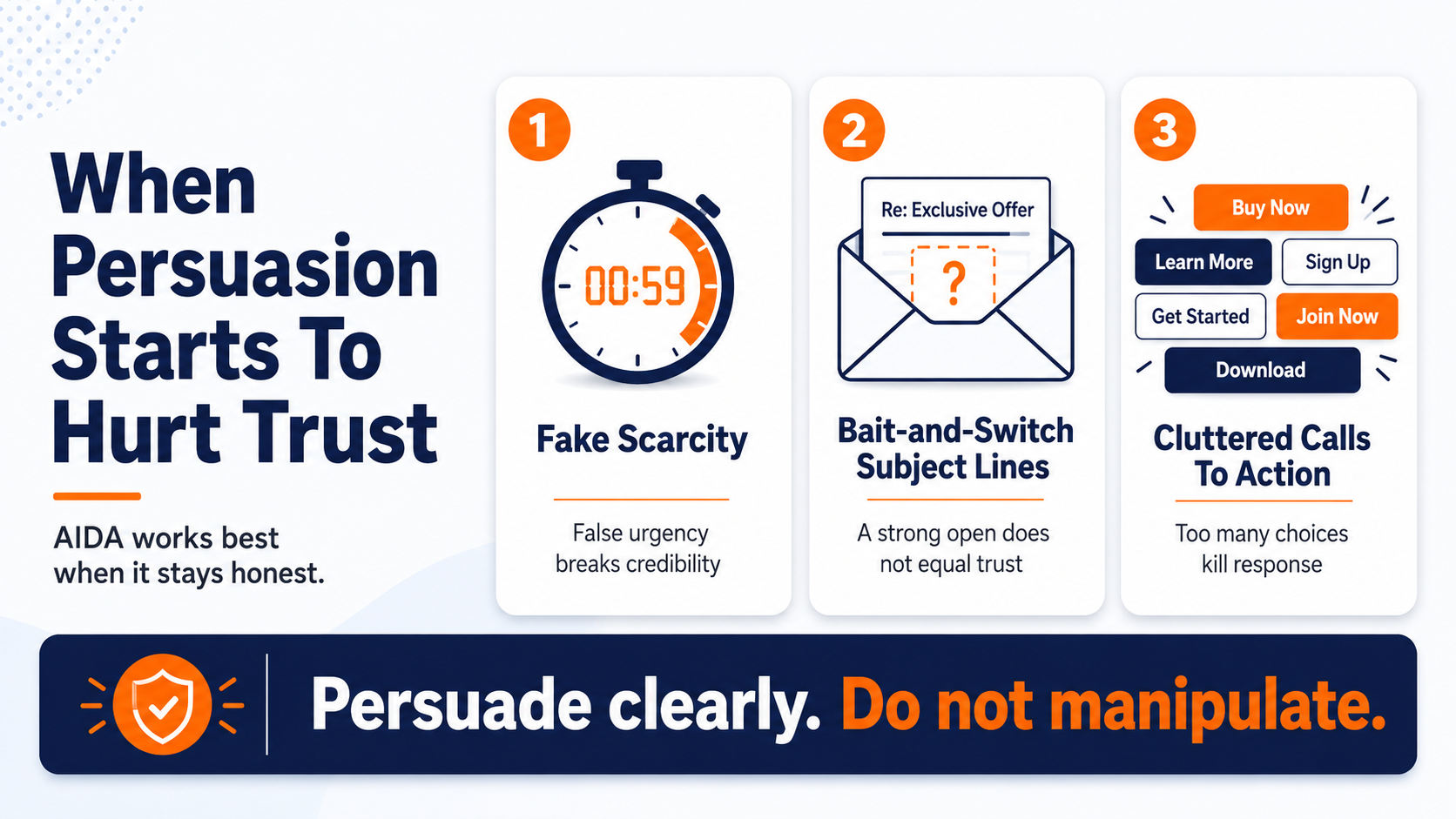
You can execute all four stages perfectly and still lose the reader if the email feels like a trick. AIDA persuades. It doesn't give you permission to manipulate. The line between the two is where most brands accidentally torch their credibility.
Here are the three that show up most often, and what each one actually costs you.
Fake scarcity
"Only 3 spots left" on an offer that resets every Monday. "Sale ends tonight" on a sale that's been ending tonight for six weeks. Readers clock this faster than you think, and once they catch you once, every future deadline you send reads as a lie.
Real scarcity is one of the strongest desire drivers there is. Fake scarcity spends that entire asset for one campaign's worth of clicks and leaves you with nothing to draw on next time.
Bait-and-switch subject lines
The subject line promises one thing, the email delivers another. You win the open and lose the reader in the first sentence, because the gap between what you promised and what you gave becomes the only thing they remember.
This one shows up in your data as a strong open rate paired with a dismal read time or CTOR. If that pattern keeps repeating, your subject lines are writing checks your content can't honor, and your audience is learning to ignore you.
Pro Tip: If your subject line wouldn't survive being read out loud next to your opening sentence, rewrite one of them so they match.
Burying the action under clutter
You did the hard work. You earned attention, held interest, built desire. Then you handed the reader a wall of six buttons, three links, and a "P.S. also check out" and asked them to figure out what you actually want.
Every extra choice at the action stage is friction, and friction is where conversions die. One email, one primary action. If a second link genuinely earns its place, make it visibly secondary so there's never a question about the main thing you want them to do.
Adjust the Desire Stage for Where the Reader Already Is
The same desire copywriting that lands with a loyal customer falls flat with a cold prospect, and vice versa. Desire is the stage most sensitive to relationship, so it's the stage you tune hardest based on who's reading.
Everything before this can stay roughly constant. A good subject line grabs attention regardless of audience. But what makes someone want the outcome depends entirely on how much they already trust you.
Cold prospects need proof, not enthusiasm
Someone who's never bought from you doesn't care that you're excited. They care whether this is real and whether it works for people like them. So the desire stage for a cold audience leans on evidence, a concrete result, a relevant number, a specific before-and-after they can picture.
This is also where relevance does heavy lifting. Targeted, segmented sends dramatically outperform batch-and-blast to cold contacts, which is why list segmentation matters most at exactly this stage. A cold prospect getting a message that speaks to their actual situation feels less like an ad and more like a fit.
Loyal customers need a reason this one is worth it
Existing customers already believe you. Spending the desire stage re-proving your credibility to them is a waste, they've seen the proof, they bought. What they need is why this offer, now, is worth their attention when they already have what you sell.
For that group, desire runs on newness, exclusivity, or a genuine upgrade to something they already use. Early access. A feature that solves a problem they've mentioned. A reward for sticking around. The emotional hook shifts from "this is trustworthy" to "this is for you specifically, because you're already in."
Pro Tip: Before you write the desire section, ask one question, does this reader need proof or a reason? The answer decides everything that follows.
Turn Human Psychology Into High-Converting Email Sequences
If you’re a naturally empathetic marketer, this AIDA formula will seem like second nature and now, you can apply even more best practices to writing persuasive emails to your prospects and customers.
Just remember to keep that human psychology in mind. After all, we’re just people working and communicating with other.
Ready to turn passive openers into active buyers?
Understanding the AIDA formula is only half the battle, the real magic happens when you pair persuasive copy with the automation tools to send it at the exact right moment. Schedule a 1-on-1 demo today, and we’ll show you how to build, trigger, and optimize high-converting email sequences using your actual campaign data.
Key Takeaways
The AIDA Framework & Metric Mapping:
- Attention - KPI: Open Rate: Hook recipients in the inbox using personalized greetings and pain-point-driven subject lines.
- Interest - KPI: Read Time / Scroll Depth: Engage readers with concise storytelling, relatable problems, and strategic shock value.
- Desire - KPI: Click-to-Open Rate / CTOR: Tailor messaging based on audience relationship. For example, cold prospects need proof (data/testimonials), while loyal customers need a reason (exclusivity/upgrades).
- Action - KPI: Conversion Rate / ROI: Provide a single, concise, visually clear call-to-action (CTA) to minimize conversion friction.
Troubleshooting Campaign Drop-Offs:
- High Opens + Low Read Time: The subject line made a promise the email body failed to deliver (Attention succeeded, Interest failed).
- High Read Time + Low CTOR: Readers understood the offer but lacked the motivation to click (Desire failed).
- High CTOR + Low Conversions: The email succeeded, but friction exists on the landing page or checkout form (Destination failed).
Conversion Killers to Avoid:
- Fake Scarcity: False deadlines destroy long-term brand trust.
- Bait-and-Switch Subject Lines: Dishonest hooks drive immediate unsubscribes and low read times.
- CTA Clutter: Offering multiple competing links creates decision fatigue and stifles action.