The back-to-school aisle fills up before most families have unpacked their beach bags. Retailers know it, parents know it, and the smart email programs already have their sends queued up while everyone else is still deciding on their best subject line.
That head start matters more than it used to. Families with kids in elementary through high school plan to spend an average of $863.86 this season, and total K-12 back-to-school spending is on track to hit a record $43.3 billion. That's a lot of open wallets moving through a short window, and back-to-school emails are how you reach them before the money is spent.
Why this season belongs on your email calendar
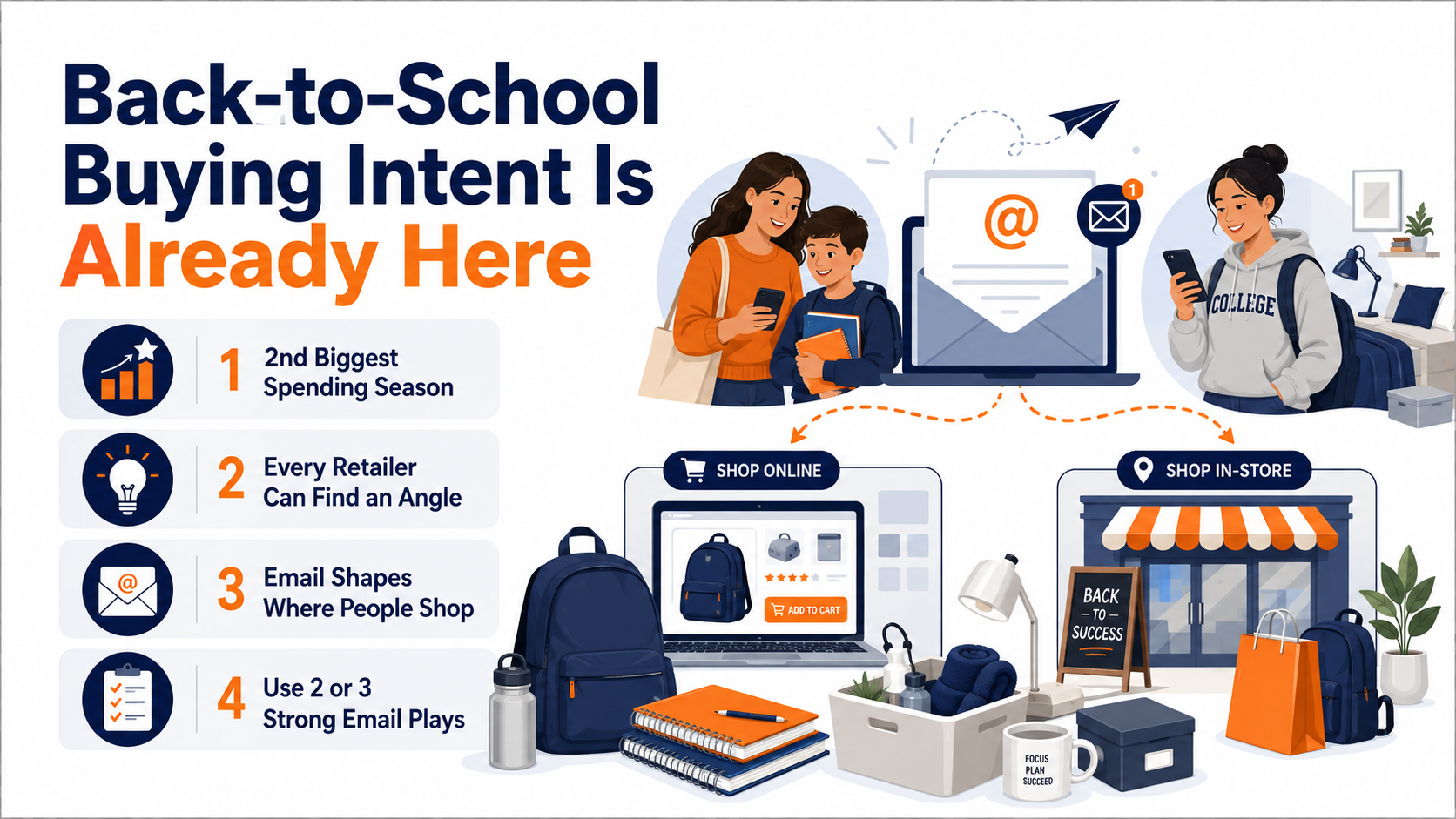
Back-to-school is the second biggest spending stretch of the year, trailing only the winter holidays. Parents are actively hunting for deals, kids are making lists, and college students are furnishing entire apartments from scratch.
A lot of brands miss this opportunity to capitalize on this momentum without the right email marketing strategy. This isn't only a moment for stores that sell notebooks and backpacks. Every retailer can find an angle, and those who do get to ride a wave of buying intent that's already in motion.
Turn inboxes into traffic
Only about half of families plan to buy their school items online this year, which means the inbox is doing more than closing a sale. It's shaping where people decide to shop in the first place, online or in your store. Your email is often the nudge that points them one way or the other.
Below are five back-to-school emails you can adapt to almost any product. You don't need all five. You need the two or three that fit your brand and a plan to actually send them.
The Traditional Back-to-School Sale Still Works
A discount is the most obvious play for a reason, because it works. Parents are primed to spend, and a well-timed promotion gives them a reason to choose you over the store down the street.
If you sell the usual suspects like clothes, supplies, and electronics, this email practically writes itself. Feature the school-related items up top, make the deal impossible to miss, and give people a clear call-to-action to buy.
The trick is not burying the offer. A back-to-school shopper is scanning, not reading. If the discount, the deadline, and the button aren't obvious in the first second, you've lost them to the next email in the stack.
Reach buyers early before they shop elsewhere
A lot of families start browsing weeks before they buy, waiting for the deal that finally makes them commit. If your sale email lands during that window instead of after they've already stocked up elsewhere. And unfortunately, you just become the one who closes the purchase. Send too late, and you're discounting to people who already bought from someone faster.

Don't forget the college crowd
Back-to-school stopped being just a little-kid event a long time ago. College students and their families are spending too, and they're buying bigger ticket items like laptops, dorm furniture, and mini fridges.
The spending per college student now runs well above what families lay out for a K-12 kid, and it lands in different categories. Electronics, dorm furnishings, and food dominate that list, which is a completely different email than a back-to-elementary-school flyer.
Segment your list so parents of younger kids and college-bound shoppers each get an offer that fits. A dorm bedding bundle and a kids' uniform discount are two different emails, and treating them as one waters both of them down.
Sell something unrelated? Get creative
No pencils or lunchboxes in your catalog? You can still own the season with a theme.
A skincare brand can frame a sale as a well-earned break for parents once the kids are back in class. A car dealership can pitch cash back to the family upgrading their carpool vehicle. A pet boutique can lean into training season with leashes and puzzle toys for the new routine.
The season is a hook, not a hard rule about what you sell. Wrap your existing products in a back-to-school story, and the offer lands. The buying mood is already there. You're just giving it a reason to point at you.
Go beyond the straight discount
A percentage off is not your only lever. Free shipping, a free gift with a minimum purchase, or a coupon good on a future order can all move the same needle without training customers to wait for markdowns.
That last point matters more than most brands admit. Discount every season, and you teach your best customers to never pay full price. A future-dated coupon or a free gift protects your margin while still giving the shopper a reason to act now.
|
Pro Tip: Give first-time back-to-school buyers a coupon that only unlocks on their next order, so the seasonal rush turns into a second purchase in September. |
Which Back-to-School Emails Fit Your Brand
Not every email type suits every brand, and the comparison below maps each one to what it's best at.
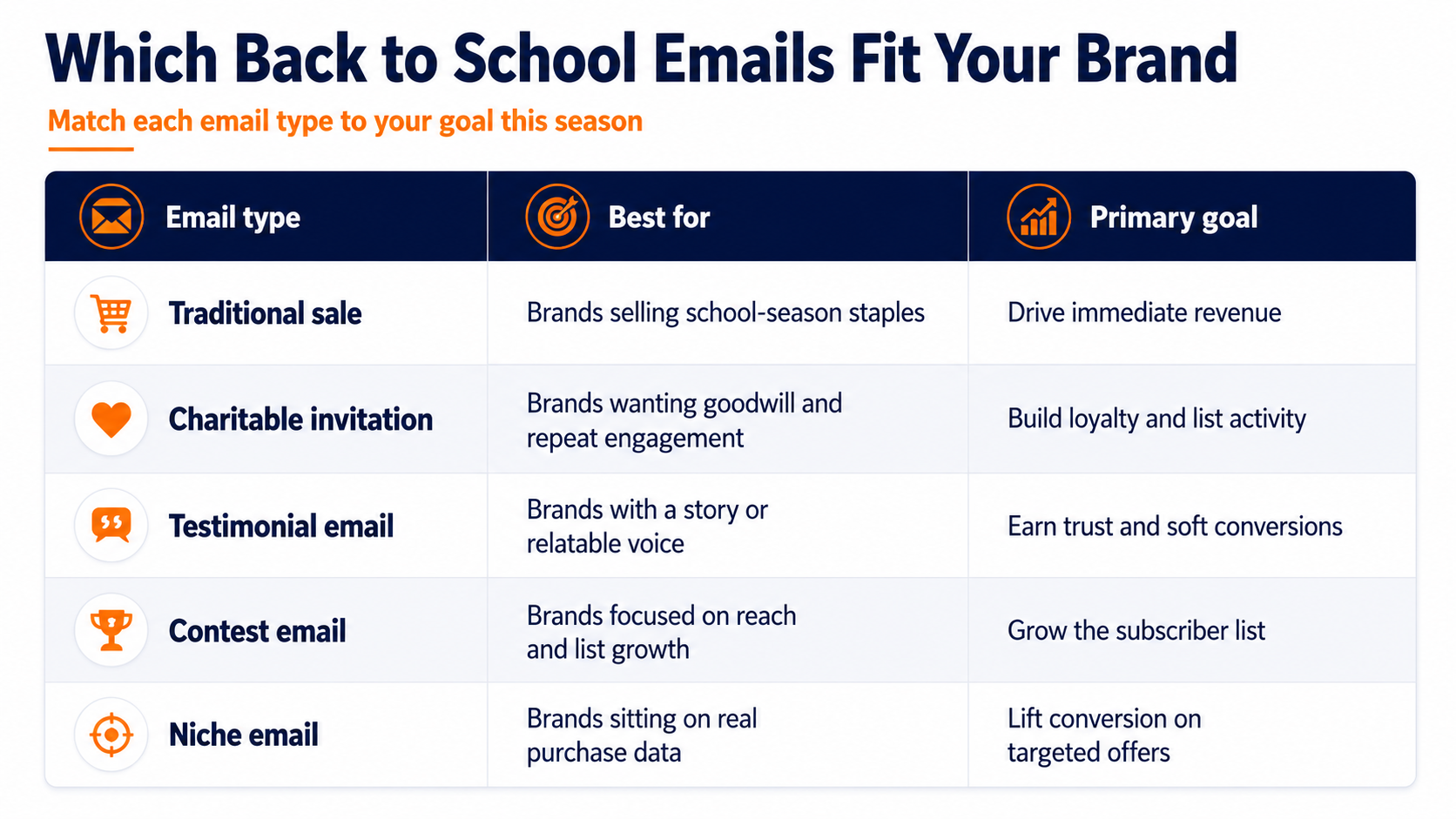
The point of laying it out this way is to stop treating the season as one big blast. Each of these does a different job, and the brands that win back-to-school are usually running the two or three that fit them, not all five at half effort.
Turn Attention Into A Charitable Invitation
Back-to-school promotions pull traffic to your store and inbox. Once you have that captive audience, you can do more than sell to it. You can invite it to give back.
Charitable back-to-school emails build goodwill and give your brand a reason to show up in the inbox that isn't another discount. Collect school supplies for kids in need, fill a bus with canned goods for the local food shelf, or rally donations for a nearby school program.
The event can be as simple or as elaborate as you have the appetite for. What matters is that you ask people to join, and email is the cleanest way to make that ask at scale.
Make it a short series, not a one-off
The mistake here is sending a single email and hoping it sticks. A cause campaign works better as a drip sequence that carries people from awareness to action.
Announce the campaign in the first email. Follow with a formal invitation to the event. Send a thank-you with a small coupon for anyone who participates, then close with a reminder as the drive winds down.
That rhythm is exactly the kind of multi-step follow-up most teams start with good intentions and then abandon after email one. The idea usually survives the kickoff meeting. It rarely survives a busy week.
The key is to build a sequence that fires on its own once someone opts in, so the second and third emails don't depend on anybody remembering to send them.
Why give-back campaigns punch above their weight
A donation drive gets people through your door and associates your brand with something bigger than a sale. Outdoor and apparel brands do this well with used-clothing collection drives that promise to donate or recycle whatever comes in.
The revenue doesn't always show up on the same day, and that's fine. You're buying loyalty and list engagement, and both pay off across every send that follows.
There's a deliverability angle too. Engaged subscribers who open and click your cause emails signal to inbox providers that people want your mail, which helps every promotional send that comes after it land where it should.
Put Parents In The Spotlight With A Testimonial Email
Most back-to-school marketing points the camera at the kids. Flipping it toward the parents is an underused move that can land harder, because parents are the ones actually reading and buying.
A skincare or beauty brand can build a series around real morning routines from staff who are parents themselves. The email reads like one mom trading tips with another, and that personal register is easier to trust than a polished product pitch.
These emails run a little longer than your average sale blast, and that's the point. They're different enough to stop the scroll, and the extra length buys room for a real story instead of a headline and a button.
Keep the call to action soft
The instinct is to bolt a buy-now button onto every message. Resist it here.
A testimonial email works best when the ask is light, something like reply with your question instead of a hard push to check out. The story does the selling, and the low-pressure CTA keeps it feeling human.
Counterintuitive as it sounds, the soft ask often outperforms the hard one in this format, because the reader never feels handled. They feel talked to.
|
Pro Tip: End a testimonial email with a reply-based question instead of a buy button, so responses land in your inbox and feed the next round of stories you tell. |
Let location decide who sees what
This is where dynamic content in your emails earns its keep. If you gather testimonials from parents in Chicago, New York, and Orlando, you can serve each subscriber the voice from their own city.
A local face makes a national campaign feel personal without you writing three separate emails. One template, three audiences, and every reader gets the version that feels closest to home.
You can extend the same idea past location. A parent of a toddler and a parent of a high schooler can see completely different testimonials from the same send, each one chosen to match where that reader actually is.
Run A Contest Email To Build Buzz And Your List
A contest does two jobs at once. It generates buzz around your brand, and it hands you a clean reason to collect email addresses from people who want to hear from you.
Tie the prizes to what you actually sell so every entrant is a genuine potential customer. A yoga brand can offer a classroom makeover for a teacher. A supply company can give away a fully stocked backpack. The prize does double duty as a product showcase.
A giveaway can be as simple as entering a name to win, or as involved as asking for a photo or a short story. The more effort you ask for, the fewer entries you'll get, so match the ask to the size of the prize.
Promote it everywhere, not just email
Email is a great way to invite the contacts you already have, but a contest deserves a wider net. Mention it on in-store signage, your website, your blog, and every social channel you run.
The more entry points you create, the more new addresses you collect, which feeds the campaigns you'll send long after the contest ends.
This is the part that turns a one-week promotion into a long-term asset. A contest that only reaches your current list mostly entertains people who already know you. One that reaches past your list grows it.
Capture the email at entry
Make an email address part of the entry form. That single step turns a fun giveaway into one of the cheapest list-building tools you have.
Every name you add during a contest is a subscriber you can reach for the holidays, the spring sale, and next year's back-to-school season. The prize costs you once. The list keeps paying out.
Just make sure the signup is honest about what people are opting into, a marketing list and not only a contest entry, so the subscribers you gain actually want to be there when you email them later.
Keep deliverability high with clean opt-ins
A clean opt-in also protects the list you already have. Dump a wave of people who only wanted the prize onto your main list, and your open rates sag, which drags down deliverability for everyone.
Better to gain a smaller group who genuinely want your emails than a big pile of names who tune out by the second send.
Send The Niche Email That Speaks To One Specific Buyer
Every student needs the basics, pencils, notebooks, a calculator. But the real money hides in the specifics, and generic blasts leave it on the table.
A footwear brand can send an email built entirely around uniform-approved shoes. That message means nothing to most of the list and everything to the parents at schools with a dress code.
The narrower the email, the more it feels like it was written for one person. And an email that feels one-to-one gets opened, read, and acted on at rates a mass blast never touches.
Segment on what people already bought
Comb through past purchase history and build email segmentation around it. If someone bought kids' swimwear from you in July, a back-to-school deal for swim gear is a message they'll actually want.
Market to small groups instead of blasting one email to every parent and hoping a few bites land. The tighter the segment, the more relevant the offer, and relevance is what turns an open into a sale.
Purchase history is the richest signal you have, because it's behavior, not a guess. Someone who bought a specific category once is far more likely to buy it again than a random name who happens to fit a demographic.
The math on targeted sends
This is where email segmentation pays for itself. Segmented campaigns can drive as much as a 760% increase in email revenue compared to one-size-fits-all blasts.
That number sounds almost too big until you remember what it's measuring. It's not one clever email beating another. It's the compounding effect of better opens, higher clicks, and lower unsubscribes stacking up across every send once you stop treating a diverse list like a single person.
We've watched this pattern hold for years. The brands that win the season aren't the ones with the cleverest single email. They're the ones whose segments keep working in the background, sending the right offer to the right buyer without anyone rewriting the campaign each time.
Add personalization on top of segments
Segmenting decides who gets the email. Personalization decides how it reads once it lands. Dropping in a subscriber's name, location, or past purchase makes a targeted send feel one-to-one.
You can layer in name, address, job title, and more, and the two tactics compound. A well-built eCommerce segmentation strategy plus real personalization is the difference between an email that gets skimmed and one that gets clicked.
The pairing is what does the work. Segmentation gets the right offer to the right group, personalization makes each person in that group feel individually addressed, and together they lift the whole send.
Turn A Seasonal Push Into A Year-Round Engine
Here's what we covered. Back-to-school is a record-setting spending window, it's open to every brand willing to find an angle, and the back-to-school emails that win it are the targeted, well-timed ones, a straight sale, a charitable invite, a parent testimonial, a contest, or a tightly niched offer. The common thread across all five is relevance, and relevance comes from sending the right message to the right segment at the right moment.
Replace manual spreadsheets with smart automation
What's missing for most teams is the system that acts on it after the first email goes out. With the right marketing automation system that's built to close, updating who's in each segment based on what subscribers are actually doing and firing the next email automatically.
If your back-to-school plan lives in a spreadsheet and depends on someone remembering to hit send, book a marketing automation audit, and we'll show you which segments would move your revenue the most before the first bell rings.